-->
Drop Down MenusCSS Drop Down MenuPure CSS Dropdown Menu
Showing posts sorted by date for query Gyro. Sort by relevance Show all posts

Monday, June 15, 2026

Seen Dodge Firearrow Concept series

Unique ONES - In the intriguing world of automotive design, the collaboration between America and Italy has produced some truly remarkable cars, and one shining example is the Dodge Firearrow Series.
1954 Dodge Firearrow II (left) posed along with the 1954 Dodge Firearrow IV (right). (Picture from: VintageRaceCars)
Conceived in the early 1950s by Virgil Exner, the design chief at Chrysler Corp, and crafted by the esteemed Turin-based coachbuilder Carrozzeria Ghia, these concept cars stand as a testament to the fusion of style and innovation. Now, let's us talking about those Firearrow concepts as follows;

1. Dodge Firearrow I
In 1953, the first Firearrow concept came out of Chrysler's advanced styling studio and was a dummy. Later, three Firearrows followed led to Dual Ghias. The Firearrow I was a true roadster and painted in Red and Gray, while the interior was yellow with maroon piping. Its wheels were full wheel covers and the bodyside molding wrapped all of the ways around the car and has dual headlights.
1953 Dodge Firearrow I Concept sat alongside with Abarth Fiat 1100 (Ghia) at the 1953 Turin Motor show. (Picture from: CarStyling.ru)
The Dodge Firearrow, a sleek, 34-inch-high sports roadster, is a new 'idea' car of the Dodge Division, hand-crafted by Ghia of Turin, Italy. At that time, William C. Newberg, president of Dodge, says that certain design features of the experimental body may well be reflected in future Dodge production models, but there are no present plans to produce the Firearrow.
1953 Dodge Firearrow I Concept was designed by the Chrysler Corp design chief in the time, Virgil Exner and built by Carrozzeria Ghia. (Picture from: CarStyling.ru)
The car is shown for the first time on November 12, 1953, at Chrysler Corporation's annual new car press party in Detroit. And today, it is on display at Petersen’s Museum although the seats are now brown.

2. Dodge Firearrow II
The second series of roadster-styled concept car of Dodge itself is built on a 119-inch chassis and equipped with a Red Ram Hemi (241 cubic inch engine) combined with a four-speed Gyro-Torque semi-automatic gearbox, so then the car is claimed to be capable of spewing power up to 150 horsepower.
1954 Dodge Firearrow II Concept appeared with different front and rear sections than the previous model. (Picture from: OtoBlitz)
It painted in yellow and looked a lot like Firearrow I, except the body side molding didn’t wrap around the car, chrome wire wheels replace the full hub caps, single headlights replaced the dual, and Firearrow I’s split bumper was changed.
Rear three-quarter view of the 1954 Dodge Firearrow II Concept. (Picture from: OtoBlitz)
But, it retained the two-seats behind the dashboard and striking frameless windshield when it appeared in 1954.

3. Dodge Firearrow III
In 1954, the two-seat Firearrow Sport Coupe appeared and proclaimed as the third series of the Dodge's models. As with the earlier roadster, the metallic blue coupe was essentially a 1954 Dodge.
1954 Dodge Firearrow III Sports Coupe shown at the 2010 Pebble Beach Concours D’Elegance. (Picture from: Supercars.net) 
Dual headlights returned and now flanked a concave grille cut with narrow verticals. It also featured with the crash protection front and rear was provided by modest bumperettes. A wraparound backlight gave the Sport Coupe a particularly rakish aspect.
Rear three-quarter view of the 1954 Dodge Firearrow III Sports Coupe. (Picture from: Supercars.net) 
The third in a series of four unique Firearrow concept cars made, it has been said that this concept car had the skillful blending of the best ideas from Europe and the American design studios of Virgil Exner and brought an entirely new kind of beauty with a look of poised power.

4. Dodge Firearrow IV
The fourth series of Firearrow convertible arrived late in 1954. Despite being the series' first four-seater model, it shared many styling cues with the previous Sport Coupe model, or can be said, it was basically a soft-top version of the coupe.
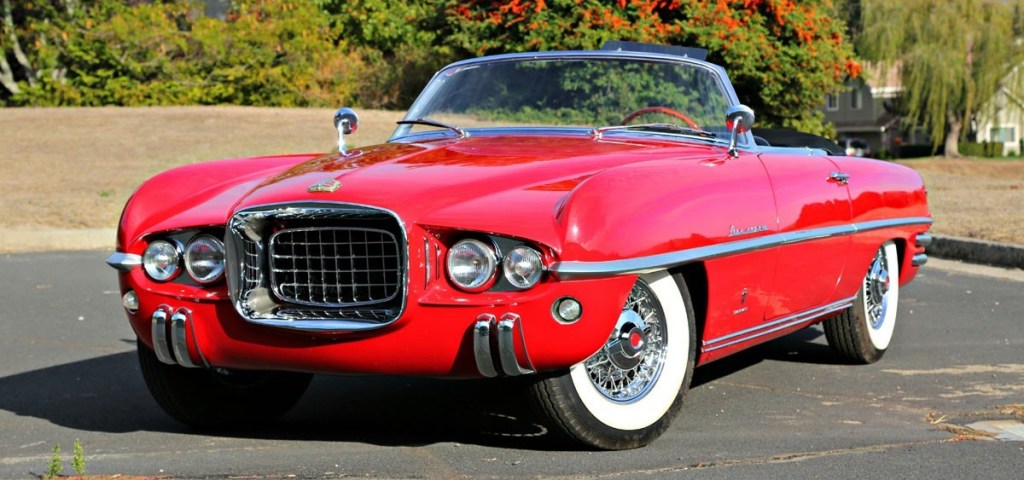
1954 Dodge Firearrow IV four-seater convertible concept car and share the same design as the previous sports coupe version. (Picture from: OtoBlitz)
The Dodge Firearrow IV was the only road-legal concept car that was actually prepared to enter the production line and adorn many car shows in the United States in 1954. And if you look at the specifications, this concept is similar to the Firearrow II which was also designed by Exner and built-in Turin by Ghia on a 119-inch chassis by using the same drivetrain.
1954 Dodge Firearrow IV convertible leather interior's with a black and white diamond pattern. (Picture from: CarStyling.ru)
The concave grille returned, though it now carried a grid treatment instead of the coupe's slim verticals. As for the convertible's leather interior, as it was a diamond pattern done in hard-to-ignore black and white, it was definitely an acquired taste. Additional sizzle was provided by the car's bright red body.
Rear three-quarter view of the 1954 Dodge Firearrow IV four-seater convertible. (Picture from: Automotivereport)
Although these timeless creations, though never mass-produced, continue to captivate the hearts of automotive enthusiasts, serving as a reminder of the innovative spirit that defined an era. The Dodge Firearrow series stands as a testament to the boundless creativity and collaboration that can emerge from the marriage of American and Italian automotive design.. *** [EKA[13072020] [24092021] | FROM VARIOUS SOURCES | CARSTYLING.RU | AUTOWEEK | SUPERCARS.NET ]
Note: This blog  can be accessed via your smart phone

Saturday, January 20, 2024

Renault's Reinastella: A Flying Saucer Tale from 2328

Futuristic RIDES - In the realm of extraterrestrial fascination, flying saucers often spark thoughts of encounters with aliens and UFO mysteries. However, not all saucers are bound for outer space; some find their origins right here on Earth, crafted by human ingenuity. This unlikely association between terrestrial design and celestial speculation is evident in various automotive creations, challenging the conventional narrative of unidentified flying objects.
The Renault Reinastella flying saucer concept, a result of the French automaker's partnership with Euro Disney in 1992, emerged as a distinctive creation. (Picture from: lAutomobileAncienne)
In the automotive world, renowned designers like Alex Tremulis ventured into uncharted territory, conceptualizing flying saucer designs. This trend extended beyond the drafting board, with manufacturers materializing these imaginative ideas into real, tangible forms. Examples include the 1953 Alfa Romeo 1900 C52 Disco Volante, the futuristic 1958 Ford X-2000, the gyroscopic wonder of 1967 Gyro-X, and the contemporary 2016 Alfa Romeo Disco Volante Spyder, each defying expectations.
The Reinastella name of 1992 Renault's flying saucer originated to the classic luxury car model, Renault Reinastella, dating back to early of 1930s. (Picture from: Secret-Classic)
Yet, amidst these earthly endeavors, there exists an intriguing anomaly—a flying saucer not confined on wheels. Renault, the famed French automotive manufacturer, ventured into uncharted skies in the early 1990s. Known for its conceptual prowess, Renault's partnership with Euro Disney in 1992 led to the creation of a flying saucer projecting into the distant future, the Renault Reinastella, named after a luxurious Renault classic model from early of the 1930s.
The Renault Reinastella, enveloped in innovative dermotylene and infused with avant-garde biomechanics, surpassed the notion of a mere vehicle. (Picture from: Proektor)
Crafted with avant-garde biomechanics and coated in the innovative synthetic material dermotylene, the Reinastella was envisioned as more than a mere vehicle. Propelled by a bio-organic engine fueled by 'plasmelf' fluid, it transcended conventional transportation, almost resembling a living organism. Operating 15 cm above the ground at 50 kph or soaring at 150 m and 300 kph, the Reinastella adapted its architecture for optimal aerodynamics during flight.
The Renault Reinastella, an airborne marvel, epitomized futuristic luxury travel for five passengers controlled by voice commands.. (Picture from: Auto-Moto)
Silently transporting five passengers through voice commands, this airborne marvel represented the epitome of luxury in futuristic travel. Access to its passenger compartment is from below through an open hatch, not from above, as the bubble remains closed.
Access to the Reinastella's passenger compartment is from below through an open hatch, not from above, as the bubble remains closed. (Picture from: Auto-Moto)
Two examples were constructed and showcased on telescopic masts during Renault's partnership with Disneyland Paris. After the event, these futuristic saucers joined the Renault Classic Collection, destined to await their sale - scheduled a whopping 305 years into the future.😮
While the Renault Reinastella may not soar through the skies, it invites us to envision a future where innovation defies the limits of logic and propels us into uncharted realms. (Picture from: Auto-Moto)
Today, the Reinastella may be considered an 'Identified Flying Object' or IFO, as it remains grounded. Despite its earthly tethering, it serves as a captivating decorative testament to Renault's imaginative prowess. A glimpse into a future more than a century away, this 'IFO' prompts us to keep dreaming, pushing boundaries, and contemplating the unimaginable.
And it's had been proven by the automaker nearly three decades later, in 2022, it collaborates with TheArsenale had succeded to fly the Air4 prototype, in celebrating the 60th anniversary of its legendary Renault 4L model.😄 *** [EKA | FROM VARIOUS SOURCES | LAUTOMOBILEANCIENNE | AUTO-MOTO | CLASSICDRIVER | CONCEPTCARZ | THRILLIST | SECRET-CLASSIC | PROEKTOR ]
Note: This blog can be accessed via your smart phone.

Saturday, October 22, 2022

Another car of tomorrow by Alex Tremulis

ONE-OFF - As a true lover of the automotive world, You are certainly familiar with the figure of Alex Tremulis, one of the visionary automotive designers with great talents who is able to produce extraordinary automotive works such as the Tucker 48, Gyro-X, and many others. Well, our discussion this time is also related to the designer's creation in 1970s for one of the well-known Japanese brands, Subaru.
1980 Subaru X100 concept built in 1973 with the aim of achieving 100 MPG designed by by Alex Tremulis, and built at the Subaru Technical Center in California by Subaru engineer Ron Jones over 6 years to complete. (Picture from: Rongineer)
The mentioned concept car named the Subaru X100, was built during a difficult era of the oil crisis with rising oil prices set by OPEC and the high costs the United States had to spent during the Vietnam War, causing stagflation in the country. This automatically causes automotive industry entrepreneurs, designers, and engineers to think even harder about ways to push the automobile's fuel efficiency limits.
1980 Subaru X100 concept's exterior by using an old airplane wing tank as the base for the car body. (Picture from: DrivingEnthusiats)
Back to the designer, Alex Tremulis who at that time was being worked as a consultant at the Subaru Technical Center (the BRAT logo and side graphics is some of his work)  and he was passionate about aerodynamics and fuel ecomony. This coincidentally seemed to be a blessing for him to execute a new breakthrough vehicles with an excellent fuel efficiency in the right time in the midst of an oil crisis.
1980 Subaru X100 concept's exterior by using an old airplane wing tank as the base for the car body. (Picture from: AlexTremulisArchives)
As quoted of Rongineer, it didn't take much time, Alex Tremulis managed to convince Walt Biggers, the brilliant godfather of the Subaru Technical Center, but more importantly he was able to sell on the idea of building the concept car to Harvey Lamm, president of Subaru of America then. In short, this car had been in Alex's mind for many years and his great idea was to drive the car across the country on one tank of gas to demonstrate the benefit of good aerodynamics on fuel economy and to provide favorable publicity for Subaru at every stop along the way.
This is the rolling chassis of the Subaru X100 Concept designed by Ron Jones. (Picture from: Rongineer)
By design, the concept car designed by Alex Tremulis is a three-wheeled vehicle with a very aerodynamic body. He was fond of saying that he was commited to "eliminating the sadistic torture of innocent air", and he meant it. Further, he designed the exterior by using an old airplane wing tank he had kept for a long time as the base for the car body.
The design and construction of the Subaru X100 chassis and drivetrain was handed to Ron Jones, who in turn brought in a talented fabricator named John McCollister. (Picture from: Rongineer)
Meanwhile, Subaru offers the prospect of a suitable powerhouse, namely a package of a 500 cc engine commonly used in the Rex, a Kei FHI class car in Japan, then combined as a perfect match with the rear drive unit mounted completely on the subframe with the suspension. The design and construction of the chassis and drivetrain was handed to Subaru engineer Ron Jones, who in turn brought in a talented fabricator by the name of John McCollister. Walt Biggers, director of Subaru’s Technical Center, oversaw the project.
Alex Tremulis stands by the main body form which was based on the aircraft wing tank. (Picture from: Rongineer)
Jones was directed to use as many off-the-shelf Subaru parts as possible. To that end, he utilized the engine, transmission, and rear suspension from the Rex, a kei jidosha not sold in America. Although aluminum wheels with a custom offset needed to be made in order to fit under the drivetrain under the body, the combination worked perfect. Much of the rest of the car was built from scratch by Jones and McCollister, including the frame, shift linkage, front suspension, front wheel, and steering system. To his credit, the chassis weighs only 70 pounds (32 kg).
1980 Subaru X100 concept while on testing in August of 1980 at the Ontario Motor Speedway in California. (Picture from: Rongineer)
The X100 was a side project, it done in the team’s spare time in Jones’ shop at the Technical Center, and taking six years to complete. The original oil crisis only lasted about six months, so the initial panic had long subsided. Still, the team saw the project through and testing began in August of 1980 at Ontario Motor Speedway in California.

Before a cross-country run could be attempted, the car had to prove it could achieve 100 miles per gallon while cruising at the national speed limit of 55 mph. For the track testing, a 1-gallon tank replaced the original 25-gallon tank. In initial tests, the car ran out of fuel a frustrating half a lap from the desired goal. Jones, who describes himself as “a bit of a lightweight”, offered to give it a try. He nailed it in one shot, finishing half a lap past the 100-mile goal. Tremulis was on hand to congratulate Jones and the team.
1980 Subaru X100 concept is powered by a 500 cc engine of the Rex, a Japanese Kei FHI class car, then combined with the rear drive unit mounted completely on the subframe with the suspension. (Picture from: DennyGibson)
And that’s it. With the embargo in history’s rear-view mirror, Subaru already established in the US, and the 100-mpg goal achieved, the cross-country promotional tour was canceled, so the car has remained in Subaru’s storage facilities since that day. Until just recently, that is. For 2018, the Lane Motor Museum in Nashville, Tennessee held an exhibit celebrating Subaru’s 50 years of being in the American market. Along with 360 variants from the museum’s own collection, Subaru of America loaned a new WRX STi, the very first BRAT, and the almost-forgotten X100.
After the exhibit ended, the BRAT and WRX STi were shipped back to New Jersey to rejoin the rest of Subaru’s historic collection. But the X100 was left on loan to the Lane Motor Museum in Nashville for another four years. It is currently on display with other high fuel mileage cars such as a Honda Insight and Volkswagen XL1. *** [EKA | FROM VARIOUS SOURCES | ALEX TREMULIS ARCHIVES | JAPANESE NOSTALGIC CAR | RONGINEER | DENNYGIBSON ]
Note: This blog  can be accessed via your smart phone.

Wednesday, October 9, 2019

Bizarre self-balancing Gyro-X vehicle back on the roads

Back in 1967, when a unique two-wheeled vehicle called the Gyro-X was built. At that time the prototype was built by a California-based company named Gyro Transport Systems. Physically the vehicle only has two wheels, one in front and one behind which at first glance looks more like a motorcycle than a car. The vehicle utilized a built-in gyroscope able to make it remain upright while on stationary condition or not moving.
Bizarre two-wheeled self-balancing Gyro-X vehicle gave an impressive demonstration at the 2019 Concorso d’Eleganza of Villa d’Este near Cernobbio, Italy. (Picture from: InilahKoran.id)
Even though the car developers initially hoped to take Gyro-X into production, it all faded when the company went bankrupt in the 1970 before the two-wheeled vehicle entered into production lines, and the only one of prototype was orphaned and neglected. Over the past 40 years, the vehicle has moved from one owner to another, which has made its conditions being more worse along the time.
Designer Alex Tremulis with the Gyro-X. (Picture from: NewAtlas)
The Gyro-X single-seat vehicle was created by a renowned industrial designer named Alex Tremulis. He had previously designed vehicles (the four-wheeled variety) for another big names of American automotives manufacturers such as Cord Automobile, Duesenberg, General Motors, Tucker Car Corporation and Ford, where he worked as Chief of Advanced Styling.
Bizarre self-balancing Gyro-X vehicle takes to the stage (on its two wheels) after winning the Dean Batchelor Trophy at the 2017 Pebble Beach Concours d'Elegance. (Picture from: AutoWeek)
According to an article in the September 1967 issue of Science & Mechanics, a ready-made two-wheeled Gyro-X can drive up to a top speed of 125 mph (201 kph), and could swoop through 40-degree banked turns without tipping. It weighs only 1,850 pounds (839 kg), measured 47 inches (119 cm) in height, only 42 inches (107 cm) in width, and 15 feet,5 inches (4,7 meters) in length. It rolls on two 15-inches wheels, and uses a small engine with power of 80-horsepower.

Its single 20-inch hydraulically-driven gyroscope – developed by noted “gyrodynamist” Thomas O. Summers Jr. – spun at up to 6,000 rpm, creating 1,300 foot pounds (1,763 Nm) of torque. It did take approximately three minutes to build up to that speed, however, meaning that drivers couldn’t just get in and go. A set of training wheel-like retractable outriggers held the vehicle up in the meantime.
Bizarre self-balancing Gyro-X vehicle able to drive up to a top speed of 125 mph (201 kph), and could swoop through 40-degree banked turns without tipping. (Picture from: TCCT)
Now, this bizzare two-wheeled vehicle has been owned by the Lane Motor Museum in Nashville, Tennessee, United States since 2011 after it had passed hands several times and many modifications had been done. And finally the museum has successfully carried out a restoration project so that the vehicle condition has been recovered as it was in its hey days in the late 1960s.

Part of the restoration project was involved rebuilding the rear, replacing the two rear wheels with one, according to the original configuration. The missing gyroscope must also be rebuilt from scratch. To handle this, the museum has registered the service of Thrustcycle Enterprises - a company that is currently developing a gyroscopically-stable two-wheeled vehicle, known as SRT. Thrustcycle will also be tasked with rebuilding control and outriggers.
"The gyro people, their thing was that the cars were going to be narrower, they were going to take up half as much room - they will be more fuel efficient, they will be safer because it will be very difficult to flip them over," explained Jeff Lane, director of Lane Motor Museum. "The ideas are good, but I think in reality the gyroscopic part is very complicated and quite expensive... it always works on paper, but it doesn't always work in the workshop. This is a very obscure and strange part of history, but also is a very interesting part of history." he said further.
An impressive demonstration of a fully restored two-wheeled self-balancing 1967 Gyro-X vehicle at the 2019 Concorso d’Eleganza of Villa d’Este. (Picture from: InilahKoran.id)
And finally in 2017 the vehicle was fully restored and exhibited to the public at the the 2017 Pebble Beach Concours d'Elegance. And again on this year, the bizarre 1967 Gyro-X two-wheeled vehicle was shown off in front of the world's automotive lovers at the 2019 Concorso d’Eleganza of Villa d’Este near Cernobbio, Italy.

See it for yourself on display at the Lane Motor Museum on a normal day. *** [EKA | FROM VARIOUS SOURCES | LANE MOTOR MUSEUM | BUZZ ANYTHING | AUTOWEEK | TCCT | WIRED | NEW ATLAS]
Note: This blog can be accessed via your smart phone.

Thursday, August 30, 2018

Waiting for the presence of the world's first tank boat

Almost a year and a half since the full-scale model (mock up) of the X18 Tank Boat 'Antasena' shown at the 7th Indo Defense event which took place in November 2016, here's the continuation news of this world's first tank boat.
Here's she is the X18 Tank Boat 'Antasena' full-scale model shown at 7th Indo Defense held on November 2016. (Picture from: http://bit.ly/2wsM1tv)
The boat that drew its concept since 2015 was offered by a shipbuilding company from Banyuwang, East Java, namely PT.Lundin Industry Invest. (North Sea Boats) in collaboration with PT.Pindad, an Indonesian state-owned enterprise as a local partner.

While its foreign partners are the CMI Defense weapons industry, and OIP (Optique et de Instruments Precision), a sensor system development company. Both are from Belgium and also involve the Swedish defense industry Bofors.

The toughest challenge in designing a large cannon-armed small boat was the recoil problem caused by the canon fire and the weight of the ship itself. Learning from Sikorsky's lack of success with their monohull tank boat design, PT.Lundin applied a catamaran design (double keel) on the X18 to make it more stable and also applied a gyro-stabilized gun.
These X18 Tank Boat 'Antasena' suitable to operate on the river channel and the shoreline as waters patrol boat. (Picture from: http://bit.ly/2wsM1tv)
In an effort to save the weight of the ship, PT.Lundin integrates lightweight composite materials that are 10 times lighter and 10 times stronger than steel and also fire resistant. This is different from the material that was used on their previous ship products such as the KCR Trimaran KRI Klewang 625. Besides that the X18 also uses aluminum material for the tower dome.

The CMI Defense is responsible for supplying the Cockerill XC-8 105HP turret system which already has a ballistic and stabilization computer system to provide solutions and correction of cannon shooting angles. This dome system is manned by two people whose have integrated with a bustle-mounted autoloader.
The vaulted tank cannon ships, X18 Tank Boat 'Antasena' also able to operate as a supporter ship in an amphibious landing or infiltration missions. (Picture from: http://bit.ly/2wsM1tv)
These tank boat able to fire all types of NATO caliber 105 mm tank munitions that provide its commanders with various ammunition options according to tactical situations in the field. This canon can also release the Falarick 105 Gun-Launched Anti-Tank Guided Missile (GLATGM) which can crush a heavy armor vehicle at a distance of 5 km.

Its main weapon is the canon caliber 105 mm hp (high pressure) can be used to fight larger ships. These floating-tank has cannon elevation angle that reaches 42 degrees so make it can be used to provide indirect gunfires as far as 10 km while the allies troops are making landings.
The X18 Tank Boat 'Antasena' of Indonesian Ministry of Defense being made at PT.Lundin shipbuilding facility in Banyuwangi. (Picture from: http://bit.ly/2PRjyWG)
As a secondary weapon, the X18 carries the Bofors LEMUR-Remote Weapon System (RWS) with 7.62 mm caliber machine guns. For the protection of the crew, PT.Lundin also provide an additional protection system at several points that can withstand bullet collisions up to 7.62 mm caliber and 12.77 mm caliber in frontal point.
The X18 Tank Boat 'Antasena' of Indonesian Ministry of Defense being made at PT.Lundin shipbuilding facility in Banyuwangi. (Picture from: http://bit.ly/2NwDVqn)
This small ship with double keel has a dimention of 18.79 m long, beam over all 6.10 m and draugh of 1 m making it suitable for maneuvering in shallow waters ranging from around the river mouth to the coast and small inter-island straits. And these X18 is supported by two MAN-made diesel engines able to generate power of 1,200 hp to drive a pair of MJP450 waterjet with a maximum speed of 40 knots (74 kph) for sail as far as 2,000 miles (3,218 km).

In its mission, these X18 Tank Boat will be manned by six crew members, besides being used as a water patrol vehicle, it can also be used as a support vessel in an amphibious operations or troop infiltration because the X18 can carry 20 fully armed soldiers and also one Rigid Inflatable Boat (RIB). Another function of the X18 is as a vehicle for logistical support or the role of Medevac.
As quoted of Angkasa Review on July 2018, the Indonesian government through the Ministry of Defense has been ordered this tank boat in 2017, and currently the construction process is being carried out at the PT.Lundin shipbuilding facility in Banyuwangi. In addition to fulfilling orders from the Indonesian government, the X18 'Antasena' has also been in demand by the United Arab Emirates and Egypt.

The X18 Tank Boat 'Antasena' will be sold with a selling price per unit in the range of €10-15 million, or equivalent to Rp.160-240 billion depending on the completeness weaponaries and equiptments carried by the ship.. *** [EKA | FROM VARIOUS SOURCES | TANKBOAT.COM]
Note: This blog  can be accessed via your smart phone

Tuesday, September 19, 2017

Russian sophisticated heavy transport helicopter will soon strengthen the Indonesian military

Indonesian Army (TNI AD) was not only strengthen its helicopter fleets with the legendary US helicopter CH-47F Chinook. And as to which reported on the latest news that the Army Aviation Center (Puspenerbad) instead planned to purchase the Russian heavy transport helicopter to strengthen its helicopter fleets starting from 2018 to 2019.
Russian heavy transport helicopter Mil Mi-26T2. (Picture from: http://bit.ly/2wshKgL)
The plan first surfaced through Indonesian Army (TNI AD) internal magazine, Palagan, on last March 2017 edition. In details mentioned that it will be purchased was the Mi-26T2 Halo, one of the newest types of Mi-26 Halo helicopter family made by the Mil Moscow Helicopter Plant, part of the Russian Helicopters. Thus Indonesia immediately followed Algeria, Venezuela who had already used it to strengthen their helicopter fleets.
Cockpit view of Russian heavy transport helicopter Mil Mi-26T2. (Picture from: http://bit.ly/2yapzUK)
As it is known that Mi-26T2 is a helicopter variant which was first launched in 2011. Thanks to a number of changes on the avionics side, the Mi-26T2 was later developed by the OJSC Ramenskoe Instrument Design Bureau (RKPB).
One of Mil Mi-26T2 heavy transport helicopter of Algerian AIr Force. (Picture from: http://bit.ly/2yapzUK)
On the RKPB's hand, these Mi-26T2 helicopter went through a revolution. The helicopter from heavy-lift transport class then has a glass cockpit with LCD, control panel, airborne computer and infrared tracking system. Even if desired, the Mi-25T2 helicopter can also be equipped with TSL-1600 Tranzas device, an additional instrument to support night flight by adopting night vision goggles (NVG).

Other avionics features installed on the Mi-26T2 helicopter such as BREO-26 digital avionics suite to improve flight stability and control in various conditions and terrain. Then there is the NPK 90-2 flight and navigation system combined with AVSTAR/GLONASS satellite based communication system. The Mi-25T2 is also equipped airborne flight recorder system, backup device system, on-board control system, and a gyro stabilized optoelectronic clock system.
Russian heavy transport helicopter Mil Mi-26T2 on action. (Picture from: http://bit.ly/2fi1c3r)
On engine's side, the Mi-26T2 also has been modernized by using the new Ivchenko-Progress D-136-2 turbo engine from Motor Sich. The machine has a Full Authority Automatic Control (FADEC) technology. This machine is capable of spraying power of 11,650 hp and can be increased to 12,500 hp in a short time, for emergency conditions. 

The new engine is also capable of showing a steady performance even though the helicopter is assigned in hot areas and at altitudes. Standard fly helicopter cruising distance reached 800 km with a maximum speed of 295 kph, but with an extra fuel tank, mileage of this helicopter can be increased up to 1,905 km.
The Mi-26T2 is the world's largest helicopter operated today with a maximum takeoff weight of 56 tons and is capable of carrying a total cargo weighing of 20 tons. It is certain that this helicopter is able to carry the BMP-3F amphibious tank which is the mainstay of Indonesian Marines or Ural 4320 trucks.

For military mobility business for example, this helicopter can even match the capacity of C-130 Hercules to load a company of infantry troops with complete weaponry can be directly transported. *** [EKA | FROM VARIOUS SOURCES | RADAR MILITER | GARDA NASIONAL]
Note: This blog  can be accessed via your smart phone