-->
Drop Down MenusCSS Drop Down MenuPure CSS Dropdown Menu

Friday, August 17, 2018

Pagani Zonda HP Barchetta, the world's most expensive hypercar today

Pagani Automobili also enlivened the Goodwood Festival of Speed ​​2018 which took place in the UK sometime ago. At the event, they showed off their latest product, Pagani Zonda HP Barchetta. This roofless hypercar is also touted to be one of the wildest Zonda cars ever produced by these Italian premium car manufacturer.
Pagani Zonda HP Barchetta crowned as the world's most expensive hypercar. (Picture from: Liputan6)
The most significant difference between the HP Barchetta model with all the other Zonda is the cut windshield, which drastically changes the overall design of the car. As for other car parts, it seems to be part of a number of the Zonda 760 models, including the front hood, headlights, and rear wheel cover like the Zonda ZoZo.
Top view of Pagani Zonda HP Barchetta. (Picture from: Liputan6)
Meanwhile in other places, the HP Barchetta has a Cinque-style carbon roof, rear wing and rear diffuser, new wheels (finished in blue on one side and gold on the other) with a stunning white interior. This car does not have a roof because it is made for those who want to feel the wind caressing the head when speeding on it.
Interior view of Pagani Zonda HP Barchetta. (Picture from: Overdrive)
As quoted from Indiantimes, that the Zonda HP Barchetta was built using mid-engined Pagani Zonda which was made 19 years ago as its base. It is also known that this super car is built using a central monocoque made of Pagani Carbo-titanium Carbo-Triax HP52, with a front and rear subframe made of steel.
Front view of Pagani Zonda HP Barchetta. (Picture from: Liputan6)
According to the same source, these cars are produced in limited numbers, namely only 3 units in the world, and one of them has become the property of Horacio Pagani (known as Pagani Automobili boss).
Left side view of Pagani Zonda HP Barchetta. (Picture from: Liputan6)
Well, with a very small number that makes the selling price of Zonda HP Barchetta fantastic, imagine it reaching £13.5 million or around US. $17.5 million (approx. Rp.250 billion). And reportedly, by the price tag like that makes this car claimed to be the most expensive street-legal hypercar in the world today.
Rear view of Pagani Zonda HP Barchetta. (Picture from: Liputan6)
While on the engine sector, on these hypercar is installed with a 7,300cc Mercedes-AMG M120 V12 engine and combined with a 6-speed manual transmission system. The power produced by those engine can reach up to 789 hp, so it's no wonder that the Pagani Zonda HP Barchetta can accelerate from 0-100 km/h in just 3.1 seconds. Wow..!!
Are you interested in becoming one of the owners of this car? But it seems that your wish will not be fulfilled, because this car has sold out just like the other colleagues, namely Pagani Huayra Roadster. So you may have to be patient to wait for the current owner to feel bored and then sell it. :) *** [EKA | FROM VARIOUS SOURCES | INDIANTIMES | OVERDRIVE | ]
Note: This blog  can be accessed via your smart phone

Thursday, August 16, 2018

The world's first transparent car

This is the Pontiac Deluxe six with the nickname 'Ghost Car,' because this car is covered in glass all over its body, it was the first transparent full-sized car to be made in America.
These 1939 Pontiac Deluxe Six 'Ghost Car' touted as a vision of the future, the car was made for the 1939-40 New York World's Fair in San Francisco. (Picture from: https://dailym.ai/2vIVIUs)
This unique vehicle was made in 1939 by General Motors in collaboration with a chemical company called Rohm & Haas, who had just developed a new product called "Plexiglas." 

To promote the recent innovation, an entire body shell was constructed for the Deluxe Six using the transparent acrylic material. 

These Pontiac's car made its debut at the 1939-40 World's Fair in New York at General Motors' 'Highways and Horizons' pavilion. As you'd imagine, it was a big hit. Most people hadn't seen Plexiglas before.
Right side view of 1939 Pontiac Deluxe Six 'Ghost Car.' (Picture from: https://dailym.ai/2vIVIUs)
And it was a fun gimmick to know and see the car's inner workings exposed. All structural metal was bathed in a copper wash and the hardware and dashboard were chrome. They even made all of its tires white!
Interior view of 1939 Pontiac Deluxe Six 'Ghost Car.' (Picture from: https://dailym.ai/2vIVIUs)
Reportedly, just two were ever made and this model has a three-speed manual transmission system, and is thought to be the last of its kind.
Left side view of 1939 Pontiac Deluxe Six 'Ghost Car.' (Picture from: https://dailym.ai/2vIVIUs)
These one of a kind display car built with a cost of around $25,000, that was big numbers compared to the price of a new Pontiac at that time was sold at a price of $700.
Later in 2011, these car was auctioned by RM Auctions and sold for $308,000. *** [EKA | FROM VARIOUS SOURCES | MY MODERN MET | DAILYMAIL]
Note: This blog  can be accessed via your smart phone

An all-electric roadster from Taiwan

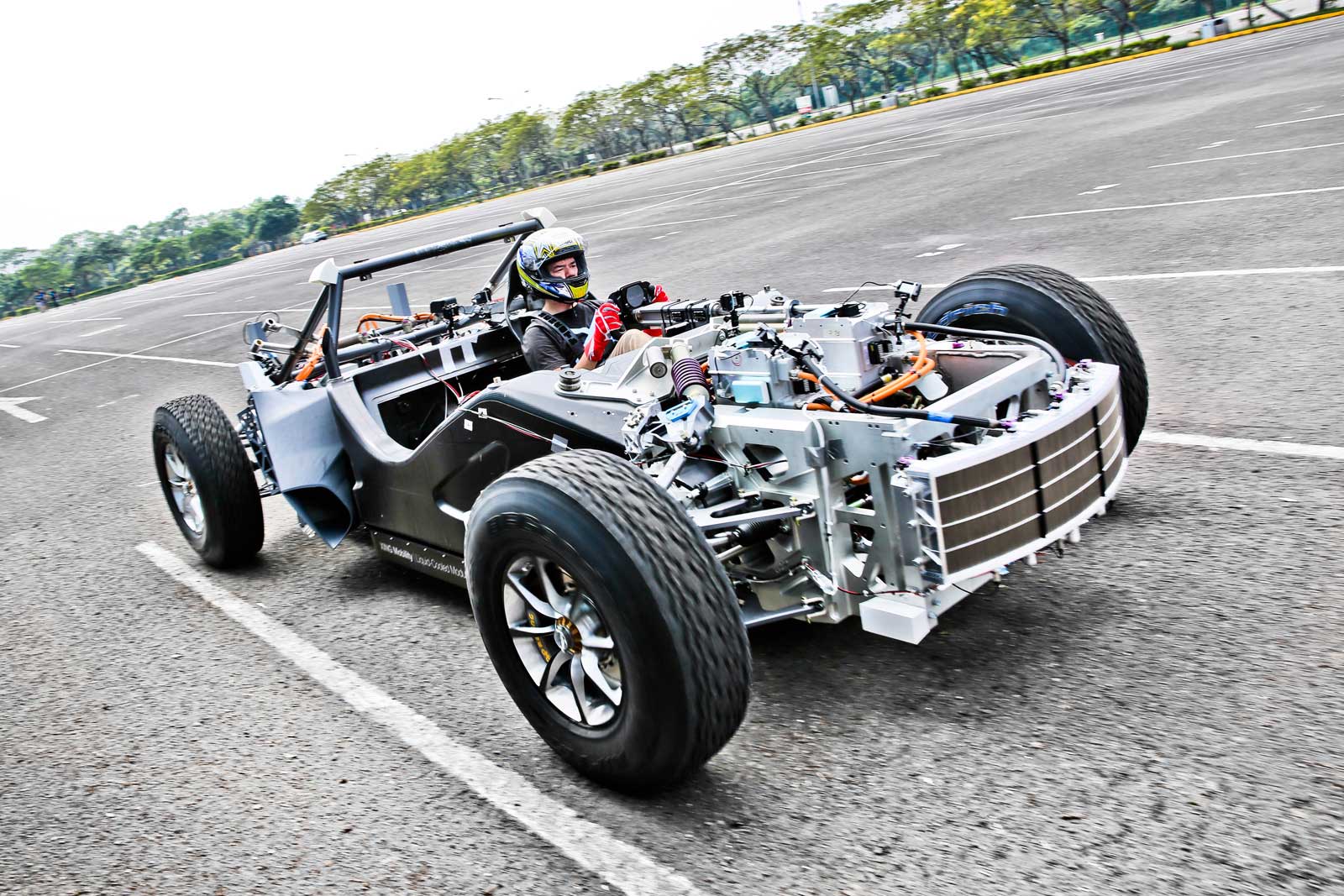
A Taiwanese automotive company named Xing Mobility, finally released the full view of their electric-powered supercar is touted would be one of serious competitors of Tesla Roadster.
Xing Miss R touted would be one of serious competitors of Tesla Roadster. (Picture from: http://bit.ly/2NMP5af)

Yes, in April 2017 they have tested an electric-powered car with the name of Miss R (another weird name) and has successfully passed the first stage of experimental process to support the power expectations of 1,341 hp (1,000 kW), and at the same time holds the status as an electric-powered supercar for on-road/off-road.

By using the four-wheel torque vector system, Miss R promises an acceleration 0-100 kph, takes only 1.8 seconds, thwart estimates of Tesla Roadster that takes 1.9 seconds at the same speed.
Left side view of Xing Miss R. (Picture from: http://bit.ly/2NMP5af)
Acceleration 0-200 kph takes about 5.1 seconds, it's looks like half of the speed of Maserati Quattroporte last year. Well for top acceleration has the highest speed in the numbers of 270 and 300 kph.
Rear-top view of Xing Miss R. (Picture from: http://bit.ly/2NMP5af)
Concerning the heat effect resulting from ultra high-performance electric, Xing has protected the battery from overheating by using a unique liquid cooler. Xing has been packing the battery modules such as the Lego toy, by carrying 4,200 lithium-ion cells and blend it in 98 packets into the car out of a total of 4,116 cells. This battery is protected with 3M Novec 7200 fluid, which is non conductive and effectively removes the heat and presses the fire.
Xing Miss R while on test. (Picture from: http://bit.ly/2AhKpar)
Xing revealed that these liquid cooling system allows the extraction of a certain amount of energy in an attempt to match Tesla's achievement, with a percentage of 30-50%. While for the mileage, it is far from achievement of the All-new Roadster was able to reach up to 998 km, but Miss R has the advantage, namely the ability to exchange the battery pack in a fairly short time, ie in only 5 minutes.
Xing Miss R while on test. (Picture from: http://bit.ly/2LW9qcL)
After completion of this initial test series, the next test is to improve all the expected performance. The Miss R prototype car is scheduled for completion on 2018. Furthermore, this car will be made in a limited number of 20 units begin in 2019.
Reportedly the price of this car reached $1 million or approximately Rp.14.5 billion. See the price offered, it's far enough from the price of New Roadster is only $200 thousand. Are you interested to have it? *** [EKA | FROM VARIOUS SOURCES | XING | ]
Note: This blog  can be accessed via your smart phone

Wednesday, August 15, 2018

The Body becomes a Tree

Have you ever imagined a cemetery area that was originally known with a tense, scary and lonely atmosphere, then turned into a green landscape full of trees, beautiful and harmonious? Actually, there are many ideas that have been initiated to make funeral concepts in the last decade, recently there is one concept that has been widely highlighted and has invited many pros and cons comments. The concept came from Italy.
There's a video that describes the concept of organic graves being viral on social media. And those video was uploaded in the Facebook social media through the "Be Inspired Aspire" pages, and has been watched more than 36 millions times.

The video introduces an environmentally friendly organic burial "coffin" concept to turn tombstone graves into a unique innovation called Capsula Mundi. These Capsula Mundi concept was first put forward by Anna Citelli and Raoul Bretezel, who made a burial pods or called the Capsula Mundi, where these pods serves as a fertilizer for the tree.
Capsula Mundi burial concept. (Picture from: http://bit.ly/2KSsVSd)
The idea is to place the body in a position like a fetus in the womb in a biodegradable burial pods. The pods are then planted on the ground with seeds or trees. The seeds are placed in a jar that stores the ashes below with a mixture of soil. In the Bios jar, the seeds that are planted take food from ash when it grows into a tree.

In Twitter, Capsula Mundi uploaded a picture of a tree hugged by someone and added with a little comment. "
My grandma is an oak tree. She chose to do this because she preferred a tree to a tombstone. And when I visit the wood, I feel grandma is still with me," wrote the @capsula_mundi account accompanied by hashtag #lifeneverstops #greenburial #trees. 
It is unfortunate until now the Capsula Mundi are still a concept because many people think it violates the rules and some norms about burying a body under the tree. In addition, not many people who want to buried in such a way and it turns out to cost quite a lot.

And Capsula Mundi claimed, if this idea is practiced, then people will visit the forest as a cemetery to remember their loved ones. *** [EKA | FROM VARIOUS SOURCES | CAPSULA MUNDI]
Note: This blog  can be accessed via your smart phone

Saleen’s S1 Coupe Remains a Standout in Modern Sports Car Design

Performance Reverie - There’s something undeniably compelling about the way modern sports cars try to balance raw mechanical excitement with contemporary design, and every so often, a model emerges that captures that balance with unusual clarity. That sense of timing is part of what makes the Saleen S1 Coupe so interesting—a car that arrived in an era obsessed with performance numbers yet manages to feel refreshingly driver-oriented. When it first appeared at the 2017 Los Angeles Auto Show, it wasn’t just another debut; it felt like a signal that Saleen was ready to reassert its identity in a rapidly shifting automotive world.
The 2018 Saleen S1 Coupe has been debuted at 2017 LA Auto Show. (Picture from: Road&Track)
Saleen’s approach with the S1 was unusually personal. Rather than collaborating with another manufacturer or reworking an existing platform, the company built this sports car entirely in-house, with Steve Saleen himself closely involved in the development. The model later being spotted in China only added to the intrigue, hinting that its reach might extend farther than initially expected. What remained constant, however, was the plan to build the earliest examples at Saleen’s headquarters in Corona, California, keeping the project grounded in the brand’s American performance roots.
Right side view of the 2018 Saleen S1 Coupe. (Picture from: Road&Track)
A quick look at the S1’s exterior reveals how seriously the team treated the design. Its carbon-fiber body gives the coupe a lightweight but premium character, wrapped around lines that are both athletic and functional. The front end is anchored by a wide air intake that immediately establishes a performance-ready stance, while the sharp LED headlights and ventilated hood add layers of personality. A steep windshield and double-bubble roof flow gracefully into the rear, creating a silhouette that feels fast even before the engine turns over, as if every surface was shaped with airflow in mind rather than ornamentation.
Dashboard view of the 2018 Saleen S1 Coupe. (Picture from: Road&Track)
Beneath that sculpted shell lies an engine that matches the visual promise. Saleen equipped the S1 with a 2.5-liter turbocharged four-cylinder unit capable of producing 450 horsepower and 350 lb-ft of torquefigures made even more compelling by the car’s 2,685-pound weight. Power is routed to the rear wheels through either a six-speed manual transmission or an automatic paddle-shifted setup, giving drivers a choice between analog engagement and modern convenience. On the road, the combination allows the coupe to sprint from 0 to 60 mph in just 3.5 seconds and continue on to a top speed of 180 mph, keeping it firmly in the realm of serious performance machinery.
Rear three quarter view of the 2018 Saleen S1 Coupe. (Picture from: Road&Track)
That capability extends beyond straight-line speed. Saleen estimated the S1 could achieve up to 1.2 g of lateral acceleration, a number made possible in part by its Continental ExtremeContact tires255/30ZR20 at the front and massive 355/25ZR20 at the rear. The wide stance, sticky compound, and lightweight construction all work together to create a sense of stability and precision, reminding drivers that handling was just as important to the development team as horsepower. It’s a car that seems designed to communicate clearly with the person behind the wheel, prioritizing connection over theatrics.
Priced at around $100,000 with a relatively small reservation deposit, the S1 Coupe represents an intriguing blend of exclusivity, heritage, and modern engineering. It isn’t positioned as a mass-market product, nor does it try to be; instead, it reflects Saleen’s desire to craft something personal, focused, and distinct in a landscape increasingly dominated by automation and digital layers. In many ways, it acts as a bridge between eras—a compact, thoughtfully engineered reminder that pure mechanical engagement still has a place in the modern performance world. *** [EKA [15082018] | FROM VARIOUS SOURCES | SALEEN | ROAD&TRACK ]
Note: This blog can be accessed via your smart phone.

Tuesday, August 14, 2018

Fittipaldi EF7: A Pininfarina-Designed Vision Gran Turismo Track Car

Racing Alchemy - Modern motorsport culture is increasingly shaped by ideas that move fluidly between the real world and the digital realm, where racing heritage, cutting-edge design, and simulation technology intersect. Within this landscape, certain machines are created not simply to compete, but to express a philosophy about speed and craftsmanship itself. The Fittipaldi EF7 Vision Gran Turismo stands as one of those rare creations, bridging past achievements and present innovation through a car that exists both as a physical track weapon and a symbol of modern performance thinking.
The 2017 Fittipaldi EF7 Vision GranTurismo by Pininfarina at Geneva Motor Show 2017. (Picture from: RobbReport)
First unveiled at the 2017 Geneva Motor Show, the EF7 Vision Gran Turismo emerged from a collaboration that reads like a blueprint for credibility. Emerson Fittipaldi, a two-time Formula 1 World Champion, partnered with Italy’s iconic design house Pininfarina and Germany-based engineering specialists HWA AG. Each brought a distinct strength to the project: Fittipaldi’s decades of racing intuition, Pininfarina’s refined sense of form, and HWA’s deep motorsport engineering background. The result was not a marketing exercise, but a focused track-only machine shaped by experience at the highest levels of racing.
Front three quarter view of the 2017 Fittipaldi EF7 Vision GranTurismo by Pininfarina. (Picture from: Motor1)
The design language of the EF7 immediately communicates purpose. Built around a carbon-fiber monocoque, the car adopts a sharp, shark-inspired silhouette that emphasizes aerodynamic efficiency and visual tension. Its proportions4,600 mm long, 1,980 mm wide, and just 1,125 mm tallsit low and aggressive, with a 2,700 mm wheelbase reinforcing stability at speed. Every surface appears sculpted for airflow, while the bodywork unmistakably reflects Pininfarina’s signature balance between elegance and intensity. Inside, the cabin remains true to its track-only identity, prioritizing driver focus over comfort, with a layout that places function firmly ahead of luxury.
Right side view of the 2017 Fittipaldi EF7 Vision GranTurismo by Pininfarina. (Picture from: MotorAuthority)
Beneath the striking exterior lies a mechanical package engineered for purity. HWA AG developed the powertrain, suspension, and braking systems, anchoring the car’s performance credentials. At its heart is a naturally aspirated 4.8-liter V8 engine producing 600 horsepower at 8,250 rpm and 510 Nm of torque at 6,000 rpm. Power is delivered through a six-speed integrated sequential gearbox paired with a bilateral mechanical limited-slip differential. With a total weight of just 1,000 kg and a finely tuned weight distribution of 48 percent at the front and 52 percent at the rear, the EF7 is engineered to reward precision and confidence on the circuit.
Rear three quarter view of the 2017 Fittipaldi EF7 Vision GranTurismo by Pininfarina. (Picture from: MotorAuthority)
The car’s story is inseparable from Emerson Fittipaldi’s own legacy. His dominance in Formula 1 during the 1970s, including becoming the youngest world champion at the time in 1972, and his unique achievement of winning both the Formula 1 World Championship and the Indianapolis 500 multiple times, lend the EF7 a rare historical weight. This is not a tribute built on nostalgia alone, but a contemporary expression of values shaped by decades of elite competition, adapted to today’s performance expectations and engineering standards.
Limited to just 39 units with a reported price of around $1.5 million, the EF7 Vision Gran Turismo was conceived as an experience rather than a conventional ownership proposition. Buyers are offered direct training sessions with Fittipaldi himself and access to the exclusive Fittipaldi Racing Club, which organizes high-performance driving events at renowned circuits worldwide. At the same time, the car reaches a broader audience through its inclusion in Polyphony Digital’s Gran Turismo series, allowing drivers to experience its character virtually. In both physical and digital forms, the EF7 captures how modern performance cars can honor racing history while embracing the evolving ways people engage with speed today. *** [EKA [14082018] | FROM VARIOUS SOURCES | FITTIPALDI MOTORS | PININFARINA | ROBB REPORT | MOTOR AUTHORITY | MOTOR1 ]
Note: This blog can be accessed via your smart phone.