-->
Drop Down MenusCSS Drop Down MenuPure CSS Dropdown Menu

Tuesday, June 16, 2026

7 Bizarre Futuristic Cars That Were Ahead of Their Time

Future Oddities - Mass-production car models may seen such ordinary thing in the eyes of automotive lovers who have different imagination, so they felt the need to show the car or vehicle considered unique and special to their eyes. No wonder if there are many eccentric minded builder and modificators whose make their futuristic dream cars come true alone without any supports or helping from automotive manufacturers.
Have You seen this past-made weird futuristic visioned vehicle? (Picture from: MessyNessy)
It should be noted, all of the vehicles below were really existed, even some of them could be driven and legally used to run on the public roads. Here's the seven most weirdest cars of all the time might you've never known or seen before;

1. 1938 Phantom Corsair
This is a six-passenger 2-door sedan prototype called the Phantom Corsair, it was designed by Rust Heinz and Maurice Schwartz, then built by the Bohman & Schwartz coachbuilding company in Pasadena, California in 1938. Although sometimes dismissed as a failure because it never entered production, the Corsair is regarded as ahead of its time because of its futuristic features, and styling cues such as faired-in fenders and a low profile.
The 1938 Phantom Corsair designed by Rust Heinz and Maurice Schwartz, then built in 1938 by the Bohman & Schwartz. (Picture from: AmazingCars)
The Corsair futuristic-styled bodywork built on the chassis taken from a Cord 810 and large enough to seat six individuals inside its cabin. To propel this rather large vehicle, a Lycoming V8 engine was fitted that displaced 289 cubic-inches capable to burst power of 190 horsepower, so allowing the Phantom Corsair to reach 115 mph. While to keep the car in the driver control, there's a drum brakes on all four corners to slow the vehicle.

2. 1942 L'Oeuf Electrique
This is an electrical classic three-wheeled vehicle called L'Oeuf Electrique (means 'Electric Egg') It was made in 1942 by a French artists, industrial designers, and an engineer as well, Paul Arzens. Reportedly, this weird looking car made during the German occupation of Northern France so that caused lack of the fuel, by considering such condition then forced Arzens to go all-electric by converting its conventional gasoline drivetrain to an electric motor. 
The 1942 L'Oeuf Electrique by Paul Arzens. (Picture from: Supercars.net)
When created, this three-wheeled electric classic vehicle intended to be personal used vehicle in future. Therefore, this electric bubble car which made him to be the first person who made small car post the war. Since this electrical classic vehicle appeared, it continues to be an inspiration for many to develop the similar ones until now.

3. 1948 Timbs Special Roadster
This is Timbs Special Roadster designed and built by Norman E. Timbs by himself in 1948. The sleek roadster has mostly aluminum bodywork built on top of a steel chassis and it need almost two years for completion with the cost of $10,000 at the time. The roadster design was actually very simple, free of any gaudy, over-designed adornment. 
The 1948 Timbs Special Roadster by Norman E. Timbs. (Picture from: Autoweek)
To keep the shape clean, no doors were cut out of the body. So to access the cabin, it's simply just hop into it. Furthermore, this slick streamlined roadster was powered by a Buick Super 8 drivetrain which allowed it to run up to a top speed of 120 mph, well that's a quite fast for its day.

4. 1950 Wing Tank Special
Here's the jet-inspired custom car called the Wing Tank Special built in an early 1950s by US Air Force Lt.Col. Edward Richer in England. He used a Ford Anglia chassis plus parts from a Chevy and an Austin, while the side-tanks came off a Lockheed T-33 jet trainer.
The
1950 Wing Tank Special by US-Air Force Lt.Col. Edward Richer. (Picture from: QuirkyRides)

As you can see the Wing Tank Special is a compact two-seater unique shaped vehicle inspired by jet-plane which was a trend at that time to display the future vehicle vision.

5. 1955 Almar's Space Race Dream Car
The following unique car known as the Almar's Space Race Dream Car was built in 1955 by Almar Nordhaug, a Norwegian who lives in Tórshavn, Faroe Island. He built the car while working at a barrel factory in there, and helped by his colleagues from the barrel factory. The overall design of the Almar's car is very similar to the 1954 Ford FX-Atmos concept car, and we believe it becomes an inspiration during its development.
Almar's Dream Car in the day as it arrived in Norway back in 1957. (Picture from: Facebook)
Furthermore, this car is built on a Vauxhall Cresta chassis complete with its engine and drive system. Then the body is built in a handmade and uniquely, it using an airplane cockpit cover functioned as the roof. This 2-seater unique-shaped car also had the gullwing doors to stand out prominently so that it will always make people immediately look at when it is passing the streets.

6. 1955 Galileo Concept
The appearance of the unique car called the Galileo Concept, since it was first shown to the public in 1957, is indeed very interesting and is still able to invite the admiration of those who see it today. The unique-shaped car was built by an unknown American automaker named Joseph Galileo.
1957 Galileo Concept is a trully stunning jet-inspired show car of 1950s. (Picture from: QuirkyRides)
He built this dream car using a frame taken from 1949 Ford, but the fiberglass body was all made by Galileo himself. He made molds of wood and plaster and shaped the car, complete with gullwing doors. The shape of the bumper is uniquely designed so that it features a jet-themed intakes that is the epitome of 1950s futuristic style on the front, then the car is powered by an Oldsmobile 'Rocket' V8 engine that's such a perfect match in both name and technology for the car.

7. 1968 Pussycar Automodule 
This is an eccentrics vehicle design called the Pussycar Automodule, and was one unique retro creation designed by Jean Pierre Ponthieu to be the vision of the future vehicle. The Pussycar Automodule seem like spherical-shaped vehicle described as 'The Car of the Year 2000,' built to be a sort of promotional purposed vehicle, and launched in 1968.
1968 Pussycar Automodule by Jean Pierre Ponthieu, and dubbed as 'The Car of the Year 2000'. (Picture from: MessyNessy)
The unique car whose rear wheel is powered by a 250 cc single cylinder engine can do wheelies! Definitely no speedster, this vehicle inches forward slowly and can also turns its wheels to drive sideways or rotate in place.
Today, we still haven't found yet a single car like this milling around the streets. One thing in certain to this day, the Pussycar Automodule remained seen as a strange car to us.

In the end, these seven wonderful cars prove that automotive history is full of creativity and bold ideas. While some may look strange by today’s standards, each one left a unique mark on the industry. They remind us that innovation often begins with the courage to be different. *** [EKA | FROM VARIOUS SOURCES | OLDCONCEPTCARS | WHICHCAR | MESSYNESSY | AMAZINGCARS | THEAUTOPIAN ]
Note: This blog can be accessed via your smart phone.

Lino Tonti’s Beautiful Italian Scooter Inspired by Marilyn Monroe

Forgotten Glamour - A remarkable vehicle does not always become famous, and some of the most fascinating creations in automotive history spend decades hidden from public memory. During the golden age of scooters in the 1950s and 1960s, countless designs emerged from both established manufacturers and passionate independent builders. Among them was an exceptionally rare Italian scooter known as the Linto Marilina, a machine whose elegance was inspired by one of the most iconic women of the twentieth century, Marilyn Monroe.
The 1954 Linto Marilina while on display in front of Marilyn Monroe's picture at the Salon Moto Légende 2019. (Picture from: CafeRacerClub.org)

Monday, June 15, 2026

Is this one of the best modern American muscle cars?

Two Nostrils - The typical American muscle car that often looks dashing with the iconic firebird badge on its hood is indeed very popular among automotive enthusiasts in the world. However, among the many Firebird models made by Pontiac from 1967 to 2002, it turns out that there is a model that we think is very special while viewed from its appearance. Take a look the picture below!
The Pontiac Trans Am Firebird WS6 (in pictured the final model 2002) gives a fierce impression by attaching a Ram Air intake featuring two nostrils. (Picture from: HotCars)
So, have you ever seen the Firebird model like above before? That is Pontiac Trans Am Firebird WS6 described as a special package called the Trans Am to the Firebird models made in 1978. So it's natural if we didn't know of the existence of this model before, considering the model was produced in limited numbers by Pontiac  plus only a few privileged person had chance to own it.
The Pontiac Trans Am Firebird WS6 (in pictured the final model 2002) gives a fierce impression by attaching a Ram Air intake featuring two nostrils. (Picture from: HotCars)
It started when Pontiac made the sporty Firebird as the answer to the Ford Mustang and Chevrolet Camaro. The car combined an available big V-8 with aggressive, attention-grabbing styling and delivered it in a relatively practical four-passenger package. Like its pony-car competitors, the rear-wheel-drive Firebird offered tire-smoking power and impressive acceleration.
The Pontiac Trans Am Firebird WS6 (in pictured the final model 2002 Convertible) gives a fierce impression by attaching a Ram Air intake featuring two nostrils. (Picture from: HotCars)
The F-body platform on which it and the Camaro were based, however, was arguably well past its prime by the early 2000s. 2002 was the final year of production for Pontiac's iconic but dated speed machine. The Firebird Trans Am was powered by GM's 5.7-liter LS1 V-8 engine. It was available as a hatchback coupe or a convertible. The WS6 package added additional enhancements to the engine and chassis. 
The Pontiac Trans Am Firebird WS6 (in pictured the final model 2002) gives a fierce impression by attaching a Ram Air intake featuring two nostrils. (Picture from: HotCars)
The coupe measured 193.8 inches in length, 74.5 inches in width and 52.0 inches in height, with a 101.1-inch wheelbase. Except for being about half an inch taller with its top up, the convertible had matching exterior dimensions. The coupe's base curb weight was 3,499 lbs, while the convertible weighted-in at a slightly beefier 3,623 lbs. The coupe and the convertible were equal in terms of interior space. 
The Pontiac Trans Am Firebird WS6 (in pictured the final model 2002) gives a fierce impression by attaching a Ram Air intake featuring two nostrils. (Picture from: HotCars)
The front seats offered 37.2 inches of headroom, 57.4 inches of shoulder room, 52.8 inches of hip room and 42.9 inches of legroom. Backseat passengers got a somewhat-cramped 35.3 inches of headroom, 55.8 inches of shoulder room, 44.4 inches of hip room and 28.9 inches of legroom. The coupe had space for 12.9 cubic feet of cargo with the rear seats up and a maximum of 33.7 cubic feet with them folded down. The convertible's trunk provided 7.6 cubic feet of storage space.
The Pontiac Trans Am Firebird WS6 (in pictured the final model 2002) gives a fierce impression by attaching a Ram Air intake featuring two nostrils. (Picture from: HotCars)
As quoted of Hotcars, the typical Pontiac' muscle car featured with WS6 package has unique appearance was initially introduced by GM to the market in 1987 as a standard feature on the Trans Am GTA and Firebird Formula, but took the WS6 package off the market in 1992 because not having an impact on its sales.
The Pontiac Trans Am Firebird WS6 (in pictured the final model 2002) gives a fierce impression by attaching a Ram Air intake featuring two nostrils. (Picture from: HotCars)
Surprisingly, in 1996 it was re-entered the market by giving a slight tweak to its uniquely made hood which had a Ram Air intake featuring two nostrils thought increasing in the engine power output from 285 horsepower to massive 305 horsepower at 5,200 rpm and 345 ft-lbs of torque at 4,400 rpm. Besides that it helped direct air for cooling its engine, along with a freer-flowing exhaust system. The package also added shocks, bushings, firmer springs, front and rear sway bars, and a firmer transmission mount.
The Pontiac Trans Am Firebird WS6 (in pictured the final model 2002) gives a fierce impression by attaching a Ram Air intake featuring two nostrils. (Picture from: HotCars)
The Firebird Trans Am WS6's performance capabilities were quite strong for its time. It could accelerate from 0 to 60 mph in five seconds flat. A quarter-mile run took just 13.5 seconds at 107.4 mph. While straight-line speed was the main attraction, the Pontiac also put out very decent braking and handling numbers. It could decelerate from 60 to 0 mph in 121 feet, which was about 10 feet better than the Camaro Z28, its platform-mate equivalent from Chevrolet. On a 200-foot skid pad, it could achieve a solid 0.84G of lateral acceleration. Finally, the Trans Am WS6 could race its way through a 600-foot slalom course at 64.6 mph.
The Pontiac Trans Am Firebird WS6 (in pictured the final model 2002) gives a fierce impression by attaching a Ram Air intake featuring two nostrils. (Picture from: HotCars)
While some people liked the interior's sweeping, curvaceous dashboard and red instrument lighting, others found it a bit cheap-looking. Either way, though, the premium WS6 model came with a strong selection of standard equipment. This included fog lamps, leather seating surfaces, a six-way power driver seat, a tilt-adjustable steering column, full power accessories, cruise control, a leather-wrapped steering wheel and shift knob, air conditioning and a six-speaker CD stereo. Options included a premium 10-speaker Monsoon audio system, and T-tops for coupes.
The Pontiac Trans Am Firebird WS6 (in pictured the final model 2002) gives a fierce impression by attaching a Ram Air intake featuring two nostrils. (Picture from: HotCars)
As mentioned before, the early Firebird WS6s are extremely rare cars as Pontiac didn’t record great sales run during those times. However, it has been estimated that about 2,500 of the 31,000 Firebirds sold in 1996 were equipped with the WS6 package
The sales of the WS6 improved in the next year to about 3,900 units. Notably, the final production year was one of the best in terms of sales with close to 15,000 units of the WS6 Trans Ams sold after selling just 7,000 the previous year.. *** [EKA [29122021] | FROM VARIOUS SOURCES | HOTCARS | ITSTILLRUNS ]
Note: This blog can be accessed via your smart phone.

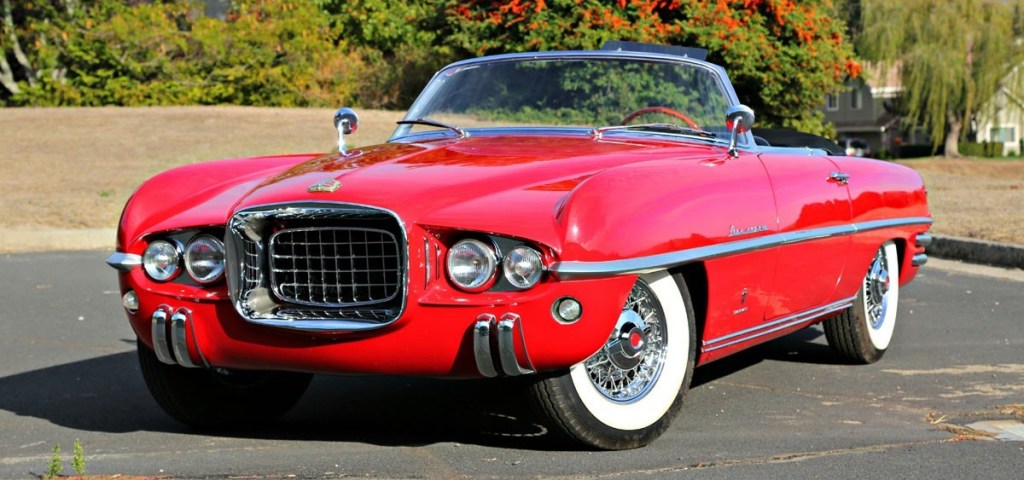
Seen Dodge Firearrow Concept series

Unique ONES - In the intriguing world of automotive design, the collaboration between America and Italy has produced some truly remarkable cars, and one shining example is the Dodge Firearrow Series.
1954 Dodge Firearrow II (left) posed along with the 1954 Dodge Firearrow IV (right). (Picture from: VintageRaceCars)
Conceived in the early 1950s by Virgil Exner, the design chief at Chrysler Corp, and crafted by the esteemed Turin-based coachbuilder Carrozzeria Ghia, these concept cars stand as a testament to the fusion of style and innovation. Now, let's us talking about those Firearrow concepts as follows;

1. Dodge Firearrow I
In 1953, the first Firearrow concept came out of Chrysler's advanced styling studio and was a dummy. Later, three Firearrows followed led to Dual Ghias. The Firearrow I was a true roadster and painted in Red and Gray, while the interior was yellow with maroon piping. Its wheels were full wheel covers and the bodyside molding wrapped all of the ways around the car and has dual headlights.
1953 Dodge Firearrow I Concept sat alongside with Abarth Fiat 1100 (Ghia) at the 1953 Turin Motor show(Picture from: CarStyling.ru)
The Dodge Firearrow, a sleek, 34-inch-high sports roadster, is a new 'idea' car of the Dodge Division, hand-crafted by Ghia of Turin, Italy. At that time, William C. Newberg, president of Dodge, says that certain design features of the experimental body may well be reflected in future Dodge production models, but there are no present plans to produce the Firearrow.
1953 Dodge Firearrow I Concept was designed by the Chrysler Corp design chief in the time, Virgil Exner and built by Carrozzeria Ghia. (Picture from: CarStyling.ru)
The car is shown for the first time on November 12, 1953, at Chrysler Corporation's annual new car press party in Detroit. And today, it is on display at Petersen’s Museum although the seats are now brown.

2. Dodge Firearrow II
The second series of roadster-styled concept car of Dodge itself is built on a 119-inch chassis and equipped with a Red Ram Hemi (241 cubic inch engine) combined with a four-speed Gyro-Torque semi-automatic gearbox, so then the car is claimed to be capable of spewing power up to 150 horsepower.
1954 Dodge Firearrow II Concept appeared with different front and rear sections than the previous model. (Picture from: OtoBlitz)
It painted in yellow and looked a lot like Firearrow I, except the body side molding didn’t wrap around the car, chrome wire wheels replace the full hub caps, single headlights replaced the dual, and Firearrow I’s split bumper was changed.
Rear three-quarter view of the 1954 Dodge Firearrow II Concept(Picture from: OtoBlitz)
But, it retained the two-seats behind the dashboard and striking frameless windshield when it appeared in 1954.

3. Dodge Firearrow III
In 1954, the two-seat Firearrow Sport Coupe appeared and proclaimed as the third series of the Dodge's models. As with the earlier roadster, the metallic blue coupe was essentially a 1954 Dodge.
1954 Dodge Firearrow III Sports Coupe shown at the 2010 Pebble Beach Concours D’Elegance. (Picture from: Supercars.net
Dual headlights returned and now flanked a concave grille cut with narrow verticals. It also featured with the crash protection front and rear was provided by modest bumperettes. A wraparound backlight gave the Sport Coupe a particularly rakish aspect.
Rear three-quarter view of the 1954 Dodge Firearrow III Sports Coupe. (Picture from: Supercars.net
The third in a series of four unique Firearrow concept cars made, it has been said that this concept car had the skillful blending of the best ideas from Europe and the American design studios of Virgil Exner and brought an entirely new kind of beauty with a look of poised power.

4. Dodge Firearrow IV
The fourth series of Firearrow convertible arrived late in 1954. Despite being the series' first four-seater model, it shared many styling cues with the previous Sport Coupe model, or can be said, it was basically a soft-top version of the coupe.
1954 Dodge Firearrow IV four-seater convertible concept car and share the same design as the previous sports coupe version. (Picture from: OtoBlitz)
The Dodge Firearrow IV was the only road-legal concept car that was actually prepared to enter the production line and adorn many car shows in the United States in 1954. And if you look at the specifications, this concept is similar to the Firearrow II which was also designed by Exner and built-in Turin by Ghia on a 119-inch chassis by using the same drivetrain.
1954 Dodge Firearrow IV convertible leather interior's with a black and white diamond pattern. (Picture from: CarStyling.ru)
The concave grille returned, though it now carried a grid treatment instead of the coupe's slim verticals. As for the convertible's leather interior, as it was a diamond pattern done in hard-to-ignore black and white, it was definitely an acquired taste. Additional sizzle was provided by the car's bright red body.
Rear three-quarter view of the 1954 Dodge Firearrow IV four-seater convertible. (Picture from: Automotivereport)
Although these timeless creations, though never mass-produced, continue to captivate the hearts of automotive enthusiasts, serving as a reminder of the innovative spirit that defined an era. The Dodge Firearrow series stands as a testament to the boundless creativity and collaboration that can emerge from the marriage of American and Italian automotive design.. *** [EKA[13072020] [24092021] | FROM VARIOUS SOURCES | CARSTYLING.RU | AUTOWEEK | SUPERCARS.NET ]
Note: This blog  can be accessed via your smart phone

Sunday, June 14, 2026

The Truly Stunning Jet-Age Dream Car: 1957 Galileo Concept

Dreaming Car - Maybe you were one who had ever watched the classic television cartoon series The Jetsons, which tells the story of a family living in a futuristic era filled with flying cars and sleek, space-age inventions. When you take a look at this next car—featured on the QuirkyRides account on X—it’s hard not to feel like one of those imaginative dreams has leapt out of the screen and into real life.
The 1957 Galileo Concept is a truly stunning example of jet-inspired automotive design from the 1950s, capturing the bold imagination and futuristic spirit of the era in a way that few other show cars ever have. (Picture from: QuirkyRides)
This car is the Galileo Concept, and since it first appeared in public in 1957, it has left a lasting impression on those who encounter it. Bold, experimental, and undeniably retro-futuristic, the Galileo Concept still manages to spark admiration today, decades after its debut. What makes it even more fascinating is the man behind the machine—a little-known American named Joseph Galileo. Though his name doesn’t appear in the history books beside famous car designers, his story is every bit as intriguing.
The 1957 Galileo Concept was built from the ground up by Joseph Galileo using a 1949 Ford chassis and a custom fiberglass body—a daring choice at a time when the material was still considered experimental. (Picture from: UndiscoveredClassics)
Joseph Galileo was a U.S. Army Air Corps veteran who served during its transformation into the United States Air Force. His journey into automotive innovation began in the late 1950s, an era when jet planes and space travel had captured the world's imagination. Inspired by this wave of technological excitement, Galileo picked up a pencil and started sketching. His vision? A car that looked and felt like it belonged in the age of jets and rockets.
The 1957 Galileo Concept features a uniquely crafted design with jet-themed front intakes that perfectly embody the bold, futuristic styling trends of the 1950s. (Picture from: Motor1)
Building such a dream from scratch is no easy feat. Galileo began with a 1949 Ford chassis and constructed the rest of the car’s body from fiberglass—a material that was still fairly experimental at the time. He handcrafted the molds himself using wood and plaster, shaping every curve and line with his own hands. The car featured striking gullwing doors and a front bumper styled like a jet intake, giving it a true 1950s futuristic flair. Powering this wild creation was an Oldsmobile “Rocket” V8 engine—a name that couldn’t have been more fitting for the concept.
The 1957 Galileo Concept is built on the sturdy frame of a 1949 Ford and showcases a custom fiberglass body, meticulously handcrafted by Joseph Galileo himself to bring his futuristic vision to life. (Picture from: Motor1)
Despite his dedication, the car was never fully completed. The interior remained unfinished, and a few exterior elements were also missing. Sadly, Galileo passed away in 2010, never getting to see his vision fully realized. It was more than a car—it was the physical expression of one man’s dream to bring the future into the present. 
The 1957 Galileo Concept is powered by an Oldsmobile 'Rocket' V8 engine, a fitting choice that not only delivered impressive performance for its time but also perfectly complemented the car’s bold, space-age theme. (Picture from: Motor1)
In 2018, the Galileo Concept quietly changed hands after being listed by Undiscovered Classics, a dealership known for showcasing rare and forgotten vehicles. While the sale price remains a mystery, what’s more important is the hope it carries: that someone out there, perhaps the new owner, might one day finish the work Galileo started and share it with the world. | 8OgnW3Xo8E8 |
For now, the Galileo Concept stands as a reminder of a time when imagination had no limits, when even an unknown veteran could dream of the stars—and almost reach them with fiberglass and a V8. It’s a car not just built with tools, but with vision, heart, and a passion that defied convention..😐 *** [EKA [04122021] | FROM VARIOUS SOURCES | UNDISCOVEREDCLASSICS | QUIRKYRIDES | UNDISCOVEREDCLASSICS IN INSTAGRAM | HEMMINGS | MOTOR1 ]
Note: This blog can be accessed via your smart phone.

Vignale Record Sperimentale 1000: The Record That Never Was

Space Spoon - Discovering the stories behind unique and rare vehicles from the past often leads to some fascinating discoveries. One such vehicle is the Vignale Record Sperimentale 1000, a concept car that came to life in 1962. Built by Vignale, an Italian coachbuilder, this one-of-a-kind car was based on the Fiat 600D platform. The car's striking design immediately captures attention, with a shape that resembles a teardrop, or "goccia" in Italian, a form that was highly favored by designers during that era due to its aerodynamic efficiency.
1962 Vignale Record Sperimentale 1000 is built based of the Fiat 600D based design prototype with a massive 'fish-bowl' windscreen. (Picture from: Twitter)
In the 1950s and 60s, the teardrop design was at the forefront of aerodynamic studies. It was considered the most efficient shape for managing airflow, and this principle was applied by various automakers. Vignale had previously explored similar design ideas with the Abarth 750 Coupe Goccia in 1956, a collaboration with Giovanni Michelotti. The Sperimentale 1000 took these concepts even further, showcasing a distinct and futuristic appearance that was meant to push the boundaries of automotive design.
1962 Vignale Record Sperimentale 1000 sat on display at the Turin Auto Show 1962. (Picture from: Carrozzieri-Italiani)
The Vignale Record Sperimentale 1000 is not just another concept car; it is a masterpiece that combines art and engineering. Its most prominent feature is the massive "fish-bowl" windshield, which wraps around the front of the car, offering a panoramic view similar to modern-day sunroofs. The smooth, aerodynamic design continues with the faired-in headlights, which are tucked behind Plexiglas to reduce air resistance. The front bumpers, shaped like bullets, add to the car's sleek profile, while the sharply cut-off tail, a hallmark of Kammback design, ensures that the vehicle slices through the air with minimal drag.
1962 Vignale Record Sperimentale 1000's wraparound windscreen was absolutely enormous, while the glass roof very much similar the current's panoramic sunroofs. (Picture from: Drive-my.com)
At the rear, the car's design continues to impress with a series of cooling ducts that not only add to its visual appeal but also serve a functional purpose by providing air to the rear-mounted engine. The Vignale Record Sperimentale 1000 was equipped with a 1,000 cc engine, an upgrade from the original 767 cc engine, thanks to the efforts of the Turin-based ZM tuning company. This enhanced engine, combined with the car's lightweight and aerodynamic form, was intended to make it a record-breaking vehicle. Although Vignale claimed a Cd figure of just 0.25, which would have made it one of the most aerodynamically efficient cars of its time, there is no evidence to suggest that any record attempts were actually made.
Inside the cabin of 1962 Vignale Record Sperimentale 1000, there're two futuristic-themed seats with three gauges are mounted into a wooden instrument panel, housed in a binnacle extending forward to the base of the windshield. (Picture from: Drive-my.com)
Inside the cabin, the Vignale Record Sperimentale 1000 continues to impress with its futuristic design. The car features two seats with a unique, aircraft-inspired wraparound headrest on the passenger side. The wooden instrument panel is home to three gauges, housed in a binnacle that extends to the base of the windshield. The seats themselves are anatomically shaped, with unusual grip handle extensions, adding to the car's avant-garde aesthetic. Interestingly, the spare wheel is stored behind the seats, a practical yet stylish solution that adds to the car's overall uniqueness.
1962 Vignale Record Sperimentale 1000's wraparound windscreen was absolutely enormous, while the glass roof very much similar the current's panoramic sunroofs. (Picture from: Carstyling.ru)
The Vignale Record Sperimentale 1000 made its debut at the 1962 Turin Auto Show, where it immediately caught the attention of automotive enthusiasts and designers alike. Initially, the car featured conventional wheel arches, but by the time it was shown again at the Geneva Motor Show in March 1963, it had undergone slight modifications. The wheel arches were now faired-in and covered with spats, likely a result of further aerodynamic experiments conducted by Vignale.
This one-off concept car represents a remarkable chapter in automotive history, blending innovative design with engineering prowess. Its unique appearance, combined with the cutting-edge technology of its time, makes the Vignale Record Sperimentale 1000 a true icon. As we look back on this incredible vehicle, it serves as a reminder of the endless possibilities that arise when creativity and innovation come together in the world of automotive design.*** [EKA [09122021] | FROM VARIOUS SOURCES | DRIVE-MY.COM | CARROZZIERI-ITALIANI | CARSTYLING.RU | QUIRKYRIDES ]
Note: This blog  can be accessed via your smart phone