-->
Drop Down MenusCSS Drop Down MenuPure CSS Dropdown Menu

Monday, June 15, 2026

Seen Dodge Firearrow Concept series

Unique ONES - In the intriguing world of automotive design, the collaboration between America and Italy has produced some truly remarkable cars, and one shining example is the Dodge Firearrow Series.
1954 Dodge Firearrow II (left) posed along with the 1954 Dodge Firearrow IV (right). (Picture from: VintageRaceCars)
Conceived in the early 1950s by Virgil Exner, the design chief at Chrysler Corp, and crafted by the esteemed Turin-based coachbuilder Carrozzeria Ghia, these concept cars stand as a testament to the fusion of style and innovation. Now, let's us talking about those Firearrow concepts as follows;

1. Dodge Firearrow I
In 1953, the first Firearrow concept came out of Chrysler's advanced styling studio and was a dummy. Later, three Firearrows followed led to Dual Ghias. The Firearrow I was a true roadster and painted in Red and Gray, while the interior was yellow with maroon piping. Its wheels were full wheel covers and the bodyside molding wrapped all of the ways around the car and has dual headlights.
1953 Dodge Firearrow I Concept sat alongside with Abarth Fiat 1100 (Ghia) at the 1953 Turin Motor show(Picture from: CarStyling.ru)
The Dodge Firearrow, a sleek, 34-inch-high sports roadster, is a new 'idea' car of the Dodge Division, hand-crafted by Ghia of Turin, Italy. At that time, William C. Newberg, president of Dodge, says that certain design features of the experimental body may well be reflected in future Dodge production models, but there are no present plans to produce the Firearrow.
1953 Dodge Firearrow I Concept was designed by the Chrysler Corp design chief in the time, Virgil Exner and built by Carrozzeria Ghia. (Picture from: CarStyling.ru)
The car is shown for the first time on November 12, 1953, at Chrysler Corporation's annual new car press party in Detroit. And today, it is on display at Petersen’s Museum although the seats are now brown.

2. Dodge Firearrow II
The second series of roadster-styled concept car of Dodge itself is built on a 119-inch chassis and equipped with a Red Ram Hemi (241 cubic inch engine) combined with a four-speed Gyro-Torque semi-automatic gearbox, so then the car is claimed to be capable of spewing power up to 150 horsepower.
1954 Dodge Firearrow II Concept appeared with different front and rear sections than the previous model. (Picture from: OtoBlitz)
It painted in yellow and looked a lot like Firearrow I, except the body side molding didn’t wrap around the car, chrome wire wheels replace the full hub caps, single headlights replaced the dual, and Firearrow I’s split bumper was changed.
Rear three-quarter view of the 1954 Dodge Firearrow II Concept(Picture from: OtoBlitz)
But, it retained the two-seats behind the dashboard and striking frameless windshield when it appeared in 1954.

3. Dodge Firearrow III
In 1954, the two-seat Firearrow Sport Coupe appeared and proclaimed as the third series of the Dodge's models. As with the earlier roadster, the metallic blue coupe was essentially a 1954 Dodge.
1954 Dodge Firearrow III Sports Coupe shown at the 2010 Pebble Beach Concours D’Elegance. (Picture from: Supercars.net
Dual headlights returned and now flanked a concave grille cut with narrow verticals. It also featured with the crash protection front and rear was provided by modest bumperettes. A wraparound backlight gave the Sport Coupe a particularly rakish aspect.
Rear three-quarter view of the 1954 Dodge Firearrow III Sports Coupe. (Picture from: Supercars.net
The third in a series of four unique Firearrow concept cars made, it has been said that this concept car had the skillful blending of the best ideas from Europe and the American design studios of Virgil Exner and brought an entirely new kind of beauty with a look of poised power.

4. Dodge Firearrow IV
The fourth series of Firearrow convertible arrived late in 1954. Despite being the series' first four-seater model, it shared many styling cues with the previous Sport Coupe model, or can be said, it was basically a soft-top version of the coupe.
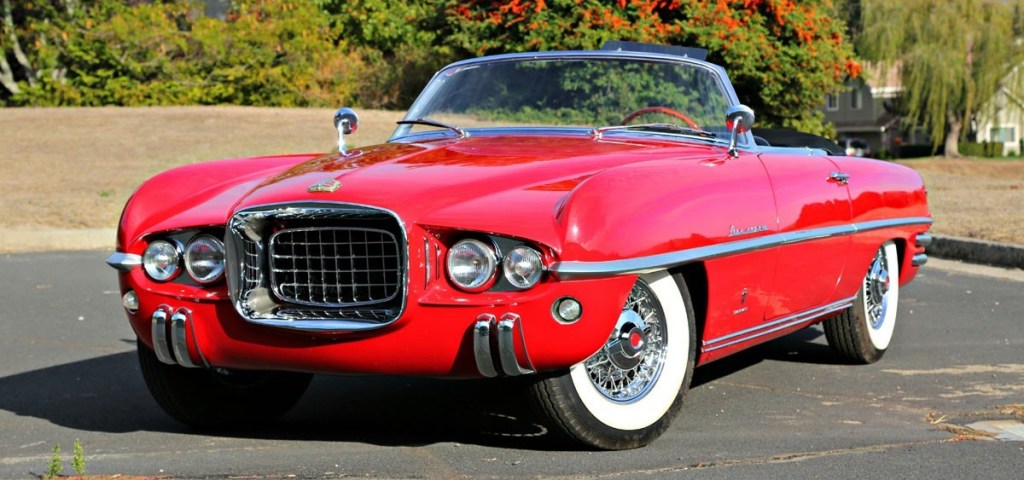
1954 Dodge Firearrow IV four-seater convertible concept car and share the same design as the previous sports coupe version. (Picture from: OtoBlitz)
The Dodge Firearrow IV was the only road-legal concept car that was actually prepared to enter the production line and adorn many car shows in the United States in 1954. And if you look at the specifications, this concept is similar to the Firearrow II which was also designed by Exner and built-in Turin by Ghia on a 119-inch chassis by using the same drivetrain.
1954 Dodge Firearrow IV convertible leather interior's with a black and white diamond pattern. (Picture from: CarStyling.ru)
The concave grille returned, though it now carried a grid treatment instead of the coupe's slim verticals. As for the convertible's leather interior, as it was a diamond pattern done in hard-to-ignore black and white, it was definitely an acquired taste. Additional sizzle was provided by the car's bright red body.
Rear three-quarter view of the 1954 Dodge Firearrow IV four-seater convertible. (Picture from: Automotivereport)
Although these timeless creations, though never mass-produced, continue to captivate the hearts of automotive enthusiasts, serving as a reminder of the innovative spirit that defined an era. The Dodge Firearrow series stands as a testament to the boundless creativity and collaboration that can emerge from the marriage of American and Italian automotive design.. *** [EKA[13072020] [24092021] | FROM VARIOUS SOURCES | CARSTYLING.RU | AUTOWEEK | SUPERCARS.NET ]
Note: This blog  can be accessed via your smart phone

Sunday, June 14, 2026

The Truly Stunning Jet-Age Dream Car: 1957 Galileo Concept

Dreaming Car - Maybe you were one who had ever watched the classic television cartoon series The Jetsons, which tells the story of a family living in a futuristic era filled with flying cars and sleek, space-age inventions. When you take a look at this next car—featured on the QuirkyRides account on X—it’s hard not to feel like one of those imaginative dreams has leapt out of the screen and into real life.
The 1957 Galileo Concept is a truly stunning example of jet-inspired automotive design from the 1950s, capturing the bold imagination and futuristic spirit of the era in a way that few other show cars ever have. (Picture from: QuirkyRides)
This car is the Galileo Concept, and since it first appeared in public in 1957, it has left a lasting impression on those who encounter it. Bold, experimental, and undeniably retro-futuristic, the Galileo Concept still manages to spark admiration today, decades after its debut. What makes it even more fascinating is the man behind the machine—a little-known American named Joseph Galileo. Though his name doesn’t appear in the history books beside famous car designers, his story is every bit as intriguing.
The 1957 Galileo Concept was built from the ground up by Joseph Galileo using a 1949 Ford chassis and a custom fiberglass body—a daring choice at a time when the material was still considered experimental. (Picture from: UndiscoveredClassics)
Joseph Galileo was a U.S. Army Air Corps veteran who served during its transformation into the United States Air Force. His journey into automotive innovation began in the late 1950s, an era when jet planes and space travel had captured the world's imagination. Inspired by this wave of technological excitement, Galileo picked up a pencil and started sketching. His vision? A car that looked and felt like it belonged in the age of jets and rockets.
The 1957 Galileo Concept features a uniquely crafted design with jet-themed front intakes that perfectly embody the bold, futuristic styling trends of the 1950s. (Picture from: Motor1)
Building such a dream from scratch is no easy feat. Galileo began with a 1949 Ford chassis and constructed the rest of the car’s body from fiberglass—a material that was still fairly experimental at the time. He handcrafted the molds himself using wood and plaster, shaping every curve and line with his own hands. The car featured striking gullwing doors and a front bumper styled like a jet intake, giving it a true 1950s futuristic flair. Powering this wild creation was an Oldsmobile “Rocket” V8 engine—a name that couldn’t have been more fitting for the concept.
The 1957 Galileo Concept is built on the sturdy frame of a 1949 Ford and showcases a custom fiberglass body, meticulously handcrafted by Joseph Galileo himself to bring his futuristic vision to life. (Picture from: Motor1)
Despite his dedication, the car was never fully completed. The interior remained unfinished, and a few exterior elements were also missing. Sadly, Galileo passed away in 2010, never getting to see his vision fully realized. It was more than a car—it was the physical expression of one man’s dream to bring the future into the present. 
The 1957 Galileo Concept is powered by an Oldsmobile 'Rocket' V8 engine, a fitting choice that not only delivered impressive performance for its time but also perfectly complemented the car’s bold, space-age theme. (Picture from: Motor1)
In 2018, the Galileo Concept quietly changed hands after being listed by Undiscovered Classics, a dealership known for showcasing rare and forgotten vehicles. While the sale price remains a mystery, what’s more important is the hope it carries: that someone out there, perhaps the new owner, might one day finish the work Galileo started and share it with the world. | 8OgnW3Xo8E8 |
For now, the Galileo Concept stands as a reminder of a time when imagination had no limits, when even an unknown veteran could dream of the stars—and almost reach them with fiberglass and a V8. It’s a car not just built with tools, but with vision, heart, and a passion that defied convention..😐 *** [EKA [04122021] | FROM VARIOUS SOURCES | UNDISCOVEREDCLASSICS | QUIRKYRIDES | UNDISCOVEREDCLASSICS IN INSTAGRAM | HEMMINGS | MOTOR1 ]
Note: This blog can be accessed via your smart phone.

Vignale Record Sperimentale 1000: The Record That Never Was

Space Spoon - Discovering the stories behind unique and rare vehicles from the past often leads to some fascinating discoveries. One such vehicle is the Vignale Record Sperimentale 1000, a concept car that came to life in 1962. Built by Vignale, an Italian coachbuilder, this one-of-a-kind car was based on the Fiat 600D platform. The car's striking design immediately captures attention, with a shape that resembles a teardrop, or "goccia" in Italian, a form that was highly favored by designers during that era due to its aerodynamic efficiency.
1962 Vignale Record Sperimentale 1000 is built based of the Fiat 600D based design prototype with a massive 'fish-bowl' windscreen. (Picture from: Twitter)
In the 1950s and 60s, the teardrop design was at the forefront of aerodynamic studies. It was considered the most efficient shape for managing airflow, and this principle was applied by various automakers. Vignale had previously explored similar design ideas with the Abarth 750 Coupe Goccia in 1956, a collaboration with Giovanni Michelotti. The Sperimentale 1000 took these concepts even further, showcasing a distinct and futuristic appearance that was meant to push the boundaries of automotive design.
1962 Vignale Record Sperimentale 1000 sat on display at the Turin Auto Show 1962. (Picture from: Carrozzieri-Italiani)
The Vignale Record Sperimentale 1000 is not just another concept car; it is a masterpiece that combines art and engineering. Its most prominent feature is the massive "fish-bowl" windshield, which wraps around the front of the car, offering a panoramic view similar to modern-day sunroofs. The smooth, aerodynamic design continues with the faired-in headlights, which are tucked behind Plexiglas to reduce air resistance. The front bumpers, shaped like bullets, add to the car's sleek profile, while the sharply cut-off tail, a hallmark of Kammback design, ensures that the vehicle slices through the air with minimal drag.
1962 Vignale Record Sperimentale 1000's wraparound windscreen was absolutely enormous, while the glass roof very much similar the current's panoramic sunroofs. (Picture from: Drive-my.com)
At the rear, the car's design continues to impress with a series of cooling ducts that not only add to its visual appeal but also serve a functional purpose by providing air to the rear-mounted engine. The Vignale Record Sperimentale 1000 was equipped with a 1,000 cc engine, an upgrade from the original 767 cc engine, thanks to the efforts of the Turin-based ZM tuning company. This enhanced engine, combined with the car's lightweight and aerodynamic form, was intended to make it a record-breaking vehicle. Although Vignale claimed a Cd figure of just 0.25, which would have made it one of the most aerodynamically efficient cars of its time, there is no evidence to suggest that any record attempts were actually made.
Inside the cabin of 1962 Vignale Record Sperimentale 1000, there're two futuristic-themed seats with three gauges are mounted into a wooden instrument panel, housed in a binnacle extending forward to the base of the windshield. (Picture from: Drive-my.com)
Inside the cabin, the Vignale Record Sperimentale 1000 continues to impress with its futuristic design. The car features two seats with a unique, aircraft-inspired wraparound headrest on the passenger side. The wooden instrument panel is home to three gauges, housed in a binnacle that extends to the base of the windshield. The seats themselves are anatomically shaped, with unusual grip handle extensions, adding to the car's avant-garde aesthetic. Interestingly, the spare wheel is stored behind the seats, a practical yet stylish solution that adds to the car's overall uniqueness.
1962 Vignale Record Sperimentale 1000's wraparound windscreen was absolutely enormous, while the glass roof very much similar the current's panoramic sunroofs. (Picture from: Carstyling.ru)
The Vignale Record Sperimentale 1000 made its debut at the 1962 Turin Auto Show, where it immediately caught the attention of automotive enthusiasts and designers alike. Initially, the car featured conventional wheel arches, but by the time it was shown again at the Geneva Motor Show in March 1963, it had undergone slight modifications. The wheel arches were now faired-in and covered with spats, likely a result of further aerodynamic experiments conducted by Vignale.
This one-off concept car represents a remarkable chapter in automotive history, blending innovative design with engineering prowess. Its unique appearance, combined with the cutting-edge technology of its time, makes the Vignale Record Sperimentale 1000 a true icon. As we look back on this incredible vehicle, it serves as a reminder of the endless possibilities that arise when creativity and innovation come together in the world of automotive design.*** [EKA [09122021] | FROM VARIOUS SOURCES | DRIVE-MY.COM | CARROZZIERI-ITALIANI | CARSTYLING.RU | QUIRKYRIDES ]
Note: This blog  can be accessed via your smart phone

Saturday, June 13, 2026

Have You Ever Heard of the Aguzzoli Condor, the Forgotten Italian Sports Car?

Forgotten Gems - For many of us, the world of motorsport history often highlights the giants—Ferrari, Porsche, Alfa Romeo—leaving many unsung stories buried beneath the roar of the mainstream. But every now and then, an obscure name resurfaces, hinting at a tale filled with ambition, rebellion, and ingenuity. One of those names is Aguzzoli, and behind it lies a creation so distinct, so full of character, it deserves to be remembered: the Aguzzoli Condor.
The Aguzzoli Condor MK2 was a 1964 prototype race car commissioned by Giovanni and Sergio Aguzzoli, designed by Franco Reggiani and built by Piero Drogo with a focus on both performance and artistic form. (Picture from: AutoHistory.Blog.Hu)

Discovering the Buick Blackhawk Concept: A Centennial Masterpiece

Heritage Reimagined - Every once in a while, the automotive world produces a car that isn’t meant to fit into a showroom or even a racetrack, but to spark imagination and showcase what’s possible when history, design, and engineering collide. For Buick, that spark came in 2003 with the creation of the Blackhawk Concept, a car that honored the company’s centennial while borrowing inspiration from its past and daring to reimagine it for the modern era.
The 2003 Buick Blackhawk concept. (Picture from: WeirdWheels in Reddit)
The Blackhawk was never just another concept. It was a rolling celebration of Buick’s identity, with its roots tied to the legendary 1938 Y-Job, the industry’s first concept car. Where the Y-Job symbolized a bold step into the future for its time, the Blackhawk was more of a tribute—an intentional nod to Buick’s legacy, but infused with muscle and modern technology. Michael E. Doble, then serving as Buick’s special vehicles manager, envisioned something extraordinary for the brand’s 100-year milestone. He turned to Steven Pasteiner, a former Buick designer and founder of Advanced Automotive Technologies in Michigan, to bring that vision to life. Pasteiner had worked with Buick since the 1960s, making him the perfect bridge between the brand’s heritage and its new centennial showpiece.
The 2003 Buick Blackhawk concept crafted by Steven Pasteiner, built based on a 1996 Buick Riviera. (Picture from: HemmingsDaily)
What makes the Blackhawk so compelling is the way it was pieced together. At its core, the car began as a 1996 Buick Riviera, but Pasteiner kept little more than its VIN and interior. The rest was transformed into something entirely different. The underpinnings were completely re-engineered with a scratchbuilt front-engine, rear-wheel-drive chassis stretched to a 129-inch wheelbase. Corvette-sourced independent suspension systems were added to give it proper handling, while a powerhouse engine ensured it had performance to match its dramatic looks. Under the hood sat a reimagined 1970 Buick 455 V8, retrofitted with electronic fuel injection and tuned to deliver 463 horsepower and 510 lb-ft of torque. Coupled with a 4L80E four-speed automatic transmission, the Blackhawk could reportedly dash from 0 to 60 mph in under five seconds—a serious figure even by today’s standards.
Interior view of the 2003 Buick Blackhawk concept. (Picture from: Carscoops)
The styling was equally audacious. Pasteiner pulled elements from Buick’s greatest hits, blending them together like a designer remix. A bold 1939 Buick grille anchored the front, while sheetmetal from 1941 and 1948 Roadmasters added classic flair. Hidden headlights gave a direct nod to the Y-Job, and a carbon fiber hardtop introduced modern sophistication. Despite all these changes, the 1996 Riviera’s interior was kept, grounding the Blackhawk in a familiar sense of comfort.
Left side view of the 2003 Buick Blackhawk concept has a retractable convertible with styling from the ‘30s. (Picture from: HemmingsDaily)
Unlike many concepts that tour international auto shows, the Blackhawk was aimed at a different audience. Buick took it straight to enthusiast gatherings, where the crowds were already deeply passionate about the brand’s history. For them, it wasn’t a flashy hot rod with oversized wheels and chrome, but rather a thoughtfully reimagined Buick that celebrated design evolution. Its cultural footprint grew even further when Hollywood picked it up—Will Smith famously drove the Blackhawk in Bad Boys II, cementing its cool factor beyond the car enthusiast world. 
Rear side view of the 2003 Buick Blackhawk concept. (Picture from: HemmingsDaily)
Eventually, the Blackhawk returned home to Detroit, finding a place at the GM Heritage Center, a sort of museum for the company’s most important vehicles. But times were tough. In 2009, during the recession, GM put several of its Heritage Center vehicles up for sale, and the Blackhawk was one of them. For a car that was built to embody Buick’s 100-year journey, its fate carried a bittersweet edge.
Today, the Blackhawk remains a reminder of what can happen when a company looks back at its history not with nostalgia alone, but with creativity and ambition. It was never about mass production or sales figures. Instead, it served as proof that a brand’s past can be reinvented into something bold and new—a philosophy that still resonates with car designers and enthusiasts alike. For Buick, the Blackhawk wasn’t just a concept car; it was a time machine on wheels, blending decades of style with the power and innovation that keep the spirit of driving alive. (See similar concept car.) *** [EKA [09062015][03092021] | FROM VARIOUS SOURCES | HEMMINGS DAILY | CARSCOOPS | CONCEPTCARZ | WIERDWHEELS ]
Note: This blog can be accessed via your smart phone.

Friday, June 12, 2026

Not a Plane, Just the Wildest Car of the 1960s: The One-of-a-Kind DiDia 150

Rolling Fantasy - Indeed, in the 1950s to the late 1960s, automotive enthusiasts around the world—especially in America and Europe—were treated to a golden age of imagination. Car shows weren’t just exhibitions; they were playgrounds of futuristic fantasies. Walking through rows of concept vehicles, visitors often found themselves stunned, mumbling phrases like, "What is that?" or wondering aloud if these radical creations could actually run like normal cars. It was a time when car design knew no limits, and nothing embodied this spirit more than one of the rarest and most extravagant automotive creations of the era: the 1960 DiDia 150.
Currently, the 1960 DiDia 150 sat on display at the National Museum of Transportation in St. Louis, Minnesota after donated by its owner Bobby Darrin in 1970. (Picture from: Wikipedia)
This car wasn’t born in a corporate design studio or crafted by a legendary carmaker. Instead, it was the vision of Andy DiDiaa fashion designer, not an automotive engineerwho spent seven painstaking years bringing this dream machine to life. From 1953 to 1960, he invested not just effort, but also a jaw-dropping $93,647 into the project, an amount that would translate to a fortune today. But this was never about money—it was about building a car that looked like nothing else on the road.
The 1960 DiDia 150, a unique-shaped dream car built by Andrew 'Andy' Di Dia for seven years long time and cost of $93,647. (Picture from: ConceptCarz)
And DiDia absolutely succeeded. The DiDia 150 is more than just a car—it’s a moving sculpture. Clad in a deep, metallic red finish made from no fewer than 30 layers of paint mixed with real diamond dust for extra sparkle, it instantly draws attention. Its body, hand-formed from soft aluminum, flows with curves and angles that resemble something more airborne than land-based. Its oversized tail finmore commonly found on boats or aircraft fuselages—stands as a bold signature, declaring this is not just a car, but a flight of fancy frozen in metal.
The 1960 DiDia 150 is originally powered by a 365 cubic-inch Cadillac engine, later replaced by a 427 cubic-inch high-performance Ford engine. (Picture from: ConceptCarz)
The innovations didn’t stop at the surface. The car featured hidden headlights and swiveling taillights that moved as the car turned, further enhancing its dramatic flair. Its interior was just as ambitious, if not more. There are four plush seats, each complete with its own ashtray, cigarette lighter, and built-in radio speakers—luxuries that felt borderline futuristic at the time. The dashboard was a spectacle on its own, equipped with large aircraft-style levers to control the heating, air conditioning, and defroster. It was less like sitting in a car and more like stepping into a private jet’s cockpit.😁
Inside the cabin of the DiDia 150 has squared steering wheel resembling a superellipse and there's a row of large levers like those of an airplane to control the air conditioning, heating and defroster on the dashboard. (Picture from: ConceptCarz)
The design quirks kept coming. A glass-covered rear cockpit and a squared-off steering wheel that mimicked the shape of a superellipse added to the feeling that the DiDia 150 was designed not just to transport, but to mesmerize. Built on a 125-inch wheelbase, it originally ran on a 365 cubic-inch Cadillac engine. However, in later years, it received a serious upgrade with a high-performance 427 cubic-inch Ford engine—giving this visual marvel the power to match its presence.
The 1960 DiDia 150 is featured in a metallic red color that is made of 30 layers of paint with real diamonds sparkled. (Picture from: ConceptCarz)
Only one DiDia 150 was ever made, making it as exclusive as it is eccentric. Its sole example eventually caught the eye of Bobby Darin, a popular singer and actor of the time. Darin didn’t just drive it—he showcased it in films and appearances, further fueling its mythos. Eventually, he gifted the car to the Museum of Transportation in St. Louis, Missouri, in 1970, where it remains preserved as a symbol of unrestrained creativity in automotive history.
The DiDia 150 was never meant to blend in—it was made to stand out, to challenge perceptions, and to celebrate what could happen when passion overrides practicality. In an age where cars are often shaped by wind tunnels and algorithms, it's refreshing to look back at something so wildly imaginative. The DiDia 150 isn’t just a car; it’s a dream on wheels—a reminder that sometimes the best ideas come from outside the garage. *** [EKA [17102020] [10112021] | FROM VARIOUS SOURCES | CONCEPTCARZ | WIKIPEDIA ]
Note: This blog can be accessed via your smart phone.