Pixelborn Power - In a world where fantasy often stays locked behind screens, it's always a pleasant surprise when something born in digital pixels gets a shot at life in the real world. From sci-fi gadgets to iconic outfits, fans and creators have a way of bringing the virtual into the tangible. But perhaps nothing feels quite as thrilling as seeing a fictional car roar to life — especially one with the kind of flair and backstory that makes heads turn both on-screen and off.
The Yamasa Raggio made its public debut and took its first test drive at Japan’s YZ Circuit in October 2005. (Picture from: Obscure Supercar on X)
That’s where the Yamasa Raggio comes into play — a car that isn’t just a nod to its video game roots but a full-on tribute to bold creativity and cross-cultural collaboration. Originally known as the Soldat Raggio in the Ridge Racer universe, this sleek machine began as a digital dream.
In the Ridge Racer universe, the car is known as the Soldat Raggio, blending the drama of a Ferrari Enzo with the sharp finesse of a Honda NSX. (Picture from: Jalopnik)
In the lore of the game, Soldat is imagined as a French car manufacturer that absorbs an Italian company named Rivelta. It’s a fictional merger that echoes the real-world prestige of something like Bugatti — another Franco-Italian fusion of performance and style. With the Raggio(which fittingly means “ray” in Italian), this digital supercar combined the drama of an Ferrari Enzo with the sharp finesse of a Honda NSX. On screen, it looked fast. In reality? It was even better. | uiq64mxCfWo |
Turning a video game car into a physical showstopper isn’t a task for the faint of heart. But Yamasa, a Japanese company known for its flashy pachinko game machines, saw real potential in bringing the Raggio into our world — and found the perfect partner to make it happen. The build was entrusted to Project Mu, a respected name in high-performance braking systems.
The Yamasa Raggio was built on a Honda NSX frame and chassis, featuring a wildly customized aluminum body and powered by the NSX’s 3.2-liter C32B V6 engine. (Picture from: RidgeRacer on Reddit)
With an NSX as the base, the Yamasa Raggio was born and made its dazzling debut at the 2006 Tokyo Auto Salon. It wasn’t just a display piece, either. This car ran, drove, and handled with surprising poise, even showing up in a promotional video tied to Ridge Racers 2 for the PSP — a fitting blend of real and virtual.
The Yamasa Raggio featured a slightly shorter nose, a flatter rear, and a longer wheelbase — understandable compromises when working from an existing NSX frame.(Picture from: RidgeRacer on Reddit)
Underneath that wildly customized aluminum body, the car still held onto the soul of the Honda NSX’s 3.2-liter C32B V6 engine. But Project Mu didn’t stop there. It was upgraded with parts like an Ogura Racing clutch, a high-performance ARC radiator, a bespoke exhaust system, and a custom suspension setup — all tuned to match the flair and performance that its game counterpart implied. Of course, no Project Mu build would be complete without those iconic turquoise brake calipers showing up at all four corners.
The Yamasa Raggio offers a supercar-like cabin experience, highlighted by a sporty three-spoke steering wheel and a clean, driver-focused dashboard and center console.(Picture from: RidgeRacer on Reddit)
Even though the final product wasn't an exact one-to-one recreation of its digital ancestor, it was close enough to thrill fans and precise enough to impress engineers. The nose was slightly shorter, the rear a little flatter, and the wheelbase longer — understandable compromises when you’re working off an existing NSX frame. What really sold the illusion, though, was the full set of decals and branding from other Ridge Racer universe staples like Rally-X, Tekken, and Mappy. It wasn’t just a car — it was a full-blown tribute to an entire game culture.
What
truly sold the illusion of the Yamasa Raggio was its full set of decals
and branding from Ridge Racer universe staples like Rally-X, Tekken,
and Mappy. (Picture from: RidgeRacer on Reddit)
But where is this eye-catching machine today? That’s a little murkier. While a blog post from Japanese detailing company Keeper Pro Shop gave brief hope that the Raggio might still be tucked away in decent shape, a closer look revealed that the photos likely dated back to 2005 or 2006 — around the same time of the car's reveal. Since then, sightings have been scarce, and the current condition and location of the Yamasa Raggio remain unknown, adding just a little more mystique to its already fascinating story. | Y3dSnULpV50 |
Still, even if it only popped into our world for a short time, the Yamasa Raggio proved that with the right blend of passion and skill, something once limited to game controllers and pixelated screens could tear across real pavement. It wasn’t just a build — it was a moment. And for those lucky enough to witness it, it’s one that’s hard to forget. *** [EKA | FROM VARIOUS SOURCES | JALOPNIK | GTPLANET | FORUMS.FORZA.NET | OBSCURE SUPERCAR ON X | JAPANESE RACING CARS ON FACEBOOK | RIDGERACER ON REDDIT ]
Note: This blog can be accessed via your smart phone
Unfiltered Passion - The world of sports cars has seen countless icons come and go, but few have captured the raw spirit of driving quite like the TVR Chimaera. A car that effortlessly blended power, style, and a touch of eccentricity, it remains the most successful TVR ever built. Even though production ended in 2003, the Chimaera's legacy continues to thrive among enthusiasts who appreciate a machine that prioritizes pure, unfiltered driving pleasure. Its story, however, is not just about performance numbers or sleek lines—it’s also a tale of ambition, reinvention, and the vision of one man who reshaped an entire brand.
The TVR Chimaera effortlessly blends power, style, and a touch of eccentricity, making it the most successful TVR ever built. (Picture from: OldMotors on Facebook)
The origins of the Chimaera trace back to the 1980s when Peter Wheeler, a British chemical engineer who had found success in the oil industry, took over TVR. At the time, the company was struggling financially and was known for its bold but often inconsistent vehicles. Wheeler, despite having no prior experience in the automotive industry, set out to change that. Under his leadership, TVR transitioned from producing quirky, niche sports cars to crafting machines that could genuinely rival the likes of Porsche and Ferrari. His first major success came in 1990 with the introduction of the Griffith—a striking, high-performance roadster that captured the imagination of driving enthusiasts.
The TVR Chimaera debuted at the 1992 Earl’s Court Motorshow, featuring a slightly larger frame built on an adapted Griffith chassis.. (Picture from: Wikipedia)
However, while the Griffith was fast and aggressive, it wasn’t necessarily refined. Wheeler recognized a gap in the market for a TVR that retained the thrill of the Griffith but offered more comfort and usability. The result was the Chimaera, which debuted at the 1992 Earl’s Court Motorshow. Built on an adapted Griffith chassis, it featured a slightly larger frame, a more forgiving suspension setup, and an interior that felt more premium without losing TVR’s signature character. While still powered by the same Rover V8 engine, the Chimaeraoffered various power outputs, ranging from 240 horsepower in its early 4.0-liter models to a ferocious 340-horsepower 5.0-liter version by the late 1990s.
The TVR Chimaera's interior offered a more premium feel while preserving TVR’s signature character and driver-focused design. (Picture from: Wikipedia)
What set the Chimaera apart wasn’t just its performance but its unique charm. It was a car that looked sophisticated yet had an undeniable sense of fun—an image further solidified by the now-famous story of Wheeler’s dog, Ned. According to legend, his German Pointer accidentally bit into a design model, creating an indentation that was later integrated into the car’s final styling. Whether entirely true or not, the tale became part of the Chimaera’s mystique and reflected the kind of unconventional thinking that defined TVR.
The TVR Chimaera powered by the Rover V8 engine, the Chimaera offered various power outputs, ranging from 240 horsepower in its early 4.0-liter models to a ferocious 340-horsepower 5.0-liter version by the late 1990s. (Picture from: Wikipedia)
Despite its refined approach compared to the Griffith, the Chimaera was by no means a tame machine. It remained a true driver’s car—lacking modern electronic aids like traction control or ABS, it demanded skill and respect on the road. Yet, for those who appreciated its raw nature, it provided an exhilarating experience unmatched by more polished rivals. It was also practical by TVR standards, offering enough space for a weekend getaway while still delivering thrilling performance.
The TVR Chimaera remained a true driver’s car—lacking modern electronic aids like traction control or ABS, it demanded skill and respect on the road. (Picture from: Wikipedia)
The Chimaera’s success was not just limited to its driving experience. It became a recognizable name thanks to its inclusion in video games like Gran Turismo, further cementing its status as a dream car for many. However, TVR’s reluctance to adapt to evolving regulations meant that the Chimaera was never sold in the U.S., limiting its reach in global markets. Optional features like power steering, air conditioning, and heated seats added some creature comforts, but ultimately, the Chimaera remained a purist’s sports car at heart. | oU5vlaFjar8 |
By the time production ended in 2003, nearly 6,000 units had been built—an impressive number for a boutique manufacturer like TVR. Although later models like the wild Tuscan and Sagaris took the brand in even more extreme directions, the Chimaera retained a special place in the hearts of those who valued a balance of power, beauty, and usability. Today, it stands as a testament to Peter Wheeler’s vision and TVR’s golden era, a reminder of a time when driving was as much about emotion as it was about speed. *** [EKA | FROM VARIOUS SOURCES | TVR | WIKIPEDIA | OLD MOTORS ON FACEBOOK ]
Note: This blog can be accessed via your smart phone.
Design Legacy - There’s something truly timeless about Italian car design—how it turns heads not just with speed, but with style, soul, and stories. Every now and then, a car emerges not just to dominate roads or racetracks, but to mark a moment in history. One of those unforgettable moments arrived when Pininfarina, the legendary design house known for sculpting some of Ferrari’s most iconic models, decided to celebrate its 70th anniversary with something bold, something beautiful, something visionary: the Ferrari Rossa by Pininfarina.
Ferrari Pininfarina Rossa concept car made for celebrated Pininfarina's 70th anniversary in the 2000. (Picture from: Motor1)
Unveiled to the public at the 2000 Paris Motor Show, the Ferrari Rossa wasn’t just another concept car. It was a love letter to the golden days of Ferrari, wrapped in futuristic curves. A tribute to the Ferrari Testarossa—arguably one of the most recognizable Ferraris of all time—this concept also hinted at where design was headed next. Even the rounded taillights, seemingly a small touch at the time, would go on to appear in the design of the Ferrari Enzo, a supercar that redefined performance in the early 2000s.
Ferrari Pininfarina Rossa concept car built by taking basis of the Ferrari 550 Maranello and designed by Ken Okuyama. (Picture from: Motor1)
What made the Rossa even more fascinating was the man behind its sleek lines and confident silhouette: Ken Okuyama. Before he left his mark with the Kode 57 and Kode 0, Okuyama shaped the Rossa while working at Pininfarina. His design signature is clear—bold, fluid lines and an aggressive stance that feels both powerful and elegant. The DNA of the Rossa clearly echoes in the Kode 57, which looks like a sharpened, more mature descendant of the concept. It’s no coincidence that when the Kode 57 came to life in 2016, it instantly drew comparisons with the Rossa.
Ferrari Pininfarina Rossa concept car still using the same engine of the 550 Maranello, ie a naturally aspirated V12 engine with capacity of 5.5-liter mated with six-speed manual transmission system. (Picture from: Motor1)
While the Rossa was never meant for production, it wasn’t just about looks. Beneath its sculpted body, it shared the heart of the Ferrari 550 Maranello: a 5.5-liter naturally aspirated V12 engine, pumping out 478 horsepower at 7,000 rpm and 419 lb-ft of torque at 5,000 rpm. The performance numbers were impressive, especially for a show car.
Ferrari Pininfarina Rossa concept car capable of reaching a top speed of about 186 mph (300 kph). (Picture from: Supercar.net)
Though a bit slower than the 550 Maranello, the Rossa still reached a top speed close to 186 mph. And let’s not forget the gated six-speed manual shifter—an unmistakable nod to classic Ferraris, offering that raw, mechanical feel that modern paddle shifters just can’t replicate.
Ferrari Pininfarina Rossa concept car was first introduced to the public at the Paris Motor Show 2000. (Picture from: Motor1)
Built purely as a showpiece, the Rossa was never intended to grace showroom floors or city streets. But its spirit didn’t end in 2000. Years later, the Kode 57, seen by many as its spiritual successor, brought similar design values into the hands of a lucky few. Only five were planned for production, and the very first was sold to boxing legend Floyd Mayweather for a staggering $2.5 million—a fitting price for something that blends rarity, art, and performance.
Today, as Ferrari explores new territories with its Icona series—think of the Monza SP1, and SP2 speedsters—it’s clear that the Rossa wasn’t just a celebration of the past. It was a preview of what was to come: a vision rooted in history but reaching boldly toward the future. Cars like the Rossa remind us that in the world of automotive design, beauty isn’t just about aerodynamics or numbers—it’s about emotion, heritage, and dreams made real through metal and motion. *** [EKA [18082019] | FROM VARIOUS SOURCES | MOTOR1 | SUPERCAR.NET ]
Note: This blog can be accessed via your smart phone.
Tilting Innovation - The world of unconventional vehicles has always been a breeding ground for creativity and engineering brilliance. Among the most fascinating innovations is the Tracer MK III, a unique three-wheeled machine that blends motorcycle agility with automotive aerodynamics. Designed and built by Australian architect Mike Richardson, this steampunk-inspired trike is not just a visual spectacle but also a remarkable feat of engineering.
The Tracer MK III is the final evolution of the three-wheeled vehicle designed and developed by Australian architect Mike Richardson between the 1990s and 2000s. (Picture from: Classic And Recreation Sportscar)
Richardson’s journey into tilting vehicles began in the late 1990s when he started experimenting with three-wheeled designs featuring a leaning-tilting suspension. His first creation, the MK I, debuted in 1997 as a single-seat vehicle with an aluminum chassis and bodywork.
The Tracer MK III was initially designed as a two-seater, but the prototype was built with only a single seat.(Picture from: Classic And Recreation Sportscar)
Powered by a 736cc air-cooled DOHC engine from a Honda CB750, it was an ambitious step toward developing a new class of vehicles. The MK II followed soon after, further refining the concept with improvements in structure and balance.
The sole Tracer MK III prototype was, in fact, built as a single-seat vehicle with an aluminum chassis and bodywork.(Picture from: Classic And Recreation Sportscar)
The most advanced version, the Tracer MK III, was originally intended as a two-seater, but the prototype that was built only accommodated a single seat. Unlike its predecessors, this model pushed the boundaries of tilting trike engineering. It retained a rear-mounted Honda engine, delivering a balance of power and efficiency.
The Tracer MK III's
striking aluminum body, inspired by classic aviation aesthetics, gave
it a unique retro-futuristic appeal, gaining recognition beyond the
automotive world.(Picture from: Classic And Recreation Sportscar)
Its striking aluminum body, inspired by classic aviation aesthetics, gave it a unique retro-futuristic appeal, gaining recognition beyond the automotive world. The design even attracted the interest of academics at Curtin University in Perth, Western Australia, who studied its innovative tilting mechanism.
The sole Tracer MK III prototype is powered by a rear-mounted 736cc air-cooled DOHC Honda engine.(Picture from: Jalopnik on X)
Despite its impressive engineering, it remains unclear whether Richardson's work led to a commercial enterprise or if his technology was ever licensed for production. However, his creations, particularly the Tracer MK III, stand as a testament to experimental engineering and the pursuit of unconventional mobility solutions. | yO5V9kr_ES0 | WEFyfzzmKzM |
This remarkable vehicle continues to spark curiosity among automotive enthusiasts and engineers alike. Whether viewed as a steampunk dream machine or a serious attempt at redefining three-wheeled transport, the Tracer MK III remains a unique chapter in the world of experimental vehicles.
Eco Fury - When people picture futuristic motorcycles, they often imagine something that hovers, glows blue, and maybe makes spaceship sounds. But back in the real world, Kawasaki took a huge leap toward that vision—minus the hover feature (for now)—with the launch of their hydrogen-powered marvel, the Ninja H2 HySE.
The Kawasaki Ninja H2 HySE prototype made its debut on December 12, 2023, during the Akashi brand’s Group Vision 2030 conference.(Picture from: OtomotifKompas)
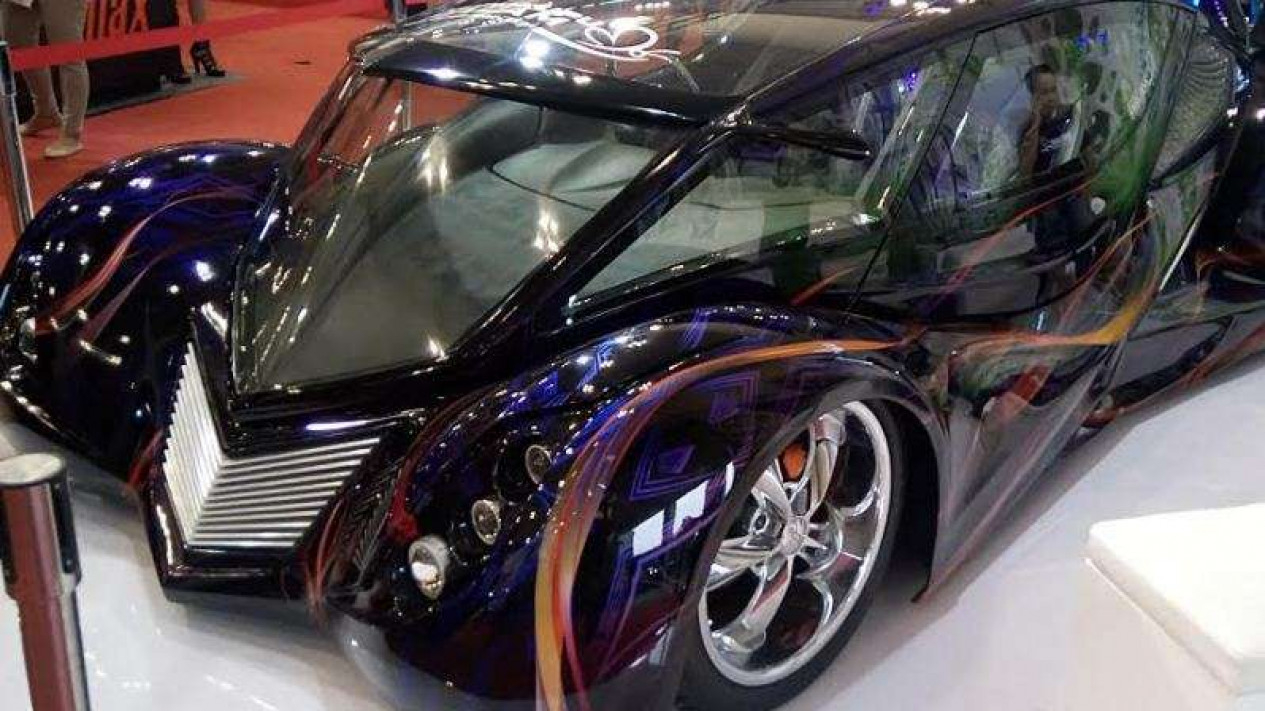
Conscious Engineering- When creativity meets passion, something truly extraordinary can happen—especially in the world of custom cars. Imagine the everyday sedan, usually modest in form and function, transformed into a stunning display of design and innovation. Now add six wheels, scissor doors, and a heart-pounding sound system, and you're no longer imagining. You're looking at reality—a bold creation called Hati Nurani - Walang Kadung.
Hati Nurani - Walang Kadung, an Indonesian six-wheeled custom car at the Indonesia International Auto Show (IIMS) 2015 in Kemayoran Jakarta. (Picture from: Viva.co.id)
Born in the vibrant city of Yogyakarta, Indonesia, Hati Nurani, which translates to "Conscience" in English, is anything but ordinary. It’s a custom-built six-wheeled sedan that challenges conventional automotive design, crafted by the hands of Kupu-Kupu Malam Auto Custom, one of Indonesia’s most respected modification workshops. Built in 2011 and still turning heads today, this unique vehicle is a rolling testament to how art, philosophy, and engineering can come together in a single frame.
Hati Nurani – Walang Kadung was built on a 1951 Chevrolet sedan, with its original chassis retained—though significantly extended to accommodate an additional axle.(Picture from: Viva.co.id)
Led by General Manager Kunto B Wibisono, the Kupu-Kupu Malam team didn’t just aim to modify a car—they wanted to tell a story. According to Kunto, Hati Nurani is rooted in deep personal and cultural values. For them, modifying a car isn’t just about the aesthetics or performance specs; it's about putting soul into steel. And with this project, they’ve done exactly that.
The foundation of this extraordinary machine is a Chevrolet 51 sedan, with its original chassis preserved—though extensively stretched to support an additional axle. Drawing inspiration from nature, specifically the grasshopper (known locally in Javanese as Walang Kadung), the car features striking scissor doors that resemble insect wings in motion. This clever use of biomimicry gives Hati Nurani a uniquely organic yet futuristic character that sets it apart from anything else on the road.
Hati Nurani – Walang Kadung, inspired by nature and specifically the grasshopper (locally known in Javanese as Walang Kadung), features striking scissor doors that mimic the graceful motion of insect wings. (Picture from: OyotPring)
Painted in a sleek black with colorful tribal-style graphics in silver, red, blue, and yellow, the car’s visual impact is undeniable. The paint itself uses a 90 Line Waterbase system, ensuring both depth and durability. The front lights are from Eagle Eyes Projector and Autovision, enhancing its modern look while delivering excellent visibility.
Step inside, and the futuristic impression only deepens. The interior is fully customized with electric seats, a tailor-made gear lever, and uniquely engineered pedals. Every detail reflects thought and craftsmanship. Just in front of the gear shift lies a control panel with buttons for an advanced air suspension system—one for each of the six wheels, offering supreme comfort and control.
Right side view of Hati Nurani - Walang Kadung by Kupu-Kupu Malam Auto Custom.(Picture from: Wartakota)
But perhaps the most jaw-dropping part of Hati Nurani is its sound system. It's not just powerful—it’s almost cinematic. Featuring a 2-DIN DVD system, five Venom monoblock amplifiers, three four-inch Venom amps, four 12-inch and six 10-inch Venom subwoofers, plus a combination of Venom split and coaxial speakers—this car doesn’t just drive, it performs. With 40 small monitors scattered inside and a pair of 7-inch screens, entertainment is everywhere. Add in the dual Venom capacitor banks and you’ve got a mobile concert hall that’s as technically impressive as it is immersive.
Rear side view of Hati Nurani - Walang Kadung by Kupu-Kupu Malam Auto Custom. (Picture from: OyotPring)
Under the hood, the heart of Hati Nurani - Walang Kadung beats strong. A 5,700 cc Chevrolet Small Block engine powers the beast, a popular choice for modifications thanks to its reliability and easily sourced components. It's a machine designed not only for show but also to roar to life when needed.
Building a car like this is no weekend project. It took the Kupu-Kupu Malam team around six months to bring Hati Nurani - Walang Kadung to life. While the exact cost has never been revealed, the result speaks volumes. The car claimed top honors as Champion at the prestigious Djarum Black Autoblackthrough in 2011 and continues to spark admiration and curiosity far beyond Indonesia.
This six-wheeled custom masterpiece, crafted by the renowned Yogyakarta-based workshop, still exists today. While its current location hasn’t been officially disclosed, it was proudly showcased at the 2021 Indonesia International Motor Show (IIMS) Hybrid in Yogyakarta. Years may have passed since its debut, but Hati Nurani - Walang Kadung remains a striking example of what happens when bold vision meets engineering brilliance. It’s more than just a car—it’s a rolling piece of art that dares to dream bigger, drive bolder, and stand louder. Let the ride speak for itself!***[EKA [28082015] | FROM VARIOUS SOURCES | KUPU-KUPU MALAM ON INSTAGRAM | AUTOVISION.CO.ID | VIVA.CO.ID | OYOTPRING ]
Note: This blog can be accessed via your smart phone


 With an NSX as the base, the Yamasa Raggio was born and made its dazzling debut at the 2006 Tokyo Auto Salon. It wasn’t just a display piece, either. This car ran, drove, and handled with surprising poise, even showing up in a promotional video tied to Ridge Racers 2 for the PSP — a fitting blend of real and virtual.


 Still, even if it only popped into our world for a short time, the Yamasa Raggio proved that with the right blend of passion and skill, something once limited to game controllers and pixelated screens could tear across real pavement. It wasn’t just a build — it was a moment. And for those lucky enough to witness it, it’s one that’s hard to forget. *** [EKA | FROM VARIOUS SOURCES | JALOPNIK | GTPLANET | FORUMS.FORZA.NET | OBSCURE SUPERCAR ON X | JAPANESE RACING CARS ON FACEBOOK | RIDGERACER ON REDDIT ]