Racing Rarity - For fans of automotive history, the late 1970s marked an era of bold experimentation and engineering leaps across Europe’s top performance car makers. Ferrari had their flat-12s, Porsche pushed turbocharged innovation, and BMW—long respected for its touring cars—sought to break into the supercar elite with a machine unlike any it had built before. The result was the BMW M1 Procar, a rare and compelling fusion of art, racing pedigree, and groundbreaking design that still turns heads nearly five decades later.
The BMW M1 Procar is a rare and compelling fusion of art, racing pedigree, and groundbreaking design that still turns heads nearly five decades later. (Picture from: BMW-M)
Born out of necessity and ambition, the M1’s story is one of high aspirations and complex collaboration. As BMW Motorsport looked to move past the dominance of its 3.0 CSL in the racing world, the company made a strategic decision: leave behind the familiar front-engine layout and embrace the mid-engine architecture favored by the world’s leading performance marques.
The vision for the BMW M1 Procar was clear—BMW needed something radical in both performance and image, with design by Italian maestro Giorgetto Giugiaro and initial manufacturing handled by Lamborghini. (Picture from: BMW-M)
The vision was clear—BMW needed something radical, both in performance and in image. To bring that vision to life, BMW assembled a dream team. Italian designer Giorgetto Giugiaro, already a legend for his work on the Lotus Esprit and DeLorean DMC-12, was tasked with shaping the M1’s low-slung, aggressive silhouette.
The BMW M1 Procar featured a low-slung, aggressive silhouette and boasted lightweight fiberglass bodywork over a steel space frame. (Picture from: BMW-M)
For the engineering and construction phase, BMW turned to Lamborghini,
who at the time was celebrated for its mid-engine experience with models
like the Miura and Countach. However, the collaboration wasn’t without hiccups. Financial troubles at Lamborghini caused delays and forced BMW to eventually shift production to other suppliers, but the foundation of the car had been laid.
The BMW M1 Procar was powered by a mid-mounted 3.5-liter inline-six engine producing a staggering 470 horsepower with a redline nearing 9,000 rpm, complemented by razor-sharp steering and a five-speed manual transmission that delivered power to the rear wheels with unapologetic brutality. (Picture from: Retromania4ever on X)
With a mid-mounted 3.5-liter inline-six engine producing a staggering 470 horsepower and a redline brushing 9,000 rpm, the M1 Procar was built to dominate the track. It boasted lightweight fiberglass bodywork over a steel space frame, razor-sharp steering, and a five-speed manual transmission that put power to the rear wheels with unapologetic brutality. It sprinted from 0 to 60 mph in just about 4.4 seconds and could reach a top speed nearing 192 mph—a jaw-dropping figure for the era.
The rear section of the BMW M1 Procar was engineered not only for striking aesthetics but also to enhance aerodynamic performance, featuring elements such as a massive rear spoiler that provided increased downforce and improved stability at high speeds. (Picture from: BMW-M)
Yet BMW faced an unexpected challenge: in order to compete in the Group 4 racing class, at least 400 road-going units of the BMW M1 had to be produced for homologation. With the production setbacks, this requirement was slow to meet, risking the M1’s racing future. Rather than let the car’s potential waste away, BMW created their own series—the Procar Championship. Slotted as a support series for Formula One weekends, Procar races saw legendary F1 drivers like Niki Lauda and Nelson Piquet battle it out in identically prepared M1s. It was thrilling, dramatic, and ultimately cemented the M1 Procar as a motorsport icon.
The 1979 BMW M1 Procar received a unique personal touch from Andy Warhol, who painted directly onto the car to capture his vision of speed and motion in every brushstroke.(Picture from: Supercarsnet)
Among the most legendary examples of this model is the M1 Procar painted by Andy Warhol in 1979. Unlike other BMW Art Cars, which were usually painted on scale models and transferred to full-size versions by technicians, Warhol took a more personal approach—he painted directly onto the car, capturing his vision of speed and motion in every brushstroke.
The 1979 BMW M1 Procar painted by Andy Warhol competed in the 24 Hours of Le Mans and finished sixth overall—an impressive feat for a newcomer.(Picture from: Supercarsnet)
That very car raced at the 24 Hours of Le Mans and finished sixth overall, a remarkable result for a newcomer. Today, it remains part of BMW’s private collection, and despite numerous high-value offers, the company has never entertained selling it.
The 1979 BMW M1 Procar was originally destined for competition under the ownership of Vasek Polak, but regulatory changes rendered it ineligible before it could ever debut. (Picture from: MouseMotors)
Another fascinating piece of this story lies with one specific M1 Procar completed by BMW in May of 1979, originally destined for competition under the ownership of Vasek Polak. Unfortunately, regulatory changes made it ineligible before it could properly debut. The car remained preserved for a decade before finding a new owner in 1989.
This 1979 BMW M1 Procar, once owned by Vasek Polak, is believed to be the only remaining example that never saw active racing use—making it a true unicorn among an already rare breed.(Picture from: MouseMotors)
Meticulously maintained, this particular M1 is believed to be the only remaining example that never saw active racing use, making it a unicorn among an already rare breed. In 2021, it changed hands once more and continues to be carefully preserved and enjoyed during private track events. | qw1qD03YbWw |
From its exotic Italian design roots and German engineering excellence to its brief but brilliant racing career and crossover into the art world, the BMW M1 Procar is more than just a car—it’s a symbol of a brand pushing its boundaries at full throttle. In a time when supercars were still finding their identity, the M1 stood out as a rebellious masterpiece. Today, it remains a treasured reminder of when passion, innovation, and just the right amount of risk collided on the racetrack. *** [EKA | FROM VARIOUS SOURCES | BMW-M | BMW-M1-CLUB | SUPERCARS.NET | RMSOTHEBYS | SPORTSCARMARKET | GQ-MAGAZINE | MOUSEMOTORS | RETROMANIA4EVER ON X ]
Note: This blog can be accessed via your smart phone.
Visionary Innovation - In the 1960s, the automotive world was captivated by the allure of bold designs and powerful engines. Amidst this era of grandeur, a quiet revolution was brewing—a movement toward innovation and efficiency that would one day shape the future of transportation. One remarkable outcome of this foresight was the AMC Amitron, a small but mighty electric car created by American Motors Corporation (AMC). Although it never reached mass production, its legacy as a pioneer in electric vehicle design remains a testament to the ingenuity of its creators.
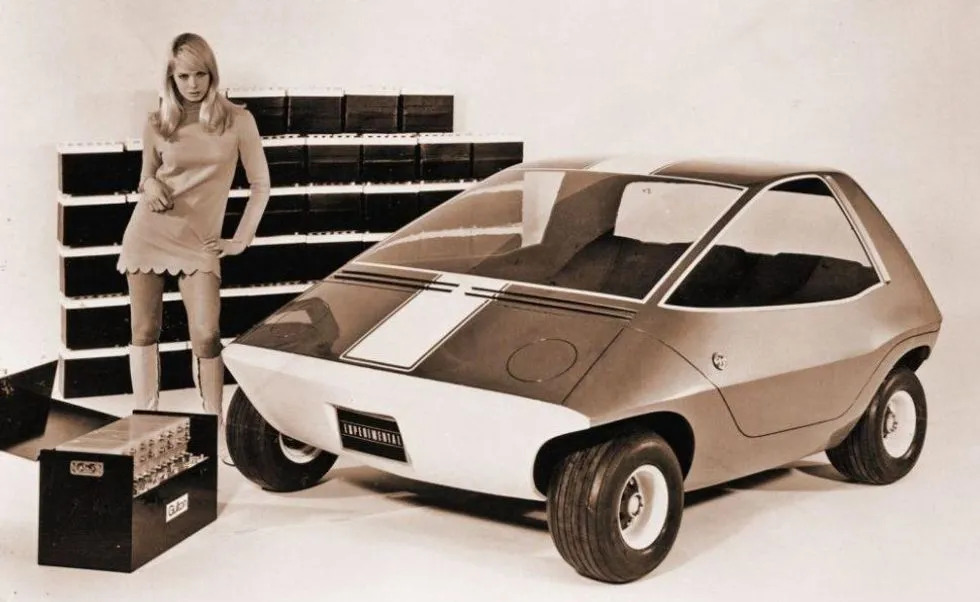
The AMC Amitron was an experimental electric subcompact car built in 1967 by American Motors Corporation (AMC) in collaboration with battery manufacturer Gulton Industries. (Picture from: Noticias.Coches)
The AMC Amitron was introduced in 1967, a direct result of the Electric Vehicle Development Act of 1966 in collaboration with Gulton Industries, which aimed to encourage research into electric vehicles. Unlike its competitors, AMC chose not to retrofit an existing model but instead designed a vehicle from scratch. The Amitron stood out not just for its futuristic concept but for its trailblazing approach to urban mobility. At only 85 inches (2.16 meters) long and weighing a mere 1,100 pounds, the car was a compact marvel, offering efficiency without compromising functionality.
The 1967 AMC Amitron EV concept was a compact marvel, measuring just 85 inches (2.16 meters) in length and weighing only 1,100 lbs, offering efficiency without sacrificing functionality.(Picture from: Wikipedia)
What set the Amitron apart from other vehicles of its time was its bold design and advanced engineering. The polygonal shape and clamshell-style canopy were strikingly unconventional. Unlike traditional doors, the canopy opened upward and backward, giving the vehicle a distinct appearance. Despite its compact size, the Amitron was designed with practicality in mind. The wheels were placed at each corner, maximizing interior space and providing stability. Its near-square footprint allowed three passengers to sit side-by-side in comfort—a feat remarkable for a car shorter than today's Smart car. Even the seats were innovative; they could be deflated when not in use, creating additional storage space.
The AMC Amitron EV concept featured a groundbreaking power system that combined lithium-nickel-fluoride batteries with nickel-cadmium batteries. (Picture from: Hemmings)
Technologically, the Amitron was light-years ahead of its peers. It featured a groundbreaking power system that combined lithium-nickel-fluoride batteries with nickel-cadmium batteries, a configuration that was unheard of at the time. The lithium-nickel-fluoride batteries recharged the nickel-cadmium units while the vehicle was in motion, enhancing its range and efficiency.
The
AMC Amitron EV concept faced insurmountable battery costs and technical
challenges, leading to its cancellation despite plans for a 1972
production model. (Picture from: Noticias.Coches)
Moreover, the Amitron was the first American car to incorporate regenerative braking, a feature now standard in modern electric vehicles. This technology allowed the car to recover energy during braking, further extending its range—a reported 150 miles at speeds of up to 50 mph.
The 1977 rebadged AMC Amitron EV concept, now called the AMC Electron, was updated with rear-view side mirrors. (Picture from: Wikipedia)
Despite its many innovations, the Amitron faced significant challenges that ultimately prevented it from reaching production. The high cost of battery technology and technical hurdles proved insurmountable in the late 1960s. AMC had initially hoped to bring a production model to market by 1972, but these obstacles, combined with limited consumer interest in electric vehicles at the time, led to the project's cancellation.
The Amitron did not disappear entirely. It made a reappearance in 1977 under a new name, the Electron, at the Chicago Auto Show, showcasing a fresh coat of paint and reminding the public of its potential. Its story, however, took an unusual turn when Chuck Mashigan, head of the AMC design studio, decided to preserve the vehicle.
The 1967 AMC Amitron EV concept scale model discovered in a barn alongside its full-sized prototype. (Picture from: AutoEvolution)
Rather than letting it fade into obscurity, Mashigan took the Amitron home, ensuring its survival for decades. The car was eventually passed down to his grandson, Justin, who kept it safe until it found a new home at the Petersen Automotive Museum. Today, the AMC Amitron stands as a symbol of visionary engineering and a reminder of how far electric vehicle technology has come.
The 1967 AMC Amitron Concept electric car was discovered in a barn after Chuck Mashigan, head of AMC's design studio at the time, decided to preserve it in his garage. (Picture from: AutoEvolution)
Currently undergoing a light restoration at the Petersen Museum, it will soon take its rightful place on display, allowing visitors to marvel at this unique piece of automotive history. From its futuristic design to its innovative technology, the Amitron serves as a beacon of creativity and ambition from a time when such ideas were often ahead of their era.
The story of the AMC Amitron is not just about a car but about the power of vision and perseverance. It highlights how daring innovation can leave a lasting impact, even if it doesn't achieve immediate success. For those who see it today, the Amitron is more than just a relic—it is a source of inspiration, a reminder that progress often begins with bold, unconventional ideas. Its legacy continues to fuel the imagination of those dreaming of a sustainable, electrified future. *** [EKA | FROM VARIOUS SOURCES | CLASSICDRIVER | AUTOEVOLUTION | HEMMINGS | NOTICIAS.COCHES | AUTOS.YAHOO | WIKIPEDIA | CARSTYLING.RU ]
Note: This blog can be accessed via your smart phone
Immortal Engineering - In the world of high-performance cars, where speed, design, and emotion blend into mechanical poetry, some machines refuse to fade into the background. Just when we thought we had seen the last of a legend, it makes an unexpected return. The automotive community is once again buzzing, not because of something entirely new, but because a familiar masterpiece has been reborn in a form never seen before. Say hello—again—to the Zonda, now resurrected as the stunningly exclusive Pagani Zonda Unico.
The Pagani Zonda Unico is the latest masterpiece brought to life by Pagani Automobili, crafted for a discerning client and inspired by the majestic Mount Kunlun in China. (Picture from: duPontRegestry)
When Pagani Automobili first unleashed the Zonda in 1999, the automotive world was forever changed. Crafted with an obsession for detail, performance, and artistic beauty, the Zonda became a symbol of what happens when technology and passion collide. Many believed the story of the Zonda had ended when Pagani shifted its focus to newer creations like the Huayra and more recently, the Utopia.
The Pagani Zonda Unico's body is entirely carbon fiber, tinted with a mesmerizing blue hue that glows with energy. (Picture from: Motor1)
But time and again, the Zonda has defied the odds. Somehow, it keeps returning—not as a recycled idea, but as a reimagined marvel. With the debut of the one-of-a-kind Zonda Unico, the phrase "Zonda never dies" has never rung more true. This latest iteration is more than just a throwback; it’s a tribute to enduring excellence and tailored craftsmanship. Commissioned by an exclusive client with a distinct vision inspired by Mount Kunlun—one of China’s most majestic mountain ranges—the Zonda Unico stands as a uniquely personalized expression of automotive artistry.
The Pagani Zonda Unico features exposed carbon elements—from the windshield frame to the mirror caps, and from the headlight surrounds to the intricate vents—that elevate both its aesthetics and performance. (Picture from: Motor1)
Unlike a completely new model, the Unico is a transformation of an existing Zonda chassis, yet the level of customization makes it feel entirely unique. It features aggressive aerodynamic enhancements, including a towering rear wing with its own smaller wing, a central fin that slices through the air, and a dominant roof scoop that amplifies its already commanding presence.
The Pagani Zonda Unico powered by the same AMG-sourced 7.3-liter naturally aspirated V-12 engine found in the Zonda 760 Roadster. (Picture from: duPontRegestry)
Although Pagani has remained quiet about exact performance figures, visual cues speak volumes. The body is entirely carbon fiber, tinted with a mesmerizing blue hue that glows with energy. From the windshield frame to the mirror caps, from the headlight surrounds to the intricate venting, exposed carbon elements enhance both aesthetics and performance. The attention to detail extends to the blue-accented wheels, brake calipers, quad exhausts, and taillight surrounds—every inch a reflection of bespoke excellence.
The Pagani Zonda Unico is a remarkable one-off creation derived from the iconic Zonda lineage, crafted as a single, exclusive unit for a discerning client.(Picture from: duPontRegestry)
Power is expected to come from the same AMG-sourced 7.3-liter naturally aspirated V-12 engine found in the Zonda 760 Roadster, offering up to 760 horsepower. Though interior photos haven’t surfaced, fans can only hope for the inclusion of a classic gated shifter—an homage to old-school driving pleasure. That kind of mechanical rawness is what has always set the Zonda apart from its competitors and even its own successors.
The Pagani Zonda Unico also features an aggressive aerodynamic package, which includes a towering center fin, a prominent roof scoop, and other race-inspired elements that emphasize both form and function. (Picture from: duPontRegestry)
It’s fascinating to observe how the Zonda, despite its age, continues to capture imaginations far more than newer Pagani models. The Huayra, while a technological marvel in its own right, never stirred the same emotional resonance. Perhaps it’s the soulful character of the Zonda, its analog purity in an increasingly digital world, or simply the rarity of each hand-built version that fuels its legacy.
The Pagani Zonda Unico features aggressive aerodynamic enhancements, including a towering rear wing with its own smaller wing. (Picture from: Motor1)
The Zonda Unico isn’t just a car—it’s a declaration that legends don’t retire. They evolve. They adapt. And sometimes, they return in even more extraordinary form. For those who thought they had seen the last chapter of the Zonda saga, this breathtaking creation is a beautiful reminder that some icons are simply timeless. *** [EKA | FROM VARIOUS SOURCES | PAGANIAUTOMOBILI ON INSTAGRAM | MOTOR1 | TOPGEAR | DUPONTREGESTRY ]
Note: This blog can be accessed via your smart phone.
Singular Legend - When talking about legendary supercars that have shaped the future of automotive design, few names shine brighter than Lamborghini. The brand’s relentless pursuit of innovation and performance has led to some of the most breathtaking creations the world has ever seen. One of the most iconic among them is the Lamborghini Miura, a car that not only redefined the supercar category but also paved the way for the mid-engined, two-seater sports car layout that dominates today’s performance market.
The Lamborghini Miura SVR, a car so unique that only a single unit was ever produced. (Picture from: iNews.id)
Barris' Vision - As car enthusiasts, we were immediately captivated when we first saw the aqua blue Corvette recently featured in Myron Vernis' status on X (formerly Twitter). At first glance, it might appear to be a modified version of the experimental 1958 Corvette XP-700 prototype—an iconic car that was never fully produced. However, a closer inspection reveals that this vehicle is much more than just a tribute or replica; it's a one-of-a-kind creation with its own fascinating history, far removed from the original XP-700 design.
This aqua blue Corvette was crafted by one of the leading customizers of the time, George Barris, using a 1958 production model inspired by the experimental 1958 Corvette XP-700 prototype. (Picture from: Myron Vernis's Status on X)
This particular aqua blue Corvette is based on a 1958 production model but underwent a remarkable transformation in the mid-1960s, years after the XP-700 prototype had been dismantled and reimagined as the Corvette Mako Shark I. The customization of this car was commissioned by Accessories International, a California-based company known for its automotive accessories, such as decorative moldings, chrome engine parts, and custom air filter housings. The company acquired a second-hand 1958 Corvette and saw an opportunity to turn it into a display of their products with the help of one of the leading customizers of the time: George Barris.
The customization of this car was commissioned by Accessories International, a California-based company known for its automotive accessories. (Picture from: IDAOffice)
Barris, the founder of Barris Kustoms, was a prominent figure in the world of car customization, known for his ability to transform ordinary vehicles into extraordinary works of art. While his name is most closely associated with the famous Batmobile and other Hollywood car creations, Barris’s work extended far beyond the entertainment industry. His influence in the world of automotive design, especially in the realm of custom vehicles, was immense. And this particular aqua blue Corvette stands as a testament to his artistic vision.
This is the original XP-700 prototype, showcasing a distinct design that sets it apart with the Barris's aqua blue custom Corvette.(Picture from: IDAOffice)
The customization of this Corvette is particularly interesting because it was influenced by the design of the XP-700 prototype, which Barris was familiar with. The XP-700, though never put into production, was an experimental Corvette that had a striking, futuristic design—something that intrigued Barris. For this project, Barris recreated the front end of the car from memory, capturing the distinct oval radiator air intake that was a defining feature of the XP-700. However, he left out certain non-functional elements like the side “gills,” which were more about decoration than performance.
For this project, George Barris recreated the front end of the car from memory, capturing the distinct oval radiator air intake that was a defining feature of the XP-700. (Picture from: VoloMuseum)
Barris didn’t stop at the front end; the rear of the car was also altered to give it a more dynamic and futuristic look. The design elements incorporated here mirrored features that would later be seen on the 1961 and 1962 production Corvettes. But Barris added his own unique twist: small fins at the rear, a feature that had never been seen on a Corvette before. This subtle modification added a touch of originality to the car, making it stand out even more in a world where customization was all about making a bold statement.
The aqua blue Corvette boasts a wooden-rimmed steering wheel and a driver-focused dashboard with well-placed gauges, elevating the driving experience.(Picture from: VoloMuseum)
The car’s modifications were not limited to its bodywork. Barris used various parts from Accessories International to elevate the vehicle's overall aesthetic. For example, the gleaming chrome accents in the engine compartment were not just for show—they were functional, high-quality components that demonstrated the partnership between Barris and the accessories company. Even the steering wheel was customized, sporting a wooden rim—a stark departure from the standard steering wheel on production Corvettes. This small but important touch added a sense of luxury and sophistication to the car’s interior, further showcasing the attention to detail that Barris brought to every project.
This aqua blue Corvette, originally powered by a 283, was upgraded with a 1964 Corvette 327-340 hp engine and enhanced with gleaming chrome accents in the engine bay. (Picture from: VoloMuseum)
Additionally, the transmission lever proudly bore the word “HURST,” referencing a well-known brand that supplied racing equipment. This was a nod to the car’s performance capabilities, adding an element of racing culture to the custom design. Another interesting touch was the handrail in front of the passenger seat, often referred to as a “sissy bar.” While the name might sound unusual, it was a playful addition, adding character to the car and contributing to its unique identity.
The aqua blue Corvette showcases George Barris's unique touch with rear fins, a feature never before seen on a Corvette. (Picture from: VoloMuseum)
What makes this aqua blue Corvette particularly fascinating is how it combines various elements from different sources—some inspired by the XP-700 prototype, others by the later Corvette models—and merges them into a cohesive design that was ahead of its time. The vehicle doesn’t just pay homage to its predecessors; it pushes the boundaries of what a Corvette could look like, blending style, function, and performance in a way that was truly innovative for the 1960s.
The aqua blue Corvette fascinates with its blend of XP-700 prototype elements and later Corvette features, merged into a forward-thinking design. (Picture from: IDAOffice)
While the aqua blue Corvette was ultimately a product of its era, its design feels timeless. The creative work that went into its transformation demonstrates the skill and vision of George Barris, who not only understood the technical aspects of car customization but also had a deep understanding of aesthetics. This Corvette wasn’t just about improving upon an existing model; it was about creating something new, something that stood out in a world where cars were becoming more standardized. Although no video exists for the car discussed above, here’s one featuring the 1963 George Barris Kustom Asteroid Corvette.
Though this car is no longer a regular sight on the streets, its legacy lives on as an example of what happens when creativity and automotive craftsmanship collide. The aqua blue Corvette is a true reflection of the boldness and imagination that defined an era of automotive design. It serves as a reminder that a car is not just a means of transportation—it’s an opportunity for artistic expression, a canvas for customization, and a statement of individuality. This unique vehicle, with its carefully crafted modifications, captures the spirit of automotive innovation and stands as a lasting tribute to the custom car culture that George Barris helped shape. *** [EKA | FROM VARIOUS SOURCES | MYRON VERNIS ON X | IDAOFFICE | CARSWP | VOLOMUSEUM ]
Note: This blog can be accessed via your smart phone
Heritage Reclaimed - In the golden age of motorsports during the 1960s, the sound of roaring engines and the scent of burning rubber were unmistakably linked to Ferrari. The Italian marque dominated world racing circuits with undeniable flair, and it wasn’t just their wins that turned heads—it was the passion and innovation behind each car. From that era of relentless experimentation and bold design came one particularly fascinating chapter: the birth of the Ferrari 275 P2 Speciale, a unique fusion of American vision, Italian craftsmanship, and cinematic inspiration.
1968 Ferrari 275 P2 Speciale designed by Michelotti and was built on the chassis of the 1963 275 P2 race car. (Picture from: Carstyling.ru)
It all began with the groundbreaking Ferrari 250 P, a car that marked Ferrari’s daring shift to mid-engine architecture for its 12-cylinder racing machines. Debuting in 1963, the 250 P didn't take long to make an impression, clinching victories at Sebring, Le Mans, and Nürburgring. This success laid the foundation for its spiritual successor, the Ferrari 275 P2, which carried the legacy forward with its own share of triumphs. Yet from the bones of these champions, another creation would rise—one that stood apart from Ferrari’s usual track-bred machines.
1968 Ferrari 275 P2 Speciale designed by Michelotti based off Bob Peak's sketches on the initiative of Coco Chinetti Jr. (Picture from: Carstyling.ru)
The story of the Ferrari 275 P2 Speciale began with a man named Luigi 'Coco' Chinetti Jr., the son of famed Ferrari importer and ex-racer Luigi Chinetti Sr., who was a longtime associate of Enzo Ferrari. Chinetti Jr. envisioned something different—a Ferrari not only engineered for performance but designed to dazzle American tastes with futuristic elegance. In an era where television and pop culture were shaping consumer dreams, he saw potential in combining racing pedigree with cinematic flair. To bring this vision to life, he reached out to his friend, Robert Peak, a celebrated illustrator known for his iconic movie posters.
The AMT Piranha appeared in several episodes of the 1960s TV series The Man from U.N.C.L.E., serving as the inspiration for the Ferrari 275 P2 Speciale. (Picture from: Cars4Starters)
Inspired by the sleek AMT Piranha Spy Car from the hit TV show The Man from U.N.C.L.E., Peak drafted the concept of a car that would blend fantasy and performance. With a potential buyer already interested—a young woman enamored by futuristic designs—Chinetti Jr. was ready to turn sketches into steel. He and Peak traveled to Milan to pitch the idea to esteemed designer Giovanni Michelotti. But things didn’t go as planned. Michelotti initially refused the project, leaving Chinetti Jr. deeply disappointed. (Please note that the following video features the Ferrari 275 P2, not the Ferrari 275 P2 Speciale.)
Refusing to give up, Chinetti Jr. turned to the one person with enough influence to shift the tide—Enzo Ferrari himself. Through his father’s connections, Chinetti Jr. laid out the vision and the commercial potential of the project. Enzo, ever the patron of bold ideas, lent his support. With Ferrari’s backing, Michelotti agreed to design and build the car, using a damaged 1963 Ferrari 275 P2 (chassis #0812) as the donor. The car had suffered a crash and fire in 1965 but had already made a name for itself with appearances at Le Mans, Nürburgring, and Sebring.
1968 Ferrari 275 P2 Speciale designed by Michelotti was inspired by the design of the AMT Piranha Spy Car. (Picture from: Allcarindex)
From there, a dramatic transformation took place. The chassis was restored, a new engine was installed, and Michelotti sculpted an entirely new body that oozed style and sophistication. Gone were the raw, aggressive lines of a pure race car—replaced instead by a smooth, curvaceous design reminiscent of a high-end grand tourer. Its interior followed suit, offering comfort without compromising Ferrari’s performance DNA. One of its most striking features was a pair of gullwing-style doors, adding to its almost sci-fi appeal.
The authenticity of the Ferrari 275 P2 Speciale was doubted so that Coco Chinetty Jr. was sued in court by Ferrari in 1999. (Picture from: Carstyling.ru)
Beneath the beauty beat the heart of a thoroughbred: a 4.0-liter V12 engine capable of generating 410 horsepower at 8,000 rpm, launching the car to a theoretical top speed of 300 kilometers per hour. This was no mere showpiece—it was a machine that could run with the best of them, with the added charisma of Hollywood imagination.
Only one such car was built at the time, which is part of what makes the Ferrari 275 P2 Speciale so revered today. It stood as a bold concept—a cross-continental collaboration that fused American creativity, Italian engineering, and cinematic glamour into one unforgettable automobile.
1968 Ferrari 275 P2 Speciale designed by Michelotti is powered by a 4-liter V12 engine capable of producing up to 410 hp at 8,000 rpm, theoretically can make the car accelarates up to 300 kph. (Picture from: Carstyling.ru)
Years later, in 1999, the story of this rare creation took another twist. Luigi Chinetti Jr. oversaw the reconstruction of two additional units bearing chassis numbers #0812 and #0814, entrusted to Marco Baldi of Protauto in Italy. However, these efforts sparked controversy as Ferrari themselves questioned the authenticity of the builds, leading to a legal battle.
After a lengthy three-year court process, the verdict came in favor of Chinetti Jr., and the cars were legally recognized as genuine Ferrari vehicles. Eventually, even a third car (chassis #0818) received official recognition from Ferrari, bringing the count of authentic 275 P2 Speciale models to three.


 From its exotic Italian design roots and German engineering excellence to its brief but brilliant racing career and crossover into the art world, the BMW M1 Procar is more than just a car—it’s a symbol of a brand pushing its boundaries at full throttle. In a time when supercars were still finding their identity, the M1 stood out as a rebellious masterpiece. Today, it remains a treasured reminder of when passion, innovation, and just the right amount of risk collided on the racetrack. *** [EKA | FROM VARIOUS SOURCES | BMW-M | BMW-M1-CLUB | SUPERCARS.NET | RMSOTHEBYS | SPORTSCARMARKET | GQ-MAGAZINE | MOUSEMOTORS | RETROMANIA4EVER ON X ]