Real Beast - For those of you who like the smell of rubber friction on the asphalt, you may never be satisfied by the presence only one race car. Among the number of race cars ever produced by the Stuttgart-based car manufacturer Porsche, in our opinion only the Porsche 904 Carrera GTS (short for Gran Turismo Sport) produced in 1964 is worthy of being a symbol of their legendary aesthetic.
The
Porsche 904 Carrera GTS began to be developed in early 1963 was
projected to be a successor of the Porsche 718 model and known as a
design result of Ferdinand Alexander Porsche. (Picture from: Gutxid)
The story begins in the early 1960s, when Porsche began to work on an engine focused on winning races in the FIA GT shortly after withdrawing from Formula One at the end of the 1962 season. As quoted of Wikipedia, the car which began to be developed in early 1963 was projected to be a successor of the Porsche 718 model and known as a design result of Ferdinand Alexander Porsche.
The Porsche 904 Coupé is powered by a 2.0-liter flat-four engine capable of spewing out 170 hp and also known as the RSK (Rennsport = racing, kurz = short), the factory's leading race car. (Picture from: Wikipedia)
In short after successfully going through a series of tests, finally the Porsche 904 entered the production line in 1964 to 1965. Initially, this two-seater race car was powered by a 2.0-liter flat-four engine capable of spewing out 170 hp, in later models, it is also powered by a flat-six and flat-eight 2.0-liter engines.
The Porsche 904/6 is powered by a 2.0-liter flat-six engine and built to satisfy demands in the 1965 as many 40 units. (Picture from: Wikipedia)
These Porsche 904 race cars started roaring in the racing arena at the end of 1963, for the 1964 racing season, and managed to captivate many hearts because in addition to having a capable engine, it is also equipped with a lightweight body of around 1,500 lbs which is made from a combination of several quality materials.
The race car's body is made of fiberglass and built on steel tube chassis that is specifically designed for the GT racing. As it is known that the benefit of using a lightweight body on tube chassis are its ability to refine the torque force and to provide outstanding aerodynamic performance as well so that the car can drive stably at high speeds.
The Porsche 904/8 during training for the 1,000km race at the Nürburgring in 1964. (Picture from: Wikipedia)
So it is not surprising that this car is capable of sprinting at a top speed of 160 mph (257,5 kph), and can accelerate from 0 to 60 mph (96.5 kph) in just 5.3 seconds that's fantastic numbers in the 1960s. Indeed, the speed numbers has become its superiority, which at that time was described as capable of breaking through all storms.
Meanwhile the street-legal version debuted in 1964 in order to comply with group 3 appendix J homologation regulations requiring a certain number of road-going variants be sold by the factory. As the result, at the time Porsche produced one-hundred and six 904s at four or five a day with a price ranging of US $ 7,245 (FOB Stuttgart).
The 1965 Porsche 904 Bergspyder is powered by a 2.0-liter flat-eignt engine and built specially for the European Hill Climb Championship in 1965. (Picture from: Wikipedia)
As mentioned above, the Porsche 904 Carrera GTS was released in four-cylinder, six-cylinder and eight-cylinder engine versions, which in 1964 won the Targa Florio and the FIA GT Championship respectively with engine capacities of less than two liters. The 904 models marked the beginning of a series of Porsche's sportscars that culminated in the dominant 917 models in 1970s.
The Porsche 904/6 was reportedly once owned by actors Robert Redford, Steve Earle and Jim Tidwell had been auctioned by Bonhams in January 2022. (Picture from: Hyperbeast)
At the same time, this car is known as one of the "most beautiful race cars in history" through its beautiful wedge-shaped body. This is the best interpretation of balancing design and performance which includes track performance, and everyday practicality. And during its production period, variants of the 904 model that have been produced by Porsche include the 904 Coupé, 904/6, 904/8, and 904 Bergspyder.
Currently the Porsche 904 Carrera GTS is one of the millions of dollars classic racing cars like one of the 904 cars that was reportedly once owned by actors Robert Redford, Steve Earle and Jim Tidwell had been auctioned by Bonhams in January 2022. As quoted of the Bonhams, this rare 1964 Porsche 904/6 (powered by a flat-six 2-liter engine and original bodywork) is sold for €1,345,500 or US $1,539,117 (approx Rp.22.1 billions) incl. premium.😮 WOW!! *** [EKA [15022022] | FROM VARIOUS SOURCES | WIKIPEDIA | HYPERBEAST | BONHAMS ]
Note: This blog can be accessed via your smart phone
It's GONE Scooters are a new, affordable mode of transportation that quickly gained popularity shortly after the end of World War II. Almost all of mainland Europe and even the world feel the vibration of this scooter trend.
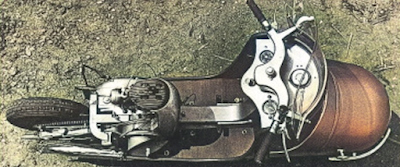
The Neroba Roller attained prototype stage only, and never been produced due to expensive production cost plus the absence of investors who were support the financing. (Picture from: Hannsklemm)
Wilhelm Neuscheler posed along with his Neroba Rollerscooter. (Picture from: Hannsklemm)
When Vespa and Lambretta dominate scooters markets in Europe back in then 1950s to 1960s. So dominant, that two Italian brands are considered to be the legends almost without any competitors. Then what about in Germany?
Apparently this scooter trend is also felt and has attracted the interest of entrepreneurs in those country to produce scooters, which tried to fills a niche that exists in between those two Italian scooter brands, especially for the fulfillment of the domestic scooter market.
The overall design of the Neroba Roller is similar to another classic German scooters at the time. (Picture from: Scooters of Germany Group)
Well, we saw a picture of this scooter that we have never seen before which posted on the Facebook page of the Scooters of Germany Group by Mr. Marco Bohème. We are sure many of you must have never seen this one German scooter. Based on the information we got from the Facebook pages, the scooter was named Neroba Roller whose prototype was designed and built by Wilhelm Neuscheler, an aeronautical engineer in the 1950s.
The Neroba Roller was designed with such a nice backbone construction made of cast aluminum to support the body. (Picture from: Hannsklemm)
According to Mr. Marco Bohème, initially he got this unique scooter information from the old magazine Klassik Motorrad Nr.6 edition of November-December, 2010. Too bad we don't have and get the mentioned old magazine physically, so in the case we only got less information about the Wilhelm Neuschler made scooter virtually through the Facebook's pages and the Hannsklemm sites.
As quoted of Hannsklemm, the Neroba Roller prototype was developed by Wilhelm Neuscheler, when he and his family moved to Rommelsbach shortly after the end of World War II in late 1949 or early 1950. Later to commercialize his designed scooter, he also founded a company named Neroba (short of Neuscheler Rommelsbach).
There's no information regarding the drivetrain of the Neroba Roller scooter, but it looks like the Neroba Roller is powered by a 150cc or 175cc 2-stroke engine. (Picture from: Hannsklemm)
Furthermore, the Neroba Roller is designed with such a nice backbone construction made of cast aluminum to support the body. While viewed of the front, it looks rounded similar to the bullet with a single large headlight. Too bad we also didn't find any information regarding the drivetrain of this scooter, but it looks like the Neroba Roller is powered by a 150cc or 175cc 2-stroke engine.
Uniquely, the German-made scooter has a trunk above the front wheels and some said make it to be hardly to ride. In our opinion it's unlikely, as you can see from the pictures the Neroba Roller's front body is separate from the scooter controller construction. What do you think?
Unfortunately there are none left today, and seems that all of the Neroba Roller scooters are lost with the passage of time. (Picture from: Hannsklemm)
Due to the high production costs, worsened by the absence of investors who were support the financing, at the end this scooter made by Neuscheler never entered the production line. And as written on an article on of the Automarkt trade journal of February, 1954 issue stated that there're only 10 units of the Neroba Roller scooters ready for sale at the time. Unfortunately there are none left today, and seems that all of those Neuscheler-made scooters are lost with the passage of time.😭
And if the article above is still considered inadequate or inaccurate, or if you have additional information related to this marque, please don't hesitate to let us know via the comments column below the article.
Kept spur your adrenaline on the power of two-wheeled monster and stay alive with the true safety riding. May God will forgive Your sins and so does the cops...... *** [EKA | FROM VARIOUS SOURCES | SCOOTERS OF GERMANY GROUP | HANNSKLEMM ]
Made to be Still many automotive manufacturers have big ambitions to build a sports car that can undermine the dominance of the Bugatti Veyron, although it's difficult. However, there's a French automotive manufacturer named Genty Automobile is believed to have all the requirements to become a prominent rival to the super sports car made by Bugatti.
The Akylone supercars by Genty Automobile is shown off as a full scale display model. (Picture from: RareComponentCars)
As reported of Caradvice in 2014, Genty Automobile launched its supercar called the Genty Akylonewhich carries a 4.8 liter V8 twin-turbocharged in-house engine so that it can spit out up to 1,011 hp of power and 1,270 Nm of torque and then all the power would be channeled to the car's rear wheels via a 7-speed sequential transmission.
The preproduction chassis of the Genty Akylone supercars completed with a 4.8 liter V8 twin-turbocharged in-house engine. (Picture from: RareComponentCars)
This car was began to be developed by Genty in early 2010 and was first shown in "virtual form" in 2013, is claimed to be able to accelerate from rest to 100 kph in just 2.7 seconds with a maximum speed of 354 kph, if it true having such performances, the Akylone estimated to be a prominent rival the Bugatti Veyron,McLaren P1 and Ferrari LaFerrari at the time.
The Genty Akylone supercar showing as a CG 3D rendering image. (Picture from: RareComponentCars)
This Genty made car has dimensions of 4,467 mm in length, 2,050 mm in width, 1,115 mm in height, and a wheelbase of 2,780 mm, so the Akylone is believed to have a more aerodynamic performance with a frame that combines parts of the car's body arranged into three parts, ie front, center, and rear.
The Genty Akylone supercar interior in a CG 3D rendering image. (Picture from: RareComponentCars)
Meanwhile, the French-made supercar uses a body built on a composite monoblock chassis that combines carbon fiber and aluminum. So it is not surprising that the weight of the Genty Akylone is very light at only 2,429 lbs (1,101 kg) and the front-rear weight distribution ratio is 42:58. That's near
perfect for a car of this type and should make for sure footed handling.
The Genty Akylone prototype is claimed to be able to accelerate from rest to 100 kph in just 2.7 seconds with a maximum speed of 354 kph. (Picture from: RareComponentCars)
A
major element of the interior is a huge display in the middle of the
dashboard, which is touch-sensitive, and a console behind the steering
wheel that displays information from different driving modes. It is
plush and appears to use high quality materials.
There is no certainty about the price, but what is certain is that the French-made supercar that has a design similar to the McLaren F1 is only produced of 15 units in coupe-styled and 10 units for the roadster type. As qouted of Rarecomponentcars, its estimated price per unit is likely to be in excess of $400,000. Genty is currently in the process of building a preproduction prototype, having shown; virtual images rendered in 3D, a full-size concept model built on a rolling chassis.
Hope this not like many other would-be supercar makes create a big
splash and then vanish into thin air, sometimes resurfacing in a new
guise. The Akylone's most recent public showing was in early 2020, prior
to the Covid 19 pandemic. Recent news has been scant. Still, it will be
interesting to see how this Genty's audacious endeavor be appears. Stay
tuned and wait further news (if there's any).😊 *** [EKA | FROM VARIOUS SOURCES | GENTY AUTOMOBILE | CARADVICE | MOTORAUTHORITY | RARECOMPONENTCARS | TOPSPEED ]
War Machine The World War II that occurred from 1939 to 1945 cannot be denied anymore that's one of the darkest parts in the history of mankind that has drained a lot of blood and tears. But on the other hand, it seemed during the war period, as if it became a stage for each other to show off the superiority of technology applied to various supporting equipments for their soldiers on the battlefield, including motorized vehicles.
The Indian 841 in its original military trim was produced by Indian Motorcycle during 1942 to 1943 for the US Army. (Picture from: Silodrome)
For example, when the BMW R71 motorcycles used by the Axis alliance-forces especially the Nazi German army, proved to be very tough and reliable in supporting the mobility of its troops on various mission operations in the desert so it was not surprising that in early 1941, the German's R71 was touted as ruler of the desert and overpowered the vehicles used by the Allied Forces.
The Indian 841 after sold and owned by civilian with yellow-white patterns all over the body, and some leather ornaments decorated with tassels on the edges far out of the military props feels. (Picture from: Silodrome)
How come? Because its twin boxer engines stays cool even the motorcycle used in hot weather thanks to the exposed head, while the drive shaft is never dirty with sand so that the R71 can run smoothly in the desert.
Of course this worried their opponent, especially the United States. Even though at the beginning of 1941, the United States had not directly involved in World War II, they had supplied various war equipment for the Allied Forces. In short, then the US Army gave the challenges to several major American motorcycle makers such Harley-Davidson and Indian Motorcycle to develop a motorcycle that could match the enemy's mainstay R71.
The Indian 841 used a simple girder fork for the front suspension and there were plungers on the back. (Picture from: Silodrome)
Shortly after that, HD introduced the Harley-Davidson XA model in 1942 although in appearance similar to its predecessor Harley-Davidson WLA model, the engine was the same as the BMW R71, which both used a twin boxer engine complete with axle drive.
However, Indian Motorcycle takes a different and more unique approach. They designed a new 90-degree V-twin engine, using the same head as the Scout model. The compression ratio is reduced to 5.1 to 1 so it can run on lower quality fuels.
The Indian 841 is featured with unusual longitudinal V-twin has its head out in the airflow for better cooling. (Picture from: Silodrome)
The Indian Motorcycle made engine was sat not longitudinally within the frame of the motorcycle, but in a transverse configuration, like the Moto Guzzi or Honda CX500, allowing the cylinders to protrude in the open, so it getting the same cooling benefits as the BMW R71, and also makes shaft drive easy to implement because the crankshaft is already rotating in the correct orientation.
As a result, this motorcycle then given the name of Indian 841, the name that for some people called was less special for a motorcycle made by Indian Motorcycle. Then the US Army commissioned the motor maker to produce 1,000 units of this motorcycle during 1942 to 1943 and tested it extensively along with the Harley-Davidson XA.
The
Indian is powered by a 737 cc 90º V-twin air-cooled engine with the
power was just 25 bhp and it was fed back through a four-speed gearbox
to the shaft drive. (Picture from: Silodrome)
Although in the end, the US Army did not adopt both motorcycle models as their official military vehicle. It could be said that the top brass of the American military at that time is like a man is amazed to the enemy's grass yard seen greener than in their own yard. Although in the end, they choose the typical HD WLA production motorcycle of efficiency and financial factors. And the remaining unused Indian 841 units were sold to civilian consumers.
Since the beginning it was developed by Indian Motorcycle which was not developed for general use (although in the end it had to be). Because they really wanted a pretty cool ride like this Indian 841 to be used by Captain America to hit the German Nazi soldiers and could be said that it's a unique two-wheeled vehicle prototype of the US military for special mission in the desert.
The
Indian 841 has a weight of 528 lbs (240 kgs) when ready to ride, and as
such it did suffer a little from insufficient power though this could
be largely remedied by increasing the compression ratio. (Picture from: Silodrome)
It could be a stark contrast to the Indian 841 motorcycle unit is featured in this article and also auctioned at Mecum at the end of April, 2021. As you can see, this unique motorbike looks very flamboyant, with yellow-white patterns all over the body, and some leather ornaments decorated with tassels on the edges far out of the military props feels. How did it happen?
Because after being sold to civilians, usually the new owners then repainted with various colors and decorated their motorbikes with various accessories, like other Indian motorcycles at that time. That's roughly how this former US Army vehicle gets a distinctive appearance. So no wonder if you probably won't be able to guess if you just look at the appearance.
Kept spur your adrenaline on the power of the two-wheeled monster and
stay alive with true safety riding. May God will forgive Your sins and
so does the cops...... ***[EKA | FROM VARIOUS SOURCES | ID.MOTOR1 | MECUM | SILODROME ]
Note: This blog can be accessed via your smart phone.
Mega Flying Today a superyacht sailed away in the ocean might sound normal. However, what if there's anyone who made a superyacht that can sail on water but also could be flied in the air? This kind of yacht going to be realized by a design company based in Rome, Italy called Lazzarini Design Studio. Well, the Italian company made the design of all-new mega yacht concept capable to sail on the ocean and could be flied on the sky as well.
New luxury mega Air Yacht concept designed by Lazzarini Design Studio to fly rather than sail thanks to two large airships. (Picture from: UK Time News)
This Lazzarini-designed unique vehicle is called Air Yacht and is said specially for private owners whose carried a vision of the evolution of the mega yacht / aviation and is not intended for tourist or public transportation purposes.
The Air Yacht concept consists of twin fuselages that look like Zeppelin airship filled of
400,000 cubic meters of compressed helium and special main structure in the middle, is driven by eight rotating
electric motors opposite with the power supplied by the ultralight
batteries and solar panels. (Picture from: BlackXperience)
According to Lazzarini, this cruise ship will have a carbon fiber structure and a length of 150 m (492 feet) and width of 80 m (262 feet). This unique mega yacht is driven by eight rotating electric motors
opposite with the power supplied by the ultralight batteries and solar
panels.
New luxury mega Air Yacht concept designed by Lazzarini Design Studio has a total length of 150 meters, with a width of 80 meters. (Picture from: UK Time News)
As quoted of the UK Time News, the Air Yacht concept of Lazzarini consists of twin fuselages that look like Zeppelin airship filled of 400,000 cubic meters of compressed helium and special main structure in the middle, which offers a 360° view.
New luxury mega Air Yacht concept designed by Lazzarini
Design Studio has five passenger suites available on each airship and a special main structure in middle for the 'shipowner suite,' which offers a 360° view. (Picture from: UK Time News)
The two enermous air ballons are connected to the main central structure through four carbon decks on each side that passengers can move between different areas on the airship. For the master suite based on the main central structure, which is around 78 meters. There is also a spacious living room with a dining room and swimming pool.
There is also a spacious living room with a dining room and swimming pool inside of the Air Yacht concept of Lazzarini Design Studio. (Picture from: BlackXperience)
This luxury water yacht is able to carry up to 22 passengers. Mega Yacht this fly has 10 cabins for passengers, five on each plane, plus a ship owner suite in the middle area, which offers 360 degree views. There is also a possibility for this yacht using helipad, with this into additional options.
There is also a spacious living room with a dining room and swimming pool inside of the Air Yacht concept of Lazzarini Design Studio. (Picture from: BlackXperience)
The Air Yacht can fly at a maximum speed of about 60 knots (69 mph / 111 kph) for more than 48 hours with zero emission and also sail on the ocean at a speed of 5 knots (5.7 mph / 9 kph). When a water landing is necessary, Lazzarini said, that the airship is pushed down by the rotation of the engines and can stay in the water thanks to depressurization of the helium and ballast anchoring system.
Currently the Air Yacht is just a unique concept of future vehicles made by Lazzarini Design Studio that offer many other portfolios, such as cruise ship projects, automotive, and aerospace. Might still fresh in your memory one of them such the Lazzarini One electric-powered supercar concept specially for the rich in you.
If there are any buyers or investors, Lazzarini is targeting to build this super unique airship and collect helium within five years. However, every potential customers must have a ton of money because the price is estimated to be very fantastic, ie around US $ 621 million (Rp. 8.9 trillion). Even now the Italian company already has much larger version called the Air Yacth V.2. We're really speechless and amazed.😲 *** [EKA | FROM VARIOUS SOURCES | LAZZARINI DESIGN STUDIO | UKTIMENEWS ]
Mysterious Taifun - The internet is full of surprises, and every once in a while, it reveals something that sparks both curiosity and wonder. One such discovery came from a former Twitter or X post by Quirky Rides and an article published by Hemmings in June 2018, showcasing a peculiar classic car that had long been forgotten by many. This car was none other than the Haller Taifun, a one-of-a-kind creation from Germany, crafted in 1952 by Rudolph Haller, an aircraft and speedboat builder based in Munich.
This
was a unique-shaped German custom car named Haller Taifun designed by
Rudolph Haller, an airplane and speedboat builder in Munich, likely was
built based on Porsche 356. (Picture from: ClassicGasolene)
The story of the Haller Taifun begins with its inspiration, rooted in both aviation and automotive design. As documented in the 1953 Trend Book Dream Cars, Haller built this ultrastreamlined sports sedan using components from the Porsche 356, along with parts from Volkswagen. Its unusual appearance made it stand out immediately, especially the front end, which resembled a bullet. When we look at photos of the car, we can see a slight resemblance to the Wikov 35 Kapka, a streamlined car produced by the Czechoslovakian company Wikov in 1931. However, the Haller Taifun had a more refined and practical design compared to the Wikov model, especially for its time.
The Haller Taifun is powered by a supercharged 40 hp Porsche's engine and said to be capable of more than 125 mph.(Picture from: Autopuzzles)
The rear of the car is equally fascinating, with its fender design embodying the ultimate in 1950s fin styling. The four exhaust pipes at the back added to its futuristic rocket-like appearance. Inside, the car was as unique as its exterior. According to SpeedAge magazine in its July 1952 edition, the interior featured a built-in bar and an astonishing number of gauges—nearly 20 of them—spanning across the dashboard. It’s easy to wonder what the driver would do with so many gauges, as they likely served both functional and decorative purposes, creating a cockpit-like feel.
The Haller Taifun car's front end seem a kind of a bullet, and also had some slight similarity to the 1931 Wikov 35 'Kapka' streamlined classic car. (Picture from: Auta5p.eu)
Under the hood, the Haller Taifun was equipped with a supercharged 40-horsepower Porsche engine, capable of reaching speeds over 125 mph. This was quite impressive for a car built in the early 1950s. However, as with many rare and custom cars, the Haller Taifun eventually disappeared from the public eye. For years, there were no reports or sightings of the car, until it resurfaced in a rather unexpected place—the United States.
The Haller Taifun's rear fenders providing the ultimate in the current fin styling with four exhaust pipes provide a rocket-ship effect in the rear. (Picture from: ClassicGasolene)
By the late 1950s or early 1960s, the Haller Taifun was reportedly seen on display at Pappy's Motor Sales on Livernois Avenue in Detroit. The car was used to draw attention to the dealership, with its striking design catching the eye of potential customers. Yet, how this car made its way across the Atlantic remains a mystery.
The Haller Taifun seen on display at the Pappy's Motor Sales on Livernois Avenue in Detroit to attract customer's attention in the late 1950s or early 1960s. (Picture from: Customrodder)
Some believe that post-war Germany saw several coachbuilders creating custom cars to appeal to American soldiers stationed there. It's possible that one such soldier, captivated by the futuristic design of the Haller Taifun, brought the car back to the U.S. after completing their service. This could explain why the car bears similarities to the Studebaker - Buick LeSabre, as the soldier may have been influenced by American automotive styles before bringing this unique vehicle home.
The Haller Taifun seen on display at the Pappy's Motor Sales on Livernois Avenue in Detroit to attract customer's attention in the late 1950s or early 1960s. (Picture from: Customrodder)
Despite the theories, the true fate of the Haller Taifun remains unknown. For a car this distinctive, it seems unlikely that it would simply vanish without a trace for nearly seventy years. Yet, until further documentation or reports surface, the mystery endures. Could it have been scrapped, or is it hidden away in a private collection, waiting to be rediscovered? The questions remain, and for now, the Haller Taifun exists only in stories and old photographs, leaving enthusiasts and historians alike to wonder what really happened to this unique piece of automotive history. *** [EKA [10020222] | FROM VARIOUS SORCES | CUSTOMRODDER | QUIRKYRIDES | CLASSICGASOLENE | HEMMINGS | BNPPARSITE | WEIRDWHEELS | ARTOFIT.ORG | GOOGLE BOOK (POPULAR MECHANIC) ]
Note: This blog can be accessed via your smart phone.


 Currently the Porsche 904 Carrera GTS is one of the millions of dollars classic racing cars like one of the 904 cars that was reportedly once owned by actors Robert Redford, Steve Earle and Jim Tidwell had been auctioned by Bonhams in January 2022. As quoted of the Bonhams, this rare 1964 Porsche 904/6 (powered by a flat-six 2-liter engine and original bodywork) is sold for €1,345,500 or US $1,539,117 (approx Rp.22.1 billions) incl. premium.😮 WOW!! *** [EKA [15022022] | FROM VARIOUS SOURCES | WIKIPEDIA | HYPERBEAST | BONHAMS ]