Visionary Metal - In a world where automotive design is now driven by software updates, touchscreen dashboards, and autonomous capabilities, it’s easy to forget there was a time when innovation meant bending metal into visions of the future. Long before sleek EVs roamed the streets and luxury meant connectivity, Chrysler had already laid the foundation for what a car could be—not just as transportation, but as an art form, a statement, and a glimpse into tomorrow. One car from the past still echoes with that same futuristic spirit: the 1941 Chrysler Thunderbolt.
The 1941 Chrysler Thunderbolt stood apart not just for its striking design but as a rolling vision board—an experimental marvel that redefined what was possible in the automotive world.(Picture from: MoparInsiders)
Crafted during an era when America was immersed in the elegance of the Art Deco movement, the Thunderbolt stood apart not just for its looks, but for what it represented. It wasn’t a mass-production vehicle, and it never pretended to be. Instead, it was a rolling vision board—an experimental marvel that redefined what was possible for the automotive world. Chrysler called it the “car of tomorrow,” and even today, that doesn’t feel like an overstatement.
Chrysler called the 1941 Thunderbolt the “car of tomorrow,” and even today, that hardly feels like an overstatement. (Picture from: Carstyling.ru)
Its most eye-catching feature? A fully retractable, all-metal hardtop that vanished at the touch of a button. In 1941, that level of electric automation felt like pure magic. The design came from Ralph Roberts and Alex Tremulis, with construction handled by the Briggs Body Works Company. This innovative roof made the ThunderboltAmerica’s very first hardtop convertible—free from the bulky mechanisms or canvas hassles that usually came with convertibles of the time. One switch, one seamless motion, and the roof disappeared like a magician’s trick. The trade-off? Just a single bench seat, since the roof’s housing took up most of the trunk space—but the futuristic impact was well worth it.
The 1941 Chrysler Thunderbolt featured a fully retractable, all-metal hardtop—designed by Ralph Roberts and Alex Tremulis—that vanished at the touch of a button, a feat of electric automation that felt like pure magic in 1941. (Picture from: MoparInsiders)
The body design was another bold step forward. Gone was the traditional grille. In its place, a smooth, streamlined front with hidden air intakes tucked beneath a minimalist bumper. The car looked less like something from the assembly lines of Detroit and more like it had landed from a retro-futuristic dream. With aluminum panels sculpted by LeBaron under the careful eye of Roberts and designer Alex Tremulis—who would later bring the iconic Tucker 48 to life—the Thunderbolt’s form flowed like water. Wheel skirts fully enclosed the tires, and the headlights remained invisible until switched on, preserving the car’s smooth silhouette.
The 1941 Chrysler Thunderbolt boasted a forward-thinking interior featuring electric windows, push-button doors, a Lucite-lit dashboard, and refined materials like polished aluminum, rich leather, and Bedford cord throughout. (Picture from: MoparInsiders)
Underneath all that visual drama was serious performance. Riding on a modified 1940 Chrysler Crown Imperial chassis, the Thunderbolt was powered by a 5.3-liter straight-eight engine pumping out around 140 horsepower. It could cruise beyond 100 mph, which was impressive even by today’s standards for a luxury concept. But speed was only part of the equation. Inside, it was a showcase of technology and luxury working in perfect harmony.
The 1941 Chrysler Thunderbolt packed a 5.3-liter straight-eight engine with around 140 horsepower, capable of cruising past 100 mph—impressive even today. (Picture from: MoparInsiders)
From electric windows to push-button doors, and a Lucite-lit dashboard that seemed ripped from a sci-fi comic book, the interior was a masterclass in forward-thinking design. Materials like polished aluminum, rich leather, and Bedford cord wrapped around every surface. Chrysler even installed Fluid Drive, its semi-automatic transmission system, with an optional overdrive unit—proof that the brand wasn't just interested in looking futuristic but driving like it, too.
Front three-quarter view of another one of the five 1941 Chrysler Thunderbolts, finished in green with a copper top, copper trim, and a green interior. (Picture from: Hemmings)
Only five Thunderbolts were ever completed—each painted differently and hand-built to perfection. They weren’t for sale; they were for inspiration. Sent across the country on tours, these machines stopped traffic and packed showrooms. At a dealership in Sacramento, over 8,500 people came to see it. In Denver, 29,000 braved snow and hail just for a glimpse. These weren’t just curious onlookers—they were dreamers being introduced to a new kind of car.
Rear three-quarter view of another one of the five 1941 Chrysler Thunderbolts, finished in green with the top, side trims, and bumper painted in copper.(Picture from: Hemmings)
Though it never reached production, the Thunderbolt didn’t need to. Its mission wasn’t to fill garages but to ignite imaginations. As Chrysler faced an uncertain wartime future, this one-off marvel reminded the world that Detroit was still brimming with ideas, creativity, and courage.
Today, even as Chrysler marks over a century of innovation, the Thunderbolt remains one of its brightest stars—a rare blend of beauty, brains, and bravery. It wasn’t built to be practical. It was built to be remembered. And more than 80 years later, it still is. *** [EKA | FROM VARIOUS SOURCES | MOPARINSIDERS | HEMMINGS | CARSTYLING.RU ]
Note: This blog can be accessed via your smart phone.
Electric Foreshadowing - In an era when tailfins and V8 engines dominated American roads, the idea of a small electric car seemed more like science fiction than an industry goal. Yet within the design studios of Ford in the early 1960s, there were hints—subtle, easily overlooked—that some minds were already drifting toward a different kind of future. Among those whispers of change stood the Astrion, a concept cloaked in mystery and layered intention.
The Ford Astrion Concept's proportions suggested performance; and its styling hinted at a sleeker evolution of the Thunderbird.(Picture from: Hemmings)
At first glance, the Ford Astrion didn’t scream “electric.” Its proportions suggested performance; its styling hinted at a sleeker evolution of the Thunderbird. The sharp haunches, formal roofline, and sculpted sides looked like they belonged to a grand touring coupe. But behind that stylish exterior, a second, lesser-known chapter adds new depth to the story.
The
Ford Astrion Concept features sharp haunches, formal roofline, and
sculpted sides looked like they belonged to a grand touring coupe.(Picture from: Hemmings)
After the completion of the 1961 Lincoln Continental project, Ford's Roy Lunn initiated a small, internal experiment. He approached the Styling department to develop a compact electric vehicle—an idea radically ahead of its time.
Behind the stylish exterior of the Ford Astrion Concept lies a lesser-known chapter that adds depth to Ford’s earliest visions of a personal, possibly electric future—shaped not by specs or features, but by form, emotion, and the freedom to dream.(Picture from: Hemmings)
Under the guidance of Elwood Engel, the project was assigned to designers Colin Neale and Alex Tremulis, with Gale Halderman supervising. What followed was an unusual and clever design exercise: the team sculpted a single clay model and split it down the middle. Neale designed one half, calling it the Firefly, while Tremulis and Halderman shaped the other. | 9r7wy1k97oo |
Both sides were compelling enough to move forward. The designs were cast in fiberglass, and a prototype was created—outfitted with a small electric motor and battery. Initially called the Astrion, the tiny car was later renamed the Hummingbird. Despite its top speed of just five miles per hour, the Hummingbird served a memorable role: ferrying Bill Ford across the cobblestone courtyard at Ford’s facilities.
This might have been the Hummingbird, a compact vehicle—possibly envisioned as an EV—initiated by Roy Lunn after the 1961 Lincoln Continental project as a quiet internal experiment within Ford’s Styling department. (Picture from: Concept Cars & More on Facebook)
What makes this especially interesting is the name “Astrion” itself. While the sleek coupe and the electric Hummingbird appear unrelated in form, they may share something deeper—an origin rooted in imagination rather than production intent. The name might not have been model-specific, but rather an internal label passed around to represent bold, experimental thinking. In this light, the Astrion becomes more than a mystery car; it becomes a symbol of Ford’s willingness to explore what came next.
Roy Lunn’s team crafted a single clay model, splitting it down the middle—Neale designed one side, naming it the Firefly, while Tremulis and Halderman shaped the other. (Picture from: Concept Cars & More on Facebook)
Looking back, the Astrion’s story straddles two very different interpretations. One is sculptural and expressive—a design vision that may have flirted with Thunderbird lineage. The other is technical and humble—a quiet electric prototype made not for showrooms, but for curiosity’s sake. Both are valuable. And the coincidence of them sharing a name may not be a coincidence at all.
Furthermore, the designs were cast in fiberglass, and a prototype was built—equipped with a small electric motor and battery.
(Picture from: Hemmings)
So while the automotive world looks back at the Astrion and wonders whether it was a sporty Thunderbird offshoot or just another unused design, maybe it’s worth looking at it differently. Maybe the Astrion was one of Ford’s earliest visualizations of what a personal, possibly electric vehicle of the future might look like—not through the lens of specs or features, but through form, feeling, and the freedom to dream.
The
electric Hummingbird, though seemingly unrelated in form to the sleek
Astrion coupe, may share a deeper origin rooted in imagination over
intent. (Picture from: Hemmings)
And if that's the case, then the Astrion was never "just a concept car." It was the start of a conversation Ford designers would keep having—quietly at first, then loudly, decades later—about how we move forward, and what it means to drive tomorrow. *** [EKA | FROM VARIOUS SOURCES | HEMMINGS | EN.WHEELAGE.ORG | CONCEPT CARS & MORE ON FACEBOOK ]
Note: This blog can be accessed via your smart phone.
Futuristic RIDES - In the realm of extraterrestrial fascination, flying saucers often spark thoughts of encounters with aliens and UFO mysteries. However, not all saucers are bound for outer space; some find their origins right here on Earth, crafted by human ingenuity. This unlikely association between terrestrial design and celestial speculation is evident in various automotive creations, challenging the conventional narrative of unidentified flying objects.
The
Renault Reinastella flying saucer concept, a result of the French
automaker's partnership with Euro Disney in 1992, emerged as a
distinctive creation. (Picture from: lAutomobileAncienne)
In the automotive world, renowned designers like Alex Tremulis ventured into uncharted territory, conceptualizing flying saucer designs. This trend extended beyond the drafting board, with manufacturers materializing these imaginative ideas into real, tangible forms. Examples include the 1953 Alfa Romeo 1900 C52 Disco Volante, the futuristic 1958 Ford X-2000, the gyroscopic wonder of 1967 Gyro-X, and the contemporary 2016 Alfa Romeo Disco Volante Spyder, each defying expectations.
The Reinastella name of 1992 Renault's flying saucer originated to the classic luxury car model, Renault Reinastella, dating back to early of 1930s. (Picture from: Secret-Classic)
Yet, amidst these earthly endeavors, there exists an intriguing anomaly—a flying saucer not confined on wheels. Renault, the famed French automotive manufacturer, ventured into uncharted skies in the early 1990s. Known for its conceptual prowess, Renault's partnership with Euro Disney in 1992 led to the creation of a flying saucer projecting into the distant future, the Renault Reinastella, named after a luxurious Renault classic model from early of the 1930s.
The
Renault Reinastella, enveloped in innovative dermotylene and infused
with avant-garde biomechanics, surpassed the notion of a mere vehicle. (Picture from: Proektor)
Crafted with avant-garde biomechanics and coated in the innovative synthetic material dermotylene, the Reinastella was envisioned as more than a mere vehicle. Propelled by a bio-organic engine fueled by 'plasmelf' fluid, it transcended conventional transportation, almost resembling a living organism. Operating 15 cm above the ground at 50 kph or soaring at 150 m and 300 kph, the Reinastella adapted its architecture for optimal aerodynamics during flight.
The Renault Reinastella, an airborne marvel, epitomized futuristic luxury travel for five passengers controlled by voice commands.. (Picture from: Auto-Moto)
Silently transporting five passengers through voice commands, this airborne marvel represented the epitome of luxury in futuristic travel. Access to its passenger compartment is from below through an open hatch, not from above, as the bubble remains closed.
Access to the Reinastella's passenger compartment is from below through an open hatch, not from above, as the bubble remains closed. (Picture from: Auto-Moto)
Two examples were constructed and showcased on telescopic masts during Renault's partnership with Disneyland Paris. After the event, these futuristic saucers joined the Renault Classic Collection, destined to await their sale - scheduled a whopping 305 years into the future.😮
While
the Renault Reinastella may not soar through the skies, it invites us
to envision a future where innovation defies the limits of logic and
propels us into uncharted realms. (Picture from: Auto-Moto)
Today, the Reinastella may be considered an 'Identified Flying Object' or IFO, as it remains grounded. Despite its earthly tethering, it serves as a captivating decorative testament to Renault's imaginative prowess. A glimpse into a future more than a century away, this 'IFO' prompts us to keep dreaming, pushing boundaries, and contemplating the unimaginable.
OLD But NEW - In the vibrant 1950s, American magazines brimmed with illustrations depicting futuristic cars and space vehicles envisioned for the late 20th century. During this era, automotive manufacturers engaged in a fierce competition to transform these visionary designs into tangible, awe-inspiring vehicles, showcasing them at prestigious car shows.
1958 Ford X-2000 concept car. (Picture from: OldCarConcepts)
Among these ambitious concepts was the Ford X-2000, a distinctive creation conceived by the minds of Bill Balla and Alex Tremulis in 1958. Notably, Tremulis had gained acclaim for his involvement in the iconic Tucker automobile style. Although the Ford X-2000 progressed from sketches to scale models, it never materialized into a production-ready vehicle.
Front three-quarter of the 1958 Ford X-2000 concept car. (Picture from: OldCarConcepts)
One of the most striking features of the Ford X-2000 was its unconventional front end, a departure from the norms of 1958 automotive design. The grille and hood drew inspiration from the 1957 Ford Edsel, a vehicle notorious for causing significant financial losses to its parent company due to escalating production costs.
Front view of the 1958 Ford X-2000 concept car. (Picture from: OldCarConcepts)
The exterior design of the X-2000 raised eyebrows, with the vertical oval motifs earning it nicknames like "egg on the horns,""horse collars," and even "collision rings." These monikers, often sarcastic and bordering on rudeness, reflected the public's mixed reception to the avant-garde design.
Interior view of the 1958 Ford X-2000 concept car. (Picture from: OtoBlitz)
Despite the controversy surrounding its appearance, the interior of the concept car resembled the futuristic vehicles featured in sci-fi series like The Jetsons. The rear, in particular, sported the iconic 'yank tank' characteristic of 1950s cars, complemented by Rocket-style taillights.
Left side view of the 1958 Ford X-2000 concept car. (Picture from: OldCarConcepts)
Initially confined to the realm of scale models, the Ford X-2000 found renewed interest in 1994 when British automotive enthusiast Andy Saunders discovered it in the book "Dream Cars"(JR Picard, 1981). Undeterred by the challenges, Saunders embarked on the seemingly impossible mission to bring this dream car to life, basing his creation on the 1962 Mercury. Recalling his expertise in resurrecting distinct automobiles, including the 1957 Aurora Safety Car, 1984 Citroën Indecision 2, and numerous others.
The outcome was nothing short of extraordinary, capturing the attention of classic car enthusiasts and the automotive media alike. The Ford X-2000 Concept, crafted by Andy Saunders, became a star attraction at numerous automotive exhibitions, captivating audiences with its blend of retro-futuristic design and meticulous craftsmanship. *** [EKA [25112019] | FROM VARIOUS SOURCES | ANDI SAUNDERS | OLDCARCONCEPTS]
Note: This blog can be accessed via your smart phone.
Forgotten ONES - In the early days of automotive design and manufacturing, before the advanced technology we have today, car stylists and designers often relied on scale models to bring their visions to life. These models served as a tangible representation of their designs, allowing them to be examined, refined, and shared with other designers, consumers, and potential investors.
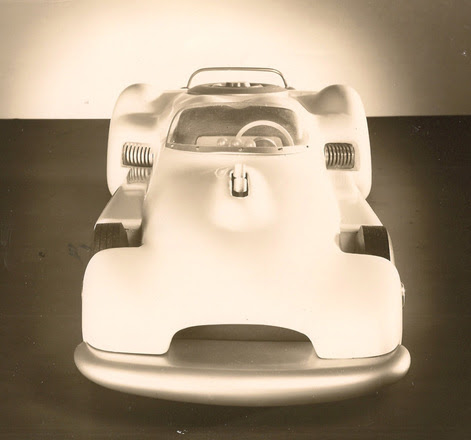
The 1951 final result of The Tucker-Tremulis-Neidlinger-Kaiser-Frazer sports car model with the newly built removeable hardtop and enclosed front fender, including a fresh new paint job. (Picture from: GyronautX1)
However, these models were typically just a preliminary step in the development process. As final designs evolved, the fate of these original models varied from becoming interesting paperweights to being dismantled for other projects. This pattern can be observed in numerous automotive projects, including the likes of the Ford Thunderbird Mexico, Ford Muroc, Ford Seattle-ite XXI, Pontiac Club de Mer, and many others.
The 1951 final result of The Tucker-Tremulis-Neidlinger-Kaiser-Frazer sports car model with the newly built removeable hardtop and enclosed front fender, including a fresh new paint job. (Picture from: GyronautX1)
One noteworthy automotive designer who embraced the use of scale models was Alex Tremulis. What sets his sports car models apart is that they served as a wellspring of design inspiration for several prominent car companies throughout the years. This journey began with the Tucker Corporation and culminated with Kaiser-Frazer, as these models took on a life of their own, transcending their original purpose.
Alex Tremulis, Chief Stylist for Tucker, examines wooden car miniatures used in developing styling for Tucker cars. (Picture from: GyronautX1)
As we delve into the story of Alex Tremulis' sports car models, we will uncover their role in pushing the boundaries of streamlining and aerodynamics. The genesis of this sports car concept can be traced back to Tucker. In a 1948 issue of Tucker Topics, a dealer magazine from the Tucker Corporation, there's a captivating photograph featuring Alex Tremulis alongside the Tucker 48 production model and a sports car model that appears to be in the early stages of development, prior to receiving its finishing touches.
Alex Tremulis posed with his model-making tools and the Tucker sports car in 1949, examines what looks to be the completed and finely detailed scale model. (Picture from: GyronautX1)
After successfully producing 51 units of the Tucker 48 in 1948, Tremulis continued to pursue his passion for automotive design. During his tenure at Ford Motor Company in the 1950s, he contributed to projects such as the Ford Thunderbird Mexico. However, there's a lesser-known chapter in Tremulis' career, involving an intriguing sports car design that was initially conceived for Tucker but later transitioned to Joseph Neidlinger and eventually found its way to Kaiser-Frazer.
The confident creator of the next American sports car looks ready for all takers in the project in 1949. (Picture from: GyronautX1)
While the exact timeline of this design's creation remains uncertain, several photos of the sports car model alongside a Tucker 48 scale model have surfaced. It's plausible that this unknown sports car design was conceptualized around the same time as the only car model ever produced by Preston Tucker's company.
Initially the Tucker-Tremulis-Neidlinger-Kaiser-Frazer sports car model has menacing front view shows proportions that were still far ahead of its time. (Picture from: GyronautX1)
This design exudes a menacing front end, featuring proportions that were undeniably ahead of its time. Notably, the exposed front wheel tops may have been influenced by Tremulis's friend, Ab Jenkins, who emphasized the importance of monitoring tire wear and suspension performance, especially in racing.
Sunday
Times newspaper clipping published April 23, 1949 which reported that
the proposed sports car was described as having a guaranteed top speed
of 125 miles per hour. (Picture from: GyronautX1)
In an April 23, 1949 article in the Sunday Times, the proposed sports car was described as having a guaranteed top speed of 125 miles per hour. Reportedly, there were four orders for this sports car model, although it remains unclear if any of them were fulfilled. Despite the Tucker 48 facing production challenges at that point, Tremulis remained committed to the project.
The
exposed front wheel tops may have been influenced by Tremulis's friend,
Ab Jenkins, who emphasized the importance of monitoring tire wear and
suspension performance, especially in racing. (Picture from: GyronautX1)
As time passed, Tremulis
continued to refine the design, relying on traditional techniques like
paint and ink to manipulate studio photos. In 1951, the model received a
significant update with a removable hardtop, enclosed front fenders,
and a fresh paint job. This transformation was a testament to Tremulis's unwavering dedication to his craft.
These are some early pictures of the Tucker-Tremulis-Neidlinger-Kaiser-Frazer during 1949. (Picture from: GyronautX1)
With no Photoshop available, Alex Tremulis took paint and ink directly to the studio photos in order to create the enclosed fenders.
Alex Tremulis' pencil lines attempt to redefine the front fenders.
The removeable hardtop is painted onto the side view photo and the front fenders are pencilled in.
By this juncture, Alex Tremulis had joined Kaiser-Frazer, where he assumed a pivotal role in the advanced styling studio. In April 1951, exactly three years after its initial debut as a Tucker project, the revamped model made its first public appearance in the Kaiser-Frazer newsletter.
The freshened-up sports car model makes its first public debut in the Kaiser-Frazer newsletter by April 1951. (Picture from: GyronautX1)
Come October 1951, Science and Mechanics magazine caught wind of Kaiser-Frazer's future plans and featured photos and descriptions of the sports car model. By this time, its top speed had soared to over 135 miles per hour. The model showcased several distinctive features, including two air intake tubes on the hood, front intake of the rear-fenders to enhance brake cooling, a spare tire mounted atop the rear deck, and a row of exhaust outlets at the rear.
Come October 1951, Science and Mechanics magazine caught wind of Kaiser-Frazer's future plans and featured photos and descriptions of the sports car model. (Picture from: GyronautX1)
Unfortunately, despite the anticipation, the design failed to progress beyond 1952. The Tucker-Tremulis-Neidlinger-Kaiser-Frazer sports car model remained proudly displayed on Tremulis's credenza, never materializing into a real production car. To this day, it remains a mystery whether this scale model is still in the possession of the Tremulis family or has found a new home.
Alex Tremulis at work in his Kaiser-Frazer office in the Willow Run plant in 1951, while the Tucker-Tremulis-Neidlinger-Kaiser-Frazer sports car model sits proudly on his credenz.. (Picture from: GyronautX1)
In retrospect, the journey of Alex Tremulis' sports car models is a testament to the relentless pursuit of innovation and design excellence within the automotive industry. These scale models not only served as creative outlets for their creator but also sparked inspiration across multiple generations of car enthusiasts and designers.
While they may not have become full-fledged production vehicles, they remain cherished relics of a bygone era, capturing the spirit of a time when the automotive world was ripe with possibilities. *** [EKA | FROM VARIOUS SOURCES | GYRONAUTX1 | ]
Note: This blog can be accessed via your smart phone.
Forgotten Ingenuity - From the dawn of automotive creativity, inventors have constantly sought to challenge conventional designs, sometimes producing vehicles so unusual they remain etched in history for their audacity rather than their success. Among these imaginative machines was a strikingly unique three-wheeled car that looked as if it had descended straight from the skies—an aircraft-inspired creation known as the Aérocarène 700.
The Aérocarène 700 three-wheeled prototype was showcased at the Grand Palais, drawing attention for its unique design and innovation. (Picture from: Aerocarene.fr)
Crafted by French engineers C. Desbenoît and G. Bodu, the Aérocarène made its debut at the Paris Motor Show in October 1947, just a couple of years after the world emerged from the shadows of World War II. At first glance, it was clear this was no ordinary vehicle. Its three-wheel configuration and microcar proportions created a compact yet futuristic profile, while the cabin, constructed from Duralinox aluminum alloy, could seat two passengers snugly. Instead of conventional doors, the entire front of the body slid forward to allow entry—a bold solution that foreshadowed modern targa-top designs, with ventilation provided by a sliding Perspex roof.
A colorized photo shows the Aérocarène 700 prototype in a striking royal blue, complete with a crystal steering wheel, displayed at the 1947 Paris Auto Show in the Grand Palais.(Picture from: Aerocarene.fr)
The design extended beyond aesthetics. Its front wheel was shrouded in an aerodynamic cover, seamlessly integrating headlights that followed the steering direction, a concept today recognized as dynamic cornering lights. This clever feature bore similarities to the innovations seen later in the Tucker Torpedo, a visionary project from the late 1940s penned by George Lawson which later attempted to build into reality by Alex Tremulis, later known as Tucker 48.
The Aérocarène 700 prototype was unveiled in October 1947 at the Paris Motor Show, drawing attention with its innovative three-wheeled design.(Picture from: Zwichenghas)
For its time, the Aérocarènewas also mechanically advanced: the front wheels featured an independent suspension with double wishbones and a torsional stabilizer, while the single rear wheel relied on coil springs. Hydraulic brakes replaced the cable-operated systems typical of small cars in the 1940s, and rack-and-pinion steering allowed precise control from left to right.
A detailed view of the Aérocarène 700’s cabin was showcased at the 1947 Paris Motor Show, held at the Grand Palais in Paris, highlighting its innovative design.(Picture from: Zwichenghas)
Powering this futuristic microcar was a modest air-cooled, two-cylinder 700 cc two-stroke engine, capable of producing approximately 23 hp at 4,000 rpm. Coupled with an electromagnetic Cotal transmission featuring four forward gears, the 280 kg car was reportedly capable of reaching 120 kph—a remarkable feat for such a lightweight vehicle. Despite the impressive brochure claims, the Aérocarène never progressed beyond these prototypes; no production units were made.
The Aérocarène 700 prototype features an unusual three-wheeled design, with a Duralinox aluminum alloy cabin that accommodates two passengers.(Picture from: Zwichenghas)
The reason behind this abrupt halt lay not in the car’s design, but in the era’s economic reality. Post-war France faced severe shortages of raw materials, and any new automotive production required explicit government approval. Without permission, the engineers could not secure the necessary resources, forcing the project to a premature end. It was a missed opportunity, as the Aérocarène’s design and engineering hinted at a vehicle that could have been a standout on urban streets.
The Aérocarène 700 features a crystal steering wheel and a luxurious interior, designed for high-end customers and inspired by Delahaye automobiles.(Picture from: Aerocarene.fr)
A few years after the Aérocarène first appeared, a similar idea took shape in Germany. In the 1950s, aircraft manufacturer Messerschmitt introduced the KR200 Kabinenroller, a three-wheeled vehicle often described as a “plane on wheels.” Unlike the Aérocarène, the KR200successfully reached the market, capturing public attention with its compact, aerodynamic design. Its popularity showed that aircraft-inspired vehicles could be practical and appealing when timing and circumstances aligned.
An illustration shows the mechanism that allows the entire front of the Aérocarène 700’s body to move, providing access to the cabin.(Picture from: KlassiekerPassie.nl)
Building on that concept, Messerschmitt later developed a four-wheeled version called the FMR Tg500during the 1960s. This model continued the “plane on wheels” philosophy but offered enhanced stability and performance, proving that the original idea behind the Aérocarène was not impossible—it simply required the right environment and resources to thrive.
To enter the Aérocarène 700’s cabin, the entire front of the body must slide forward, a unique solution since the car has no doors.(Picture from: KlassiekerPassie.nl)
Decades later, the Aérocarène itself briefly reemerged in discussions about automotive innovation. In 2020, reports indicated that the original creators planned to revive the three-wheeled design with an electric motor, aiming for a 2021 launch. However, as 2023 has arrived, no evidence suggests that this modern reinterpretation has hit the roads, leaving car enthusiasts curious and somewhat wistful about what might have been.
The Aérocarène 1100, the next three-wheeled model, had its design drawings prepared in 1948.(Picture from: Zwichenghas)
Despite never reaching full production, the Aérocarène 700 stands as a remarkable symbol of post-war creativity. Its daring design and inventive engineering remind us that true innovation often faces hurdles beyond technical skill alone. Sometimes, the most extraordinary vehicles are those that remain in memory—a fleeting vision of what could have transformed the streets and inspired generations of automotive design.😎*** [EKA [15042023] | FROM VARIOUS SOURCES | AEROCARANE.FR | ZWISCHENGAS | KLASSIEKERPASSIE.NL | DZEN.RU | WIKIPEDIA | ALLCARINDEX | SMALLCARSCLUB | ELECTREK | PINTEREST ]


 Crafted during an era when America was immersed in the elegance of the Art Deco movement, the Thunderbolt stood apart not just for its looks, but for what it represented. It wasn’t a mass-production vehicle, and it never pretended to be. Instead, it was a rolling vision board—an experimental marvel that redefined what was possible for the automotive world. Chrysler called it the “car of tomorrow,” and even today, that doesn’t feel like an overstatement.


 Today, even as Chrysler marks over a century of innovation, the Thunderbolt remains one of its brightest stars—a rare blend of beauty, brains, and bravery. It wasn’t built to be practical. It was built to be remembered. And more than 80 years later, it still is. *** [EKA | FROM VARIOUS SOURCES | MOPARINSIDERS | HEMMINGS | CARSTYLING.RU ]