Unique ONES - Exploring the unique cars crafted by global automakers in the past is undeniably enjoyable, as it serves as a wellspring of inspiration for today's creative minds. One standout example is the E-GO Rocket, a groundbreaking concept car unveiled by Rinspeed AG. under the visionary leadership of Frank M. Rinderknecht. Renowned for their annual showcase of innovative designs at the Geneva Motor Show, Rinspeed consistently marries timeless aesthetics with cutting-edge technology, captivating audiences worldwide.
The Rinspeed E-GO Rocket is a groundbreaking concept car unveiled by Rinspeed AG. under the visionary leadership of Frank M. Rinderknecht, and unveiled at the 1998 Geneva "Salon de l'Auto" show. (Picture from: Rinspeed)
The E-GO Rocket, unveiled at the 1998 Geneva "Salon de l'Auto" show, is a testament to Rinspeed's commitment to pushing automotive boundaries. Developed within a swift six-month timeframe, this single-seater sports car challenges practicality norms, drawing inspiration from the sleek Bonneville salt flats land speed record cars of the 1940s.
The Rinspeed E-GO Rocket crafted with a composite body to achieve exceptional strength and rigidity while maintaining a lightweight profile at 1,050 kilograms. (Picture from: AllCarIndex)
Crafted with a composite body, the E-GO Rocket achieves exceptional strength and rigidity while maintaining a lightweight profile at 1,050 kilograms. The adjustable inclination of the windshield, coupled with 18-inch wheels adorned with 235/50 and 255/45 Continental tires, enhances both performance and visual appeal.
The Rinspeed E-GO Rocket' bodyworks built on a formidable steel tube frame, and powered by a supercharged aluminum-block V8 engine sourced from the renowned Eibach company. (Picture from: Rinspeed)
Beneath the classic racing car exterior lies a formidable powerhouse – a supercharged aluminum-block V8 engine sourced from the renowned Eibach company. Leveraging expertise from their work with international motorsport teams and the McLaren Formula 1 Racing Team, Rinspeed ensures a driving experience that transcends expectations.
By utilizing its engine power output of 410 horsepower, the Rinspeed E-GO Rocket capable to accelarate from 0 to 100 km/h in a mere 4.8 seconds, reaching a top speed of 260 km/h. (Picture from: DisenoArt)
With a rated output of 410 horsepower, the E-GO Rocket catapults from 0 to 100 km/h in a mere 4.8 seconds, reaching a top speed of 260 km/h. This impressive acceleration is a testament to Rinspeed's commitment to delivering not just aesthetics but also formidable performance.
The interior of the Rinspeed's single-seater marvel reflects a fusion of racing influences and modern comfort with the seat adorned in a mix of leather and washed blue denim, creates a unique ambiance. (Picture from: DisenoArt)
The interior of the Rinspeed's single-seater marvel reflects a fusion of racing influences and modern comfort. The seat, adorned in a mix of leather and washed blue denim, creates a unique ambiance. Despite the open-air cockpit and racing elements, the interior boasts high-end features such as satellite navigation and a multimedia system with CD/radio.
The Rinspeed E-GO Rocket boasts 18-inch wheels adorned with 235/50 and 255/45 Continental tires, enhancing both its performance and visual allure. (Picture from: DisenoArt)
While the Rinspeed E-GO Rocket is poised for production based on orders, the avant-garde creation's price remains undetermined. The anticipation surrounding the production units of this unique vehicle, beyond the one showcased at the 1998 Geneva Motor Show, adds an element of mystery to its exclusivity.
In essence, Rinspeed's E-GO Rocket stands as a testament to the brand's unwavering dedication to redefining the automotive landscape. The marriage of timeless design, advanced technology, and exhilarating performance positions this concept car as a symbol of innovation in the ever-evolving world of automobiles. The legacy of Rinspeed's daring concepts continues, leaving enthusiasts eagerly awaiting the next groundbreaking revelation. *** [EKA | FROM VARIOUS SOURCES | RINSPEED | DISENOART | ALLCARINDEX ]
Note: This blog can be accessed via your smart phone.
Rare ONES - Entering the challenging era of the 1990s, Bugatti Automobiles, the renowned French car manufacturer, found itself in dire straits. At the time, under the ownership of Romano Artioli, the company had recently released the Bugatti EB110, a sportscar based on Marcello Gandini's design, in hopes of reviving its fortunes.
The Rinspeed Bugatti Cyan built based on the recently unveiled Bugatti EB 100 GT, and made its debut at the 1994 Geneva Motor Show. (Picture from: Pinterest)
Radical Versatility - In the world of cars, some creations come along that feel less like machines and more like wild experiments—bold statements that challenge what we expect a vehicle to be. Back in 2003, one such machine stole the spotlight at the Geneva Motor Show: the Rinspeed Bedouin. At first glance, it seemed familiar, rooted in the unmistakable DNA ofthe Porsche 911 Turbo. But spend even a few seconds looking closer, and it became obvious that this was no ordinary sports car—it was something stranger, more playful, and in many ways ahead of its time.
The 2003 Rinspeed Bedouin Concept. (Picture from: Rinspeed)
The Bedouin started its life as a 996-generation Porsche 911 Turbo, but Rinspeed’s vision took it in an entirely new direction. This Swiss design house, led by Frank M. Rinderknecht, has long been known for dreaming up vehicles that bend the rules, and the Bedouin might be one of their most daring ideas. It wasn’t just about looks or novelty. Rinspeed set out to prove that a performance car could be both environmentally forward-thinking and versatile enough to thrive where few sports cars dared to tread. Its engine was still a twin-turbocharged 3.6-liter flat-six, but it had been reimagined to run on natural gas—something that, even today, feels remarkably progressive for a concept car more than two decades old.
The 2003 Rinspeed Bedouin Concept. (Picture from: GridOto)
Visually, the Bedouin looked like it had stepped out of a parallel universe. The body, made entirely from lightweight composite materials, kept echoes of the 911’s silhouette but sat a full 15 centimeters higher on a specially designed Eibach adjustable off-road suspension. Large air intakes, widened fenders, and a functional diffuser gave it an aggressive stance, while 18-inch Rinspeed alloys wrapped in Continental SportContact 4x4 tires hinted that this Porsche-based creation wasn’t afraid of dirt trails or gravel roads.
The 2003 Rinspeed Bedouin Concept. (Picture from: CollectionCars)
And then there was its party trick—the roof. Unlike anything seen on a sports car before, the Bedouin’sroof could literally reshape the vehicle’s character. With the help of two electric motors, the entire upper structure lifted and folded in an elaborate motion. In a matter of seconds, a sleek coupe-like profile could transform into a pickup truck, complete with an extendable cargo bed stretching up to 185 centimeters. It wasn’t just clever engineering; it was theater on wheels.
The 2003 Rinspeed Bedouin Concept. (Picture from: GridOto)
Inside, Rinspeed didn’t hold back either. The cabin mixed Porsche familiarity with eccentric touches that felt more like jewelry than car trim. Rich Poltrona-Frau leather in Cotto brown wrapped the seats and panels, while Swarovski crystals were inlaid across the doors and even embedded into the shift knob, which itself was made of solid crystal. A Blaupunkt infotainment setup—complete with a fold-out 7-inch display, DVD playback, reversing camera, and the ability to connect a Sony PlayStation—turnedthe Bedouininto something of a rolling entertainment lounge.
The 2003 Rinspeed Bedouin Concept. (Picture from: CollectionCars)
For all its extravagance, the Bedouin wasn’t dismissed as a gimmick. Even Porsche itself acknowledged the creativity behind it, with Rinderknecht recalling that Stuttgart’s engineers appreciated how the transformation respected the 911’sessence without compromising its engineering soul. That’s saying something, considering how fiercely protective Porsche has always been of its flagship sports car.
The 2003 Rinspeed Bedouin Concept. (Picture from: GridOto)
Looking back now, the Bedouin feels almost prophetic. It hinted at a world where performance cars didn’t have to be tied down by tradition—where flexibility, sustainability, and sheer imagination could coexist in a single machine. While the recently launched Porsche 911 Dakar is a far more polished and production-ready take on the “all-terrain sports car,” the Bedouin remains a reminder of how bold concepts can spark ideas long before the market is ready to embrace them. | R_GR3RjDnWU |
Two decades on, the Rinspeed Bedouin still stands out as one of those rare concept cars that wasn’t just futuristic for its time, but almost futuristic for ours. It might never have made it to showrooms, but its spirit lingers in every unconventional sports car that dares to go off-road or rethink what performance should look like. For a fleeting moment in 2003, the Bedouin showed the world that a Porsche could be part desert explorer, part luxury lounge, and part sci-fi experiment—and somehow, it all worked. *** [EKA | FROM VARIOUS SOURCES | RINSPEED | COLLECTINGCARS ]
Note: This blog can be accessed via your smart phone.
Hodgepodge Design - There's a car with a strange design while at first glance looks similar to the Ferrari Testarossa sports car of the 1980s had appeared on the Twitter social media pages, then immediately attracted our attention to find out more. What car is that? It was the Porsche 930 Turbo Rinspeed 969 or R69, a custom sports car built based on the Porsche 930 Turbo (known to public as the Porsche 911 Turbo) by Rinspeed, Inc.
The Porsche 930 Turbo Rinspeed 969, a custom sports car built only 12 units based on the Porsche 930 Turbo by Rinspeed, Inc. in 1984. (Picture from: Motor1)
Might be previously we only knew that the Rinspeed' car was only the Splash, a kind of amphibious vehicle or the sQuba Concept, the world's first underwater car. But it turns out that this Zurich-based coachbuilder company also had a track record of building unique cars previously such this Rinspeed 969.
We don't know what the Rinspeed designers were thinking when attaching the Testarossa-likened body kit to the Porsche 930 Turbo. (Picture from: Motor1)
The unique-shaped car is powered by a 3.3 liter flat-six engine coupled with a 4-speed manual transmission. The engine is capable of generating power of 296 hp which is then channeled to the rear wheels via a four-speed manual gearbox, so it can make this car accelerate from rest to 100 km/h in just 5.4 seconds. That's a quite impressive results for a car made in the early 1980s even today.
The Porsche 930 Turbo Rinspeed 969's interior is wrapped in brown leather combined with tartan fabrics. (Picture from: Motor1)
This uniquely shaped sports car was actually built by Rinspeed only 12 units with a completely new bodywork which at first glance looks similar to the modified Ferrari Testarossa in some lower corners. I don't know what the Rinspeed designers were thinking when attaching the Testarossa-likened body kit to the Porsche 930 Turbo.
The Porsche 930 Turbo Rinspeed 969 is powered by a 3.3 liter flat-six engine coupled with a 4-speed manual transmission system. (Picture from: Motor1)
Furthermore, this sports car uses the pop up headlights and unique taillights same to the Porsche 944. There are a number of other modifications including the 930 Turbo'stypical rear spoiler has been replaced with a roof spoiler and an extended rear engine covering.
There are a number of other modifications including the 930 Turbo's
typical rear spoiler has been replaced with a roof spoiler and an extended rear engine covering. (Picture from: Motor1)
Then its interior is wrapped in brown leather and tartan fabric plus the four-level Pioneer Stereo System on the center console which can be controlled with a special button located on the steering wheel and ready to entertain You while drive along with it.
Here's a good news for those of You who have a dream to be the new owner of the Porsche 930 Turbo Rinspeed 969 sports car. Today, one of those twelve cars is being on sale at Hexagon Classics, a renowned London-based classic cars dealership, and the unique pearl white colored unit on display had the price tags of ₤ 119,995 or $ 162,533 (approx Rp. 2.336 billions). Let's get it check the car at the dealer, before it's sold to the other guy. It's guarantee, You wouldn't regret, due to it was a perfect scarce item or You'll be mourn in the rest of your lifes for let it go.🤗*** [EKA [09022022] | FROM VARIOUS SOURCES | MOTOR1 | HEXAGON CLASSICS | ONLY9BUILT ]
Note: This blog can be accessed via your smart phone.
Adaptive Minimalism - For decades, the automotive world has chased bigger engines, heavier bodies, and ever-growing dimensions, only to later question whether that path truly serves modern mobility. As cities grow denser and environmental awareness sharpens, the idea of a car as a static, one-size-fits-all object feels increasingly outdated. It was precisely this shift in thinking that set the stage for the Rinspeed iChange, a concept that dared to ask a simple but radical question: what if a car only used as much energy and space as it truly needed at any given moment?
The Rinspeed iChange, a concept that dared to ask a simple but radical question: what if a car only used as much energy and space as it truly needed at any given moment? (Picture from: WeirdWheels in Reddit)
Unveiled at the 2009 Geneva Motor Show, the Rinspeed iChange was created by the Swiss innovation house Rinspeed under the direction of visionary Frank M. Rinderknecht. Rather than presenting another futuristic shell, Rinspeed used the iChange as a statement about adaptability and responsibility in personal transportation. Built with engineering support from Esoro, the project was never meant to predict a production model but to spark discussion about how vehicles could evolve alongside changing energy demands and usage patterns.
The Rinspeed iChange, unveiled at the 2009 Geneva Motor Show under the direction of Frank M. Rinderknecht, was conceived not as a mere futuristic concept, but as a statement on adaptability and responsibility in personal mobility. (Picture from: WeirdWheels in Reddit)
At first glance, the iChange looks more like a streamlined sculpture than a conventional car. Its teardrop-shaped body is made from lightweight glassfibre and stands just over one meter tall, emphasizing aerodynamics above all else. The absence of traditional doors immediately sets it apart; instead, entry is gained through a forward-tilting canopy roof integrated with solar panels. The design prioritizes minimal drag when driven solo, allowing the car to function as a single-seat electric sports machine with striking proportions.
The Rinspeed iChange appears more like a streamlined sculpture than a conventional car, featuring a teardrop-shaped glassfibre body just over one meter tall that prioritizes aerodynamic efficiency above all else. (Picture from: WeirdWheels in Reddit)
The true magic happens when functionality meets transformation. With the push of a button, the rear section of the iChange rises and expands, converting the vehicle from a one-seater into a three-seater in seconds. This adaptive body concept ensures that additional weight and aerodynamic compromise only occur when passengers are actually on board. It directly addresses the inefficiency of carrying unused space, a common flaw in everyday cars that are often designed for maximum capacity but rarely operate at it.
The Rinspeed iChange reveals its defining innovation at the push of a button, as the rear section rises and expands to transform the car from a single-seater into a three-seat vehicle within seconds. (Picture from: WeirdWheels in Reddit)
Beneath the sculpted skin lies an all-electric drivetrain producing 150 kW, fed by lithium-ion batteries available in different configurations for short or longer trips. Despite its eco-focused mission, performance was not sacrificed. The iChangeaccelerates from zero to 100 km/h in just over four seconds and reaches a top speed of around 220 km/h. A six-speed pre-selector gearbox derived fromthe Subaru WRX contributes to this balance of efficiency and excitement, while partnerships with companies like Siemens ensured advanced energy management and system integration.
The Rinspeed iChange carries its adaptive philosophy into the cabin through lightweight, eco-friendly materials, refined high-tech wool, and interchangeable seat elements that mirror the car’s flexible nature. (Picture from: WeirdWheels in Reddit)
Inside, the cabin reflects the same adaptive philosophy as the exterior. Lightweight, eco-friendly materials dominate, including high-tech refined wool treated to meet strict environmental standards. The interior design uses unconventional textures and interchangeable seat cushions, extending the concept of flexibility to the passenger experience.
The Rinspeed iChange uses an adaptive body and flexible interior elements to avoid carrying unnecessary weight and space, addressing a core inefficiency of conventional cars designed for capacity they rarely use. (Picture from: WeirdWheels in Reddit)
Technology plays a central role as well, with a power-efficient Harman/Kardon infotainment system, 3D navigation that calculates energy-saving routes, and even an iPhone replacing the traditional car key to control essential functions. More than a decade after its debut, the Rinspeed iChange still feels remarkably relevant. | wYQd6VKA-Oc |
Supported as a research project by the Swiss Federal Ministry for Energy and enhanced by solar panels that assist with cooling and battery charging, it captured a moment when the industry began seriously questioning old assumptions. The iChange was never about mass production; it was about mindset. In a time when adaptability, sustainability, and smarter resource use are no longer optional, its core idea continues to resonate, quietly challenging drivers and manufacturers alike to consider whether they, too, are ready to change. *** [EKA | FROM VARIOUS SOURCES | RINSPEED | SUPERCARWORLD | TOPGEAR | SUPERCARS.NET | WEIRDWHEELS IN REDDIT ]
Note: This blog can be accessed via your smart phone.
Autonomous car that can drive itself, according to the manufacturer can be sold at the end of this decade. If you have this, the rich do not need the driver again (privacy is preserved), the traffic crowded possibility is reduced, as well as accidents.
A Swiss car manufacturer company, Rinspeed will bring their newest innovation vehicle in the Consumer Electronic Show (CES) 2016. They will present a concept car developed from the BMW i8 named 'Rinspeed Σtos Concept'.
In the creation of their latest creations, Rinspeed decided to adopt the technology for futuristic and everything that could potentially facilitate its driver. They introduced the concept car named Etos (written Σtos). Like the popular trend nowadays, Rinspeed tried to explore the idea of self-driving, but does not reduce the level of awareness of the driver against the surrounding environment. Uniquely, Ethos also accompanied by a drone.
Rinspeed Etos Concept is a self-driving BMW i8 complete with its own drone. (Picture from: http://bit.ly/1OwleQn)
Outward appearance of Rinspeed Etos mixed to presents the premise of sophistication, but maybe you feel a bit familiar. That's because in fact, Etos utilize its base of BMW i8, a hybrid sports car that has been marketed since mid-2014. The Ricspeed Etos carries a mix of aluminum and carbon fiber structure, plus the Corning Gorilla Glass as the roof and drone landing pad.
In the interior, Etos has a retractable steering. When you turn on the autopilot, the steering will be hiding in the dashboard, expand the space in the vehicle. You can relax while reading a book, or watch the video through two curved 21.5-inches ultra-HD screens. Then its infotainment features, Etos is supported by Harman Connected Car technology, can respond to voice commands, gesture, and a touch input.
So what does the drone's function? Rinspeed choose the type of DJI UAV, which can be used for various tasks such as sending a bouquet of flowers, or ordered to take selfie photos until to record video while driving the car. When inactive, the quad-copter dwells its drones pad, located on the back of Etos. The landing platform saves 12,000 LED lights customizable, can make it as the message board.
There are eight HD cameras outside, presenting a panoramic view of 180 degrees to the front and rear, without blind spots. In complicated situations eg narrow road or parking, the Curb View features (shows a view directly to the wheels) turns on automatically. Later in the trip, the navigation system displays a 3D view of buildings, trees, stations, and others.
So, why will present at CES, instead of at the Geneva Motor Show? "The main innovation in automotive engineering in the future will emerge from the digital realm," said Frank M. Rinderknecht, as quoted Autoblog on Sunday, October 11, 2015. "That's why all the major manufacturers and suppliers are now present at the Consumer Electronic Show." ***[EKA | FROM VARIOUS SOURCES | RINSPEED | GIZMAG | AUTOBLOG]
At the moment the car is not only developed as a vehicle for speeding on the mainland. More than that, it is also designed to be able to glide across the surface of the water and even diving in the water. With this 2 in 1 concept, the vehicle owners do not need to get confused if you live in the islands, coastal or flooding area.
This is because the car can change form into a waterproof vehicle. However, to have the vehicle as it turned out to be a very expensive cost. As the price of the Swiss car house modification, Rinspeed sQuba named. In the United States, this submarine car is sold at a fantastic price, which is U.S. $49,250 (or approximately Rp. 500 million). Of course, the price is comparable to the ability of this car.
Rinspeed claimed sQuba be able to dive in the water with a depth of up to 10 meters (32.8 feet). Remarkably for a dive function requires only the touch of a button. Rinspeed sQuba inspired by the Lotus Esprit, the James Bond film "The Spy Who Loved Me" submarine car that was released in 1977. For that, they also take the type of design base Lotus Elise, and the results sQuba looks was no less beautiful.
Rinspeed sQuba is zero emission vehicle, and an electric powered vehiclealso which uses three electric motors, one for the land use, and two motors for the water. At the time of driving on the mainland, the car is powered by an electric powertrain rear-wheel drive, utilizing the supplied by lithium-ion batteries that can be recharged. To drive on the roads, the sQuba 'relies on a stainless coil-over suspension from KW automotive and large Pirelli tires mounted on custom-made forged light-weight wheels from AEZ with 17- and 18-inch diameters'.
Upon entering, floats on the surface and dive in the water, the vehicle is powered by a dual power that comes with two propellers called as Seabob water jet. Ground speed of the car is 120 km/h (75mph). On the surface of the water, top speed is 6 km /h (3.2 kn; 3.7 mph) and while underwater it is 3 km/h (1.6 kn; 1.9 mph).
The sQuba has an open cockpit for 'safety reasons' (so that people can get out easily anytime in case of an emergency). The occupants of the car have to breathe compressed air through built-in scuba masks. For driving in the water, the sQuba also has a jet engine to drive the car. *** [EKA | FROM PREVIOUS SOURCES | RINSPEED | OVI | PIKIRAN RAKYAT 25012013]
Car technologies continues to evolve to adjust the progress of time. There are many crazy ideas that have never been seen before began to be applied and has now become a reality.
Call it an autonomous technology where the car can drive itself without being controlled by a driver, the car using the artificial intelligence (AI) technology that can understand the feelings of its driver, and another one that will be introduced is the natural-nuanced vehicles.
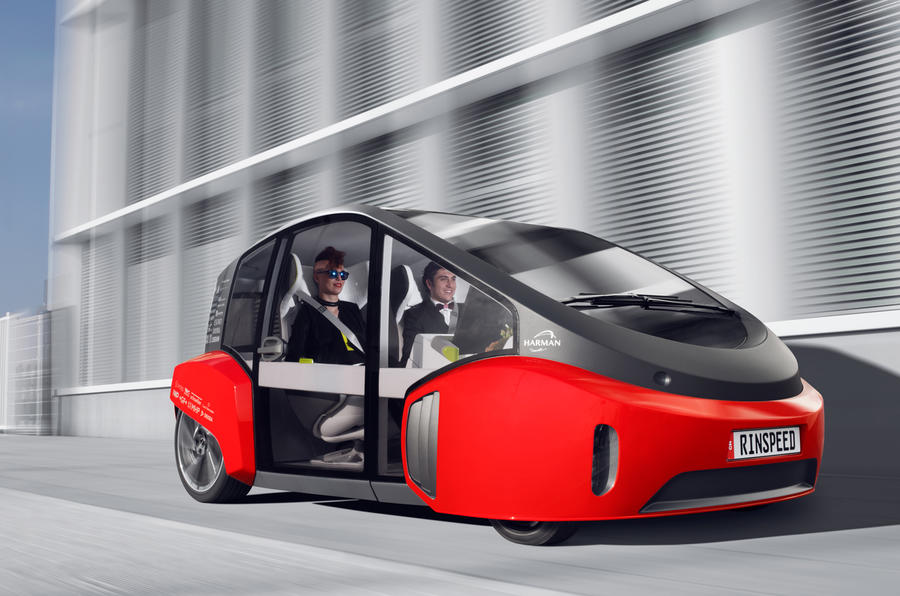
Rinspeed Oasis, a two-seated autonomous city-car with a mini garden inside. (Picture from: http://adf.ly/1gf9Da)
Rinspeed, a Swiss automotive companies have been made an autonomous car with a futuristic design that is far different from the others. And these two-seat autonomous city-car model will be revealed at the Consumer Electronics Show (CES) in Las Vegas in January 2017.
The front wheels can turn on their own axis, enabling the car to navigate incredibly tight turns and rotate on the spot to squeeze into parking spaces. While the car’s windscreen features virtual and augmented reality technology, where illustrations and data can be placed beside on objects outside.
There's a mini garden with bonsai trees in front of the dashboard of Rinspeed Oasis. (Picture from: http://adf.ly/1gf65C)
Not only that, inside the cabin also contained plants. So that the passengers will be served the nuances of technological sophistication and as well as the garden at once in it.
Yes, inside the car called Oasis, there's the plants was placed behind the windshield. According to Rinspeed boss Frank M. Rinderknecht, Oasis is designed as a sophisticated vehicles, agile, fast, integrated with a small garden inside it.
Oasis steering wheel can be used as a table when the car drove in autonomous driving mode. (Picture from: http://adf.ly/1gf65C)
The existence of this car is like changing the concept of home+garden into the car+garden. A small space inside the cabin is suitable for planting trees as bonsai.
Meanwhile, if the car is not drive manually or in autonomous mode, the steering wheel can be changed into a table. Its position will be changed to horizontal is not tilted like normally steering wheel, so that it can be used to put items, such as laptops and others.
Passengers also can make video calls by utilizing the built in camera in the car. In general, the Oasis cabin is designed as a comfortable modern living room occupied for two people.. *** [EKA | FROM VARIOUS SOURCES | AUTOCAR]


 In essence, Rinspeed's E-GO Rocket stands as a testament to the brand's unwavering dedication to redefining the automotive landscape. The marriage of timeless design, advanced technology, and exhilarating performance positions this concept car as a symbol of innovation in the ever-evolving world of automobiles. The legacy of Rinspeed's daring concepts continues, leaving enthusiasts eagerly awaiting the next groundbreaking revelation. *** [EKA | FROM VARIOUS SOURCES | RINSPEED | DISENOART | ALLCARINDEX ]