Singular Legend - Every now and then, the automotive world surprises us with a forgotten marvel—something bold, bizarre, and utterly unlike anything on today’s roads. While modern cars often favor practicality and polish, the 1970s were a breeding ground for wild ambition. Hidden in the shadows of that daring era is a machine so rare, it almost sounds mythical: the Bizzarrini P538 AMX/3 Spyder. A mid-engine enigma, this one-off convertible isn’t just rare—it’s a rolling contradiction of origins and intentions, a meeting point between Detroit horsepower and Italian finesse.
The Bizzarrini P538 AMX/3 Spyder was born when the ninth AMX/3 chassis, sold after AMC canceled the project in 1971, was transformed by renowned Cuneo-based restorer Giorgio Giordanengo into a custom, hand-built convertible completed around 1972. (Picture from: FastestLap)
The car was born from an unlikely collaboration between Italian engineering legend Giotto Bizzarrini and American Motors Corporation (AMC). AMC dreamed of a mid-engine sports car to rival Ferrari and Lamborghini. Bizzarrini, with his deep racing pedigree and visionary instincts, was tasked with the engineering of what would become the AMX/3. Though only a handful of coupes were completed, one chassis—believed to be the ninth—took a different path entirely. It would eventually become the Spyder, the only open-top version of the AMX/3 project.
The Bizzarrini P538 AMX/3 Spyder is visually striking, sitting low, wide, and purposeful with sleek lines and a stance that blends aggression and elegance. (Picture from: Perico001 on Flickr)
Initially, AMC explored several avenues for developing the AMX/3. ItalDesign was involved in its styling, while AMC also considered outsourcing production to Karmann in Germany, who had experience assembling AMC Javelins for the European market. However, their partner BMW reportedly declined the plan, citing a lack of resources and estimating a need for 30 to 32 engineers to bring the car to life. Some sources even suggest BMW internally designated the concept as the E18. Ultimately, following a recommendation from Renzo Carli of Pininfarina, AMC brought in Bizzarrini to carry out the basic engineering in late 1968. The prototype he developed would later be known as the Bizzarrini Sciabola.
The Bizzarrini P538 AMX/3 Spyder, despite minor dimensional differences that have sparked debate, remains firmly rooted in the original Bizzarrini-AMC design.(Picture from: WeirdWheels on Reddit)
But the story doesn’t end with Bizzarrini’s involvement. After AMC canceled the project in 1971, the ninth chassis didn’t vanish into obscurity. Instead, it was sold to Giorgio Giordanengo, a respected restorer from Cuneo, Italy. He took the unfinished skeleton and gave it new life with a fully custom, hand-built Spyder body. Completed around 1972, this transformation resulted in a one-of-a-kind convertible that would stay mostly hidden from the spotlight for decades.
The Bizzarrini P538 AMX/3 Spyder houses a 6.4-liter AMC V8 engine capable of producing up to 560 horsepower, depending on configuration, with power delivered through a manual transmission for a raw, mechanical driving experience. (Picture from: HistoricAutoPro)
When it finally emerged at the 2002 Bizzarrini Expo held in Brussels, the car caused a stir among collectors and enthusiasts alike. It was a mystery, a rarity, and a piece of forgotten history. Over the years, people have called it by different names—the Bizzarrini P538, the AMX Spyder, or the Giordanengo Spyder in honor of the man who finished it. Whatever label it carries, its presence is impossible to ignore.
The Bizzarrini P538 AMX/3 Spyder offers a supercar-like cabin experience, highlighted by a sporty three-spoke steering wheel and a clean, driver-focused dashboard and center console. (Picture from: Nasshan)
Visually, the Spyder is striking. It sits low, wide, and purposeful, with sleek lines and an aggressive yet elegant stance. The open-top design exposes the cabin, giving it a raw and uncompromising feel. Underneath that dramatic exterior lies a 6.4-liter AMC V8 engine, pushing out up to 560 horsepower, depending on the setup. Power is delivered through a manual transmission, keeping the driving experience mechanical and visceral. With a weight of around 1,190 kg, the car is built for balance, agility, and sheer performance.
The Bizzarrini P538 AMX/3 Spyder is the only known Spyder variant ever tied to the AMX/3 project.. (Picture from: Perico001 on Flickr)
What truly sets this car apart is its singularity. It's the only known Spyder variant ever tied to the AMX/3 project. While other AMX/3s followed a fixed formula, this one broke away from the mold. It’s not merely a car—it’s a narrative in motion, shaped by abandoned dreams, cross-continental collaboration, and a craftsman’s relentless vision. Though some have debated its authenticity due to small dimensional differences, its roots remain undeniably connected to the original Bizzarrini-AMC design. | MP4YXqymE5Q |
Today, the Bizzarrini P538 AMX/3 Spyder stands alone—not tucked away in a museum or mirrored by replicas, but alive as a raw, running reminder of a time when bold ideas weren’t left as sketches, but shaped into roaring realities. In a world where so many cars blur into sameness, this one dares to be different. It doesn’t just tell a story—it is the story.. *** [EKA | FROM VARIOUS SOURCES | FERRARICHAT | HISTORICAUTOPRO | FASTESTLAPS | WIKIPEDIA | HEMMINGS | GORDON CALDER ON FLICKR | WEIRDWHEELS ON REDDIT | NASSHAN ]
Note: This blog can be accessed via your smart phone
Joystick Reality - Every now and then, a fictional car drives its way out of the screen and onto the real-life streets—and when it does, it's a moment that blends fantasy with reality in the coolest way possible. For fans of Grand Theft Auto V, few rides are as iconic as the Bravado Banshee. It’s that sleek, muscular beast you probably remember tearing through Los Santos, dodging cops, and outrunning helicopters. But what if we told you that this virtual dream car wasn't just pixels and code? What if it had an actual steering wheel, real horsepower, and a backstory that's just as wild as any GTA mission?
As Rockstar Games prepared for GTA V’s 2013 launch, they partnered with West Coast Customs to turn the Bravado Banshee from in-game icon to real-world supercar. (Picture from: Obscure Supercar on X)
Let’s rewind a bit. When Rockstar Games was gearing up for the release of GTA V back in 2013, they didn’t just promote it with flashy trailers. Instead, they teamed up with West Coast Customs—the automotive wizards known for turning dreams into driveable reality—to bring the Bravado Banshee into the real world. This wasn't just a wrap job or a themed paint scheme slapped onto a random car. They took a 2006 Dodge Viper SRT-10 and transformed it, inside and out, into the full-blown, street-legal version of the game’s beloved sports car.
For Grand Theft Auto V fans, the Bravado Banshee stands out as an iconic, muscle-bound machine built for high-speed chaos across Los Santos. (Picture from: RockStarGames)
From the jump, the creators paid close attention to the details. Using the in-game design as their blueprint, they handcrafted an interior that mirrors the digital cockpit. The seats were specially stitched and upholstered with the Banshee logo, and the dash, console, and door panels got a complete makeover with carbon-fiber inlays.
The Bravado Banshee was crafted by West Coast Customs, commissioned by Rockstar Games for the 2013 launch of GTA V, by modifying a 2006 Dodge Viper SRT-10.(Picture from: Carscoops)
To top it all off, they installed a premium sound system and bathed the car in a glossy metallic blue finish, highlighted by crisp ice white racing stripes—just like you'd expect to see burning rubber outside a mod shop in Los Santos. Only one of these Banshees exists. That makes it not just a collector’s item, but a piece of gaming history on four wheels.
The Bravado Banshee features a handcrafted interior that mirrors its digital cockpit, with custom-stitched seats bearing the Banshee logo and a full carbon-fiber makeover on the dash, console, and door panels. (Picture from: Carscoops)
While it might look like something built to dominate street races, the real-life Banshee actually spent most of its time in garages rather than on highways. It’s clocked just over 8,000 miles across nearly two decades—meaning its 8.3-liter V10 engine and six-speed manual transmission are still raring to go. But the story doesn’t stop at the build. It gets better—or at least, more surprising. The first person to own this high-octane showpiece wasn’t a millionaire collector or die-hard gamer.
The Bravado Banshee is powered by an 8.3-liter V10 Viper engine paired with a six-speed manual transmission.(Picture from: Carscoops)
It was a grandmother from Havelock, North Carolina. Her youngest son had entered a sweepstakes using her credit card without her knowledge, and she ended up the legal winner. Though not exactly in the market for a supercar, she decided to try and turn it into tuition money. In 2014, she listed it for $170,000. But the car didn't sell, and a year later, it went for just $45,200.
The Bravado Banshee wears a glossy metallic blue finish accented with sharp ice white racing stripes. (Picture from: Carscoops)
Since then, the Banshee has bounced through a couple of new owners and auctions, each sale lower than the last. Most recently, in 2025, it changed hands again for $30,800—a far cry from its initial hoped-for price tag. So, while it may not have become the jackpot some hoped for, it's still a rolling tribute to gaming culture and creative car building. | YrCjPFcbPnU |
Today, the Bravado Banshee stands as a fun reminder of how far marketing stunts can go, and how a well-crafted game world can leap into real life in the most unexpected ways. It's a car born from pixels and passion, now cruising among us—quietly legendary, undeniably unique. *** [EKA | FROM VARIOUS SOURCES | ROCKSTARGAMES | CARSCOOPS | OBSCURE SUPERCAR ON X ]
Note: This blog can be accessed via your smart phone
Fluid Boldness - In a world where most cars follow the rules, Luigi Colani spent his life joyfully rewriting them. Long before sleek aerodynamics became trendy and before “futuristic design” became a buzzword, this German-born designer was already turning imagination into metal. Starting in the early 1950s and continuing well into the new millennium, Colani roamed freely through the world of industrial design—shaping everything from chairs and cameras to airplanes and, of course, some of the most outlandish cars ever built.
Luigi Colani's radically reimagined 1969 Bizzarrini 5300 GT—where muscle car meets living sculpture in a bold expression of Biodesign. (Picture from: Story-Cars)
Luigi Colani (1928 - 2019). (Picture from: Wikidata)
If one thing defined his vision, it was his devotion to nature’s forms: flowing, round, and completely free of harsh angles. He called it Biodesign, and once you see it, you never forget it. His career in car design reads like a gallery of rolling sculptures. In 1959, he teamed up with Abarth and Alfa Romeo to create the 1300 Berlinetta, a compact yet futuristic coupe that looked like it had been formed by the wind itself. The 1970s brought the Miura Le Mans Concept, Colani’s surreal take on Lamborghini’s iconic model, reimagined for endurance racing with a shape that almost floated.
In 1968, Colani introduced his 'C-Form' concept—a
visionary take on aerodynamics where the entire vehicle’s body was
shaped like an inverted wing. (Picture from: Bubblemania.fr)
Not even Formula 1 escaped his touch. The Eifelland Type 21, which appeared in 1972, looked like a spacecraft in a field of race cars—complete with a single rearview mirror sprouting from its nose and bodywork that defied every norm. As time went on, his ideas only grew bolder. In 1989, Colani unleashed the Ferrari Testa D’Oro, a radical reinvention of the Testarossa built to chase speed records. Its silhouette was wild, but it was no fantasy—it actually performed.
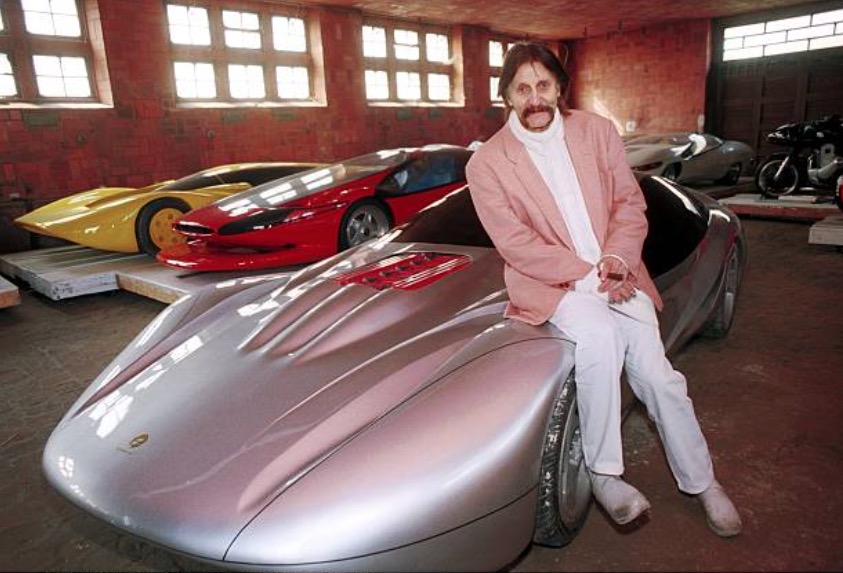
Luigi Colani posed alongside his car creations, such as the Mamba Concept, Ferrari Testa D'Oro, and many others. (Picture from: RawViper)
By the late '90s, he introduced the Colani Mamba Concept, reportedly designed as an experimental proposal for a future Dodge Viper. It ditched brute-force muscle in favor of an organic, serpentine shape—more creature than car. Then came the Innotruck in 2012, a full-sized biodynamic truck that looked more like a rolling spaceship than a cargo hauler. It was futuristic, functional, and totally unmistakable.
The
Innotruck posed along with Luigi Colani, and as you can see here, the
front of the truck gives a unique access for the driver get into the
cockpit by sliding its glass nose. (Picture from: Bubblemania.fr)
Yet, among all his automotive visions, one project managed to balance Colani’s unfiltered creativity with the legacy of classic performance: the 1969 Bizzarrini 5300 GT by Luigi Colani. The original Bizzarrini was already a head-turner—an Italian GT powered by American muscle, built for both beauty and speed. But to Colani, it still played too safely. He saw potential not yet realized. So, he transformed it.
The original Bizzarrini 5300 GT is the first Giotto Bizzarrini's production version car after he estabilished his own company in 1966. (Picture from: Petrolicious)
And what a transformation it was. In Colani’s hands, the Bizzarrini 5300 GT turned into something wild and visceral. Just look at the front end—feral grille slats that seem to snarl, headlights deeply recessed behind black bars like the eyes of a predator. The body, finished in an arresting yellow, flows like molten lava, with oversized fenders and swollen haunches that seem to shift under light. It’s not a car you simply look at—it’s one that stares back. The entire silhouette seems grown rather than built, like some high-speed creature engineered in nature’s own wind tunnel.
A head-on look at Colani’s 1969 Bizzarrini 5300 GT—where organic flow meets fierce presence, redefining what a sports car can look like. (Picture from: Story-Cars)
He didn’t alter the powerplant or core mechanicals; Colani’s work was pure form. But in doing so, he changed how the Bizzarrini 5300 GT was perceived. No longer just a beautiful Italian GT, it became a rolling sculpture. A challenge to the conventions of what a performance car should be. His version didn’t chase symmetry or elegance—it chased raw feeling, emotion, energy. And that’s exactly what makes it unforgettable.
Shrunk in size, not in spirit—Colani’s Biodesign lives on in every curve of this striking 5300 GT model, with fluid forms and fearless flair. (Picture from: Story-Cars)
What makes this car so captivating is how it bridges worlds—part classic grand tourer, part science fiction. It shows what happens when a visionary dares to reimagine something already iconic and breathes new life into it. Colani’s redesign didn’t boost performance on paper, but it gave the car something far more elusive: a wild soul. Perhaps by watching the video below, we can better grasp the rhythm behind Luigi Colani’s unique design flow.
Today, that 1969 Bizzarrini 5300 GT by Luigi Colani stands not only as a rare collector’s item but as a reminder that design can be fearless. That form can speak just as loudly as function. And that once in a while, someone like Colani comes along—not to follow the road, but to reshape it entirely. *** [EKA | FROM VARIOUS SOURCES | BUBLEMANIA.FR | STORY-CARS | MYCARQUEST | RAWVIPER | DESIGNDIFFUSION ]
Note: This blog can be accessed via your smart phone
Pure Velocity - The world of high-performance sports cars is often dominated by well-known names like Ferrari, Lamborghini, and McLaren. However, some smaller manufacturers have managed to carve out a niche by offering pure driving experiences that rival or even surpass these industry giants. One such company is Noble Automotive, a British brand that may not have the global recognition of its competitors but has certainly earned the respect of driving enthusiasts. The Noble M12 GTO-3 and its evolved version, the GTO-3R, are prime examples of the brand’s dedication to raw, unfiltered performance.
The 2002 Noble M12 GTO-3. (Picture from: Supercars,net)
After the initial success of the M12 GTO, Noble introduced the upgraded GTO-3 in 2002. Featuring a three-liter turbocharged Ford Duratec V6, it produced 30 more horsepower than the original 2.5-liter model. This engine, housed within a lightweight space-frame chassis, delivered exceptional power with minimal turbo lag. The GTO-3 maintained the same fundamental design as its predecessor but improved upon its performance, making it an even more thrilling car to drive.
The 2002 Noble M12 GTO-3.(Picture from: Supercars,net)
The GTO-3 was built with a singular purpose—performance. Its body was entirely made from composite materials, keeping it light and strong. A large rear wing and front splitter provided significant downforce, helping the car stay planted during high-speed cornering. While this aerodynamic focus limited its top speed to 165 mph, it dramatically improved handling, making the GTO-3 feel incredibly stable even under extreme conditions. But where the car truly excelled was its power-to-weight ratio. Weighing nearly 700 pounds less than a Ferrari Enzo, the Noble made better use of its horsepower than most of its competitors.
The 200 Noble M12 GTO-3.(Picture from: Supercarsnet)
However, Noble didn’t stop there. The GTO-3R took things even further, refining the formula with additional performance upgrades. This model featured the same three-liter turbocharged V6 but with an increased output of 352 horsepower at 6,200 rpm and 350 lb-ft of torque between 3,500 and 5,000 rpm. A new six-speed manual transmission, paired with a Quaife limited-slip differential, enhanced power delivery to the rear wheels. This combination allowed the GTO-3R to accelerate from 0 to 60 mph in just 3.9 seconds and hit 100 mph in a blistering 9.0 seconds. | l9wBVF68DYc |
One of the most unique aspects of both the GTO-3 and GTO-3R was their ride quality. Unlike most modern performance cars, these Nobles lacked traditional anti-roll bars, a decision that allowed each wheel to react independently. This unconventional design gave the cars an unexpectedly smooth ride, absorbing road imperfections without sacrificing handling precision. Despite their aggressive performance, the GTO-3 and GTO-3R remained surprisingly comfortable, offering a more forgiving driving experience than one might expect from such focused machines.
Inside, luxury was sacrificed for weight savings and driver engagement. The interior was minimalist, featuring deeply bolstered bucket seats, a roll cage, and basic controls. There were no power windows, no traction control, and no ABS—features that most modern sports cars include as standard. This stripped-down approach reinforced the Noble’s core philosophy: driving should be about connection, not convenience. Even the six-speed gearbox required a deliberate hand, adding to the car’s mechanical feel.
The 2004 Noble M12 GTO-3R. (Picture from: PistonHeads)
Lee Noble, the mastermind behind Noble Automotive, brought years of experience to these cars. Before founding his company, he had worked on projects like the McLaren F1, Ultima Can-Am, and Ascari Ecosse. His deep understanding of motorsport engineering was evident in every aspect of the Noble M12 GTO-3 and GTO-3R, ensuring they remained true to the spirit of high-performance driving.
The 2004 Noble M12 GTO-3R. (Picture from: PistonHeads)
With the success of these models at the time, Noble set its sights on the future, announcing the upcoming GTO-3T, a track-focused version with a 400-horsepower engine and an FIA-approved roll cage. This move reinforced the brand’s commitment to performance, proving that Noble wasn’t just about building fast road cars—it was also ready to dominate the track. | l9wBVF68DYc |
For those who crave an unfiltered driving experience, the Noble M12 GTO-3 and GTO-3R deliver in ways that few other cars can. They may lack the prestige of more mainstream supercars, but their raw power, lightweight design, and engaging handling make them true driver’s machines. In a world where technology often dulls the connection between car and driver, these Nobles stand as a reminder of what pure performance really feels like. *** [EKA | FROM VARIOUS SOURCES | SUPERCARS.NET | TOPGEAR | PISTONHEADS | RAREANDONTHEROAD IN FACEBOOK ]
Note: This blog can be accessed via your smart phone.
LOST GEMS - The world of motorsports is filled with stories of innovation, ambition, and sometimes unfulfilled potential. One such story revolves around the Triumph Conrero Le Mans, a car that combined the craftsmanship of two legendary figures: Giovanni Michelotti, an Italian designer renowned for his sleek automotive designs, and Virgilio Conrero, a master of tuning engines. These two names alone evoke images of speed, performance, and beauty. Yet, despite the brilliance of its creators, the Triumph Conrero Le Mans never got its chance to shine on the racetrack, and instead, became a symbol of what could have been in motorsport history.
The Triumph Conrero Le Mans combined the craftsmanship of Italian designer Giovanni Michelotti and engine tuning expert Virgilio Conrero. (Picture from: Carrozzieri-Italiani)
Virgilio Conrero, born in Turin at the tail end of World War I, was no stranger to mechanics and engineering. During World War II, he served as a mechanic in the Regia Aeronautica, Italy’s air force, gaining valuable experience that would later shape his career. After the war, Conrero's love for automobiles took him on a different path, and in 1951, he founded Autotecnica Conrero. This company would go on to become a key player in tuning Alfa Romeos and Lancias, creating machines that were not only fast but also aesthetically pleasing. Despite his success, Conrero's work was often overshadowed by the more well-known Abarth, but his Conrero-Alfas earned a devoted following and remain prized possessions for car collectors today.
The Triumph Conrero Le Mans was intended as part of a four-car team for the 1961 race, but only one was completed, and not in time to compete. (Picture from: Carrozzieri-Italiani)
The Triumph Conrero Le Mans project began in the early 1960s, with Standard-Triumph seeking Conrero's expertise to develop a car for the 24 Hours of Le Mans. The goal was to build a four-car team for the 1961 race, but in a twist of fate, only one car was completed, and that too, not in time for the race. The car was finished in 1962, with its tubular spaceframe and aerodynamic body designed by Michelotti. It also featured the powerful Sabrina engine, a unit capable of producing a reported 165 bhp. This engine, combined with the lightweight chassis, allowed the car to reach nearly 150 mph on England’s M1 motorway, a remarkable feat for its time.
The Triumph Conrero Le Mans, completed in 1962, featured a tubular spaceframe, Michelotti-designed aerodynamic body, and a 165 bhp Sabrina engine. (Picture from: Carrozzieri-Italiani)
Despite the car’s impressive capabilities, it never got the chance to prove itself on the world stage. The Leyland takeover of Triumph in the early 1960s led to the project being shelved, ending what could have been a triumphant moment for the British carmaker at Le Mans. The Triumph Conrero Le Mans was left in limbo, a brilliant creation that was never given the opportunity to race. The wind tunnel tests conducted at the Polytechnic of Turin showed promise, but Triumph's decision to withdraw from competitions dashed the hopes of seeing the car’s potential realized on the track.
The Triumph Conrero Le Mans, despite promising wind tunnel results from the Polytechnic of Turin, was left in limbo after Triumph's withdrawal from racing. (Picture from: Carrozzieri-Italiani)
The Triumph Conrero Le Mans, however, did not disappear into obscurity. The car still exists today, a living relic of a bygone era in British motorsport. While it never got to compete at Le Mans, it stands as a testament to the creativity and ambition of its creators. Michelotti's design and Conrero's tuning came together to form a car that could have been a serious contender. In many ways, the car's existence is a reminder of how many great ideas and innovations in motorsports were cut short by external forces beyond the control of their creators.
The Triumph Conrero Le Mans, despite its impressive capabilities, never reached the world stage as the Leyland takeover in the early 1960s shelved the project. (Picture from: Carrozzieri-Italiani)
For fans of British sports cars, the Triumph Conrero Le Mans represents a tantalizing 'what if.' What if Triumph had gone ahead with the project? What if it had competed at Le Mans? Would it have claimed victory? These questions may never be answered, but the legacy of the car lives on, a chapter in the long and storied history of motorsports, where dreams are sometimes left unrealized, but never forgotten. *** [EKA | FROM VARIOUS SOURCES | CARROZZIERI-ITALIANI | CARSTYLING.RU | CLASSICCARS | STORY-CARS | MOSSMOTORING | FORUMAUTOSPORT | WIKIPEDIA ]
Note: This blog can be accessed via your smart phone
Electric Opulence - In the world of luxury cars, there’s always room for something bold—something so daringly different that it makes you pause, squint, and ask, "Is this for real?" That’s exactly the kind of attention Dacora Motors seems to be chasing with its jaw-dropping debut: an ultra-luxury electric vehicle that looks like a love letter to 1930s elegance with a twist of sci-fi drama.
Dacora’s bold ultra-luxury EV, crafted with Pininfarina, merges Streamline Moderne curves with electric power—like a gala-ready Beetle from another universe. (Picture from: Carscoops)
Enter Dacora’s first-ever vehicle, a curiously retro-futuristic EV that’s as much a piece of moving art as it is a car. Designed in collaboration with the famed Italian studio Pininfarina, the vehicle is Dacora’s statement of intent—and it’s loud. Imagine the flowing lines of Streamline Moderne architecture meeting a high-performance electric powertrain, wrapped in a body that feels like an alternate-universe Volkswagen Beetle dressed for a gala. It’s not subtle, and that’s clearly the point.
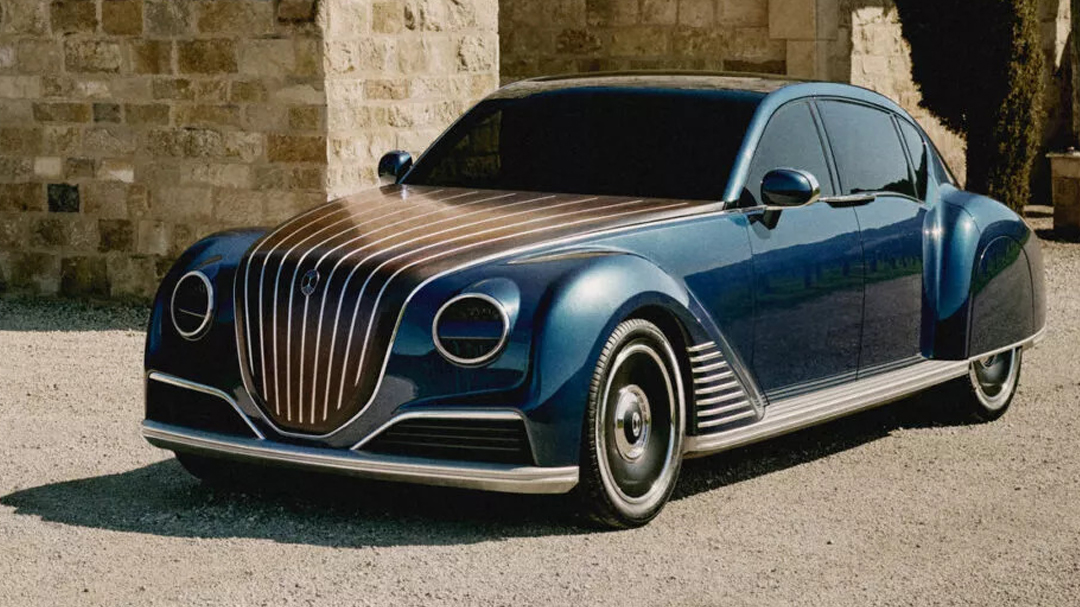
Dacora’s bold ultra-luxury EV showcases old-school glamour with circular headlights flanking a handcrafted wood hood, while bulging fenders and minimalist wheels blend vintage charm with futuristic restraint. (Picture from: TopSpeed)
Despite Dacora's questionable claim of creating the first American-made ultra-luxury vehicle in nearly a century—something Cadillac Celestiq would quickly challenge—their debut effort is not just about headline-grabbing. Underneath that curvaceous wooden hood sits an electric drivetrain that reportedly pushes over 800 horsepower, launching the nearly 6,500-pound vehicle from zero to sixty in under four seconds. That’s no small feat. Dacora also estimates a range of around 400 miles on a single charge, which puts it on par with top-tier EV offerings.
Dacora’s bold ultra-luxury EV, their first-ever vehicle, is a retro-futuristic creation that feels as much like moving art as it does a car. (Picture from: TopSpeed)
Visually, the car is a parade of old-school glamour. Circular headlights flank a handcrafted wood hood. Bulging fenders and minimalistic wheels balance a vintage aesthetic with futuristic restraint. The rear end sweeps down in a dramatic slope, ending in afterburner-style taillights that wouldn’t look out of place on a spaceship. Covered rear wheels and an SUV-like 7.5-inch ride height add just enough quirk to keep you guessing whether it’s more luxury sedan or elevated cruiser.
Dacora’s bold ultra-luxury EV offers a thoughtfully curated interior where woven wool, sustainable bioleathers, and warm woods replace cold plastics and screens, doubling as elegant surfaces for digital displays that disappear when not in use. (Picture from: Carscoops)
Step inside, and you’ll find an interior that feels like it was curated rather than assembled. Gone are the cold plastics and screen overloads of modern cars. In their place: woven wool, sustainable bioleathers, and warm woods that not only look elegant but serve as canvases for projected digital displays that vanish when not in use. The entire cabin is modular, designed to be reimagined with the seasons. Think linen interiors in the summer, wool in the winter—like fashion, but for your car.
Dacora’s bold ultra-luxury EV features a fully modular cabin designed to change with the seasons, like fashion—linen for summer, wool for winter. (Picture from: Carscoops)
Dacora isn’t stopping at simple personalization either. Seating configurations range from a minimalist three-seat executive lounge to a more expansive seven-passenger layout. Console options include luxuries you didn’t know you needed: from humidors and espresso machines to a literal bonsai garden under a glass dome. There’s even talk of a biometric safe and a mini fridge, all seamlessly integrated to make the car feel more like a rolling penthouse suite.
Dacora’s
bold ultra-luxury EV features a dramatically sloping rear end that
culminates in afterburner-style taillights fit for a spaceship. (Picture from: Carscoops)
If full electrification isn’t your style, Dacora plans to offer a hybrid option as well, though they’re keeping those details tightly under wraps for now. What’s clear is that flexibility is part of the brand’s DNA—whether that’s in design, performance, or powertrain options.
Dacora’s bold ultra-luxury EV features a dramatically sloping rear end that culminates in afterburner-style taillights fit for a spaceship. (Picture from: Carscoops)
Each of these vehicles will be hand-built at Dacora’s 100-acre Hudson Valley Garage campus in New York, adding yet another layer of exclusivity. With a starting price of $500,000 and a required $50,000 refundable deposit, it’s targeting a niche market—one apparently eager to buy in, as Dacora claims reservations have already exceeded their initial production targets. Still, they’ve been suspiciously quiet about just how many cars that first run includes. | v8wZCkM14Ok |
While time will tell if Dacora Motors can deliver on all its ambitious promises, there’s no denying that their debut is something the industry hasn’t seen before. In a world of cookie-cutter luxury and EVs that often play it safe, Dacora has taken a wildly imaginative leap—and whether it soars or stumbles, it’s definitely going to turn heads. *** [EKA | FROM VARIOUS SOURCES | DACORA | CARSCOOPS | THEEVEREPORT | TOPSPEED ]
Note: This blog can be accessed via your smart phone.


 The car was born from an unlikely collaboration between Italian engineering legend Giotto Bizzarrini and American Motors Corporation (AMC). AMC dreamed of a mid-engine sports car to rival Ferrari and Lamborghini. Bizzarrini, with his deep racing pedigree and visionary instincts, was tasked with the engineering of what would become the AMX/3. Though only a handful of coupes were completed, one chassis—believed to be the ninth—took a different path entirely. It would eventually become the Spyder, the only open-top version of the AMX/3 project.


 Today, the Bizzarrini P538 AMX/3 Spyder stands alone—not tucked away in a museum or mirrored by replicas, but alive as a raw, running reminder of a time when bold ideas weren’t left as sketches, but shaped into roaring realities. In a world where so many cars blur into sameness, this one dares to be different. It doesn’t just tell a story—it is the story.. *** [EKA | FROM VARIOUS SOURCES | FERRARICHAT | HISTORICAUTOPRO | FASTESTLAPS | WIKIPEDIA | HEMMINGS | GORDON CALDER ON FLICKR | WEIRDWHEELS ON REDDIT | NASSHAN ]