-->
Drop Down MenusCSS Drop Down MenuPure CSS Dropdown Menu

Friday, May 16, 2025

Ferrari 400: The GT Misstep That Never Reached America

Misguided Luxury - The automotive world is full of legends—cars that inspire awe and admiration, setting new benchmarks for performance, design, and engineering excellence. Ferrari, one of the most revered names in the industry, has a long history of producing such icons. But not every prancing horse was a masterpiece. Some models, despite wearing the legendary badge, failed to capture the essence of what makes a Ferrari truly special. One such example is the Ferrari 400, a car that carried the weight of grand tourer aspirations but fell short of delivering the magic expected from Maranello.
The Ferrari 400, a car that carried the weight of grand tourer aspirations but fell short of delivering the magic expected from Maranello. (Picture from: SupercarNostalgia)
When the Ferrari 400 was unveiled at the 1976 Paris Motor Show alongside the stunning 512 BB, it promised a blend of performance and luxury, continuing the lineage of front-engined V12 four-seaters that began with the 250 GTE in 1959. It was essentially an evolution of the 365 GT4, featuring a larger 4.8-liter engine and subtle design updates. Yet, what made the 400 most infamous was its attempt to introduce something unprecedented in Ferrari history—a three-speed automatic transmission. This decision was aimed at attracting the American market, where effortless driving was preferred over the thrill of a gated manual shifter. Ironically, despite its intention, the 400 was never officially sold in the United States due to federal emissions and safety regulations.
The Ferrari 400, unveiled at the 1976 Paris Motor Show, promised a blend of performance and luxury, continuing the company's lineage of front-engined V12 four-seaters. (Picture from: SupercarNostalgia)
The idea of an automatic Ferrari was controversial from the start. Enthusiasts saw it as a compromise, a dilution of the brand’s racing DNA in favor of convenience. Unlike the six experimental 365 GTs equipped with automatic transmissions for testing purposes in the late 1960s, the Ferrari 400 was a full-production model, allowing any well-heeled customer to own one. However, its grand touring credentials were overshadowed by a lack of excitement. The 340-horsepower V12 had the pedigree of Ferrari’s legendary Colombo engine, but pairing it with a sluggish Borg-Warner three-speed automatic drained much of its spirit. While the manual variant, the 400 GT, retained some driving engagement, the automatic version, the 400 A, felt like a missed opportunity for a brand known for its exhilarating machines.
The Ferrari 400 lacked the visual drama expected from the brand, with Pininfarina's understated, boxy design resembling luxury coupes rather than high-performance exotics. (Picture from: SupercarNostalgia)
Even in terms of styling, the 400 lacked the visual drama expected from a Ferrari. Designed by Pininfarina, its understated and boxy appearance was more in line with luxury coupes of the era rather than high-performance exotics. Practical? Yes. Exciting? Not quite. Compared to its rivals, such as the Lamborghini Espada, it was the more discreet choice—favored by conservative buyers who wanted a fast yet low-profile grand tourer. While some appreciated its refinement and spacious interior, it never achieved the desirability of other Ferraris from the same period.
The Ferrari 400 featured a luxurious interior, offering premium leather seats, electric windows, and a well-appointed air conditioning system for added comfort. (Picture from: SupercarNostalgia)
The chassis and suspension setup provided a comfortable ride, featuring independent suspension with self-leveling technology, power steering, and disc brakes on all four wheels. The car even had a luxurious interior with leather seats, electric windows, and air conditioning. However, none of these features could disguise its hefty weight, which reached 1,700 kg—significantly heavier than its predecessor. The added weight, combined with the automatic transmission, dulled its acceleration and handling, making it feel less like a Ferrari and more like an expensive European cruiser.
The Ferrari 400 featured a luxurious interior, offering premium leather seats, electric windows, and a well-appointed air conditioning system for added comfort. (Picture from: SupercarNostalgia)
Despite its underwhelming reception, the Ferrari 400 remained in production until 1979 before being succeeded by the fuel-injected 400i. Out of the 502 units produced, nearly two-thirds were automatics, proving that Ferrari’s attempt at catering to a more relaxed driving audience had some level of success—just not in the way they originally intended. Since it never officially reached American dealerships, a handful of cars made their way across the Atlantic through grey market imports, where they had to undergo costly modifications to meet US regulations. | zDSY6FonYwY |
Today, the Ferrari 400 remains one of the most overlooked models in the brand’s history. It lacks the collectibility of the 250-series classics, the raw excitement of mid-engined icons, and the groundbreaking innovation seen in later Ferraris. However, it serves as an important lesson in Maranello’s journey—an experiment in balancing performance with comfort, and a reminder that not every Ferrari is destined for greatness. While it may never be remembered as a legend, the 400 still holds a unique place in Ferrari’s timeline, if only as a cautionary tale of how even the most celebrated automaker can occasionally miss the mark. *** [EKA | FROM VARIOUS SOURCES | FERRARI | TOPGEAR.NL | SUPERCARNOSTALGIA ]
Note: This blog can be accessed via your smart phone.

Rare and Beautiful Italian Scooters That Time Forgot (Part 1)

Scooter Relics - Italy, often affectionately dubbed "The Spaghetti Country," is not only renowned for its cuisine but also as the birthplace of some of the world’s most beautiful and iconic scooters. After World War II, the two-wheeled vehicle market in Italy flourished, giving rise to numerous scooter manufacturers. Among the most prominent were Piaggio, with its legendary Vespa, and Innocenti, the maker of Lambretta.
The scooters atmosphere in Rome around the 1950s in William Klein's camera shots. (Picture from: RTVE.es)

Thursday, May 15, 2025

Italdesign GTZero Concept Blends Performance, Heritage, and Futuristic Tech

Electric Legacy - Amidst the rapid evolution of electric vehicles, there was a time not too long ago when bold concepts captured the imagination of the automotive world. Back in 2016, while many manufacturers were still tiptoeing around electrification, Italdesign made a statement that blended vision, design, and innovation. At the Geneva Motor Show—a prestigious platform known both for mainstream launches and rare automotive artistry—a small Italian manufacturer with a deep-rooted design legacy introduced something refreshingly ahead of its time: the Italdesign GTZero Concept.
The Italdesign GTZero electric supercar unveiled at the Geneva Motor Show 2016. (Picture from: Autocar)
Italdesign, a name revered among car enthusiasts and design aficionados, has long stood as a beacon of automotive creativity. Founded in the late 1960s by the legendary Giorgetto Giugiaro, the company played a key role in shaping numerous iconic vehicles across decades. Now operating under Audi's umbrella, Italdesign continues to push boundaries—not only in design but also in embracing future technologies. The GTZero is a prime example of how a boutique firm can deliver a futuristic vision with the polish of a large manufacturer.
The Italdesign GTZero is a prime example of how a boutique firm can deliver a futuristic vision with the polish of a large manufacturer. (Picture from: Autocar)
The GTZero was not just a showcase of striking design; it was a technological manifesto. Fully electric, the vehicle was built on a modular monocoque carbon fiber frame, making it lightweight yet robust. This foundation houses an integrated battery and three electric motorstwo at the front and one at the rear—that together produce a powerful 490 horsepower. This allows the GTZero to hit a top speed of 250 kilometers per hour, while still delivering an impressive driving range of 500 kilometers on a full charge. Even by today's standards, those numbers remain highly respectable.
Left side view of Italdesign GTZero electric supercar concept. (Picture from: Autoexpress)
Practicality wasn’t ignored in the quest for performance. Italdesign engineered the battery system for fast charging, capable of reaching 80% capacity in just 30 minutes. Beyond speed and range, versatility was also at the core of the GTZero's design. The modular architecture allowed for flexible cabin configurationsranging from a 3+1 layout to a hybrid-compatible setup. Inside, the cabin was designed to comfortably seat two adults and two children, but could be adjusted to accommodate three passengers in the front and a child behind the driver, depending on needs.
Sketched Interior View of the Italdesign GTZero Electric Supercar Concept. (Picture from: CarAndDriver)
Visually, the GTZero made an instant impression. Its sharp, flowing lines and aggressive stance drew clear inspiration from the Lamborghini Huracán, another Italian icon. But Italdesign didn’t stop there. They infused the GTZero with design cues from a variety of past concept models, including the Alfa Romeo Scighera, Daewoo Bucrane, Bizzarrini Manta, and the Ferrari GG50. Each influence was carefully woven into the car’s silhouette, creating a modern form that paid homage to automotive history while looking firmly toward the future. 
Rear side view of Italdesign GTZero electric supercar concept. (Picture from: Autocar)
Inside the cockpit, the GTZero embraced a minimalist, tech-forward approach. Traditional controls were replaced with a touch-sensitive interface capable of recognizing different finger inputs to access various functions. The steering wheel, stripped of conventional paddle shifters, featured buttons to control lighting, wipers, indicators, and even the digital dashboard display. Only the parking brake remained analog—a small but intentional nod to tactile interaction in an otherwise digital environment. The concept also marked the debut of Italdesign’s new brand logo, signaling a refreshed identity to accompany its leap into electrification.
While the GTZero never went into production, its impact was undeniable. It served as a bold expression of what Italdesign stood for: innovation without compromise, heritage infused with modernity, and performance driven by sustainability. Today, as the automotive industry continues to move swiftly toward an electric future, concepts like the GTZero remind us that sometimes, the most compelling ideas come from those who dare to be different. *** [EKA [14032016] | FROM VARIOUS SOURCES | ITALDESIGN.IT | AUTOCAR | AUTOEXPRESS | CARANDDRIVER ]
Note: This blog can be accessed via your smart phone.

Mitsubishi Starion: The Forgotten Turbo Icon of the 1980s

Shadow Legend - In the vibrant tapestry of 1980s automotive culture, where turbochargers whistled and angular silhouettes ruled the roads, names like Supra, RX-7, and 300ZX are often the first to echo in enthusiasts' minds. But tucked beneath the surface of mainstream nostalgia lies a gem that deserves far more attention than it typically receives—a car with bold styling, advanced engineering, and a story that spans continents and corporate identities. That car is the Mitsubishi Starion.
The Mitsubishi Starion, a car with bold styling, advanced engineering, and a story that spans continents and corporate identities. (Picture from: de.Motor1)
Unveiled in 1982, the Starion marked Mitsubishi’s serious foray into the realm of high-performance sports coupes. While it shared showroom space with more practical models, the Starion stood apart, with a name rooted in mythology. Inspired by the “Star of Arion”a mythical steed said to be born of Poseidon and Demeter—the name reflected a legacy of strength and swiftness. This wasn’t just marketing flourish; it was a symbol of Mitsubishi’s intent to bring something truly distinctive to the performance world.
The Mitsubishi Starion has a fascinating journey of rebranding and adaptation. Though originally sold under the Mitsubishi badge, the car's North American identity began to shift as the Conquest Conquest. (Picture from: de.Motor1)
What followed was a fascinating journey of rebranding and adaptation. Though originally sold under the Mitsubishi badge, the car's North American identity began to shift by 1984. Chrysler, seeing potential in the sporty coupe, marketed it under its Dodge and Plymouth brands as the Conquest. This simple rebadging didn’t change the car’s mechanical DNA—it remained thoroughly Mitsubishi underneath—but it allowed the vehicle to tap into a broader market.
Rear view of earlier, narrow-bodied Mitsubishi Starion.. (Picture from: Wikipedia)
By 1987, the model was absorbed more formally into the Chrysler portfolio as the Chrysler Conquest, even while Mitsubishi continued to sell its own versions. This dual-branding approach earned the car the nickname "Starquest," a blend of both identities, and a name now fondly used among enthusiasts. 
Front three quarter view of the 1982 Mitsubishi Starion Turbo EX 2.0. (Picture from: Wikimedia)
Under the hood, the U.S. versions packed a punchy 2.6-liter turbocharged inline-four. Producing up to 188 horsepower and 234 lb-ft of torque by the late 1980s, the engine was notable not just for its output, but for pioneering the use of balance shaft technology—so effective that even Porsche licensed it for their 944
Left side view of the 1988 Mitsubishi Starion Turbo 2.0 (wide-body). (Picture from: Wikipedia)
Paired with rear-wheel drive and a standard five-speed manual transmission, the Starion delivered a compelling drive, especially with the wide-body variants that appeared starting in 1986. These versions brought flared fenders, larger wheels, and intercoolers, enhancing both performance and presence.
Front three quarter view of the rebadged Starion as the Chrysler Conquest TSi (in pictured 1987 model). (Picture from: Wikipedia)
Globally, the Starion story was a bit different. European and Japanese markets initially received smaller 2.0-liter engines to avoid tax penalties associated with larger displacements. These models introduced the 4G63B engine, a powerplant that would become legendary in its own right as it evolved into the beating heart of the Mitsubishi Eclipse and Lancer Evolution. With various turbocharged configurations available, the non-American Starions offered high-revving alternatives that catered to different performance tastes.
The Mitsubishi Starion built its legacy with strong motorsport credentials, earning accolades in touring car series across Europe, Japan, and North America. (Picture from: DeepEnd.id)
The Starion’s motorsport credentials added further depth to its legacy. Competing in touring car series around the world, it earned accolades across Europe, Japan, and North America. Mitsubishi also campaigned it in rally events, including a Group B prototype that, while never officially homologated, found success in events like the Paris-Dakar Rally. It was a car that proved its mettle on the tarmac and on the dirt, embodying the kind of versatility rarely seen in sports coupes of the time.
The Mitsubishi Starion 4WD prototype was never fully developed, due to the cancellation of Group B. (Picture from: Wikipedia)
As Mitsubishi's performance lineup expanded by the end of the decade, the Starion’s role began to fade. New models like the Eclipse, built in partnership with Chrysler through the Diamond-Star Motors joint venture, captured the spotlight with fresh styling and accessible performance. The Starion, lacking a second-generation redesign, quietly exited the stage after 1989, making it a rare breed today. With fewer than 75,000 units reaching American shores, and just 159 Mitsubishi-branded examples sold in its final year, it remains one of the more elusive and collectible Japanese sports cars from that era. | xShPMfPr8oc |
Now, in a time when vintage turbocharged coupes are seeing a renaissance among collectors, the Mitsubishi Starion stands out as a daring, innovative vehicle that never got the credit it deserved. Its blend of muscular design, technical sophistication, and racing spirit make it more than just a footnote in automotive history—it’s a symbol of a bold moment when Mitsubishi aimed for the stars. *** [EKA | FROM VARIOUS SOURCES | MOTORTREND | DRIVENTOWRITE || DE.MOTOR1 | WIKIPEDIA | DEEPEND.ID | WAY ]
Note: This blog can be accessed via your smart phone.

Wednesday, May 14, 2025

Masterpieces on Wheels: The Three Most Expensive Cars in 2025

2025’s Pinnacle - In the fast-moving world of automotive innovation, the lines between art, engineering, and luxury grow increasingly blurred. The year 2025 brings a fresh surge of excitement for car enthusiasts, marked not only by breakthrough technologies but also by the arrival of vehicles whose prices defy belief. Carefully arranged from the least to the most expensive, a trio of exceptional creations has captured global attention with their extraordinary craftsmanship and exclusivity.
Horacio Pagani in front of his-owned creation, the Pagani Zonda HP Barchetta at the 2017 Pebble Beach Concours d'Elegance. (Picture from: Pagani Automobili on Facebook)
Sitting at the bottom of this remarkable trio is the breathtaking Pagani Zonda HP Barchetta, an Italian masterpiece priced at approximately $18.03 million USD (approx. Rp.303 billions). Pagani Automobili, renowned for its bold hypercar designs and uncompromising performance, crafted the Zonda HP Barchetta as a tribute to its founder, Horacio Pagani. Only three units exist, making it an ultra-rare collectible coveted by enthusiasts around the world. 
The Pagani Zonda HP Barchetta's design features an open-top layout paired with a distinctive fairing behind the driver’s seat, forming a striking and aggressive silhouette. (Picture from: en.WheelsAge.org)
Its design features an open-top layout paired with a distinctive fairing behind the driver’s seat, forming a striking and aggressive silhouette. Underneath its dramatic bodywork lies a 7.3-liter V12 engine developed in collaboration with AMG, delivering an unforgettable symphony of power. Built with a lightweight yet incredibly strong Carbo-titanium structure and reinforced with a steel front and rear subframe, the Zonda HP Barchetta stands as a true marvel of modern engineering.
The Pagani Zonda HP Barchetta built with a lightweight yet incredibly strong Carbo-titanium structure and reinforced with a steel front and rear subframe, and made it stands as a true marvel of modern engineering. (Picture from: Liputan6)
Rising next is an extraordinary creation from the legendary British marque: the Rolls-Royce Boat Tail, valued at approximately $27.3 million USD (approx. Rp.459 billions). Designed under the prestigious Coachbuild program, each Boat Tail is meticulously crafted to reflect its owner’s personal vision. Inspired by the luxurious yachts of the 1920s and 1930s, the Boat Tail blends nostalgic elegance with modern sophistication. 
The Rolls-Royce Boat Tail shows off coachbuilding chops of the Phantom platform, inspired by the luxurious yachts of the 1920s and 1930s to blend nostalgic elegance with modern sophistication. (Picture from: Autoblog)
The rear, shaped like a ship’s deck, houses thoughtful luxuries including a custom parasol and a bespoke champagne compartment, turning every outing into a celebration of refined grandeur. Often described by Rolls-Royce as the world’s finest picnic experience on wheels, each unit took more than four years to complete, and only three examples exist worldwide, solidifying its status as an automotive work of art.
The Rolls-Royce Boat Tail's rear, shaped like a ship’s deck, houses thoughtful luxuries including a custom parasol and a bespoke champagne compartment, turning every outing into a celebration of refined grandeur. (Picture from: Suara)
Topping this prestigious list is the magnificent Rolls-Royce La Rose Noire Droptail, commanding a stunning price of approximately $31.25 million USD (approx. Rp.525 billions). This masterpiece represents the pinnacle of luxury, with only four units created globally. Drawing inspiration from the rich elegance of the Black Baccara rose, the La Rose Noire Droptail combines classic craftsmanship with modern design innovation. Its deep crimson exterior shimmers with mesmerizing depth, while the interior transforms into a mobile gallery, featuring hand-finished black sycamore wood sourced from France.
The Rolls-Royce La Rose Noire Droptail was unveiled just hours before its customer delivery at Rolls-Royce’s private booth during the 2023 Pebble Beach Concours d'Elegance. (Picture from: MerahPutih)
Every detail is meticulously crafted by Rolls-Royce’s finest artisans. To complete its exclusivity, the car includes a removable Audemars Piguet timepiece, blending the worlds of haute horology and automotive excellence. As Rolls-Royce’s first two-seater roadster in the modern era, the La Rose Noire Droptail offers an open-air experience like no other, redefining what true luxury feels like on the road.
The Rolls-Royce La Rose Noire Droptail, inspired by the rich elegance of the Black Baccara rose, seamlessly blends classic craftsmanship with modern design innovation, featuring a mesmerizing deep crimson exterior. (Picture from: Suara)
These three magnificent vehicles showcase how the world of ultra-luxury automobiles continues to evolve, reaching new levels of creativity, craftsmanship, and exclusivity. More than mere modes of transportation, they are enduring symbols of human ingenuity, passion, and artistry. With production limited to only a few examples and prices reaching tens of millions of dollars, they offer a rare glimpse into a world where cars become timeless treasures, destined to be admired for generations. *** [EKA | FROM VARIOUS SOURCES | ROLL ROYCE | ROBBREPORT | AUTOBLOG | CARANDDRIVER | PAGANIAUTOMOBILI ON FACEBOOK | INDIANTIMES | OVERDRIVE | EN.WHEELSAGE.ORG ]
Note: This blog  can be accessed via your smart phone

Unveiling the Cadillac NART Zagato: A Tale of Ambition and Design

Ambitious Engineering - In the world of automotive legends, certain names instantly evoke prestige, passion, and innovation. One such name is Luigi Chinetti—best known for bringing Ferrari to North America and founding the revered North American Racing Team (NART). But beyond his successes with Ferrari and racing glory, Chinetti harbored a dream that had little to do with importing exotic cars or winning on the track. He wanted to build something entirely his own—a car that would represent his vision from the ground up.
The Cadillac NART Zagato is a sports car designed by Luigi Chinetti Jr. and built in 1970 under the independent NART brand, in collaboration with GM and Zagato. (Picture from: MotorTrend)
By the late 1960s, that dream began to take shape. With years of experience in the luxury car scene and a strong presence in the American market, Chinetti saw a unique opportunity to step beyond Ferrari. In 1968, driven by this personal ambition, he began crafting a new car with the help of his own son, who designed the concept. It wasn’t just going to be another high-performance vehicle; it was going to be a bold statement.
To maintain a sports car’s performance despite its size, Zagato used extensive aluminum in the bodywork, achieving a sleek, futuristic design that kept the weight low and made it a true showstopper. (Picture from: MotorTrend)
To bring this dream to life, Chinetti turned to two powerhouse collaborators: General Motors (GM), a dominant force in American automotive manufacturing, and Zagato, a renowned Italian coachbuilder famous for sculpting some of Europe’s most beautiful and aerodynamic cars. The collaboration aimed to combine American muscle with Italian finesse—and the result was the one-off sports car known today as the Cadillac NART Zagato.
Inside the cabin of the 1970 NART Zagato, the dashboard and steering column, which features a classic three-spoke steering wheel, were sourced directly from Cadillac’s own lineup, blending familiar American luxury with the car’s unique design. (Picture from: Autoevolution)
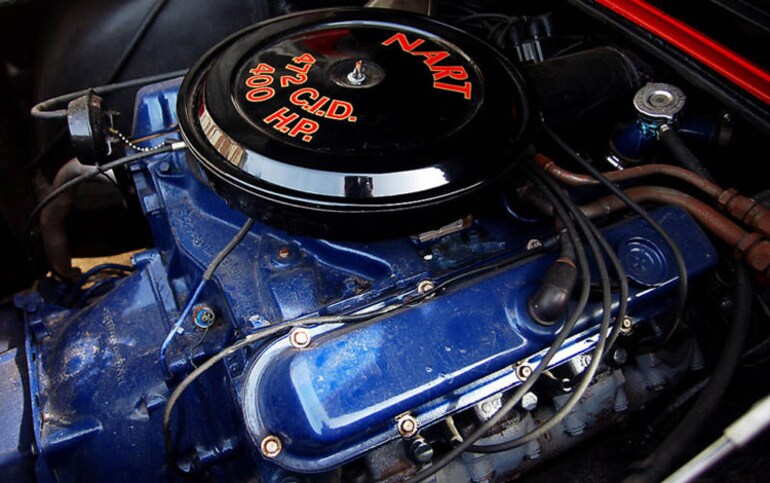
This car wasn’t built from scratch in the traditional sense. Its core came from the Cadillac Eldorado, but everything from its drivetrain to its structure was reimagined. Most notably, the original front-wheel-drive V8 setup was relocated to the rear—an ambitious engineering feat in itself. The powerful 472 cubic-inch engine, which originally produced 375 horsepower, was upgraded to churn out an estimated 400 horsepower. This bold move showed just how serious Chinetti was about performance.
The 1970 NART Zagato's cabin boasts a luxurious four-seater layout, with each seat meticulously covered in genuine leather, accented by striking red stripes along the edges, enhancing both comfort and visual appeal. (Picture from: MotorTrend)
Design elements were a clever blend of various GM vehicles. The taillights, for instance, were taken from a Pontiac GTO, while the dashboard, steering column, and braking system came from Cadillac’s own lineup. To counterbalance the car’s size and ensure it performed like a proper sports car, Zagato used aluminum extensively in its bodywork, keeping the weight impressively low. The sleek, futuristic design made it a true showstopper.
The 1970 NART Zagato is essentially a heavily modified Cadillac built on a chassis that originally started as a Cadillac Eldorado, with the 472 cu-in V-8 and FWD transaxle repositioned to the rear. (Picture from: MotorTrend)
In 1971, the Cadillac NART Zagato made its official debut at the Turin Motor Show. Chinetti hoped it would be the beginning of a new chapter in his automotive journey. Orders were ready to be taken, and two additional designs were already in the pipeline. But then, unexpectedly, GM pulled out of the project. The economic downturn of the early ’70s, coupled with delays during development, led the American giant to withdraw its support—leaving the project hanging by a thread.
The Cadillac NART Zagato wasn’t built entirely from scratch, as it was based on a Cadillac Eldorado but extensively reengineered from its drivetrain to its overall structure. (Picture from: MotorTrend)
With GM gone, Chinetti’s ambitious plan fell apart. No further units were produced, and the only existing prototype remained within the Chinetti family for years. It wasn’t until 1987 that the car changed hands, sold to a collector in Illinois who gave it a complete restoration. After that, the car seemingly vanished—until it resurfaced on eBay in 2008, listed from Brussels, Belgium for just $25,000. How it got there remains a mystery.
The Cadillac NART Zagato might never have become the production icon Chinetti envisioned, but it stands today as a remarkable testament to a moment when creativity, passion, and collaboration tried to break the mold. It’s a story not just about a car, but about daring to dream beyond the limits—even when the odds say otherwise.*** [EKA [15072021] | FROM VARIOUS SOURCES | MOTORTREND | AUTOEVOLUTION | CARROZZIERI-ITALIANI ]
Note: This blog can be accessed via your smart phone.