Compact not Small Maybe many of us have never seen the figure of this tiny car before. Well, that's reasonable because this car actually only exists in Germany called the Treser T-1 'Youth Car' which was first produced by Walter Treser Automobilbau GmbH, a car manufacturer based in Hofstetten, Germany.
The Treser T-1 'Youth Car' is produced by Walter Treser Automobilbau GmbH only 20 units ever during a short production periods of 1987 to 1988. (Picture from: RareComponentCars)
Who's Walter Treser? He's a German famous automotive engineer who once worked for Audi. Perhaps, his name is best known for his role in the development of the original Audi Quattro or 'UR-Quattro,' as it is called today. Treser championed the integration of 4-wheel drive into the company's race cars and passenger cars. His efforts at Audi resulted in a string of rally racing victories and DTM competitions that would continue well until today.
The Treser T-1 'Youth Car' style conveys its mid-engined packaging, with minimal front and rear overhangs, and a high shoulder wedge-shaped profile. (Picture from: RareComponentCars)
As quoted of the Rarecomponentcars, shortly after parting ways with Audi, Treser went on to establish his own custom car manufacturing and tuning company in Hofstetten, Germany in 1981. It should also be noted that during the production period, this car manufacturer in addition to making the cars as mentioned above, also produced several other car models. For the first two years, the company dealt with concept cars. It was not until 1987 that Walter's auto company produced his first vehicle under the owned marque, Treser.
The Treser T-1 'Youth Car' interior features door shelves, sporty control panel, high center console with accessible shift lever arrangement. (Picture from: RareComponentCars)
The company is mostly known for making the most expensive Audi ever built. It was a turbocharged Quattro that featured a tuned suspension and a full leather interior. Its output stood at 250 horsepower. Treser built a similar Audi 100 and went further with the Treser-Audi Quattro Roadster. This model debuted at the 1983 IAA in Frankfurt, the Tresser's roadster featured with a powered retractable roof and exaggerated, track-mounted blister fenders that were wider than the standard one.
The Treser T-1 'Youth Car' is powered by a rear-mounted transversely Golf GTi engine to drive its rear wheels. (Picture from: RareComponentCars)
The company also produces various other Audi models with integrated 4WD and higher ground clearance some kind of a trendy "Safari" thing decades earlier called Treser Hunter Type 85. Among the models of this type is the stretched and raised Audi 5000 named Treser Largo.
There's a seat shell for a small trunk behind the two optimal shell seats, called an 'oven bench' in internal jargon, was arranged in such a way that the roof disappeared, snake-like, behind it when opened. (Picture from: RareComponentCars)
Still, Walter Treser's true ambition was to create a car of his own. The idea was to produce an affordable sports car and that's could be a defying project for him. Then he decided to build his dream car as a hardtop roadster featured with a rear-wheel drive, rear-engine that was powered by a Golf GTi engine mounted transversely. He partnered with Hydro Aluminum, a company he tasked with designing an aluminum honeycomb floor-pan for those car.
One of Treser's more famous creations of the 1983, the Treser Roadster based on the Audi Ur-Quattro. (Picture from: Flickr)
Treser designers Gert Schollmann and Hans-Joachim Walitschek began designing the T-1 in 1982. The style conveys its mid-engined packaging, with minimal front and rear overhangs, and a high shoulder wedge-shaped profile. The interior features door shelves, sporty control panel, high center console with accessible shift lever arrangement.
One of Treser's more famous creations of the 1984 to 1985, the Treser Hunter Type 85 based on the Audi 100. (Picture from: FavCars)
A seat shell for a small trunk behind the two optimal shell seats, called an 'oven bench' in internal jargon, was arranged in such a way that the roof disappeared, snake-like, behind it when opened. As the result the Treser T-1 'Youth Car' has a brief and compact designs The spec called for light weight and an aerodynamic shape, with a fully retractable folding roof.
One of Treser's more famous creations of the 1986, the Treser Largo based on the Audi 5000. (Picture from: AudiStory)
Initially, Treser intended his car could be considered to be a "Ferrari for young people" featured with interesting but not too expensive technology, and affordable production costs. However what happened next was the opposite, the T-1 sports car development costs had soared through the roof construction also due to the bespoked aluminum floor and uses Volkswagen sourced drivetrain components. As the result, the company only built 20 examples of Treser T-1 'Youth Car.' This unique Treser car debuted at the Frankfurt Motor Show 1987 with a black hardtop and a red example with the retractable roof and a beige leather interior.
The car was then enrolled for racing during the DTM season with Tom Kristensen was the test driver behind the wheel. The race was exciting, but not enough to save Walter Treser Automobilbau from bankruptcy. The company became insolvent in 1988.😭
As quoted of the Audiworld, the Treser brand name made a comeback in the early '90s. This time, they tuned Volkswagen Corrados, Polos, and Golfs. Treser decided to come back to motorsport as well. He was part of the team that developed the 4WD DTM Calibras built by Opel. *** [EKA | FROM VARIOUS SOURCES | PETROLHEADIA | RARECOMPONENTCARS | AUDIWORLD | SECONDWIKI | ROADANDTRACK | 1000SEL ]
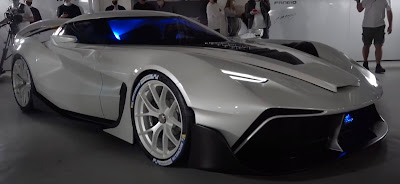
F12 Anger Face - There's a hypercar currently attracts a lot of attention in cyberspace, and becomes a trend due to it said to be the only one in the world, in the other hand it has an appearence sort a bit similar to the Ferrari F12TdF. As quoted of Autoevolution, the hypercar has ever been seen in the United Arab Emirates in May last year, and from its exterior appearance, it can be seen as the wildest creation if compared to the standard version.
The custom-built Veloqx Fangio has been seen in action for the first time at the Yas Marina Circuit in Abu Dhabi. (Picture from: Motor1)
Recently, the mentioned hypercar is back and and making its official debut at Yas Marina Circuit in Abu Dhabi by using another name as the Veloqx Fangio. Well, the name is may be a bit unique and sound unfamiliar, but there's a long history behind it.
It turns out that the hypercar's name is linked to the UK-based Veloqx Racing Team that plans in near future to end its hibernation in motorsport since the climax of its successful 2004 campaign with a pair of Audi R8 LMP1 prototypes, which resulted in a winning at the Sebring 12 Hours racing events and a runner-up at the Le Mans 24 Hours at that year.
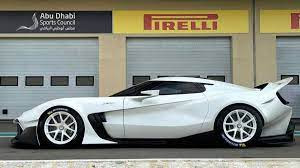
The custom built Veloqx Fangio is powered by a V12 zero-emission combustion engine that can run on a variety of alternative fuels, including biofuels and hydrogen. (Picture from: HotCars)
Meanwhile, Fangio was chosen as a tribute to an Argentinean legendary racer and five-time F1 world's champion, Juan Manuel Fangio nicknamed El Chueco. During his long racing career, he also competed in those two endurance races we mentioned above, plus the 24 Hours of Spa. In addition, Fangio ever won the 1953 Carrera Panamericana.
The custom built Veloqx Fangio is the result of three years of dedication and craftsmanship from the Veloqx team to pay tribute to El Chueco. (Picture from: AutoMundo)
Besides that, the legendary Argentine racer has raced using many cars made by the world's top automotive manufacturers, such as Alfa Romeo, Ferrari, Lancia, Maserati, and Mercedes, plus several defunc brands such as Gordini and Talbot-Lago.
Once everything is clear what exactly is the Veloqx Fangio. It's just that there is no official statement regarding this, but as quoted of the Motorsport, which had a chance to interview to the founder of the UK-based racing team, Sam Li last year who said that his team was planning to race at the FIA World Endurance Championship in near future by using its own car named the Veloqx Fangio Hypercar.
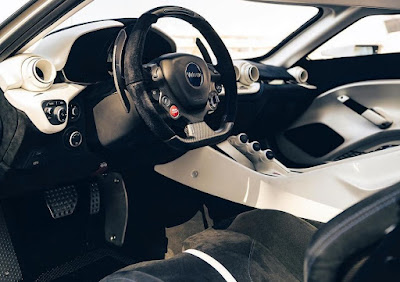
While the interior appears to be appropriately race car-spartan with one interesting feature is a digital tachometer and speedometer located on the passenger’s side of the dashboard. (Picture from: Speedster-News)
It is also stated that the car will be powered by an engine capable of running on various types of fuels including biofuels and hydrogen. And reportedly a 'zero-emission combustion engine' is also being developed, along with a low-volume road car. The plan is for the car to start racing in 2025, though Sam Li has not ruled out an early return of the Veloqx Racing Team.
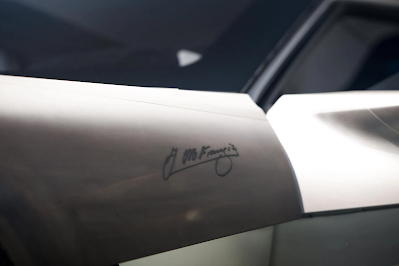
The Veloqx Fangio is a custom built car based on the Ferarri F12TdF to pay
tribute to Juan Manuel Fangio and even
has his signature on the side. (Picture from: Speedster-News)
Initial tests took place last year at the Bahrain International Circuit and have now been filmed at the Yas Marina Circuit in Abu Dhabi. As we can be seen, the Veloqx Fangio looks crazy cools and run on an LMP2' spec slick-tyres. Furthermore, its ultra-aggressive body kit serves the functional purpose of maximizing aerodynamics after three years of Computational Fluid Dynamics (CFD) research, and meanwhile the giant front divider looks like it could easily double as a snow plug, the rear diffuser is reminiscent of a tractor aerator.
The custom built Veloqx Fangio is a crazy looking thing with an ultra-aggressive body kit and even runs on LMP2-spec slick tyres. (Picture from: Zero2Turbo)
Judging by the innards, the Veloqx Fangio uses more than just an Ferrari borrowed engine that at first glance looks to be based on the F12, possibly the same engine used by the F12TDF. However, it still cannot be confirmed. We know for a fact that the engine sound is excellent and the top-mounted quad exhaust is an interesting sight to behold.
However, there's some bad news regarding the use of the 'Fangio' name for the car. As quoted of Motor1, Fangio's heirs said that Veloqx never requested such authorization... This, without a doubt, could cause a serious problem for the British company. But on the other hand Li assures that he has the rights to use the Fangio' name 'in the fields of motoring and the automotive industry.' Hopefully this problem can be resolved as well as possible.
As quoted of Automundo, as seen at the Yas Marina Circuit in Abu Dhabi, it looks very impressive by its performance, and reportedly the British-based Veloqx team plans to produce in limited numbers of 12 units only. Well now is the time for us to sit back and wait for further news. Ciao, baby..!! *** [EKA | FROM VARIOUS SOURCES | MOTORSPORTS | MOTOR1 | CARSCOOPS | AUTOMUNDO | HOTCARS | AUTOEVOLUTION ]
Star Rides - Back in the 1990s, the automotive world was a playground for creativity, wild concepts, and one-off projects designed not for the masses but for icons. And when you’re Wilt Chamberlain—one of the most legendary figures in NBA history standing over seven feet tall—your car needs aren’t exactly what you’d call “standard.” This is the story of a rare gem, the Chamberlain Searcher One, a supercar so unique that it wasn’t just built to turn heads—it was engineered to fit a giant.
NBA Star Wilt Chamberlain posed along with his dreamcar called Searcher One (Picture from: New York Times)
From a distance, the car might give off Jaguar XJ220 vibes, with its long, sleek silhouette and exotic appeal. But look a little closer, and you'll find something far more bespoke. Commissioned in 1996, the Chamberlain Searcher One wasn’t just a vanity project—it was a serious performance machine, crafted with personal touches from the ground up. And it all started with Wilt himself. He wasn’t content with just buying a Ferrari or Lamborghini. Instead, he sketched out his dream ride and handed the vision over to Peter Bohanna, a talented engineer with a resume that included working on James Bond film props and futuristic vehicle concepts.
The Seacher One is a mid-engine one-off sportscar specially built for NBA Basketball star Wilt Chamberlain in the 1996. (Picture from: Drive2.ru)
Bohanna took Chamberlain’s vision seriously, beginning the process with a full-scale wooden body buck. One of the main challenges was Wilt’s towering frame—standard sports cars were out of the question. To accommodate, the car’s cockpit had to be extended by six inches, and the roofline adjusted, all while keeping the proportions sporty and aggressive. The result was a dramatic fiberglass body, one that flowed smoothly from nose to tail and screamed '90s supercar fantasy.
The Seacher One is built on a steel and aluminium monocoque with steel tube sub frame and GRP bodywork. (Picture from: Rarecomponentcars)
Bringing this vision to life required serious expertise, which came in the form of Lyncar Motor Company in the UK. Known for their experience in endurance racing, Lyncar based the Searcher One’s chassis on a Le Mans-style design, combining a steel and aluminum monocoque with a tube sub-frame for added strength. Once the body and chassis were complete, the car was flown to California for its final stages.
The Chamberlain Seacher One while sat on display at Brad's Service Center on Front St in Chicopee, MA. (Picture from: Reddit)
Stateside, the car came into the hands of Richard Paul, who initially planned to install a Jaguar V12 engine. But plans changed, and instead, the Searcher One ended up with a thunderous GM V8 mounted at the rear, putting out an estimated 700 horsepower, paired with a 5-speed manual transmission. The interior was nothing short of luxurious, featuring hand-shaped aluminum details, Italian glove leather upholstery, and race-inspired seats with four-point harnesses—proof that performance and comfort could meet halfway.
The Seacher One is powered by a rear-mounted GM V8 engine (which reportedly produces up to 700 hp) combined with a 5-speed manual transmission. (Picture from: Axialflow)
It’s said that Wilt Chamberlain spent around $750,000 to build the Searcher One. Surprisingly, despite all this effort, Wilt rarely drove the Searcher One. Aside from a few visits to the track, the car mostly sat idle, racking up barely 100 miles. It's speculated that even with the modified cockpit, the seating still wasn’t comfortable enough for Wilt’s massive frame. A supercar custom-built to fit a legend, yet it barely got the chance to stretch its legs.😲 | tPnjlm9i2F4 |
What remains today is a story that feels almost mythical—a car designed for a basketball giant, built with movie-set precision, then fading into obscurity. TheChamberlain Searcher Onemay not have roared across highways or conquered race tracks, but its presence left a quiet ripple in the world of custom car craftsmanship. For those lucky enough to glimpse it, it’s a reminder that some legends are built not just for speed, but for the story they carry..***[EKA [19022022] | FROM VARIOUS SOURCES |WIKIPEDIA|NYTIMES|GREYFLANNELAUCTION|AXIALFLOW|RARECOMPONENTCARS|MADABOUT-KITCARS|DRIVE2.RU|CLASSICANDRECREATIONSPORTSCARS |REDDIT]
Note: This blog can be accessed via your smart phone.
Time Busting - Do you remember the iconic car roled in the 'Back to The Future' trilogy in the 1980s? The car, whose full name is DeLorean DMC-12 is konwn as the only one produced by an American car company called the DeLorean Motor Company (DMC) during short production periods of 1981 to 1982.
A teaser image of DeLorean EVolved electric powered sportscar as the result of collaboration DMC with the Italian coachbuilder company, Italdesign. (Picture from: Carscoops)
The mentioned car became popular because it used as a time machine vehicle that could fly in those mentioned 'Back to The Future' trilogy starring Michael J. Fox (as Marty McFly) and Christopher Lloyd (as Dr. Emmett L Brown).
However, the company ever thought that the sedan had become an iconic car, even before the first sequel of the 'Back to The Future' movie was made. But unfortunately the popularity factor was not able to raise the prestige of the DMC-12 at all. The irony of this car was failed to compete in the market and the automaker was later went into bankruptcy in 1982.
The legendary DeLorean DMC-12 taken role as an advance time travel machine in the Back to The Future trilogy in the 1980s. (Picture from: GridOto)
Hopely this time the news right. As quoted of the DeLorean Motor Company official website. To revive this legendary car, it turns out that the American manufacturer not alone, it also involved a well-known Italian coachbuilder company, Italdesign.
It seems that it is not just a rumor anymore and is believed to be true with the presence of a teaser video shared by DeLorean Motor Company and Italdesign through the official social media accounts of both companies. As quoted of Carscoops and Auto Express, DeLorean Motor Company is preparing for a 'comeback' in 2022 by launching an electric vehicle named DeLorean EVolved.
In the teaser video, DeLorean shows a glimpse of the silhouette of the EVolved design which is said being done in collaboration with Italdesign. In addition to doors similar to the DMC-12 owned, the electric version DeLorean sportscar also has a windshield design similar to its predecessor. The difference is that there is no more DMC logo on the grille. Instead, the latest DeLorean car will have a "V" shaped logo.
Unfortunately, neither DeLorean nor Italdesign have released more exterior details or technical specifications of the latest DMC-12 successor. But considering the EVolved will be electric, of course there is no longer a 2,894 cc Peugeot-Renault-Volvo (PRV) V6 engine with 130 hp that originally filled the engine bay. There is a possibility for the DeLorean EVolved will be use the EVX coded platform developed by Italdesign in collaboration with Williams Advanced Engineering.
In
this year, DMC will launch the DMC-12 successor as an electric powered
sportscar named DeLorean EVolved in collaboration with the Italian
coachbuilder company, Italdesign. (Picture from: Carscoops)
At a glance about the EVX, Italdesign said that the platform could be developed into an electric sedan, crossover, GT, and convertible. It is also predicted to have a 104-120 kWh battery packages that is claimed to be able to give off a maximum power of 1,000 kW or 1,360 hp. Not only that, the EVX can also be configured with a 160 kWh battery so that it is claimed to be able to cover a distance of up to 1,000 kilometers.
When it is produced later, hopefully it will be successful in the market. For now on, there is nothing wrong if we just wait and see for the continuation of the news about this electric car from DMC and Italdesign. Because that's what we can do right now. See ya..! *** [EKA | FROM VARIOUS SOURCES | DELOREAN | INSIDEEV | CARSCOOPS | AUTOEXPRESS | BLOG.DUPONTREGESTRY.COM ]
Two-G in One-B When we saw this unique-shaped car for the first time on the Quirky Rides' status at Twitter we were momentarily stunned, because at first glance it looks like a Volkswagen Beetle, but upon closer inspection it looks more like a Porsche model. What the car is this? Maybe that's your impression when you first saw this car. Thus, here's one unique Brazilian custom made car adopted two German legendary car-designs.
Volkswagen Fusca Cintra 959 designed by André Cintra and built based on the legendary Volkswagen Beetle. (Picture from: QuirkyRides)
This unique-looking car was made by Brazilians whose idea came about when the country were closed the doors for imported cars. So that's sparking the illusion and imagination of many creative people in Brazil to make their own car creations based of the famous sports car.
Volkswagen Fusca Cintra 959 attended in an automotive event at the Autódromo de Interlagos which clearly inspired by Porsche 959 as the result of André Cintra (in pictured one who stand next to the car with hands in pockets and glasses). (Picture from: FuscaClassic)
The mentioned car above was Volkswagen Fusca Cintra 959 is created by a Brazilian youth named André Cintra in early 1990s. The unique car was inspired by Porsche 959, the famous racing car participated (competing in Group-B) at many major rallies in the world, even in the famous Paris-Dakar Rally. Amazingly, the Porsche 959 won the Paris-Dakar Raly in 1986, as well as made Porsche being the only automaker to win all kinds of races and championships where it raced!
Anísio Campos (standing on the left), Fernando Stickel (in the middle) Tito Nakao (on the right) posed along with André Cintra (below crouching) in the designers course promoted by Anísio and Stickel back in the 1988. (Picture from: FuscaClassic)
The story begins when in 1988, a Brazilian car designer named Anísio Campos and Fernando Stickel founded an automotive designers class for youth and asked his students to make the design-changed sketches of the legendary Volkswagen Beetle. One of his students was André Cintra, who was 15 years old at the time. He is known as a true Porsche fan to the point that he keeps a photo of the Porsche 959 under his pillow, which reportedly through the photo, then he created a unique car with a nice combining of VW and Porsche exterior designs.
Volkswagen Fusca Cintra 959 designed by André Cintra was a body kit transformation by adapting the genius minds of Ferdinand Porsche in his two most famous projects namely the Porsche 959 and the traditional Volkswagen Beetle. (Picture from: BrasilForeadeSerie)
André Cintra sketched the design changes of the Volkswagen Beetle to Porsche complete with assembly schematics. As Anísio Campos stated at the time, that the Cintra project was an agile proposal as it was a body kit transformation by adapting the genius minds of Ferdinand Porsche in his two most famous projects namely the Porsche 959 and the traditional Volkswagen Beetle. As the result was a viable car to produce, and did not rely on great financial investment.
Volkswagen
Fusca Cintra 959 designed by André Cintra was a body kit transformation
by adapting the genius minds of Ferdinand Porsche in his two most
famous projects namely the Porsche 959 and the traditional Volkswagen
Beetle. (Picture from: FuscaClassic)
Armed with the passion and knowledge he gained from Anísio Campos, André Cintra (then 19 years old) decided to go a step further and bought a VW Beetle of 1985 to serve as a guinea pig. He did many experiments for over a year until the mold was ready. André Cintra made his dream car by hand based on the Volkswagen Beetle (in Brazil called Fusca) with a body made of fiberglass in the 1992. The original Beetle's fenders and hood were removed. Its body consists of three pieces of fiberglass glued to the rest of the Beetle's structure.
The car other detailing such as the rear view mirrors, headlights, etc are taken from the cars of the time. The taillights are genuine of the Porsche 911s, while the wheels are replicas of those used on Porsches. While the interior is only accommodate 1 passenger sat on the Recaro racing seat. And three units ever built for racing track purposed only, and all powered by a 1.8 turbo Volkswagen engine.🏁 *** [EKA | FROM VARIOUS SOURCES | QUIRKY RIDES | AR.MOTOR1 | FUSCACLASSIC | BRASILFORADESERIE ]
Sempre Una Vespa - We are sure most of you must have seen the Piaggio MP3 passing by on the streets in your place. But has it ever think by us how the Italian scooter manufacturer first developed it? Well, on this occasion we will show to You the figure of several three-wheeled vehicles that were ever develop and launch in the 1980s which is most likely the forerunner of the Piaggio MP3.
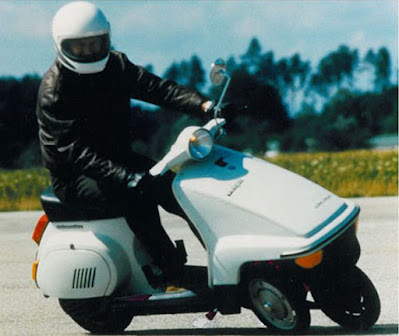
The Trautwein Doppelfront Prototype built on Piaggio Vespa PX 200 E-Lusso by Dr. Wolfgang Trautwein.(Picture from: MedienWerkStatt)
You would be remembered that long before the Piaggio MP3 was born, the Italian scooter manufacturer had also produced simple three-wheeled vehicles such as the Piaggio Ape. Of course, in terms of appearance and technology, the classic three-wheeled vehicle is far behind when compared to the MP3.
Then you will ask whether previously there were three-wheeled vehicles that had technology similar to the Piaggio MP3, of course the answers were many, such as the Italjet Scooop without forgetting the Renault Ublò concept or Autostudi A-Trix and many others.
The Trautwein Doppelfront Prototype built on Piaggio Vespa PX 200 E-Lusso while on the road testing.(Picture from: SoyMotero.net)
Well, when we talk about the Piaggio MP3, of course we will discuss exclusively about tilting three wheeler vehicles, not vehicles like the classic Piaggio Ape, sidecars (there are also tilted) or ordinary tricycles. So it can simply be said that what we will be discussed is more focus on three-wheeled vehicles with two wheels positioned in front (such later adopted by the Piaggio MP3), because it is considered more rational, stable and effective than the one which has two wheels at rear.
The Trautwein Doppelfront Prototype built on Piaggio Vespa PK 125 by Dr. Wolfgang Trautwein. (Picture from: 2StrokeBuzz)
It's hard to say who actually first developed a three-wheeled vehicle like this. However, the history of the tilting three wheeler vehicle can be said to have started with a such vehicle developed in 1946 by Ernst Neumann called the Neander N2. As can be seen from the old image circulating in internet, the Neumann-developed three-wheeled vehicle is a three-wheeled racing car that looks has double spring that tip with driver's weight, so it can tilt while speeding on the curves.
The Trautwein Doppelfront Prototype built on Piaggio Vespa PK 125 while on the road testing. (Picture from: BikeIt.gr)
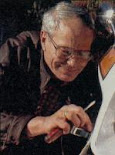
Dr. Wolfgang Trautwein (Picture from: Maxmatic.com)
And the forerunner of the MP3 which was specifically developed by the Italian manufacturer stems from the Trautwein Doppelfront tilting three-wheeled prototype which was originally developed by an engineer, inventor from Meersburg at the Bodensee, Germany named Dr. Wolfgang Trautwein in the 1980s.
Initially, the concept started from the implemented vehicle by a simple and effective dual-wheel in front, where its modular steering system so that it can be combined with different vehicles, it is even said to have been installed on the Honda CX500C and is combined with the Silver Wing fairing model (not a scooter as it is today).
The first tilting three-wheeler developed in 1946 by Ernst Neumann called the Neander N2 racing car that looks has double spring that tip with driver's weight, so it can tilt while speeding on the curves. (Picture from: Cybermotorcycle)
Dr. Trautwein suggested the concept using the Vespa-scooter platform, exactly three decades after the first motorcycle was equipped with a double-front chassis. In mid-1984 Dr. Trautwein received two original Vespa scooters (Vespa PX 200 E-Lusso and Vespa PK 125) from the Genoa-based scooter manufacturer to build a prototype of the tilting three-wheeler vehicle which later could be considered to be the forerunner of the MP3 today.
The Trautwein Doppelfront Prototype built on Honda CX 500 by Dr. Wolfgang Trautwein. (Picture from: Wikimedia)
Under the hoods, the Vespa tricycles hide the newest variant of the Trautwein developed front axle for motorcycles, known as the parallelogram axle. Thus, the scooter effectively avoids wheel-flutter. The suspension is arranged so that the wheels do not only turn when rolling, but also tilt. The floorboards of the Vespa are firmly connected to the lower parallelogram, and follow its movements. This changed style of driving comes relatively easily to the rider.
The Trautwein Doppelfront Prototype built on Honda CX 500 while on the road testing. (Picture from: Epilog.de)
And according to Dr. Trautwein, the chassis offers many safety advantages, ie decreased hazard of front end slip on wet pavement, rails, etc. The vehicle provided more safer braking, better handling when it cornering. Furthermore it provided more space for a trunk over the front axle. Besides, the comfort is quite convincing.
The Aprilia Los Angeles three-wheeler concept is shown as a prototype of the Intelligent Mobility Lab. Motorizzato Piaggio Master 500 at the 2000 Bologna Motorshow. (Picture from: ApriliaForum)
The concept of a tilting three-wheeled vehicle is continuously being developed by Piaggio and at the 2000 Bologna Motorshow, another well-known Italian brand, Aprilia launched the Los Angeles is a prototype of the Intelligent Mobility Lab. Motorizzato Piaggio Master 500, refined and evolved and already has the electro-hydraulic block to do without the stand.
The Piaggio MP3 500 HPE Sport Advanced known as the world's first tilting three-wheeled vehicle featured with reverse gear. (Picture from: GridOto)
There is no mention of production, but of accessories, ABS, GPS and a covered version with a reclining roof. Unfortunately, it will remain a prototype, even in this case it is the lack of economic liquidity that takes away the possibility of driving it on the roads, but now the way is marked. Finally the first model of Piaggio MP3 was launched in 2006 and marketed globally by this Italian manufacturer which then occupies the highest niche in its production line to this day.
The Piaggio MP3 is known as the world's first tilting
three-wheeled motorcycle which is equipped with various mainstay
features so that it is claimed to be more safer to ride. And today Piaggio MP3 comes in many variants under several powertrain options ie 250cc, 300cc, 400cc and 500cc. 🇮🇹


 As quoted of the Audiworld, the Treser brand name made a comeback in the early '90s. This time, they tuned Volkswagen Corrados, Polos, and Golfs. Treser decided to come back to motorsport as well. He was part of the team that developed the 4WD DTM Calibras built by Opel. *** [EKA | FROM VARIOUS SOURCES | PETROLHEADIA | RARECOMPONENTCARS | AUDIWORLD | SECONDWIKI | ROADANDTRACK | 1000SEL ]