Retro Ingenuity - Sometimes the automotive world surprises us with machines that feel less like products and more like ideas made tangible—snapshots of what designers and engineers were dreaming about at a particular moment in time. The mid-1980s were full of that kind of experimental energy: wedge shapes, bold door mechanisms, and a willingness to treat even compact platforms as canvases for something exciting. Within that creative atmosphere emerged the Mitsubishi Colt Mirage Spyder Concept of 1986, a car that seemed built to stretch the imagination rather than fill showrooms.
The 1986 Mitsubishi Colt Mirage Spyder Concept, a car that seemed built to stretch the imagination rather than fill showrooms. (Picture from AllCarIndex)
Mitsubishi based the concept on the second-generation Mirage, a modest, sensible hatchback known more for efficiency than theatrics. Yet the transformation into the Spyder was dramatic enough that the origin was almost unrecognizable. The designers carved the car into an open-top, speedster-style roadster with a profile so low it looked ready to slice through the air. Adding scissor doors—a feature usually reserved for high-end exotics—gave the prototype a futuristic flair, and the overall shape suggested a playful rebellion against the norms of its era. While surviving documentation about the interior is limited, the exterior alone indicated a focus on sensation as much as function. It was the sort of design crafted to spark a reaction before you even approached it.
The 1986 Mitsubishi Colt Mirage Spyder Concept was shaped as an open-top speedster with an ultra-low profile that looked ready to cut through the air. (Picture from AllCarIndex)
Technical specifics were never the core purpose of the project, and Mitsubishi kept the details close. However, the concept likely borrowed from the Mirage’s familiar mechanical lineage. That would mean a 1.5-liter 4G15 inline-four resting under its sculpted panels, probably in the single overhead cam configuration common at the time. Engines of that type produced around 94 horsepower at the crank, more modest than muscular, but sufficient for a lightweight experimental roadster. For a car built primarily to showcase styling and possibility, the powerplant served more as a dependable companion than a headline feature.
The 1986 Mitsubishi Colt Mirage Spyder Concept featured scissor doors typically seen on exotic cars, reinforcing its futuristic flair and playful defiance of 1980s design norms. (Picture from AllCarIndex)
The Spyder’smost visible moment in the spotlight arrived not on a motor show floor but on film. It made an appearance in Jackie Chan’s 1986 movie Armour of God, where its unusual silhouette and theatrical doors made it immediately memorable. For many viewers, this fleeting role became their only encounter with the car, reinforcing its status as something rare—almost mythical.
The 1986 Mitsubishi Colt Mirage Spyder Concept likely drew from the Mirage’s mechanical roots, using a 1.5-liter 4G15 SOHC inline-four producing around 94 horsepower to suit its lightweight, experimental nature. (Picture from AllCarIndex)
Like many concept vehicles of its time, the Colt Mirage Spyder was never meant for mass production. It lived as a one-off prototype, a design experiment that existed long enough to leave an impression and then quietly fade into Mitsubishi’s archives. Yet its legacy feels surprisingly current. Today’s automotive landscape, with its revived interest in compact sports cars, retro-influenced styling cues, and the blending of the practical with the playful, echoes some of the spirit that shaped the Spyder decades ago. Even its audacious door design resonates with modern brands that use dramatic openings as part of their identity. | X6xQyx4NQNY |
What remains most compelling about the 1986 Colt Mirage Spyder Concept is the way it captures a moment when imagination outran expectations. It took a humble platform and reimagined it as something adventurous, cinematic, and almost whimsical. That kind of creative leap is why concept cars continue to fascinate; they remind us that automotive design isn’t only about engineering constraints or market demands, but also about daring to shape metal into ideas. *** [EKA | FROM VARIOUS SOURCES | STORY-CARS | ALLCARINDEX | CCDISCUSSION ]
Note: This blog can be accessed via your smart phone.
Mini Monster - Japan is known for its innovation and creativity in the automotive world, and nowhere is this more evident than in the delightful variety of small, uniquely styled vehicles that roam the streets. Known as 'kei cars,' these compact vehicles are manufactured by nearly every major Japanese brand, including Daihatsu, Honda, Mitsubishi, Nissan, Suzuki, and Toyota. These small cars have a charm that’s hard to overlook, thanks to their petite size and characteristic designs.
The RE Amemiya GReddy 6-AZ1 was rebuilt in 2000, emerging in its final form with a striking white finish. (Picture from: GTSupreme)
Maestro WORKS - Luigi 'Lutz' Colani, a legendary figure in automotive design, brought his visionary touch to numerous projects, but one that stands out for its mystery and intrigue is his concept for the Dodge Stealth. This unique design, often referred to as the Luigi Colani Blue Car, reimagined the controversial Dodge Stealth, a car that found itself at the center of national debates about American identity in the early 1990s. Colani’s interpretation breathed new life into the Stealth, taking it beyond the limits of its original concept and influencing future designs in the process.
The Dodge Stealth Concept by Luigi Colani, also known as the Colani Blue Car, was displayed at the Colani Design Museum. (Picture from: CultObjects in Flickr)
The Dodge Stealth itself was part of a collaboration between Chrysler and Mitsubishi, built on the Japanese Z16A platform shared with the Mitsubishi GTO/3000GT. While it carried Dodge branding, the car’s Japanese origins became a point of contention. In 1991, the Stealth was selected as the pace car for the 75th Indianapolis 500, but this decision faced harsh criticism from union leaders and patriotic fans who felt the car didn’t represent true American craftsmanship. The tension surrounding the Stealth was heightened by the Gulf War, leading Chrysler executives to reconsider their choice. In February 1991, just months before the race, they replaced the Stealth with a pre-production Dodge Viper, a car that symbolized American muscle and ingenuity.
The Colani Blue Car is said to be a design built for the Dodge Stealth, based on Mitsubishi's Z16A platform, which is shared with the Mitsubishi GTO/3000GT.(Picture from: CultObjects in Flickr)
Amid this controversy, Luigi Colani’s design for the Dodge Stealth emerged. While it’s unclear whether Colani was officially commissioned by Chrysler or whether this was an independent project, his design transformed the Stealth in a way that was uniquely his. Colani’s take on the car featured his signature bio-design language, with fluid, organic shapes that made the vehicle look like it was in motion even when standing still. The front fascia, with its elongated nose and double headlights, gave the car an almost otherworldly appearance, blending aerodynamic efficiency with Colani’s artistic vision. The rear, reminiscent of American muscle cars like the Camaro, added a sense of raw power and speed to the design.
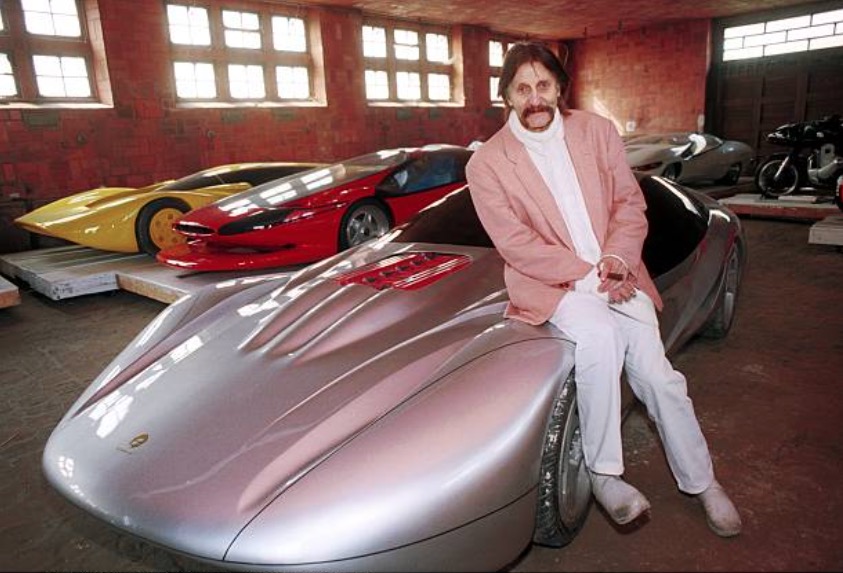
Luigi Colani posed alongside his car creations, such as the Mamba Concept, Ferrari Testa D'Oro, and many others. (Picture from: RawViper)
Although the Luigi Colani Dodge Stealth concept didn’t reach mass production, it showcased Colani’s ability to reinterpret a vehicle at the center of a national debate and turn it into something bold and futuristic. His design pushed the boundaries of what the Dodge Stealth could be, moving it away from the controversy surrounding its Japanese roots and into the realm of art and innovation.
The Colani Mamba Concept, when viewed as a whole from the front, reveals a unified design where the flowing lines and curves come together to resemble the shape of a Mamba snake's head.(Picture from: Sumally)
Interestingly, Colani’s work on the Dodge Stealth seemed to have a lasting influence on his later designs. In the late 1990s, Colani revisited the Dodge brand, creating several remodels of the Dodge Viper in collaboration with Autohaus Getra, a German automotive company. His work on the Viper, including the Mamba Concept, featured striking elements that echoed his earlier Stealth design. The distinctive double headlights and flowing lines that characterized the Colani Blue Car reappeared in these remodels, suggesting that Colani’s experience with the Stealth left a lasting impact on his design philosophy.
The Colani Shark Speedster was designed and built by Luigi Colani in collaboration with the German auto design house Reinhard Stahl.(Picture from: Autoweek.nl)
Colani’s work in the early 2000s further demonstrated the influence of his Dodge Stealth concept. One notable example is the Colani Shark Speedster, a design that emerged in collaboration with Reinhard Stahl, a German auto design house. The Shark Speedster, with its sleek lines and futuristic aesthetic, bore a resemblance to the Colani Blue Car, particularly in its front fascia. It’s as though Colani took the DNA of the Stealth design and refined it for the next generation of his work. | zF4wJglSr_8 |
The Luigi Colani Dodge Stealth concept stands as a testament to the designer’s ability to turn controversy into creativity. Where others saw a car mired in debates about national identity, Colani saw an opportunity to push boundaries and redefine what the Stealth could be. His Blue Car design, with its organic shapes and radical ideas, not only reimagined the Stealth but also laid the groundwork for future projects, leaving an indelible mark on automotive design well into the 2000s. *** [EKA | FROM VARIOUS SOURCES | COLANI | COLANI.ORG | CULTOBJECTS IN X | BUBBLEMANIA.FR | STORY-CARS| RAWVIPER | DODGEGARAGE | MOPARINSIDERS | REDDIT WEIRDWHEEL ]
Note: This blog can be accessed via your smart phone.
Weird ONES - From Japanese automotive manufacturers, we are spoiled by a variety of impressive automotive products. One of the most fascinating sights in Japan is the array of unique and charming small cars, known as Kei cars, produced by famous manufacturers such as Daihatsu, Honda, Mitsubishi, Nissan, Suzuki, and Toyota.
Yamaha also ventured into the kei-car market segment with a unique offering, the YM MobileMates Ami, in 1991. (Picture from: SmallCarsClub)
However, there is one well-known Japanese brand that typically does not come to mind when thinking about four-wheeled vehicles: Yamaha Motor Company. Famous for its musical instruments and motorcycles, Yamaha has made a surprising yet noteworthy entry into the world of cars with the Yamaha OX99-11 and the Yamaha Sports Ride Concept.
The YM MobileMates Ami, a peculiar micro coupé inspired by the design of the Ferrari F40, was essentially a modified version of the Daihatsu Opti. (Picture from: GridOto)
Yamaha's journey into the automotive industry started much earlier than the OX99-11. In 1967, Yamaha played a significant role in developing Japan's first true sports car, the Toyota 2000GT. Over the years, Yamaha also designed and supplied various engines to other automakers, including the renowned 3.0-liter V6 and 3.4-liter V8 units for the Ford Taurus SHO. Despite these achievements, Yamaha never fully embraced the production of four-wheeled vehicles, focusing instead on their strengths in motorcycles and engines.
The
YM MobileMates Ami, a peculiar micro coupé inspired by the design of
the Ferrari F40, was essentially a modified version of the Daihatsu
Opti. (Picture from: GridOto)
The love for small cars in Japan is immense, particularly for the Kei cars. These compact vehicles are beloved for their small size and efficient engines, typically around 660 cc. Kei cars are a staple of Japanese automotive culture, known for their practicality and charm. Interestingly, Yamaha also dipped its toes into this market segment with a unique offering in 1991.
When the YM MobileMates Ami is compared directly with the Ferrari F40, the design is strikingly similar, though it is smaller and more whimsical. (Picture from: SmallCarsClub)
YM MobileMates, a branch of Yamaha Motor Company, introduced the Ami (stylized as "ami"), a peculiar micro coupé inspired by the design of the Ferrari F40. The Ami was essentially a modified version of the Daihatsu Opti, featuring a faux mid-engine design and an exaggerated rear spoiler. This tiny car, with its whimsical Ferrari-inspired appearance, boasted the same engine as the Opti – a 40.5 kW (54 hp) SOHC or DOHC 12-valve engine.
The tiny YM MobileMates Ami with its whimsical Ferrari-inspired appearance, boasted the same engine as the Opti – a 40.5 kW (54 hp) SOHC or DOHC 12-valve engine. (Picture from: BeForward)
The transformation from the Daihatsu Opti to the Ami involved significant modifications. While the doors and front fenders remained the same, the roof was reshaped into an arched design, and the rear end was equipped with fake air intakes to mimic a mid-engine layout. The four round taillights unmistakably paid homage to Ferrari, giving the Ami a distinctive look that was hard to ignore.
The YM MobileMates Ami also featured with a dummy mid-engine design body coupled with a spoiler that is the same height with its rounded roof. (Picture from: DrivenToWrite)
Initially, Yamaha planned to produce 600 units of the Ami, priced at 2.15 million yen. However, the market had more affordable alternatives, such as the Autozam AZ-1 and Suzuki Cappuccino, which were priced around 1.4 million yen. Interestingly, the car was sold exclusively in the Tokyo area through an event ticket supplier called Ticket Pia. Consequently, the Ami struggled to find buyers, and only three units were sold, making it an extremely rare and collectible vehicle. | QCCTj-71WOQ |
In an era where many cars feel overly serious and uniform, the Yamaha Ami stands out as a delightful exception. Its whimsical design and limited production make it a unique gem in automotive history, a testament to Yamaha's innovative spirit and willingness to explore beyond its traditional boundaries. The Ami remains a charming reminder that even in the world of cars, there's always room for fun and creativity. *** [EKA | FROM VARIOUS SOURCES | HANDWIKI | SMALLCARSCLUB | DRIVENTOWRITE | OV9 | BEFORWARD ]
Note: This blog can be accessed via your smart phone
Futuristic ONES - From the 2023 Japan Mobility Show, it's Mitsubishi Motors Corporation's turn to shine as they introduce the Mitsubishi D:X Concept at this automotive event. This concept car is set to be the future successor to the Delica model and is destined for mass production.
The Mitsubishi D:X Concept is taking center stage at Mitsubishi's booth during the 2023 Japan Mobility Show. (Picture from: Kumparan)
Hiroshi Nagaoka, the Executive Vice President of Mitsubishi Motor Corporation, highlighted the unique nature of the D:X Concept compared to other Mitsubishi concept cars. He explained, "This D:X Concept is a bit different compared to other Mitsubishi concept cars, such as the previous XForce. So this is different, it won't exactly look like this, but usually when Mitsubishi has a concept model, it won't be produced for long."
The Mitsubishi D:X Concept plays a crucial role in the development of the new Delica line, focusing on plug-in hybrid (PHEV) technology as its primary power source. (Picture from: Otomotif-Kompas)
While an exact production timeline for the MPV Crossover prototype remains undisclosed, the company's goal is clear – it shouldn't be later than 2023. Nagaoka emphasized, "We still don't know the timing, but maybe before 2030 we can see it. Because this is a global model, to challenge the global market, we will try to bring it."
The Delica's character can be seen from the Mitsubishi D:X Concept's side window graphics that extend from the front of the cabin to the sturdy D pillar. (Picture from: PhilKotse)
The D:X Concept plays a crucial role in the development of the new Delica line, focusing on plug-in hybrid (PHEV) technology as its primary power source. What sets the D:X Concept
apart is its ability to combine the characteristics of both MPV and SUV
concepts. It promises to handle various terrains and obstacles with
ease, all while providing a comfortable and spacious interior like that
of an MPV.
What sets the Mitsubishi D:X Concept apart is its ability to combine the characteristics of both MPV and SUV concepts. (Picture from: Viva)
A futuristic, aggressive design with a boxy body is the first impression when you see the D:X Concept. The Delica's character can be seen from the side window graphics that extend from the front of the cabin to the sturdy D pillar.
The Mitsubishi D:X Concept's interior is very spacious and safe, with panoramic seats that move up and down, providing an unprecedented driving experience. (Picture from: PhilKotse)
The impression of space is created by the windshield which extends downwards. Over fender fenders with large diameter tires provide a strong impression, with additional slip plates and protectors on the foot steps.
The front still carries the Dynamic Shield model. The laser projector lamp has a distinctive T shape, extending to the side to give a wide impression. This D:X Concept uses a copper color with a semi-gloss texture.
The Mitsubishi D:X Concept promises to handle various terrains and obstacles with ease, all while providing a comfortable and spacious interior like that of an MPV. (Picture from: Viva)
Nagaoka provided further insights into its design, saying, "The size is larger than the current Delica model, as the ground clearance is very high. So you could say this car can be taken anywhere because it can also rotate 360 degrees."
The Mitsubishi D:X Concept aligns with Mitsubishi's latest hybrid technology advancements, ensuring enhanced performance, power, and a focus on environmental sustainability. (Picture from: Viva)
Moreover, the D:X Concept aligns with Mitsubishi's latest hybrid technology advancements, ensuring enhanced performance, power, and a focus on environmental sustainability. This aligns with the company's commitment to achieving carbon neutrality.
In summary, the Mitsubishi D:X Concept isn't just another fleeting idea. It represents the future successor to the Delica model and is on track for mass production. This concept car distinguishes itself from typical Mitsubishi concepts, underlining the company's dedication to bringing it to life.
While an exact production date for the MPV Crossover prototype remains unspecified, the goal is to make it a reality before 2030, especially in global markets. The D:X Concept combines the best of both MPV and SUV worlds, making it versatile for any adventure while maintaining passenger comfort. Additionally, it incorporates Mitsubishi's latest hybrid technology to contribute to a more sustainable automotive future. *** [EKA | FROM VARIOUS SOURCES | MITSUBISHI | PHILKOTSE | CARSCOOPS | TOPGEAR | HUPEBEAST ]
Note: This blog can be accessed via your smart phone.
Forgotten ONES - In the 1980s can be regarded as an era where the Japanese-made sports cars began to squirm and show its potential to the whole world. One of them who tried to give birth to a Japanese super car is Jiotto Caspita, where the original design of the car was done by Kunihisa Ito, who was the vice-president and chief designer of Jiotto Design Inc. and manufactured by Dome Co. Ltd.
1989 Jiotto Caspita Mk1 is powered by Motori Moderni flat-12 450 hp enginecoupled with the Weissmann's 6-speed gearbox. (Picture from: TopCarRating)
And the name of Dome Co., Ltd. itself is popular as a racecar constructor, which in the 1980s was responsible for Toyota's Le Mans racing activities. While on this day Dome more busy handling racing car from Honda. And Jiotto Caspita itself was introduced at the Tokyo Auto Show 1989, with the road-legal concept of Group-C class racing cars.
Jiotto Caspita MK1 is the first prototype mid-engine sports car designed and manufactured by Dome in 1989. (Picture from: Wikies)
The car had a bonded aluminium and carbon fibre monocoque chassis made
by Mitsubishi Rayon Co. The construction technique involved sandwiching
aluminium between layers of carbon fibre and then baking them to create a
rigid structure.
When first present to the world, Jiotto Caspita should be able to generate power of about 450 hp which is sourced from a Motori Moderni flat-12 engine. But unfortunately, the machine is apparently known to have a fatal weakness, so the team decided to leave the Jiotto Caspita project, along with sluggish demand for a supercar at the time. However, it seems that the company is not yet ready to completely abandon their supercar project, so the name of Jiotto Caspita rose again in 1993.
1993 Jiotto Caspita Mk2 is powered by a 3.5-liter V10 Judd's engine coupled with the Weissmann's 6-speed gearbox. (Picture from: WheelAge)
In 1993, Jiotto Caspita has had a different look, as well as a more convincing factor could be seen on its engine, this car using a 3.5-liter V10 engine from Judd GV, an F1 machine supplier from the UK. Then both engines were longitudinally mounted, and coupled with a 6-speed gearbox built by Wiesmann.
And thanks to the Judd's engine, the new Jiotto Caspita with an overall curb weight of 1,260 kg (2,734 lbs) capable to generate power of 585 hp and gives the Caspita a 0-60 mph acceleration time of approximately 4.7 seconds and a top speed of 199 miles per hour (320 kph).
Initially the public response was positive, so the automaker planned to produce the car in a limited number of only 30 units. However, due to a deteriorating deal with Subaru and the global recession which means a lack of demand for sports cars, the production plan never came to fruition. It's so sad, this Japanese-made super car never see the sun again and then forgotten to this day.😭
Currently the Jiotto Caspita Mk1 is on display at the Motorcar Museum of Japan, while the Jiotto Caspita Mk2 is still in Dome ownership and sits on display in their museum under the wind tunnel at their headquarters. *** [EKA [06072017] | FROM VARIOUS SOURCES | WIKIPEDIA | GTPLANET | DOME]
Note: This blog can be accessed via your smart phone.
Rare ONES - The automotive world witnessed a remarkable transformation when the Mitsubishi Eclipse entered its third generation in 1999. This evolution was closely inspired by the striking design of the Mitsubishi SST (Sophisticated Sports Touring), a concept vehicle unveiled at the 1998 North American International Auto Show. Notably, this marked Mitsubishi's inaugural venture into showcasing a concept car at a US auto exhibition.
The Mitsubishi SST (Sophisticated Sports Touring) introduced as "a glimpse into Mitsubishi Motors' vision for an upcoming sporty model, later the third-generation Eclipse emerged shortly thereafter. (Picture from: AllCarIndex)
The original press release for the Mitsubishi SST introduced it as "a glimpse into Mitsubishi Motors' vision for an upcoming sporty model." True to this vision, the third-generation Eclipse emerged shortly thereafter. However, intriguingly, the concept boasted a few distinctive elements that didn't make it to the production model.
The Mitsubishi SST (Sophisticated Sports Touring) was a concept vehicle unveiled at the 1998 North American International Auto Show. (Picture from: AllCarIndex)
For instance, the unique yellowy-green paint was an adventurous departure from Mitsubishi's conventional offerings. A highlight on Mitsubishi's stage was the SST concept coupe, a product of the design prowess of a studio in Claressa, California. This coupe was conceived to serve as a preview of the potential aesthetics for sports cars in the coming century.
The Mitsubishi SST (Sophisticated Sports Touring) was a concept vehicle unveiled at the 1998 North American International Auto Show. (Picture from: ConceptCarz)
The designers heralded the emergence of an "industrial" or, as they coined it, a geomechanical style that would leave an indelible mark. It's intriguing to note that the SST's influence might have been channeled into the Mitsubishi production lineup. This very Californian studio had already steered the development of the latest Eclipse coupe, the Lancer, Mirage Coupe sedan, and even played a role in refreshing the styling of the 3000 GT model.
The Mitsubishi SST (Sophisticated Sports Touring) was a concept vehicle unveiled at the 1998 North American International Auto Show. (Picture from: ConceptCarz)
The deliberate foray into the sports concept realm by the North American arm of Mitsubishi held a strategic purpose. The brand was intent on fortifying its foothold within the sports car sector, aiming to captivate enthusiasts and carve its niche.
The Mitsubishi SST concept coupe under unique yellowy-green paint known as a product of the design prowess of a studio in Claressa, California. (Picture from: AllCarIndex)
However, as the production Eclipse rolled out, some elements of the SST concept were left on the drawing board. The distinctive conjoined taillights, a hallmark of the concept, didn't make their way to the production variant. Moreover, the production Eclipse didn't mirror the SST's breadth and lower stance, an omission that perhaps missed an opportunity to fully capture the concept's allure. It's a poignant thought – the SST concept's design integrity could have potentially propelled greater success for the Eclipse had Mitsubishi adhered more faithfully to its original blueprint.
The Mitsubishi SST (Sophisticated Sports Touring) employing composite materials and carbon fiber, the car's body achieved a delicate balance of lightweight agility and enduring robustness. (Picture from: AllCarIndex)
Under the SST's hood lay a tangible promise. Unlike many ephemeral concepts, the SST was a bonafide automobile equipped to perform commendably on the road. The showcased model boasted a spirited 210-horsepower 4-cylinder turbocharged engine, with the option of a 3.5-liter V6, reminiscent of Mitsubishi's esteemed Diamante and Montero models. Additionally, the automatic transmission offered a manual mode, adding a dash of sportiness to the driving experience.
The Mitsubishi SST (Sophisticated Sports Touring) showcased model boasted a spirited 210-horsepower 4-cylinder turbocharged engine. (Picture from: AllCarIndex)
The structural composition of the SST was equally captivating. Employing composite materials and carbon fiber, the car's body achieved a delicate balance of lightweight agility and enduring robustness. Distinctive corrugated side surfaces, coupled with elegantly designed air intake apertures, contributed to its arresting visual appeal. Not to be overlooked were the wheel arches, accommodating striking 20-inch wheels that underscored the SST's distinctive persona.
The Mitsubishi SST (Sophisticated Sports Touring) featured with distinctive conjoined taillights, a hallmark of the concept, didn't make their way to the production variant. (Picture from: AllCarIndex)
The design philosophy underlying the SST's creation emanated from the Mitsubishi studio in California. Termed "metal in motion" by its creators, this thematic thread was destined to weave through the brand's forthcoming developments. This same studio also birthed the TECHNAS SUV concept, a showcase from the preceding year. Notably, the Detroit auto show also witnessed the unveiling of the HSR-VI concept, a familiar sight from its Frankfurt debut.
In retrospect, the evolution of the Mitsubishi Eclipse from the SST concept to its production form signifies a captivating journey. The spirit of innovation and the drive to captivate enthusiasts while pushing design boundaries remain at the core of Mitsubishi's automotive legacy. As the automotive landscape continues to evolve, one can't help but wonder what future metamorphoses await the iconic Eclipse nameplate. *** [EKA | FROM VARIOUS SOURCES | MITSUBISHI | ALLCARINDEX | CONCEPTCARZ | CARSTYLINGRU | ]


 What remains most compelling about the 1986 Colt Mirage Spyder Concept is the way it captures a moment when imagination outran expectations. It took a humble platform and reimagined it as something adventurous, cinematic, and almost whimsical. That kind of creative leap is why concept cars continue to fascinate; they remind us that automotive design isn’t only about engineering constraints or market demands, but also about daring to shape metal into ideas. *** [EKA | FROM VARIOUS SOURCES | STORY-CARS | ALLCARINDEX | CCDISCUSSION ]