Unique BIG SCOOTER - When we delve into the world of scooters during their heyday in the 1950s and 1960s, it becomes evident that motorcycle manufacturers worldwide ventured into crafting these nifty two-wheeled wonders. The United States, known as the birthplace of the Cushman scooter, which served as inspiration for Italian designer Corradino D'Ascanio's creation of the iconic Vespa scooter for Piaggio in 1946, has a rich history with numerous two-wheeled vehicle manufacturers that continue to thrive.
2004 Vetter Torpedo, a unique Harley Davidson Sportster-engined scooter created by one of the most legendary American motorcycle designers named Craig Vetter. (Picture from: BigDogAdventures)
Even renowned American motorcycle manufacturers such as Harley-Davidson, famous for its robust, large-displacement motorcycles, once ventured into the world of scooters from 1960-1965 by using only 165cc 2-stroke engine model, the Harley Davidson Topper.
2004 Vetter Torpedo is designed in a distinctive style and color that became a trend in the 1950s such as portholes, tailfin, ribbed bumpers, two-tones colors. (Picture from: MotorRoller-Info)
Today, we shine a spotlight on a unique American scooter designed by one of the most legendary motorcycle designers in America, Craig Vetter, featuring a Harley Davidson Sportster engine. This distinctive scooter, known as the Vetter Torpedo or Defiant, made its debut in 2004 after two years of meticulous development.
2004 Vetter Torpedo is designed in a distinctive style and color that became a trend in the 1950s such as portholes, tailfin, ribbed bumpers, two-tones colors. (Picture from: MotorRoller-Info)
According to CraigVetter.com, the concept of this unique scooter took root in 1977 with the aim of offering riders unmatched comfort and a design that harked back to the 1950s. This scooter sports iconic 1950s design elements such as portholes, tailfins, ribbed bumpers, and two-tone color schemes. It truly is a one-of-a-kind creation, like nothing seen before.
The frame of this distinctive scooter was expertly crafted by Sandy Kosman, while the remaining components were sourced from Harley-Davidson's spare parts catalog. Upon completion, the scooter boasts a generous wheelbase of over 2,000 mm and a dry weight of approximately 270 kg.
2004 Vetter Torpedo scooter fiberglass body shell with two-tones colors. (Picture from: MotorRoller-Info)
But what about the heart of this machine, the Harley Davidson Sportster engine? Where is it housed? The engine, boasting a displacement of around 1,638cc (100 cubic inches), is cleverly situated at the rear, nestled beneath the seat and fuel tank. This Sportster powerplant churns out an impressive 100 horsepower, coupled with a centrifugal clutch that promises an exhilarating riding experience.
2004 Vetter Torpedo scooter looked like underneath the fiberglass body shell, it utilized a lot of the Sportster's stock parts, including the fuel tank, which was re-located to a position behind the rider, just under the tail section. (Picture from: MotorRoller-Info)
Craig Vetter reflects on his creation, saying, "I played a significant role in the development of this motorcycle concept. Modern touring motorcycles today are undeniably sophisticated and comfortable, but they remain essentially unchanged from the design I envisioned in 1977! These contemporary touring machines are challenging to mount and dismount, requiring riders to clamber over a plethora of components. Frankly, it's surprising that we've tolerated this inconvenience for so long. The eye-catching red and cream paint, reminiscent of a '56 Chevrolet, stands out in a sea of black Harleys and skull-themed decorations. My presence on this scooter never struck fear into anyone."
2004 Vetter Torpedo scooter under the bright '56 Chev red and cream paint stood out among the black Harleys and death's head decorations. (Picture from: CraigVetter.com)
As reported by The Kneeslider, the scooter featured in the images is a prototype, illustrating the type of bodywork that can be installed on the Defiant. While this particular model lacks footpegs or a passenger strap, it is indeed capable of carrying a passenger. It's worth noting that Defiant does not currently offer bodywork for sale. Instead, it offers a kit that includes the frame compatible with all Sportster components, leaving the customization of the bodywork in your capable hands.
In summary, the Vetter Torpedo or Defiant is a remarkable and uniquely American scooter, designed with a nod to the aesthetics of the 1950s and powered by the robust Harley-Davidson Sportster engine. This exceptional creation showcases the ingenuity and passion of Craig Vetter, leaving an indelible mark on the world of scooters and redefining the riding experience.
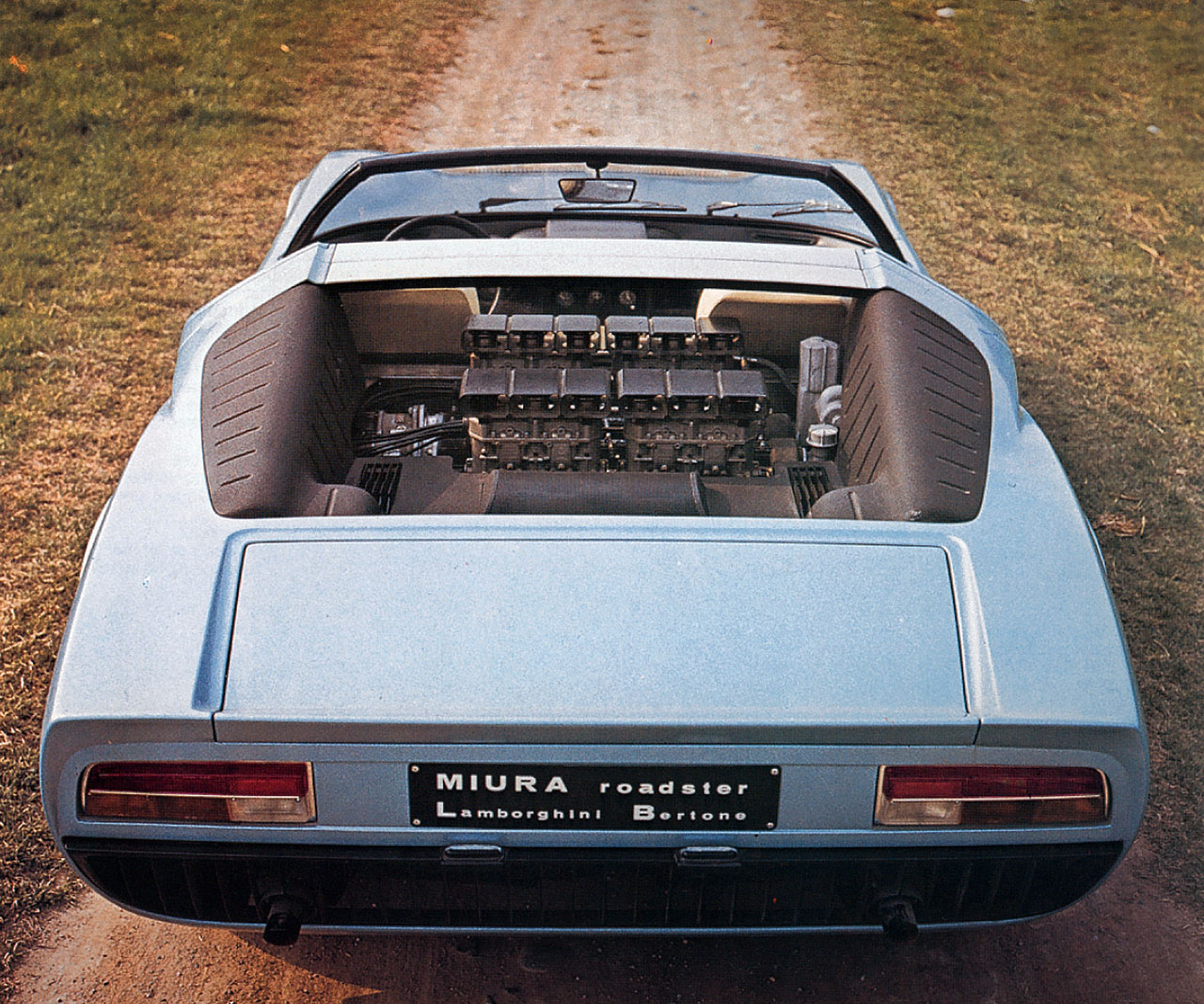
ONE-OFF - Lamborghini's legacy is punctuated with iconic sports cars that have left an indelible mark on the automotive world. Among these legends stands the Lamborghini Miura P400 Roadster, a truly exclusive gem that made its debut at the 1968 Brussels Auto Show. Crafted and conceptualized by Bertone, this open-top beauty was no ordinary Lamborghini with its roof removed. Unlike its predecessor, the 350 GTS by Touring, the Miura Roadster underwent a comprehensive redesign, showcasing exceptional taste and innovation.
Adapting a model like the Miura for a soft-top version was a formidable challenge. The Miura was notorious for its torsional rigidity issues, and simply removing the roof could have exacerbated the problem. To tackle this challenge, Bertone's Marcello Gandini took the reins and embarked on a journey to strengthen the chassis while making substantial alterations to the car's rear.
Right side view of 1968 Lamborghini Miura P400 Roadster. (Picture from: DrivingLine)
To ensure a smooth ride even at the proposed top speed of 186 mph, several crucial modifications were made. The windscreen's angle was lowered, a rear spoiler was integrated, engine louvers were omitted, and the exhaust system was expertly rerouted. The interior also received significant changes. Notably, the overhead console switches from the standard Miura had to be relocated, eventually finding their place on the central console. Furthermore, the Bertone steering wheel bore a striking resemblance to the one featured in the Marzal and the Espada prototypes, both of which were Bertone creations as well.
The Miura P400 Roadster donned a stunning bright-metallic azure blue exterior, while the interior boasted magnolia-hued leather upholstery, almost resembling white leather, reminiscent of the first 350 GTV. The impact of this showstopper prototype was enormous in Brussels and later in Geneva. However, it was destined to remain a unique creation. Many enthusiasts and collectors expressed their desire for a Miura Roadster from the Lamborghini factory. Nevertheless, Automobili Lamborghini SpA never officially produced a Miura Roadster, let alone crafted a replica. It's worth noting that Bertone also refrained from adding a top or side windows to this prototype.
A high angle rear view of 1968 Lamborghini Miura P400 Roadster. (Picture from: LamboCars)
The Miura P400 Roadster found a new home with the International Zinc and Lead Development Association (ILZRO), which utilized it as an exhibition showcase to highlight the properties of the metals they were eager to promote. Collaborating with the factory and Bertone, they reimagined the car, changed its color, and christened it as "Zn75."
When the car sold to ILZRO, the 1968 Lamborghini Miura P400 Roadster changed color and name to Zn75. (Picture from: DrivingLine)
Following its tenure with ILZRO, the car went through various owners until it was meticulously restored to its original appearance and specifications. Its grand return took place at the prestigious 2008 Pebble Beach Concours d’Elegance. In 2013, CNN sought the expertise of Hagerty Insurance to appraise this exceptional Lamborghini. The valuation that emerged was nothing short of astonishing, with a price range estimated between $8,000,000 and $10,000,000, solidifying its status as the most valuable Lamborghini ever.
In conclusion, the Miura P400 Roadster stands as a testament to the unparalleled artistry and innovation that Lamborghini and Bertone brought to the world of automotive design. Its unique blend of style, power, and exclusivity continues to captivate enthusiasts and collectors, making it a true icon in the realm of sports cars. This remarkable creation remains a testament to the enduring legacy of Lamborghini, a name synonymous with uncompromising excellence in the world of high-performance automobiles. *** [EKA [21072015] | FROM VARIOUS SOURCES | LAMBOCARS.COM | DRIVINGLINE]
Note: This blog can be accessed via your smart phone.
Hidden GEMS - In the fiercely competitive world of automotive design, many lesser-known sports car brands struggle to gain recognition among enthusiasts. However, the relentless creativity of passionate individuals transcends boundaries, leading to the creation of spectacular works of art that can rival those produced by industry giants.
The Beradino is a remarkable Italian classic sports car born from the vision of Johannes P. Paulussen, a talented German designer. (Picture from: Blog.DuPontRegestry)
Such is the case with Beradino, a remarkable sports car born from the vision of Johannes P. Paulussen, a talented German designer. Hailing from a modest middle-class background, Paulussen received invaluable advice from his father, a skilled carpenter. His father's words resonated deeply, emphasizing the importance of crafting one's own path to achieve one's dreams, even if it meant creating something as complex as a car from scratch.
Johannes P. Paulussen completes his Beradino dream sports car after an astounding 7,000 hours of labor. (Picture from: RareComponentCars)
In 1961, a young Johannes P. Paulussen embarked on a journey to bring his unique car design to life. After completing elementary school in 1967, he enrolled in the Automotive Technology program at the Technical University in Aachen, Germany. It was during this period that Beradino began to take shape, with Paulussen meticulously designing a bespoke tubular steel chassis and crafting a buck for the car's fiberglass bodywork using wood and plaster.
The Beradino cabin accommodates two passengers in a pair of ergonomic racing bucket seats, equipped with a three-spoke racing steering wheel, and features a unique central instrument panel placement. (Picture from: Goodwood)
While the aesthetics of the Paulussen sports car draw inspiration from Italian classics, its drivetrain features an air-cooled engine akin to the iconic German sports car, the Porsche 911. The engine is traditionally positioned at the rear of the car, aligning perfectly with the car's distinct body shape. When it comes to the nomenclature of his dream car, Paulussen revealed that it was influenced by a Western movie he happened to watch in 1968, where one of the actors bore the name John Beradino. The name Beradino etched itself into his mind and became the moniker for his dream car.
The Beradino sports car's versatility shines through with three roof configurations that can be effortlessly switched to transform its appearance into a fastback, notch-back with a decklid, or a full roadster. (Picture from: RareComponentCars)
The Beradino boasts a distinctive design, artfully blending elements from renowned vehicles like the Ferrari 250 GTO, Ford GT40, and Alfa Romeo Canguro. Its proportions can be deceptive, leading many to believe it's a front-engine GT car. However, the car's versatility shines through with three roof configurations that can be effortlessly switched to transform its appearance into a fastback, notch-back with a decklid, or a full roadster.
While the aesthetics of the Paulussen sports car draw inspiration from Italian classics, its drivetrain features an air-cooled engine akin to the iconic German sports car, the Porsche 911. (Picture from: RareComponentCars)
After an astounding 7,000 hours of labor, the dream car became a reality and successfully received roadworthy certification from German authorities. Johannes P. Paulussen made it his personal daily driver until 1992. However, as his teaching career and family responsibilities took precedence, the car went into storage for 17 long years.
The Beradino boasts a distinctive design, artfully blending elements from renowned vehicles like the Ferrari 250 GTO, Ford GT40, and Alfa Romeo Canguro. (Picture from: Goodwood)
It wasn't until 2009 that the Beradino sports car emerged from its hibernation, embarking on an extensive restoration process that spanned two years and required 3,000 man-hours of meticulous craftsmanship. This painstaking effort breathed new life into the Beradino, and it soon made appearances at prestigious classic car shows, including Essen, Goodwood, and Castle Classic Days, where it clinched the coveted "Best Prototype" award in 2011.
In more recent times, Johannes P. Paulussen has contemplated producing additional Beradino examples and is actively seeking investors to support this ambitious endeavor. Only time will tell if this new dream can be transformed into reality. Given that most individuals never progress beyond the concept stage when pursuing such audacious goals, we should not underestimate the significance of Paulussen's remarkable achievement in bringing the Beradino to life. *** [EKA | FROM VARIOUS SOURCES | BERADINO | RARECOMPONENTCARS | GOODWOOD | BLOG.DUPONTREGISTRY ]
Note: This blog can be accessed via your smart phone.
Timeless Revival - In the world of motorcycle enthusiasts, some projects transcend mere mechanics to become true works of art. Among these, one project that has captured widespread acclaim is the extraordinary art-deco motorcycle owned by Frank Westfall—a prominent motorcycle collector and respected local figure in Syracuse, where he operates Middle Earth Leather Works. This striking motorcycle has turned heads as it gracefully cruises city streets, a testament to the fusion of creativity and engineering.
The 1930 Excelsior KJ Henderson custom motorcycle is built and designed by Orley Ray Courtney. (Picture from: BikeExif)
The story of this masterpiece begins with the chassis of a 1930 Henderson KJ Model “Streamline” Four, a classic of its era. Originally crafted by master builder Orley Ray Courtney in 1936, this motorcycle embodies the seamless integration of artistic vision and mechanical excellence. At its heart lies an inline four-cylinder engine producing 40 bhp at 4,000 rpm, capable of propelling the bike to around 100 mph (160 kph).
The 1930 Henderson 1,301cc Model KJ 'Streamline' Four was the base of the Orley Ray Courtney's art-deco style custom motorcycle. (Picture from: Cars.Bonham)
The KJ’s body shell was a radical departure from convention. Its streamlined form features a curved, vertical-bar grille reminiscent ofthe Chrysler Airflowand a rear end echoing the elegance ofan Auburn boat-tail speedster. Every panel was meticulously hand-formed from steel, a labor-intensive process executed with precision using a power hammer.
The 1930 Excelsior KJ Henderson custom motorcycle is powered by an inline four-cylinder of 40 bhp at 4,000rpm, which can be made it run at the top speed of 100 mph (approx 160 kph). (Picture from: AFinePress)
Henderson, once a respected American marque owned by Excelsior Motor Mfg. & Supply Co., was among the “Big Three” of American motorcycle manufacturers in the 1930s, alongside Harley-Davidson and Indian. Sadly, the marque eventually faded into obscurity, with only a brief attempt at revival in the late 1990s. The enigmatic Orley Ray Courtney, the genius behind this design, remains a mysterious figure, though his work appeared in a 1953 Popular Science article showcasing the Enterprise,a 1950s custom motorcycle transformation that reflected evolving stylistic trends.
The 1930 Excelsior KJ Henderson custom motorcycle was finished in glossy black, complete with custom leather seating and a finned exhaust. (Picture from: Silodrome)
Frank Westfall played a pivotal role in bringing this historic machine back to life. He acquired the motorcycle in 2001 from collector Mike Gaglioti, who had previously obtained it from Ron Finch, a friend of Courtney. Recognizing its potential and historical significance, Westfall embarked on a comprehensive restoration. Beginning in 2002, the restoration process—undertaken with the help of expert motorcycle restorer Pat Murphy—lasted nearly a year and totaled approximately 700 hours of meticulous labor. Many steel body panels were re-formed with a power hammer to faithfully replicate Courtney’s original craftsmanship. The restored motorcycle was finished in glossy black, complete with custom leather seating and a finned exhaust.
The 1930 Excelsior KJ Henderson custom motorcycle is owned by a collector named Frank Westfall of Syracuse, and had caused a stir in June 2010 when it appeared at the Rhinebeck Grand National Meet. (Picture from: AutoEvolution)
This restored masterpiece first appeared publicly at the Rhinebeck Grand National Meet in June 2010, drawing admiration from collectors and enthusiasts alike. Its presence celebrated not just the motorcycle itself, but also the legacy of Orley Ray Courtney, showcasing the artistry, innovation, and engineering of a bygone era.
Frank Westfall’s art-deco Hendersonremains a living testament to the possibilities that emerge when passion, creativity, and historical preservation converge. For enthusiasts interested in modern interpretations of such iconic designs, companies like NMoto and Jakusa-Design offer contemporary inspirations that echo this timeless blend of style and performance.
Rare ONES - In the mid-1950s, American automotive manufacturers were driven by a fervent desire to create a sports car capable of competing with European roadsters. This era saw the emergence of iconic vehicles like the Ford Thunderbird, the GM Corvette, and the Kaiser Darrin.
1954 Kaiser Darrin 161 Sports Convertible. (Picture from: ConceptCarz)
For the last name, it all began when Dutch automotive designer Howard Darrin presented a remarkable car prototype to Henry J. Kaiser in 1952. Even though Kaiser was not initially involved in the 'sports car' business, the sheer uniqueness of the design compelled him to venture into this new territory.
The Kaiser Darrin 161 Sports Convertible was an embodiment of innovation, featuring several distinctive characteristics. Notably, it boasted a revolutionary door design that could be slid into the front fenders, giving it a distinct and futuristic appearance. Furthermore, the elongated front fenders were thoughtfully balanced with an extended rear overhang.
Interior view of 1954 Kaiser Darrin 161 Sports Convertible. (Picture from: ConceptCarz)
The car's body was primarily constructed from lightweight fiberglass, weighing a mere 300 lbs (approximately 136 kg). This reduced the overall weight of the car to just 2,176 lbs (987.9 kg). The initial prototypes were produced by Glaspar, a specialized boat and kit car company located in Santa Ana, California.
Luxury features were also a hallmark of the Kaiser Darrin 161 Sports Convertible. It came equipped with a three-point canvas roof that utilized French landau iron for added elegance. The interior of the car featured an exclusive design with full pleated leather that could be customized to the buyer's preferences. This luxury, however, came at a price, and the Kaiser Darrin 161 Sports Convertible was considered quite expensive in its time, with a price tag of US $3,668 or roughly Rp.41.8 million.
Rear side view of 1954 Kaiser Darrin 161 Sports Convertible. (Picture from: ConceptCarz)
The first production models were built on the J chassis and featured a Willys six-cylinder engine with a capacity of 2.6 liters. This engine produced up to 125 bhp (93.2 kW) of power and was paired with a three-speed manual transmission. The inclusion of a three-carburetor setup allowed the Kaiser Darrin to achieve an impressive top speed of 95 mph (152 km/h).
In 1955, when Kaiser-Willys ceased production, Darrin took the initiative to fit the remaining cars with Cadillac V8 engines. This enhancement significantly boosted the car's power output to 300 bhp, propelling it to the ranks of the fastest sports cars in the United States at the time.
In total, only 435 units of the Kaiser Darrin 161 Sports Convertible were produced, with the final 100 units featuring the Cadillac V8 engine. Thanks to its iconic design and rarity, the Kaiser Darrin 161 Sports Convertible has become one of the most sought-after cars among automotive collectors worldwide.
Today, this classic sports car remains a testament to the innovative spirit of its time and a reflection of the American automotive industry's pursuit of excellence in the sports car arena. Its unique door design and luxurious features continue to captivate enthusiasts and collectors, making it a prized gem in the world of vintage automobiles. With its historical significance and enduring appeal, the Kaiser Darrin 161 Sports Convertible stands as a remarkable chapter in the annals of automotive history. *** [EKA [10072015] | FROM VARIOUS SOURCES | CONCEPTCARZ]
Note: This blog can be accessed via your smart phone.
In Memmoriam: MALELA - Today, we delve into the fascinating world of classic Vespa scooters from the 1970s in Indonesia, a relic of the past that remains a cherished rarity. Our focus is on the Vespa Sprint 150 Veloce, a scooter with a unique charm that has left an indelible mark on enthusiasts. I am fortunate to be among the proud owners of this vintage gem, and I will share some insights and images of my own prized Vespa Sprint 150 Veloce.
My 1974 Vespa Sprint 150 Veloce (right) posed along with another Indonesian's Vespa model, 2003 Vespa Exclusive 2. (Picture from: My Private Scooters)
The Vespa Sprint 150 Veloce, a scooter briefly introduced in Indonesia during the 1970s, holds a special place in the hearts of collectors. Recognizable by its round headlights, this model is commonly referred to in Indonesia as the Vespa Sprint Bagol, although some units feature square headlights. What sets this kind of Vespa apart is its distinctive appearance, with those round headlights and a sleek, elongated rear body section that exudes elegance.
What sets this Vespa Sprint 150 Veloce apart is its distinctive appearance, with those round headlights and a sleek, elongated rear body section that exudes elegance. (Picture from: My Private Scooters)
One of the standout features of the Vespa Sprint Bagol is its eye-catching jade green indicator light on the front. This indicator illuminates when the lights and other electrical components are in use, adding a unique touch to this already captivating Vespa.
Interestingly, the Vespa Sprint 150 Veloce's headlights bear a striking resemblance to those of the Vespa GL (Gran Lusso) 150 (VLA), making it like as if a successor to these renowned models. In other part of the world, the Vespa Sprint 150 Veloce enjoyed a decade-long production run from 1965 to 1976, captivating riders worldwide.
One of the standout features of the Vespa Sprint 150 Veloce is its eye-catching jade green indicator light on the front. (Picture from: My Private Scooters)
In contrast, in Indonesia, PT. Danmotors Vespa Indonesia, the custodian of the Vespa brand at the time, only produced the Vespa Sprint 150 Veloce for a brief period, specifically in 1974-1975. This marked the end of Vespa Sprint production in the country, replaced by Vespa PX150. The Vespa Sprint 150 Veloce quickly became a trendsetter in the local scooter scene, even commanding premium prices compared to other classic Vespas.
The Vespa Sprint 150 Veloce, or Vespa Bagol powered by a 2-stroke, 145.45cc engine with a single-cylinder air-cooled design, it churn out 7.7 horsepower at 5,200 rpm, propelling this kind of Vespa to a top speed of 97 kph. (Picture from: GridOto)
A curious fact about the Vespa Sprint 150 Veloce with round headlights, or bagol, is that it initially faced resistance on the island of Java. The rounded headlight shape was seen as old-fashioned, leading many Sprint buyers to replace their round headlights with square ones. Some even went the extra mile, opting to modify their scooters to have square headlights. As a result, the remaining stock of units with round headlights found its way to other regions, including Sumatra, where both round and square headlight versions were embraced.
Admire the Vespa Sprint 150 Veloce's beauty and elegance from an overhead perspective. (Picture from: Pinterest)
On the right side of the Vespa Sprint 150 Veloce, or Vespa Bagol, nests a 2-stroke, 145.45cc engine with a single-cylinder air-cooled design. This powerhouse churns out 7.7 horsepower at 5,200 rpm, propelling this kind of Vespa to a top speed of 97 kilometers per hour.
Another typical features of this kind of Vespa is the headlight composition, Vespa incorporated parts from Aprilia or Siem. Worth noting is that Vespa models released in 1974 sport crankcases with a Piaggio's spade logo (Indonesian called cung or waru), whereas previous model of 1960s most crankcases have a crossed out 'P' logo.
As the years have passed, classic Vespas like the Vespa Sprint 150 Veloce with round headlights have grown increasingly scarce. Consequently, these gems have become highly sought-after, with their prices steadily rising. If you're considering owning a Vespa Sprint Bagol of your own, it's essential to be well-informed about its distinct characteristics before making a purchase. Exercise caution and don't hesitate to seek guidance from trusted experts in the field. Owning and maintaining a Vespa Sprint 150 Veloce is not just a passion; it's a journey into the history of these iconic scooters in Indonesia.
Kept spur your adrenaline on the power of the two-wheeled monster and stay alive with true safety riding. May God will forgive Your sins and so does the cops...... *** [EKA | FROM VARIOUS SOURCES | WIKIPEDIA ]
Note: This blog can be accessed via your smart phone.


 Even renowned American motorcycle manufacturers such as Harley-Davidson, famous for its robust, large-displacement motorcycles, once ventured into the world of scooters from 1960-1965 by using only 165cc 2-stroke engine model, the Harley Davidson Topper.


 In summary, the Vetter Torpedo or Defiant is a remarkable and uniquely American scooter, designed with a nod to the aesthetics of the 1950s and powered by the robust Harley-Davidson Sportster engine. This exceptional creation showcases the ingenuity and passion of Craig Vetter, leaving an indelible mark on the world of scooters and redefining the riding experience.