-->
Drop Down MenusCSS Drop Down MenuPure CSS Dropdown Menu

Thursday, March 17, 2022

Have You ever seen this Enzo-based supercar?

Unique ENZO Supercar manufacturers ranging from large to newly emerging many scattered throughout the world to meet the demand of exotic car enthusiasts, namely those billionaires who are known to have a lot of money.
2011 Lavazza GTX-R by Simbol Design with a slick combined design of Ferrari Enzo and Pagani Zonda. (Picture from: http://bit.ly/2qduZQ8)
Usually, well-known manufacturers bring up one model in a limited number, thereby contributing to limit ownership of that model. So many enthusiasts of exotic cars are forced to be disappointed because they cannot have it.

This gave rise to a niche in the market which was then used by other manufacturers to use it. For example, when Ferrari has launched the Ferrari Enzo supercar masterpiece in 2002 to 2004 and produced in limited quantities (only 400 units worldwide). So you can imagine how rare the supercar was.
2011 Lavazza GTX-R by Simbol Design can accelerate from 0 to 100 kph in just 4.3 seconds. (Picture from: http://bit.ly/2qduZQ8)
Because the Ferrari Enzo does have its own charm, in addition to being made in very limited quantities, the car is also specifically designed to honor the Enzo Ferrari (the company founder). In addition, the pride of the Ferrari car has a super high price, and the Enzo is no longer produced. So that many Ferrari fans become disappointed because they can not have it.
2011 Lavazza GTX-R by Simbol Design uses a V12, 5400cc BMW-owned engine, which able to spew power up to 489 horsepower. (Picture from: http://bit.ly/2qduZQ8)
But don't worry, because from a deep Alpine valley on the Swiss-Italian border comes the mad-as-a-hatter Simbol Design Lavazza GTX-R supercar. If it’s as sinister as its dark-sounding home town of Crevoladossola, it should be quite a ride. This high-powered machine has been in drawn-out development and prototype testing since 2004.
2011 Lavazza GTX-R by Simbol Design has been in drawn-out development and prototype testing since 2004. (Picture from: http://bit.ly/2qduZQ8)
Simbol Design, formerly Automobili Lavazza — not to be confused with Italy’s biggest coffee company — was founded in 1975 by Enrico Lavazza. For years he produced racing prototypes, kit cars, and replicas. The company was rebranded in 2005 when Enrico’s son Fabio took the reins.

This supercar has a shape that is almost similar to the Ferrari Enzo, especially on the front, then when looking at the top there's a roof scoop that immediately reminds us of the figure of Pagani Zonda. So it can be said that the car has a slick combined design of Ferrari Enzo and Pagani Zonda.
2011 Lavazza GTX-R by Simbol Design with the price estimated at around £270,000 (or approx Rp.5 billion). (Picture from: http://bit.ly/2qduZQ8)
But the difference, the Lavazza GTX-R uses a V12 BMW-owned engine, which has a capacity of 5,400 cc which able to spew power up to 489 horsepower and combined with 6-speed electro-pneumatic transmission system. Although it is called the Enzo wannabe, the GTX-R's performance is not embarrassing, because the car can accelerate from 0 to 100 kph in just 4.3 seconds.

The car body is made of carbon-Kevlar built atop a tubular steel frame resulting in a total mass of just 1,080 kg. With a body like that, it's no wonder that this vehicle has been turning heads. The car also comes in two types, convertible coupes, and roadsters.
Although not specified in detail, but in that time the automaker assured that the car has a price that is much cheaper than the original Enzo. As quoted from MoneyWeek in 2010, the car price estimated at around £270,000 (or approx Rp.5 billion). 

Until now, We never knew how many the GTX-R cars ever built? Furthermore, there's no info whether the manufacturer is still active or not? As if the automaker suddenly became a mystery, since we can't access the company official sites (https://www.simboldesign.com/).

No need to be confused, let's just see another supercar creation made of the Ferrari Enzo named Gemballa MIG-U1. *** [EKA [09112011] | FROM VARIOUS SOURCES | CHECK HOOK BOXING | MONEYWEEK | CARBUZZ | THE TIMES | AUTOBLOG] 
Note: This blog can be accessed via your smart phone.

Wednesday, March 16, 2022

The unique Corvette Barrister custom car

Unique ONES Those of you who call themselves true automotive enthusiasts must have heard or known the legendary name of George Barris, for having created a large number of unique and spectacular custom cars, some of which were even produced in limited numbers, such this custom car named of the Chevrolet Corvette Barrister.
1969 Chevrolet Corvette Barrister is custom built based on 1968 Corvette C3 which has been modified in such a way both technically and aesthetically. (Picture from: Carscoops)
Well, the car mentioned above is one of the legendary heritage vehicles of George Barris which was created in 1969 in limited numbers of 7 units only. This custom car builds on the 1968 Corvette C3, which has been modified in such a way both technically and aesthetically, made the car final results have a unique look and very different if compared to the original donor car.
1969 Chevrolet Corvette Barrister has the most striking elements there is the placement of the chromed exhaust side pipes that extends under the doors. (Picture from: Carscoops)
After being processed by Barris's team creative hands, the classic Corvette figure then transformed into the Barrister by adopting a quite eccentric appearance. As you can see from the hood that it is much longer than the donor car, and then there are most of these extensions ending in front of the axle which you won't find on the Corvette C3.
Though the exterior is vastly different, the Barrister' interior is largely the same to the Corvette C3, it’s been retrimmed and some new wood panelling (including a Nardi wooden steering wheel) has been added however. (Picture from: Carscoops)
In the Barrister custom car, George Barris played with the chrome accents in a festive way while combining with the headlights that were more traditional for the time. He even dared to push the grille forward and then tilt it slightly, which was then added to the segmented windshield shape into two parts inspired by the 1930s roadster style.
1969 Chevrolet Corvette Barrister is powered by a 350 cubic-inch V8 engine coupled to a four-speed automatic transmission and producing approximately 300 bhp to drive the rear wheels. (Picture from: Carscoops)
In its unique exterior appearance, also included subtle touches. And one of the most striking elements there is the placement of the chromed exhaust side pipes that extends under the doors. Another interesting feature, the custom car finishing in a two-tone paint, in this case creamy white and blue. And then there's something even more common on the George Barris' customized cars, namely classic chromed mesh-style rims with whitewall tires.
1969 Chevrolet Corvette Barrister has double-humps that have the peculiarity of stretching further back and a high chrome bumper coupled with vertically positioned tailights. (Picture from: Carscoops)
Meanwhile at the rear, it looks also something unique by repositioning the lights vertically rather than horizontally clearly inspired by the jet age styles, as is always the case with the Corvette models. Beside that there's double-humps that have the peculiarity of stretching further back and a high chrome bumper. While its interior looks nicely done. As you can see, the seats are upholstered in white leather with blue accents to match the exterior bodywork theme, and it has been given a touch of wood panelling (including a Nardi wooden steering wheel).
The Barrister custom car is driven by a 350 cubic-inch V8 engine coupled to a four-speed automatic transmission and powering the rear wheels. It also sports four-wheel independent suspension and four-wheel hydraulic ventilated disc brakes. As mentioned above, George Barris only makes a limited number of Corvette Barristers, which are only 7 units. And one of them which is the car number 2 in the car series will be auctioned under the hammer of Mecum on March 16 to 19, 2022. 

Unfortunately, the Mecum Auctions listing makes no mention of how many miles the car has under its hood, nor does it provide us with a pre-auction estimate. But it can certainly be expensive, due to in 2019, when Bonhams sold a black and gold colored one for $51,520. And now after three years, most likely the Corvette Barrister's value has gone up and is estimated to exceed $100,000. Wow!! *** [EKA | FROM VARIOUS SOURCES | CARSCOOPS | MECUM | SILODROME ]
Note: This blog  can be accessed via your smart phone

Tuesday, March 15, 2022

One of the 1950s Ferrari iconic race cars by Scaglietti

Iconic Car As we know that since beginning the Italian prancing horse logoed premium car manufacturer produces a lot of racing cars. And one of them is the Ferrari 121 LM (also known as the Ferrari 735 LM). It was a racing car produced by Ferrari in 1955, and was converted from the Ferrari 376 S sports car was participated of the Mille Miglia racing event for the 1955 season.
The Ferrari 121 LM was specifically developed to compete in the 24 Hours of Le Mans 1955 converted from the Ferrari 376 S sports car and bodied by Carrozzeria Scaglietti. (Picture from: Italianways)
The Ferrari 121 LM sports car was specifically developed to compete in the 24 Hours of Le Mans 1955, while a year earlier, Ferrari had won with the Ferrari 375 Plus. At that time the Maranello-based car manufacturer made those sports cars in limited numbers of only 4 units. The first example was converted before Mille Miglia, the rest after the race. Most of the specifications remained the same apart for the engine, which received a much bigger displacement and power output.
The Ferrari 121 LM driven by Eugenio Castellotti while speeding at the 24 Hours of Le Mans 1955 at the Circuit de la Sarthe. (Picture from: Wallpaperup)
Unlike its predecessor, the Ferrari 121 LM name referred to the displacement of one cylinder, as was the naming convention. The models 'LM' suffix invoked of the 24 Hours of Le Mans as the intended to be the racing event participated by those cars. Inherited chassis numbers also had an 'LM' suffix.
The Ferrari 121 LM name referred to the displacement of one cylinder, as was the naming convention, while its 'LM' suffix invoked of the 24 Hours of Le Mans as the intended to be the racing event participated by those cars. (Picture from: Italianways)
The car body and chassis similar to that from the Ferrari Mondial Series II with lesser aerodynamics and outdated braking technology than the competition, as Enzo Ferrari had firmly believed in engine power to win at racing, meanwhile all the work is done by Carrozzeria Scaglietti in Modenna.
The Ferrari 121 LM is known as a single-seater race car which has a shrouded-cockpit coupled with the tiny perspex wind deflector and a shrouded roll hoop behind the RHD steering setup. (Picture from: Italianways)
As the result, the Ferrari 121 LM powered by an Aurelio Lampredi-designed inline-6, 4,4 liter engine called Tipo 121, and was created as a larger displacement evolution to the engines used in the Ferrari Monza race cars of the 1950s.
The Ferrari 121 LM powered by an Aurelio Lampredi-designed inline-6, 4,4 liter engine called Tipo 121. (Picture from: Italianways)
Speed, speed, and more speed was the aim for this racing sports car as its four-cylinder engine produced 360 hp and as the results, it recorded as the fastest with a top speed of 181 mph on a straight during the practice trial for the 24 Hours of Le Mans 1955 race at the Circuit de la Sarthe

Unfortunately, all three 121 LMs had to withdraw from the race early, due to their tires being worn and unfit to support the model’s power, and left Sir Stirling Moss, the British driver at the wheel of the Mercedes-Benz 300 SLR finished at first, while the prancing horse only finished at third place with the Ferrari 376 S.
The 1955 Ferrari 121 LM Spider is just one of four LMs built and only one of two cars converted from the 118 LM by the factory. (Picture from: Italianways)
The 4.4-litre iteration was also the final capacity step in the inline-six model lineage. After the Le Mans disaster (the worst accident in motorsport ever, causing 84 deaths and leaving 120 people hurt), the new race regulations forced a 2.5-litre cap, so Ferrari returned to the 625-engined Monza models for the 1956 season. Ferrari would also never return to the inline-six configuration and focused instead on a new V6 Dino engine.
Its four-cylinder engine produced 360 hp and as the results, it recorded as the fastest with a top speed of 181 mph on a straight during the practice trial for the 24 Hours of Le Mans race at the Circuit de la Sarthe. (Picture from: Italianways)
After leaving the Scuderia Ferrari, the car found its new owner named William Doheny, CEO of Superior Oil, who restored the car after the tragic accident that claimed the life of racing driver Ernie McAfee in 1956. The 1955 Ferrari 121 LM Spider was only one of four LMs made and only one of the two cars converted of the Ferrari 118 LM by the prancing horse sports car breeder.

In the following years, the Ferrari 121 LM remained alive under Doheny ownership and competed in the historic first race at Monterey in 1974 and continued to appear at various other racing events and shows with subsequent owner Bill Ziering until 1997.
As an iconic Ferrari race car, it is not surprising that when presented at an annual automotive event such the Monterey Car Week 2017 then, there're a lot of eyes staring to its iconic figure. At that time the car was on display and then auction by RM Sotheby's. As quoted of CarThrottle, the mentioned classic Ferrari 121 LM sports car is sold for $5,720,000 (approx Rp. 80 billions). Wow!! *** [EKA | FROM VARIOUS SOURCES | FERRARI | ACQUIREMAG | SPORTSCARMARKET | CARREVSDAILY | CARTHROTTLE | ITALIANWAYS | WIKIPEDIA ]
Note: This blog can be accessed via your smart phone.

Monday, March 14, 2022

The Track-Driven Motorcycle That Changed Military Innovation

Unusual Locomotion - Long before sleek superbikes and futuristic electric scooters took over the streets, there was a time when innovation in transportation took on a far more rugged and experimental form. In the tense years leading up to World War II, engineers around the world were in a race not just for speed, but for survival — blending mechanical ingenuity with military ambition. Among the strangest creations to roll out of that era was a machine that looked like it belonged more on a battlefield than a boulevard: a track-driven motorcycle that defied both convention and comfort, known as the Mercier Moto Chenille.
The 1937 Mercier Moto Chenille. (Picture from: Unusuallocomotion)
Built in 1937 by Swiss inventor Adrien Mercier in Bois-Colombes, France, this extraordinary hybrid of a motorcycle and a tank was designed for military use. It wasn’t made to win style awards or offer a smooth Sunday ride; its purpose was purely tacticalto conquer terrains where ordinary motorcycles would surrender. The design itself tells a story of bold experimentation: a long tubular rear frame stretched out to support both the saddle and fuel tank, while a track mechanism dominated the front end. Instead of the familiar pair of wheels, it featured tank-like treads leading the way, and a single rubber wheel at the back, modest in size but crucial in function
Front and rear view of the 1937 Mercier Moto Chenille. (Picture from: Unusuallocomotion)
Beneath this rugged skeleton lay a set of two metal skids running from rear to front, allowing the machine to glide across rough ground when the rear wheel could no longer find traction. At its heart, the Mercier Moto Chenille carried a 350cc JAP (JA Prestwich) OHV Sports engine mounted at the front — a modest but reliable source of power. With just 11 horsepower, it might sound underwhelming by today’s standards, yet in the late 1930s it represented a precise balance of strength and simplicity. 
Left side view of the 1937 Mercier Moto Chenille. (Picture from: Unusuallocomotion)
The engine was paired with a Soyer 3-speed manual transmission and a hand-operated clutch that directed power to the track, enabling the vehicle to reach speeds of around 40 mph (roughly 64 km/h). Stopping the machine required a hand-operated internal expanding brake connected to the drive wheel of the track, supported by two leaf springs on either side to absorb the shocks of unforgiving terrain. Every component of the Moto Chenille seemed designed not for comfort, but for endurancea mechanical creature built to crawl, climb, and persist.
Right side view of the 1937 Mercier Moto Chenille. (Picture from: Unusuallocomotion)
When the French military tested the prototype on steep slopes of up to 45%, they were intrigued. The vehicle’s strange hybrid nature seemed promising for reconnaissance or transport missions across uneven landscapes. Mercier even developed the motorcycle in several configurations, suggesting a mind constantly refining and reimagining the possibilities of mobility. Yet despite its ingenuity, only three prototypes were ever built, and none went into mass production. The project faded into obscurity as the world’s attention turned toward larger machines of war.
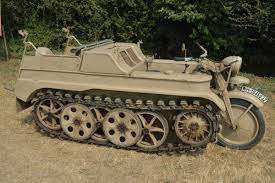
Still, the legacy of Mercier’s invention echoed beyond France. Just a few years later, in 1941, German engineers at NSU Werke developed the NSU Kettenkrad — a tracked motorcycle strikingly similar in concept to Mercier’s creation. Unlike the Moto Chenille, the Kettenkrad did see action on the battlefield, serving the German military during World War II. It became one of the most iconic military vehicles of its kind, but its DNA — that fusion of motorcycle agility and tank traction — can be traced back to Mercier’s workshop in Bois-Colombes
The NSU Kettenkrad is designed by Ernst Kniekamp in 1939, then produced by the NSU Werke of Neckarsulm in 1941. (Picture from: TanksetPanzerOverblog)
Today, the surviving example of the Mercier Moto Chenille stands as more than just a relic of experimental warfare. It’s a window into a time when invention was driven by necessity and curiosity in equal measure — when engineers weren’t afraid to blur the lines between categories in pursuit of progress. In a modern world where motorcycles are designed for precision and pleasure, the Mercier Moto Chenille reminds us of an era when machines were born from bold ideas and raw imagination. It may never have raced on the battlefield, but its spirit — half motorcycle, half tank — continues to roll through history as one of the most fascinating mechanical oddities ever built.

Kept spur your adrenaline on the power of two-wheeled monster and stay alive with the true safety riding. May God will forgive Your sins and so does the cops.... ••• [EKA [24122016][14032022] | FROM VARIOUS SOURCES | UNUSUALLOCOMOTION | YESTERDAYS ]
Note: This blog can be accessed via your s mart phone.

Sunday, March 13, 2022

Stout Scarab: The Futuristic Minivan That the World Wasn’t Ready For

Futuristic Pioneer - When we think about family vehicles today, the minivan usually comes to mind—a practical choice for those who value space, comfort, and togetherness on the road. In many places like Indonesia, where large families are common, these vehicles are part of daily life. Yet long before the minivan became a familiar sight, one man in America had already envisioned something remarkably similar, though his creation arrived decades ahead of its time. That man was William Bushnell Stout, an engineer with a background in both automobiles and aviation, and the car he built was called the Stout Scarab.
The 1936 Stout Scarab on display at the 2012 Concours d’Elegance of Southwest Michigan. (Picture from: Hemmings)
Unveiled in the 1930s, the Scarab looked nothing like the cars of its era. Inspired by the scarab beetle and borrowing elements from aircraft design, it carried a streamlined, futuristic body that seemed almost alien compared to the boxy sedans of the day. Stout worked with John Tjaarda, an aeronautical designer, to shape its lightweight aluminum body and smooth curves, aiming not only for style but also for efficiency. The sleek exterior reduced wind resistance and improved driving performance, making it stand out as one of the earliest attempts at aerodynamic automotive design.
The steering wheel and dashboard view of the 1936 Stout Scarab. (Picture from: ShangralaFamilyFun)
Inside, the Scarab was even more radical. Instead of a traditional layout with the engine up front and a bulky chassis underneath, Stout placed the Ford 221 CID flathead V8 engine at the rear. This clever move freed up space in the cabin, giving passengers a level of comfort that was unheard of in the 1930s. Independent suspension on all four wheels added to the smoothness of the ride, while the flat floor created roominess that made the car feel more like a moving lounge than a conventional automobile. Stout even imagined it serving as a “mobile office,” which explains its long wheelbase and reconfigurable seating.
The 1936 Stout Scarab had a table, moving chairs, and three cigar lighters in its cabin. (Picture from: ShangralaFamilyFun)
The idea was bold, but execution was another story. Unlike giants such as Ford or General Motors, Stout ran a small operation. His company, Stout Motor Car Company, had limited resources, and production was far from the scale needed to make the Scarab a common sight on the road. Although Stout dreamed of building 100 units per year, only around nine cars were actually produced between 1935 and 1936. Priced at about $5,000—a staggering amount at the time—the Scarab was simply out of reach for most buyers. Critics also found its design too unconventional, and what was meant to look visionary instead appeared strange to a public not ready for such a leap.
The 1936 Stout Scarab on display at the Owls Head Transportation Museum (Owls Head, Maine). (Picture from: Hemmings)
Despite its commercial failure, the Stout Scarab holds a special place in automotive history. It has often been called the world’s first minivan, a title that fits when you consider its shape, layout, and purpose. What seemed radical then has since become normal: rear engines, spacious interiors, aerodynamic curves, and flexible seating are all features that define family cars today. While the Scarab never reached mass production, its DNA can be seen in countless vehicles that followed.
Today, the few surviving Scarabs are priceless treasures. What once failed to attract buyers at $5,000 in the 1930s now commands prices estimated around $90,000, reflecting both its rarity and its significance as a pioneering design. It may not have succeeded in its own time, but the Stout Scarab lives on as proof that being ahead of the curve sometimes means waiting for the world to catch up. For a glimpse of a vehicle with a somewhat similar spirit, you can look at the 1941 Ford Western Flyer Motorhome*** [EKA [20112019][13032022] | FROM VARIOUS SOURCES | SHANGRALA FAMILY FUN | HEMMINGS ]
Note: This blog can be accessed via your smart phone.

Saturday, March 12, 2022

Ferrari 125 S: The First Sports Car That Started It All

Prancing Genesis Speed has always fascinated people. Whether it’s athletes breaking records on the track or machines pushing boundaries on the road, there’s something magnetic about performance taken to the limit. For car enthusiasts, one name sits right at the heart of this pursuit: Ferrari. Today, Ferrari stands as a symbol of precision, power, and prestige, but its story began with a single groundbreaking creation that laid the foundation for everything that followedthe Ferrari 125 S, the very first car to carry the legendary name
The first Ferrari sportscar named Ferrari 125 built-in 1947. (Picture from: RadarSeluma)
The company itself was born from Enzo Ferrari’s relentless passion for racing
. He started Scuderia Ferrari in 1929, originally supporting drivers and building competition cars. But it wasn’t until 1947 that the world was introduced to Ferrari S.p.A. as we know it—dedicated to crafting high-performance road cars while staying rooted in motorsport. That year, on March 12 in Maranello, the Ferrari 125 S made its first appearance, not yet dressed in sleek bodywork but alive with an engine and chassis that carried the promise of something extraordinary.
Enzo Ferrari with the 3 Ferrari's crews who designed the Ferrari 125 S. (Picture from: RadarSeluma)
The 125 S was the brainchild of a team led by Gioacchino Colombo, with engineering input from Giuseppe Busso and Luigi Bazzi. It was more than just a machine—it was the spark of an idea that Ferrari could not only compete but also define what a sports car should be. This debut wasn’t about luxury or comfort; it was about capturing the spirit of racing in a form that could inspire generations to come.
The Ferrari 125 S first debuted on March 12, 1947, in Maranello. (Picture from: RadarSeluma)
True to that spirit, Ferrari wasted no time putting the car to the test. Just two months after its first ignition, the 125 S was entered into competition at the Piacenza circuit. The day didn’t go as planned—the car was leading when a faulty fuel pump dashed its chances of victory. Yet the setback proved short-lived. A mere nine days later, at the Rome Grand Prix, the same car crossed the finish line first, claiming Ferrari’s maiden win and setting the stage for a dynasty of motorsport triumphs.
The Ferrari 125 S displayed alongside one of the most sophisticated prancing horse logoed cars, LaFerrari Aperta. (Picture from: RadarSeluma)
What makes the 125 S so important today isn’t just its engineering or its performance, but what it represents. It embodies Ferrari’s very beginning, the moment when Enzo’s vision shifted from being a sponsor and builder of race cars for others to creating a brand with its own identity. And while technology has leapt forward in unimaginable ways—culminating in hypercars like the LaFerrari Aperta showcased during Ferrari’s 70th anniversary in 2017—the DNA of that first car still runs through every prancing horse on the road or track. 
Now, over 75 years since the 125 S first roared to life on the streets of Maranello, Ferrari has become more than just a car manufacturer. It has become a cultural icon, a blend of artistry and engineering excellence recognized around the world. And yet, all of it traces back to that single, raw, imperfect but determined machine—the Ferrari 125 S—that proved speed, passion, and innovation could be forged into something timeless. Wanna see Boudier or ARC Vector? *** [EKA [16112019][12032022] | FROM VARIOUS SOURCES | FERRARI | BLACKXPERIENCE | RADARSELUMA ]
Note: This blog can be accessed via your smart phone.