-->
Drop Down MenusCSS Drop Down MenuPure CSS Dropdown Menu

Sunday, February 27, 2022

The most beautiful Alfa Romeo Scighera concept car of 1990s

Misty Mist - Alfa Romeo is indeed famous for having cars that have great appeal, even arguably very sexy, surpassing the Ferrari & Lamborghini! In the row of Alfa Romeo's beautiful concept cars, there are Alfa Romeo TZ3, Alfa Romeo 4C, Alfa Romeo Brera, and the most legendary, Alfa Romeo Scighera. As quoted of Wikipedia, the name 'scighera' means 'mist' in Milanese dialect.
The Alfa Romeo Scighera concept car built and designed in 1997 as a collaboration result between Alfa Romeo and Italdesign. (Picture from: Pedal2Metal)
That's probably the design that doesn't suit most tastes. However, many car design observers assume that the Scighera, designed by Italdesign, one of the famous Italian automotive design house is one of the most beautiful car designs in the world. What do you think?

The Scighera, which was first introduced in 1997 and built based on Alfa Romeo 164, and uses a chassis and body from a combination of aluminum composite and carbon fiber, thus making Scighera has a relatively lightweight, which is only 1,447 kg. This lightweight was obtained with exotic designs such as unique door and window openings, which then made many people captivated at that time (and until now, maybe!)
1997 Alfa Romeo Scighera concept car built uses a chassis and body from a combination of aluminum composite and carbon fiber, thus making it has a weight of only 1,447 kg. (Picture from: Pedal2Metal)
At that time, when Alfa Romeo and Fabrizio Giugiaro from Italdesign made Scighera, they wanted to make it the mainstay supercar of the Alfa Romeo brand, which at that time its prestige as a sports car manufacturer began to fall.

To fulfill this purpose, Alfa Romeo then installed a 3,000cc V6 TwinTurbo mid-mounted engine taken from the modified Alfa Romeo 164. The engine has a quite impressive capability at the time, namely bursts of power up to 400hp at 7,500rpm.
The Alfa Romeo Scighera GT looks fierce with a more aggressive body design, full of sponsors' stickers, a giant GT Wing, and the use of Sparco Cromodora's super-lightweight alloy wheels. (Picture from: Pedal2Metal)
But for now, maybe a burst of power of 400hp is considered standard for the sportscar. Although it has a standard power, the Schigera can accelerate from 0 to 96kph in just 3.7 seconds and has a top speed of 300kph. This impressive performance is obtained in addition to the light bodyweight and aerodynamics, also because the sports car applies a 4WD drive system taken from the Alfa Romeo 155.
The Alfa Romeo Scighera GT also included as one of the participants of the NFS Hot Pursuit III racing game simulation. (Picture from: Pedal2Metal)
The appearance of the racing version? Although Alfa Romeo and ItalDesign do not plan to include Scighera in the production line, in order to further stick their impression as a supercar, then Alfa Romeo made a racing version of this car which was later given the name Scighera GT to enter in a famous racing game, NFS Hot Pursuit III.
This car looks fierce with a more aggressive body design, full of sponsors' stickers, a giant GT Wing, and the use of Sparco Cromodora's super-lightweight alloy wheels, making the Scighera GT equals with the Ferrari P4/5 Competizione, as a serious-made racing concept car. *** [EKA[24052020] | FROM VARIOUS SOURCES | WIKIPEDIA MOTOR1 ]
Note: This blog can be accessed via your smart phone.

Saturday, February 26, 2022

Fierce Looks of the Hawaiian-Made RX-777: A Custom Automotive Marvel

The HUla Dancer - For automotive enthusiasts, having a standard vehicle is sometimes not enough, and they always want the vehicle they use to look attractive and, if possible, not be the same as the others. And usually the best way to change the appearance of a vehicle so that it has a different appearance is modification or customization.
The RX-777 is a custom car made by Adam Taylor based on the Mazda RX-7 back in 2019. (Picture from: Motor1)
Besides that, modification can be a place to pour ideas and not be limited in time, which sometimes can also produce unexpected results, especially if the source of inspiration comes from many famous car designs. Like the work of the following extraordinary car modifications based on the legendary Mazda RX-7 roadster.
The Adam Taylor's RX-777 is truly amazing, all sectors have changed at all and no longer looks like the Mazda RX-7. (Picture from: TecheBlog)
As quoted of the Motor1 page, it turns out that the mentioned car modification process carried out by Adam Taylor, a gentleman from Oahu, Hawaii has been running for approximately 10 years and names the modified car result as the RX-777. The Hawaiian gentleman also said that he has modified the car since he was in high-school, so it's no surprising that the modifications this time were amazing.
The Adam Taylor's RX-777 is powered by a GM's LS V8 engine that is claimed to be able to produce 950 horsepower and a top speed of 200 mph. (Picture from: Motor1)
Indeed, the donor car that is used as the basis of this modification process is also not an ordinary car. Because it is one of the legendary sports cars produced by the Japanese manufacturer Mazda ranging from 1978 to 2002. This rear-wheel drive car is powered by a wankel rotary engine with a cylinder capacity of 1,146 cc.
Adam Taylor has spent 10 years designing and producing body panel components from sheet metal . (Picture from: Motor1)
But after getting a modification touch from Adam Taylor, the results are truly amazing, all sectors have changed at all and no longer looks like the Mazda RX-7. In addition, the headlights are also taken from the Aston Martin Vantage. While at the rear, the lights and its stern shape looks similar to Lotus Elise which is completed by a unique ducktail spoiler.
The Adam Taylor's RX-777 has a large new fender design to accommodate giant-sized rims and unique ducktail spoiler. (Picture from: Motor1)
Even its previous 13B-REW coded standard drivetrain with a burst of power of 252 hp that was later replaced with a GM's LS V8 engine that is claimed to be able to produce 950 horsepower and a top speed of 200 mph. Furthermore this RX-777 modified-result car has a bodywork that looks fatter than the Dodge Viper painted in an unusual metallic green color.
After the work is complete, the RX-777 modified by Adam Taylor looks bold and fierce like a supercar, so what about its performance? Can you imagine, such small wheeled things running with huge bursts of engine power. Buzzzz... *** [EKA | FROM VARIOUS SOURCES | MOTOR1 | TECHEBLOG | WIKIPEDIA ]
Note: This blog  can be accessed via your smart phone.

Friday, February 25, 2022

Frank Brogan, a humble inventor from Cincinati with nearly 1,000 vehicle creations

Humble Inventor Since the beginning of the development of motorized vehicles, it seems that the existence of minimal motoring (small, no-frills, basic transportation) has never satisfied the American automobilist. In 1912, development of the cyclecar as a simple vehicle began in Europe and quickly spread to the United States, where more than 200 manufacturers grew and shriveled within 18 months. After Ford stopped producing the Model T in 1927, start-ups like Martin, Littlemac, American Austin, and Bantama tried to fill the economy car void. However, people prefer large used cars over small ones.
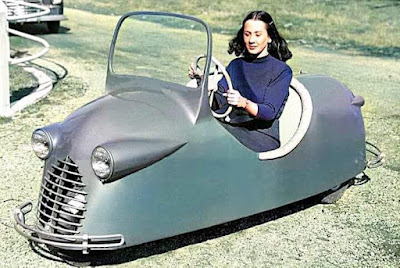
Here's a sleek 1946 Brogan Doodlebug looked like an escapee from an amusement park.. (Picture from: TimAlderman)
But during World War 2 the supply of reliable used vehicles dwindled, but not with the creativity of individual automotive enthusiasts in creating simple and compact vehicles. One who were highly creatives such Frank Brogan believed attitudes would change. And through the B&B Specialty Co., his-owned company based in Rossmoyne, Ohio, primarily manufactures screws, fasteners, and other machine products. Besides that he also created a lightweight Brogan Foldable Monoplane that can be towed from the airport to the owner's house for storage in the garage. 

Then he also had time to design a scooter for his daughter, and in 1944, he was asked by his wife to design a small car that could be used to make shopping tasks easier for women whose husbands took their primary vehicles to work. So, Frank Brogan then engineered a small and sleek vehicle for 2 passengers called the Brogan Doodlebug. Due to its unique name, it is most likely taken from a small insect called the doodlebug. This vehicle features a very sleek steel body with the headlights and windshield posts seamlessly blended in. Furthermore, the open-top, doorless three-wheeled vehicle is about 96 inches long and has a wheelbase of about 66 inches, and can be rotated to its own length. 
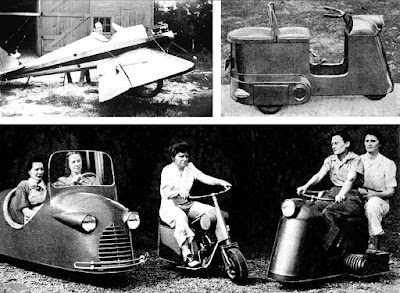
Frank Brogan’s creations were highly creative but marginally marketable. (Picture from: TheOldMotor)
The vehicle is powered by an engine mounted on the rear. It is also mentioned that the engine installed in this compact car can be chosen by the buyer, at that time two choices were provided, namely the one-cylinder Briggs & Stratton engines or the Onan air-cooled two-cylinder. The Brogan Doodlebug can reach a top speed of 45 mph and travel nearly 70 miles on a gallon of gasoline.

Brogan's tiny Doodlebug vehicle is built specifically for women, so he makes sure it's easy to operate and maintainance. Gear-shifting was automated using a mercury-actuated system similar to fluid drive, which eliminated the clutch pedal. Replacing the hidden front tire simply required popping out the grille and unscrewing two bolts. The engine was removed quickly, by raising the rear deck cover, remove the three pins, remove the gas line, and lift the engine from its position next to the five-gallon fuel tank and battery. Frank Brogan refered an October 1944 clipping from The Washington Post, which featured Ray Russell’s Gadabout in his patent application.
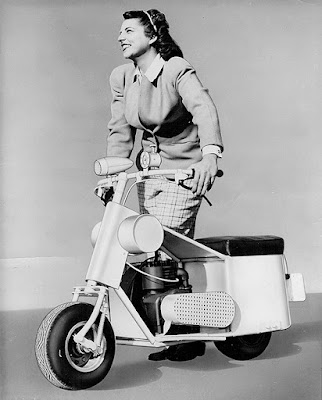
B & B Specialty Company built and sold hundreds of Brogan-Cycles. (Picture from: TheOldMotor)
After the Doodlebug appeared in popular national-wide newspapers and magazines, Brogan received an average of 200 postcards and letters each month covering purchase and distribution requests that came from across the United States and about 20 foreign countries. At that time Brogan made 30 Doodlebugs by hand and sold them for $400 each before realizing that he was actually losing about $100 for each the car he produced.😯 Tooling for mass production required $150,000 which he didn't have, so he suspended the Doodlebug sales.

Instead, he used the same chassis design for the three-wheeled Errand Boy delivery scooter, and developed the four-wheeled Brogan-Truck pickup and delivery van. The Brogan-Trucks feature one steerable wheel at the front and three independent wheels at the rear with power transferred via a chain to the center rear wheel. The odd configuration eliminates the need for expensive differentials. The price of the Brogan-Truck starts at $450, and at the time Frank Brogan managed to sell over 200 units. But he still wanted to build a passenger car.
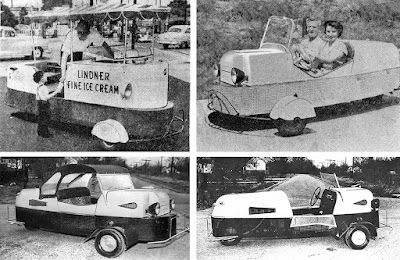
1951 Broganette Ice Cream Truck, and Roadster that has doors fold down. (Picture from: TheOldMotor)
As quoted from The OldMotor, in 1951, B&B Specialty Co. introduced the $500-priced Broganette Roadster powered by a two-cylinder Onan engine as the answer to the demand for small and cheap cars. At that time he managed to sell less than a dozen of these vehicles before starting to modify the design with different bumpers, trim and fenders. He completed 50 more before losing a nearly half-dozen others in a fire-blazes that destroyed his factory in 1958.

Three months later he managed to reorganize his company in Cincinati which became known as B&B Manufacturing by employing around 16 workers, the company is back in producing scooters and golf carts. The company was also among the first to manufacture go-carts, by offering the Twin-B Runabout and Hornet.
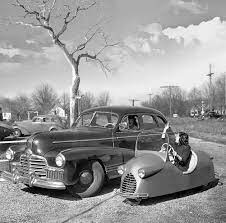
Ten-horsepower Doodlebug rolled on a 66-inch wheelbase. (Picture from: TheOldMotor)
Frank Brogan finally sold his shop in 1959, but he continued to occupy the corner of the building that produced his last two-seater small car called the Brogan Street-Cart. As the name suggests, the Street-Cart is meant for driving around the city. All the features installed on his small car were attempted to meet the regulations that existed in America at that time, such as front and rear bumpers, a brake on each rear wheel, headlights, taillights, turn signals, and a horn.
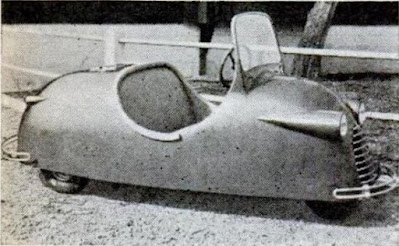
Frank Brogan made 30 Doodlebugs by hand and sold them for $400 each before realizing that he was actually losing about $100 for each the car he produced. (Picture from: TheOldMotor)
The tubular Street-Cart frame is enveloped by a simple sheet metal body from which a pair of small headlights flared above angular fenders; the engine is enclosed in a perforated aluminum rear deck. Uniquely, the small car is claimed to be able to reach a top speed of 35 mph using small wheels like those usually attached for a lawnmower or a child’s coaster wagon. Brogan only sold about 23 Street-Carts before he passed away in 1974.😢

In all, Frank Brogan had made nearly 1,000 miniature cars, trucks, bicycles, and wagons. The variety of vehicles launched from his humble block-and-frame machine shop has made him a celebrity in and around Cincinnati. But his refusal to perfect or advertise his innovative products widely is preventing him from reaching a wider audience and reaching his full potential as a small passenger vehicle manufacturer. *** [EKA | FROM VARIOUS SOURCES | THEOLDMOTOR | ATLASOBSCURA | TIMALDERMAN ]
Note: This blog can be accessed via your smart phone.

Thursday, February 24, 2022

Here's beautiful classic cabriolet-styled cars by Willy Bernath

Lost&Found One time while surfing the internet, we came across a picture of a classic car that looks very elegant and unique. From some pictures, it can be seen that this classic car has smooth curves all over its white colored body. So it is not surprising that he look so unique and elegant. 
The beautiful cabriolet classic car (today version) was built on the Citroën Traction Avant 11B chassis by Willy Bernath commisioned by an Arab prince back in the 1944. (Picture from: Flickr)
Then we tried to find out what car it was? From several sources on the internet we found that the beautiful car was built on the 1938 Citroën Traction Avant 11B chassis by Willy Bernath back in the 1944.
An original version of the Citroën Traction Avant 11B cabriolet classic car creation of Willy Bernath before restored with the grille covered the headlights. (Picture from: Aventure-citroen-min.forumactif.com)
For your info, Willy Bernath was born in La Chaux de fond on March 1, 1914. In the mid-1930s, he had ever worked in Hamburg and Zurich to become a master coachbuilder, and  beside that he was also skilled sky athlete whose ever participated in the Winter Olympics in Garmisch Partenkirchen in 1936.
The beautiful cabriolet classic car was built on the Citroën Traction Avant 11B chassis by Willy Bernath featured with his typical styles of a wide horizontal grille composed of aluminum rods which surround the front of the wing, usually accompanied by integrated headlights. (Picture from: Aventure-citroen-min.forumactif.com)
Then in 1938 he started his coachbuilt workshop in Geneva, unfortunately, it had a short but brilliant career until 1946. During and immediately after World War II, the new automobile chassis were hard to come, and Bernath resorted to offering custom-made convertible coupe bodies on secondhand chassis. 
The beautiful cabriolet classic car was built on the Citroën Traction Avant 11B chassis by Willy Bernath sat on display in the museum that was gathered for the 75th birthday of the Traction Avant in 2009. (Picture from: Flickr)
During these hard and short 8 years of production, only 25 car chassis were bodied in his workshop ranging from Lancia, Fiat, Talbot, Jaguar, Alfa Romeo and Citroën. As you could be seen, the unconventional style of Willy Bernath's car is influenced by several famous coachbuilders at the time such the Figoni et Falaschi and Pinin Farina, and also adopts a relatively modern style for the time.
The partially restored and unpainted cabriolet styled Jaguar SS100 classic car creation of Willy Bernath workshop during 8 years production periods of 1938 to 1946 was sat on displat at the ClassicAuto Madrid 2019. (Picture from: ClassicandSportsCar)
His trademark, a wide horizontal grille composed of aluminum rods which surround the front of the wing, usually accompanied by integrated headlights. His patented construction method, similar to the Superleggera construction used by Carrozzeria Touring, involved a light tube frame covered by aluminum sheets.
The beautiful cabriolet styled Alfa Romeo 6C 1750 classic car creation of Willy Bernath of Willy Bernath workshop during 8 years production periods of 1938 to 1946. (Picture from: Aventure-citroen-min.forumactif.com)
This beautiful cabriolet-styled car was built on the chassis of a Citroën Traction Avant 11B in 1944 and was initially for an Arab prince but remained in a garage in Geneva until the end of the war. At the end, it was sold to a doctor from Neuchatel, and then found in the collection of the famous collector Jean Tua who kept it since 1972 until his museum was sold in 2005. 
Another beautiful cabriolet classic car creation of Willy Bernath workshop during 8 years production periods of 1938 to 1946. (Picture from: Aventure-citroen-min.forumactif.com)
This car is one of just three of Bernath's creations that are known to exist today, among other a Jaguar SS100 (last seen at the ClassicAuto Madrid 2019) and an Alfa Romeo 6C 1750 (was sold in original, unrestored condition for $146,000 (10% over top estimate) in 2000 by Brooks in Monaco). 

As a closing, Willy Bernath was certainly not one of the trully successful coachbuilders of Switzerland, but his efforts were brave, with advanced styling and high-quality workmanship, offering a second life for many fine cars of prewar.😎 *** [EKA | FROM VARIOUS SOURCES | AVENTURE-CITROEN-MIN.FORUMACTIF.COM | COACHBUILD | HEMMINGS ]
Note: This blog can be accessed via your smart phone.

Wednesday, February 23, 2022

Little about the unique American Doodle Bug scooter

Hiawatha Run As we all know, the 1930s and 1940s were times when the world was hit by a severe economic recession. So that this difficult condition also had an impact on the people's ability to buy four-wheeled vehicles at that time. Well, who would have thought, in such conditions there was then a scooter called the Doodle Bug which was first launch in the 1940s as an alternative to affordable vehicles for the public in America at that time. Related to its unique name, it is likely taken from a small insect called a doodlebug.
The Doodle Bug Scooter developed by the Beam Manufacturing Company in Webster City, Iowa to be sold by the Gambles department store chain in the late of the 1940s. (Picture from: Silodrome)
As quoted of the Silodrome, initially the scooter was intended for a kind of vehicle market for teenagers and those too young to ride a motorcycle on the road. Thus this Doodle Bug, Cushman, the Crocker Scootabout scooters, etc were born in America. 

However, this condition suddenly changed after World War II, where there was a significant surge in demand for motorcycles. Thus the Italian scooters born that we know today, such as the Vespa and Lambretta which is said were inspired by the American scooter designs.
The Doodle Bug Scooter has a simple tubular steel frame and a Briggs & Stratton NP engine. (Picture from: Silodrome)
At that time, people needed a simple and economical mode of transportation. And the simple scooter such the Doodle Bug could be the right answer to fulfill the market demand. Its cheap price tag and easy to ride were the positive reasons why the scooter was selling well at that time. Beside that there's one weakness, just don't expect the scooter could be run at a high speed.
The Doodle Bug Scooter has a thickly padded seat in lieu of suspension and a small rear-mounted fuel tank.. (Picture from: Silodrome)
How could be? Because this Beam Manufacturing Company developed scooter is powered by a very simple 4-stroke, side valve, single cylinder engine of the Briggs & Stratton NP capable spewing power 1.5 hp only. During the Doodle Bug production, turn out the company also used the Clinton engine beside the Briggs & Stratton NP ones. But mostly the NP engine was fitted to the overwhelming majority of Doodle Bugs, and it’s also the easiest to find parts for given its popularity.
The Doodle Bug Scooter could be made 100% road legal using aftermarket kits to add the required headlight and taillight. (Picture from: Pinterest)
The scooter was developed by the engineers of the Webster City based company with a simple tubular steel frame structure with the engine mounted behind under the seat. The rider's feet rest on a flat steel platform which is the scooter typical style, the fuel tank is rear mounted behind the seat above the rear tire. That is it! Even the scooter is not equipped with suspension or lights. Only two pneumatic tires to be a kind of suspension between the rider and the road. However, lighting (headlight and taillight) is an optional feature that can be installed on the Doodle Bug, if wanted to be road-legal vehicle.
During its production period from 1946 to 1948, the factory produced more than 40,000 Doodle Bugs, most of which were sold as “Hiawatha Doodle Bugs” by Gambles. Back in the day, Doodle Bugs sold for less than $100. Today, they are the focus of the Doodle Bug Club of America and a unique collector’s item. This American scooters have a huge fans across the United States, and there is still an annual gathering for owners and restorers in Webster City (where all Doodle Bug scooters are made).

Kept spur your adrenaline on the power of two-wheeled monster and stay alive with the true safety riding. May God will forgive Your sins and so does the cops...... *** [EKA | FROM VARIOUS SOURCES | SILODROME | ID.MOTOR1 ]
Note: This blog can be accessed via your smart phone.

Tuesday, February 22, 2022

The Shelby Daytona big-block monsters brought back alive only 6 units in 2017

Shelby Big-block Monster In the past, this car was expected by its creator Carroll Shelby to be the ruler of Le Mans, even predicted to be a masterpiece. The car is named the Shelby Cobra Daytona Coupe which is a refinement of the Shelby Daytona Coupe which was produced only six units in the 1964-1965 period.
The 1964 Shelby Cobra Daytona Coupe ‘Secret Weapon,’ a legendary racing car was expected by its creator Carroll Shelby to be the ruler of Le Mans. (Picture from: HiConsumption)
Originally, the 1964 Shelby Cobra Daytona Coupe is an improved version of the six units Shelby Daytona Coupe that had been created and is said to be more powerful. So fierce, the automaker called it as a "Secret Weapon". As we could be seen to its appearance, the latest 1964 car version has a chassis that is made longer because uses a big block engine ie 427 cubic inches, while the old one is only 289 cubic inches.
The 1964 Shelby Cobra Daytona Coupe ‘Secret Weapon’ has typical appearance with a chassis that is made longer because uses a big block engine ie 427 cubic inches, while the old one is only 289 cubic inches. (Picture from: CarVaganza)
Because it has a larger engine cubication, later this car was also known as the Shelby Cobra Daytona Coupe 427 with the code CSX2286.Initially, Carol Shelby would be introduced the new version of his racing car to the public at the 1964 24 Hours of Le Mans. But it never happened, because the car was damaged on an accident on the road when it was 'carried' by the towing car to the to the Circuit de la Sarthe, France. 

Some say the story is just a hogwash and it never happened. As quoted of Superpeformance, in reality, the car was never finished. Despite the best efforts of John Ohlsen, one of Shelby’s trusted fabricators, CSX2286 was still missing major components in June 1964 and wasn’t ready to race.
The 1964 Shelby Cobra Daytona Coupe ‘Secret Weapon’ is made of aluminum, the weight is also very light, which is only 998 kg. (Picture from: SuperPerformance)
Despite the “story,” it was never put on a truck headed for Le Mans. Instead it remained under construction in a dark and dusty corner of Carrozzeria Grand Sport, an Italian body shop in Modena often used by Shelby. In short, incomplete, CSX2286 was finally shipped back to California, where it was returned to its original short wheelbase, small-block configuration.😢
The 1964 Shelby Cobra Daytona Coupe ‘Secret Weapon’ interior has the fixed bucket seats with narrow-space leg room, and metal dash behind its classic three-spokes wooden-finished steering wheels. (Picture from: HiConsumption)
It was then raced, only once, competing at Le Mans the following year, driven by Gurney and Jerry Grant. Due to clutch trouble it failed to finish. Today, the famous blue Cobra Coupe, one of only six ever built, survives in the collection of Rob Walton, heir to the Walmart fortune.
The 1964 Shelby Cobra Daytona Coupe ‘Secret Weapon’ is powered by a 427 cubic inch V8 engine capable spewing power up to 550 hp and coupled with a 4-speed manual transmission. (Picture from: HiConsumption)
But, don't worry the replica of the mentioned car has been built only six units by Shelby Legendary Cars in 2017 with a body made entirely of aluminum and of course is powered by a 427 cubic inch V8 engine capable spewing power up to 550 hp and coupled with a 4-speed manual transmission. Due to the body of the Shelby Daytona big-block replica is made of aluminum, the weight is also very light, which is only 998 kg.
The 1964 Shelby Cobra Daytona Coupe ‘Secret Weapon’ replica is made only six units by Shelby Legendary Cars in 2017. (Picture from: HiConsumption)
According to Lance Stander, CEO of Shelby Legendary Cars, if the real-car worth over $15 millions (or approx Rp 215 billions), the recreation of Shelby’s 1964 big-block-powered Cobra Daytona Coupe built by his company only costs half a million, or exactly $495,000 (approx Rp. 7 billions).😮
The 1964 Shelby Cobra Daytona Coupe ‘Secret Weapon’ replica featured with typical appearance of Kamm-tail in the back. (Picture from: HiConsumption)
And the first of just six ever built, the 'Secret Weapon' replica was completed in 2018 and given the chassis number CSX2603, making it the first in the CSX2000 Series since the 1960s. It was then quickly sold to Craig Hansen of Des Moines, Iowa.
According to Stander, the owner never drives the car. It lives at Stander’s facility along with several others that belong to him. “The kind of owners that buy these are just buying them for show to look pretty,” Stander says. It's possibly, the car was not comfortable to drive in the roads, due to it's too hot and too small inside. Indeed, it seem crazy for us, to buy an expensive car, but never drove it on the roads.😷 *** [EKA | FROM VARIOUS SOURCES | SUPERPERFORMANCE | HICONSUMPTION | HOTCARS | IDSWATER ]
Note: This blog can be accessed via your smart phone.