-->
Drop Down MenusCSS Drop Down MenuPure CSS Dropdown Menu

Tuesday, May 19, 2015

A Big block Chevy powered Smart ForTwo

Limits for modification is difficult to determine. Especially when watching a video uploaded to Youtube by Keith Pufahl. A video recording duration of 1 minute 16 seconds it displays a total creations on the Smart ForTwo with the orientation of the drag race purposed.

Operations are conducted may be a bit "too far", because the Smart ForTwo was born with environmentally friendly concepts. Its exterior design that makes the body curvature almost no angle, were made to prioritize aerodynamics. While the technology in smaller engines for fuel efficiency.
Smart ForTwo gets big-block Chevy V8 engine. (Picture from: http://bit.ly/1ENV6XV)
But that has done much different this time even categorized as extreme. Explained, the position of the previous machine behind now pinned in the front of car. Can be seen from the end of the exhaust which is behind the front tire. The monster power comes from the "big block" Chevrolet V8 engine. Compensate for the change, the car's chassis costomized overhauled in order to become more stronger.
As quoted from Road and Track that published a picture of this Smart ForTwo in "naked" condition. From there visible, the protective frame to protect driver who are in the middle of the car. Smart body role only be "clothes", so it can immediately be removed when not needed.
This video taken during testing in No Limit Raceway in Morocco, Indiana, United States. The time record is still not good, because it continued development. The new record is 12.2 seconds solved on a 402 m straight track. The target in under 10 seconds. *** [EKA | FROM VARIOUS SOURCES | ROAD AND TRACK]
Note: This blog can be accessed via your smart phone.

This VW T1 Race Taxi Packs Porsche Performance in a Retro Body

Turbo Nostalgia - When most people think of a Volkswagen Kombi, what likely comes to mind is a slow but charming van, perfect for road trips and lazy beach days. Known for its boxy shape and laid-back attitude, the VW T1 has long been a symbol of freedom on the open road. But what if someone took that peace-loving van and turned it into something that could make your heart race at full throttle? That’s exactly what a Swiss man named Fred Bernhard set out to do—and after six years of passion-fueled work, he succeeded spectacularly with what he calls the Volkswagen T1 Race Taxi.
Volkswagen T1 Race Taxi with Porsche 993 engine. (Picture from: TheSamba)
At a glance, the Race Taxi may still carry the nostalgic silhouette of a 1960s VW Kombi, but don't be fooled—this machine is anything but a slowpoke. Bernhard completely transformed the classic van by swapping out its original engine with a powerful heart from a Porsche 993. And this wasn’t just an engine transplant—it was a full-blown performance makeover. Thanks to its twin turbochargers and a 6-speed manual gearbox, the Race Taxi now churns out an eye-popping 523 horsepower and 756 Nm of torque. That’s the kind of power usually reserved for serious sports cars, not something you’d expect to see parked next to a surfboard.
Rear side view of Volkswagen T1 Race Taxi. (Picture from: http://bit.ly/1EdtQkZ)
Visually, the van is just as bold as its performance. It sports a striking combination of gray, white, and orange accents, reflecting both its racing pedigree and custom craftsmanship. Every inch of it screams uniqueness, from its aggressive stance to the carefully integrated design details. Bernhard didn’t just modify a van; he rewrote what a VW Kombi could be.
 
And where better to showcase such a wild creation than at the iconic Wörthersee GTI Meeting in Germany? Set amidst a gathering of some of the most creative and powerful custom cars in Europe, the Volkswagen T1 Race Taxi fits right in. But even among a sea of automotive marvels, this Porsche-powered Kombi grabs attention not just because it’s different—but because it’s done right.
Fred Bernhard’s Race Taxi is more than just a cool build—it’s a rolling example of vision, skill, and the kind of deep-rooted passion that turns a simple idea into a mechanical masterpiece. What began life as a humble van is now a fusion of classic charm and modern performance. It’s a nod to automotive history, a wink at racing heritage, and a clear statement that imagination still has a place in the garage. *** [EKA [19052015] | FROM VARIOUS SOURCES | MOTORING.COM.AU | THESAMBA | VOLKSFORUM ]
Note: This blog can be accessed via your smart phone.

The evidence of pre-Columbus trade was found

Christopher Columbus's status as the discoverer of the Americas sued. Historical evidence shows precisely the opposite, there are already many foreign nations to set foot there before October 12, 1492.

More recently a number of bronze artifacts found in a 1,000-year-old home in Alaska. The findings becoming evidences, that the trade has existed between the East Asia with the region called New World (America).
Archaeologists working at the Rising Whale site at Cape Espenberg, Alaska, have discovered several artifacts that were imported from East Asia. (Picture from: http://bit.ly/1GOHP7R)
The archaeologists found these artifacts at the 'Rising Whale' site near Cape Espenberg. "From a distance, the site looks like a whale surfacing," said Owen Mason, a researcher from the University of Colorado, who took part in the excavation at the site, as quoted by LiveScience on Friday, April 17, 2015.
This map shows possible trade routes that archaeological and historical evidence, gathered over the past 100 years, have teased out. (Picture from: http://bit.ly/1GOHP7R)
The latest findings combined with other findings generated within the last 100 years shows that the merchandise, as well as the idea, until in Alaska of the East Asian civilization - long before Christopher Columbus arrived in the Caribbean Sea in 1492.

"We see the evidence of interaction, directly with the 'high civilization' such as China, Korea, or Yakutia - a region in Russia," said Mason.
One of the bronze artifacts is pictured here. It may have originally been used as a buckle or fastener although its use when it reached Alaska may have been different. (Picture from: http://bit.ly/1GOHP7R)
The 'Whale Rising' findings including two bronzes artifacts, one of which is allegedly used as a buckle or fastener - with a piece of skin, which is from the age of carbon originating from the period around 600 AD. Meanwhile, the other bronze artifacts may be used as a whistle.

Bronze had not been developed at that time in Alaska. Archaeologists suspect, these artifacts were made in China, Korea, or Yakutia, then go to Alaska via the trade route.

Inside the house, the researchers found artifacts of obsidian material - shiny black stones of volcanic eruptions - which have chemical traces indicating that it is obsidian from Anadyr River valley in Russia.

'Whale Rising' site indicates there's a trade route that connects the Bering Strait (including Alaska side) with a civilization that flourished in the East Asian, before the time of Columbus. (Who discovered America?) *** [EKA | FROM VARIOUS SORCES | LIVESCIENCE]
Note: This blog can be accessed via your smart phone.

Monday, May 18, 2015

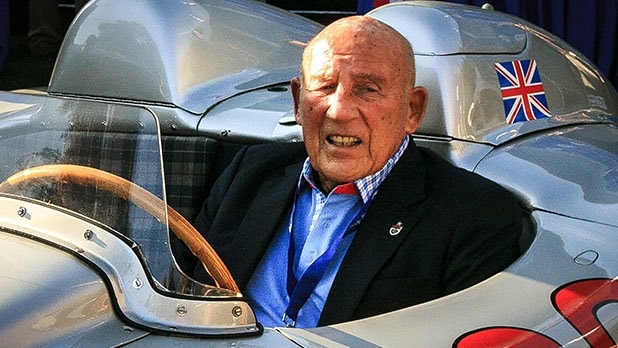
Sir Stirling Moss and #722 remain unbeaten

Sir Stirling Moss's performance has carved a legend in the Mille Miglia in 1955, as racer aged 25 years who was achieved success in the racing world career used the Mercedes-Benz 300 SLR #722. Now the car is touted as the most beautiful car racing model, which raced through the dangerous rural routes throughout the countryside in Italy.
Sir Stirling Moss at the Amelia Island Concours d’Elegance. (Picture from: http://mjm.ag/1IEBtXP)
Moss is pictured moments after winning in a record time of 10 hours, seven minutes and 48 seconds. (Picture from: http://dailym.ai/1KQymLl)
Sir Stirling Moss and co-driver Denis Jenkinson were completing a distance of 992 miles in 10 hours 7 minutes 48 seconds, with an average speed of 98.53 miles per hour with a car without safety features such as those held by modern cars today, and only rely on an excellent car brakes for the race.
Sir Stirling Moss and this Mercedes-Benz 300 SLR #722 remain unbeaten. (Picture from: http://bit.ly/1K9Bvck)
Looks like Sir Stirling Moss's performance is never going unbeaten, a record of these racers were unbeaten until 1956 and then 1957, when a fatal accident happened and caused two racers, nine spectators died, where five of them are the children. After the accident so that's the last race event.
To commemorate the 60th year of the victory of the invincible, some people from Petrolicious will show off the Sir Stirling Moss's car namely Mercedes-Benz #722 and invites hostmotorsport legendary for leading the event. *** [EKA | FROM VARIOUS SOURCES | PETROLICIOUS | DAILYMAIL | AUTOEVOLUTION]
Note: This blog can be accessed via your smart phone.

Golf GTE Sport wrapped in futuristic suits

Volkswagen really shows an extreme change in the figure of the VW Golf. This time the concept version could be considered more radical, because the VW Golf GTE Sport, that this concept model called already carrying a futuristic design.
Volkswagen Golf GTE Sport Concept with the Gullwing doors is part hot hatch, part supercar. (Picture from: http://bit.ly/1JMrheD)
This car was first introduced in Worthersee Austria which runs from May 14, 2015, with a much more futuristic look, including the application of the gullwing doors, making VW Golf GTE Sport has a very little similiarity with the serial production of GTE Golf plug-in hybrid.
Left side view of Volkswagen Golf GTE Sport Concept. (Picture from: http://bit.ly/1JMrheD)
The whole of its futuristic body is also wrapped in carbon fiber material. And the cockpit is made separately between the driver with a passenger. The seats are already used the bucket seat with 5 point seatbelt.
Interior and dashboard view of Volkswagen Golf GTE Sport Concept. (Picture from: http://bit.ly/1A5CHdi)
Now about the power source. VW Golf GTE Sport equipped with a plug-in hybrid system, which consists of a petrol TSI engine capacity of 1.6 liter, which adopted the tuning results of the Polo WRC, which gives a power of 299 hp and torque of 400 Nm.
Rear side view of Volkswagen Golf GTE Sport Concept. (Picture from: http://bit.ly/1JMrheD)
The combustion engine will be combined with two electric motors, one placed in front of the DCT gearbox house which accounts for a power of 115 hp and 330 Nm of torque, as well as another electric motor in the rear could give the power of 115 hp and 270 Nm torque.
If all the car's power source merging, could generates the power combination up to 400 hp and 670 Nm torque. When the combustion engine and electric motor combined, the VW Golf GTE Sport can accelerated from 0 to 100 kph in 4.3 seconds, before it continues gassed up to a maximum speed of 280 kph.
Although it had a fierce performance, the VW Golf GTE Sport concept remains very frugal fuel consumption. In hybrid mode, only 2 liters/100 km. And can drivr as far as 50 km just to rely on electric power alone. *** [EKA | FROM VARIOUS SOURCES | DIGITAL TRENDS]
Note: This blog can be accessed via your smart phone.

Chicken embryos with dinosaur's snout

65 million years ago, dinosaurs disappeared from the Earth. Extinction not necessarily remove the traces of the animal's existence, but leave what scientists call the "avian birds".

Based on the studies that have been done, they believe that birds living today is the result of the evolution of dinosaurs: a bird's beak structure replaces the function of the hand on a dinosaur for grasping food, making it a kind of tweezers to clamp prey. While hands dinosaurs evolved into wings in birds.
An artist rendition of the non-avian dinosaur Anchiornis (left) and a tinamou, a primitive modern bird (right), with snouts rendered transparent to show the premaxillary and palatine bones. (Picture from: http://bit.ly/1EAyiut)
Bhart-Anjan Bhullar, a paleontologist and biological development of Yale University, said that there are now at least 10 to 20 thousand species of living birds. "That way we can still say that today still include dinosaur era," he said, as quoted by LiveScience on May 12, 2015.
CT cans of the skulls of a control chicken embryo, altered chicken embryo and an alligator embryo. The chicken embryo whose protein activity had been modified shows the ancestral snout. (Picture from: http://bit.ly/1EAyiut)
Bhart-Anjan and his team at Harvard University conducted an experiment that aims to determine how the half evolved. They managed to restore the shape of the muzzle of a dinosaur in chicken embryos, and replacing half of its original shape. Muzzle shape resembles the muzzle of a Velociraptor and Archaeopteryx.

However, these embryos are not allowed to hatch. "We do not intend to produce a chicken-dinosaur species, only interested in the beak evolutionary process," added Bhullar. *** [EKA | FROM VARIOUS SOURCES | LIVESCIENCE]
Note: This blog can be accessed via your smart phone.