Lost Masterpiece - Some cars don’t just drive — they carry stories. And for those of us fascinated by the eccentric legacy of
Raymond Loewy, stories are exactly what we look for. Over time, we’ve revisited some of his most offbeat but fascinating contributions to automotive design — from
the daring 1941 Loewy Lincoln,
the streamlined elegance of the 1957 BMW 507 Loewy Concept, to
the audaciously futuristic 1959 Lancia Loraymo. Each of these cars was more than transportation; they were statements. But tucked among those bold visions is one peculiar creation not many have heard of — a British classic that wore
Loewy’s unusual ideas like a borrowed suit. It’s
the Jaguar XK140 Coupe, and its transformation says a lot about both the designer and the times.
 |
The 1955 Jaguar XK140 Coupe without front bumper as an inhouse study designed by Raymond Loewy and the bodywork built by Boano Carrozzeria. (Picture from: Carstyling.ru)
|
In 1954,
Loewy was at the top of his game.
His design studio in South Bend was turning heads across industries — from branding and packaging to planes and trains. But cars always gave him a special kind of canvas. That year,
Ferrari quietly reached out to
Loewy to create a secret design study for their Europa model. This was no small thing —
Ferrari’s styling choices almost always stayed close to home with firms like
Pininfarina.
Loewy accepted the challenge and started shaping a long,
flowing form with a clean,
unbroken line from the hood to the rear,
inspired by Virgil Exner’s “dart” motif.
 |
| The original 1955 Jaguar XK140 Fixed Head Coupe. (Picture from: Driving.ca) |
But as ideas became sketches and sketches turned to models, problems cropped up. That pointed nose — sleek as it looked — complicated everything. Where would the headlights go? How should the grille work with the bumpers? Loewy’s team tried out three or four different front-end designs before finally settling on a chromed “waterfall”-style grille that seemed to tie things together.
 |
| The 1955
Jaguar XK140 Coupe without front bumper designed by
Raymond Loewy while sat on display at the Paris Auto Salon in October 1955. (Picture from: Carstyling.ru) |
From there,
a 1:4 scale clay model was crafted and sent to Carrozzeria Boano in Italy, a respected name in coachbuilding.
Boano began working on the full-sized body based on Loewy’s vision. And then came the twist: word got out.
Pininfarina heard about
Ferrari’s side project and wasted no time voicing their discontent.
Enzo Ferrari,
caught in the middle,
wasn’t about to damage his relationship with his go-to design house.
He called the project off.
 |
| The 1955
Jaguar XK140 Coupe without front bumper as an inhouse study designed by
Raymond Loewy and the bodywork built by Boano Carrozzeria. (Picture from: Carstyling.ru) |
That could’ve been the end.
But Loewy wasn’t one to let a half-finished idea die on the drawing board.
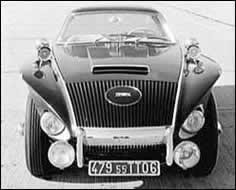 |
| The Jaguar XK140 Coupe after got a few modifications in the 1956 with a new bumper and two foglights in the front. (Picture from: TheAvanti.com) |
Instead, he pivoted. If he couldn’t make
a Ferrari, he’d make the next best thing —
using a car with similar proportions. He purchased
a Jaguar XK140 Coupe,
chassis number #814096,
which had a wheelbase and track not too far off from a Ferrari. The original body was stripped, leaving only the chassis. Then
Boano’s nearly finished bodywork was adapted and mounted to
the Jaguar platform. Adjustments had to be made, of course.
The Jaguar's slightly shorter wheelbase and taller engine forced compromises — especially on the hood, which now sat a bit higher than originally planned.
 |
| The Jaguar XK140 Coupe after got a few modifications in the 1956 shows nice proportions of the right sideview. (Picture from: Carstyling.ru) |
Still,
the result was striking and unlike any Jaguar ever made. The car made its first public appearance at
the Paris Auto Salon in October 1955.
But there were issues.
It was shown without a front bumper,
as the team was still figuring out how to integrate it without disrupting the overall design. Audiences were puzzled more than impressed, and attention was minimal. The car returned to
the Paris Auto Salon the following year with some updates, and then it was brought back to
New York in 1956.
 |
| The Jaguar XK140 Coupe after got a few modifications in the 1956 with huge window, bumper frames tail light lenses at rear. (Picture from: Carstyling.ru) |
In 1957,
the car took a dramatic turn.
Loewy sold it to
heavyweight boxing champion Archie Moore for a reported $25,000 —
a staggering sum at the time,
roughly equivalent to over $200,000 today. But this chapter didn’t last long.
That same year,
the car was reportedly destroyed in a fire. Since then, it has never reappeared, and no replicas or rebuilds have surfaced.
 |
| Archie Moore who was the then heavyweight champion behind the wheel of the Loewy's Jaguar XK140 in September 1957. (Picture from: Carstyling.ru) |
 What’s left is a nearly forgotten but incredibly rich footnote in automotive history — a Jaguar that was never meant to be a Jaguar, born from an Italian dream and carried forward by American determination. It wasn’t a production model. It wasn’t a race car. But it was a rolling sculpture, built by a man who never let convention get in the way of creation. That’s what made Raymond Loewy different — and what makes this car worth remembering. *** [EKA | FROM VARIOUS SOURCES | CARSTYLING.RU | AUTOMOBILIAC | COACHBUILD | JALOPNIK ]
 Note: This blog can be accessed via your smart phone.


