-->
Drop Down MenusCSS Drop Down MenuPure CSS Dropdown Menu
Showing posts sorted by relevance for query Alex Tremulis. Sort by date Show all posts

Tuesday, September 26, 2023

Capturing Speed and Style: The Untold Story of Tremulis' Sports Cars

Forgotten ONES - In the early days of automotive design and manufacturing, before the advanced technology we have today, car stylists and designers often relied on scale models to bring their visions to life. These models served as a tangible representation of their designs, allowing them to be examined, refined, and shared with other designers, consumers, and potential investors. 
The 1951 final result of The Tucker-Tremulis-Neidlinger-Kaiser-Frazer sports car model with the newly built removeable hardtop and enclosed front fender, including a fresh new paint job. (Picture from: GyronautX1)
However, these models were typically just a preliminary step in the development process. As final designs evolved, the fate of these original models varied from becoming interesting paperweights to being dismantled for other projects. This pattern can be observed in numerous automotive projects, including the likes of the Ford Thunderbird Mexico, Ford Muroc, Ford Seattle-ite XXI, Pontiac Club de Mer, and many others.
The 1951 final result of The Tucker-Tremulis-Neidlinger-Kaiser-Frazer sports car model with the newly built removeable hardtop and enclosed front fender, including a fresh new paint job. (Picture from: GyronautX1)
One noteworthy automotive designer who embraced the use of scale models was Alex Tremulis. What sets his sports car models apart is that they served as a wellspring of design inspiration for several prominent car companies throughout the years. This journey began with the Tucker Corporation and culminated with Kaiser-Frazer, as these models took on a life of their own, transcending their original purpose.
Alex Tremulis, Chief Stylist for Tucker, examines wooden car miniatures used in developing styling for Tucker cars. (Picture from: GyronautX1)
As we delve into the story of Alex Tremulis' sports car models, we will uncover their role in pushing the boundaries of streamlining and aerodynamics. The genesis of this sports car concept can be traced back to Tucker. In a 1948 issue of Tucker Topics, a dealer magazine from the Tucker Corporation, there's a captivating photograph featuring Alex Tremulis alongside the Tucker 48 production model and a sports car model that appears to be in the early stages of development, prior to receiving its finishing touches.
Alex Tremulis posed with his model-making tools and the Tucker sports car in 1949, examines what looks to be the completed  and finely detailed scale model. (Picture from: GyronautX1)
After successfully producing 51 units of the Tucker 48 in 1948, Tremulis continued to pursue his passion for automotive design. During his tenure at Ford Motor Company in the 1950s, he contributed to projects such as the Ford Thunderbird Mexico. However, there's a lesser-known chapter in Tremulis' career, involving an intriguing sports car design that was initially conceived for Tucker but later transitioned to Joseph Neidlinger and eventually found its way to Kaiser-Frazer.
The confident creator of the next  American sports car looks ready for all takers in the project in 1949. (Picture from: GyronautX1)
While the exact timeline of this design's creation remains uncertain, several photos of the sports car model alongside a Tucker 48 scale model have surfaced. It's plausible that this unknown sports car design was conceptualized around the same time as the only car model ever produced by Preston Tucker's company.
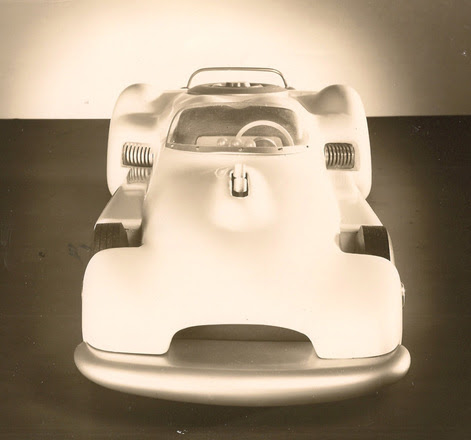
Initially the Tucker-Tremulis-Neidlinger-Kaiser-Frazer sports car model has menacing front view shows proportions that were still far ahead of its time. (Picture from: GyronautX1)
This design exudes a menacing front end, featuring proportions that were undeniably ahead of its time. Notably, the exposed front wheel tops may have been influenced by Tremulis's friend, Ab Jenkins, who emphasized the importance of monitoring tire wear and suspension performance, especially in racing.
Sunday Times newspaper clipping published April 23, 1949 which reported that the proposed sports car was described as having a guaranteed top speed of 125 miles per hour. (Picture from: GyronautX1)
In an April 23, 1949 article in the Sunday Times, the proposed sports car was described as having a guaranteed top speed of 125 miles per hour. Reportedly, there were four orders for this sports car model, although it remains unclear if any of them were fulfilled. Despite the Tucker 48 facing production challenges at that point, Tremulis remained committed to the project.
The exposed front wheel tops may have been influenced by Tremulis's friend, Ab Jenkins, who emphasized the importance of monitoring tire wear and suspension performance, especially in racing. (Picture from: GyronautX1)
As time passed, Tremulis continued to refine the design, relying on traditional techniques like paint and ink to manipulate studio photos. In 1951, the model received a significant update with a removable hardtop, enclosed front fenders, and a fresh paint job. This transformation was a testament to Tremulis's unwavering dedication to his craft.

These are some early pictures of the Tucker-Tremulis-Neidlinger-Kaiser-Frazer during 1949. (Picture from: GyronautX1)
With no Photoshop available, Alex Tremulis took paint and ink directly to the studio photos in order to create the enclosed fenders.

Alex Tremulis' pencil lines attempt to redefine the front fenders.

The removeable hardtop is painted onto the side view photo and the front fenders are pencilled in.

By this juncture, Alex Tremulis had joined Kaiser-Frazer, where he assumed a pivotal role in the advanced styling studio. In April 1951, exactly three years after its initial debut as a Tucker project, the revamped model made its first public appearance in the Kaiser-Frazer newsletter.
The freshened-up sports car model makes its first public debut in the Kaiser-Frazer newsletter by April 1951. (Picture from: GyronautX1)
Come October 1951, Science and Mechanics magazine caught wind of Kaiser-Frazer's future plans and featured photos and descriptions of the sports car model. By this time, its top speed had soared to over 135 miles per hour. The model showcased several distinctive features, including two air intake tubes on the hood, front intake of the rear-fenders to enhance brake cooling, a spare tire mounted atop the rear deck, and a row of exhaust outlets at the rear.
Come October 1951, Science and Mechanics magazine caught wind of Kaiser-Frazer's future plans and featured photos and descriptions of the sports car model. (Picture from: GyronautX1)
Unfortunately, despite the anticipation, the design failed to progress beyond 1952. The Tucker-Tremulis-Neidlinger-Kaiser-Frazer sports car model remained proudly displayed on Tremulis's credenza, never materializing into a real production car. To this day, it remains a mystery whether this scale model is still in the possession of the Tremulis family or has found a new home.
Alex Tremulis at work in his Kaiser-Frazer office in the Willow Run plant in 1951, while the Tucker-Tremulis-Neidlinger-Kaiser-Frazer sports car model sits proudly on his credenz.. (Picture from: GyronautX1)
In retrospect, the journey of Alex Tremulis' sports car models is a testament to the relentless pursuit of innovation and design excellence within the automotive industry. These scale models not only served as creative outlets for their creator but also sparked inspiration across multiple generations of car enthusiasts and designers. 
 
While they may not have become full-fledged production vehicles, they remain cherished relics of a bygone era, capturing the spirit of a time when the automotive world was ripe with possibilities. *** [EKA | FROM VARIOUS SOURCES | GYRONAUTX1 | ]
Note: This blog can be accessed via your smart phone.

Saturday, October 22, 2022

Another car of tomorrow by Alex Tremulis

ONE-OFF - As a true lover of the automotive world, You are certainly familiar with the figure of Alex Tremulis, one of the visionary automotive designers with great talents who is able to produce extraordinary automotive works such as the Tucker 48, Gyro-X, and many others. Well, our discussion this time is also related to the designer's creation in 1970s for one of the well-known Japanese brands, Subaru.
1980 Subaru X100 concept built in 1973 with the aim of achieving 100 MPG designed by by Alex Tremulis, and built at the Subaru Technical Center in California by Subaru engineer Ron Jones over 6 years to complete. (Picture from: Rongineer)
The mentioned concept car named the Subaru X100, was built during a difficult era of the oil crisis with rising oil prices set by OPEC and the high costs the United States had to spent during the Vietnam War, causing stagflation in the country. This automatically causes automotive industry entrepreneurs, designers, and engineers to think even harder about ways to push the automobile's fuel efficiency limits.
1980 Subaru X100 concept's exterior by using an old airplane wing tank as the base for the car body. (Picture from: DrivingEnthusiats)
Back to the designer, Alex Tremulis who at that time was being worked as a consultant at the Subaru Technical Center (the BRAT logo and side graphics is some of his work)  and he was passionate about aerodynamics and fuel ecomony. This coincidentally seemed to be a blessing for him to execute a new breakthrough vehicles with an excellent fuel efficiency in the right time in the midst of an oil crisis.
1980 Subaru X100 concept's exterior by using an old airplane wing tank as the base for the car body. (Picture from: AlexTremulisArchives)
As quoted of Rongineer, it didn't take much time, Alex Tremulis managed to convince Walt Biggers, the brilliant godfather of the Subaru Technical Center, but more importantly he was able to sell on the idea of building the concept car to Harvey Lamm, president of Subaru of America then. In short, this car had been in Alex's mind for many years and his great idea was to drive the car across the country on one tank of gas to demonstrate the benefit of good aerodynamics on fuel economy and to provide favorable publicity for Subaru at every stop along the way.
This is the rolling chassis of the Subaru X100 Concept designed by Ron Jones. (Picture from: Rongineer)
By design, the concept car designed by Alex Tremulis is a three-wheeled vehicle with a very aerodynamic body. He was fond of saying that he was commited to "eliminating the sadistic torture of innocent air", and he meant it. Further, he designed the exterior by using an old airplane wing tank he had kept for a long time as the base for the car body.
The design and construction of the Subaru X100 chassis and drivetrain was handed to Ron Jones, who in turn brought in a talented fabricator named John McCollister. (Picture from: Rongineer)
Meanwhile, Subaru offers the prospect of a suitable powerhouse, namely a package of a 500 cc engine commonly used in the Rex, a Kei FHI class car in Japan, then combined as a perfect match with the rear drive unit mounted completely on the subframe with the suspension. The design and construction of the chassis and drivetrain was handed to Subaru engineer Ron Jones, who in turn brought in a talented fabricator by the name of John McCollister. Walt Biggers, director of Subaru’s Technical Center, oversaw the project.
Alex Tremulis stands by the main body form which was based on the aircraft wing tank. (Picture from: Rongineer)
Jones was directed to use as many off-the-shelf Subaru parts as possible. To that end, he utilized the engine, transmission, and rear suspension from the Rex, a kei jidosha not sold in America. Although aluminum wheels with a custom offset needed to be made in order to fit under the drivetrain under the body, the combination worked perfect. Much of the rest of the car was built from scratch by Jones and McCollister, including the frame, shift linkage, front suspension, front wheel, and steering system. To his credit, the chassis weighs only 70 pounds (32 kg).
1980 Subaru X100 concept while on testing in August of 1980 at the Ontario Motor Speedway in California. (Picture from: Rongineer)
The X100 was a side project, it done in the team’s spare time in Jones’ shop at the Technical Center, and taking six years to complete. The original oil crisis only lasted about six months, so the initial panic had long subsided. Still, the team saw the project through and testing began in August of 1980 at Ontario Motor Speedway in California.

Before a cross-country run could be attempted, the car had to prove it could achieve 100 miles per gallon while cruising at the national speed limit of 55 mph. For the track testing, a 1-gallon tank replaced the original 25-gallon tank. In initial tests, the car ran out of fuel a frustrating half a lap from the desired goal. Jones, who describes himself as “a bit of a lightweight”, offered to give it a try. He nailed it in one shot, finishing half a lap past the 100-mile goal. Tremulis was on hand to congratulate Jones and the team.
1980 Subaru X100 concept is powered by a 500 cc engine of the Rex, a Japanese Kei FHI class car, then combined with the rear drive unit mounted completely on the subframe with the suspension. (Picture from: DennyGibson)
And that’s it. With the embargo in history’s rear-view mirror, Subaru already established in the US, and the 100-mpg goal achieved, the cross-country promotional tour was canceled, so the car has remained in Subaru’s storage facilities since that day. Until just recently, that is. For 2018, the Lane Motor Museum in Nashville, Tennessee held an exhibit celebrating Subaru’s 50 years of being in the American market. Along with 360 variants from the museum’s own collection, Subaru of America loaned a new WRX STi, the very first BRAT, and the almost-forgotten X100.
After the exhibit ended, the BRAT and WRX STi were shipped back to New Jersey to rejoin the rest of Subaru’s historic collection. But the X100 was left on loan to the Lane Motor Museum in Nashville for another four years. It is currently on display with other high fuel mileage cars such as a Honda Insight and Volkswagen XL1. *** [EKA | FROM VARIOUS SOURCES | ALEX TREMULIS ARCHIVES | JAPANESE NOSTALGIC CAR | RONGINEER | DENNYGIBSON ]
Note: This blog  can be accessed via your smart phone.

Friday, April 9, 2021

The streamlined T-bird Mexico concept never been grew up

Concept ONLY In a motorized vehicle design process, sometimes it has to be stopped by non-technical matters. This also happened to a beautiful car design made by Alex Tremulis in 1956. At the time, as it is well known that Alex Tremulis' design philosophy had always been to strike a happy marriage between aircraft and automotive styling.
The Ford Thunderbird Mexico concept developed to be the reply to the Chevy's racing Corvettes. (Picture from: Carstyling.ru)
Because since teenager, he already inherently understood smooth flowing lines would not only look better but would be more efficient at slicing through the air. This might be achieved by him when he spent much of his time during the 2nd World War in the process of designing an aircraft to fly faster than had ever been achieved through the use of wind tunnels.
Alex Tremulis posed alongside the finished Ford Thunderbird Mexico model as it appeared in numerous PR photo shoots. (Picture from: Carstyling.ru)
This was later applied by him while working at the Ford Motor Company, when the American automotive company was in the midst of developing an equal contender model for the Corvette that was successfully made by Chevrolet, its rival compatriot subsidiary brand of GM. As it is well known, in the time the Chevrolet was already exploring design improvements to their 1956 Corvette that would eventually lead to the 1957 Sebring SS.
The Ford Thunderbird Mexico concept alongside a turbine concept illustrates how low and sleek it appeared compared to its contemporaries. (Picture from: Carstyling.ru)
By those reasons followed by Ford to develop the concept models through its R&D department. As the result, several car models managed to develop and one of them was the Ford Thunderbird Mexico Concept designed by Alex Tremulis with his automotive design philosophy, later it proven to be able to make the car speeding more than 200 miles per hour.
Another view of the 3/8 scale street scene provides different perspectives when evaluating various designs from all angles. (Picture from: Carstyling.ru)
In short, Tremulis managed to help Ford made the highly modified supercharged 1956 Thunderbird Mexico to be the answer to the Chevy's racing Corvettes, through the car's design refinement resulting of the large number of model test carried out in the wind tunnel including with the ground effects.

Initially, Mexico was made to race  in La Carrera Panamericana. The idea is that with less horsepower, the Thunderbird chassis can still win by using aerodynamics to gain a top speed advantage over other race cars especially Mercedes.
The 3/8 scale models of La Tosca and Mexico in the Rotunda with the model makers. (Picture from: Carstyling.ru)
It's a shame Mexico never made it to the full-scale model, plus a series of tragic racing events took place in the mid-50s, leading the Automobile Manufacturers Association placed a ban on the auto manufacturer supports for racing teams.
The Ford Thunderbord Mexico concept with an added-on rounded nose, similar to the late 1960's Chrysler Superbirds. (Picture from: Carstyling.ru)
This brought the development of the Mexico's design stopped, with only a few 3/8 scaled models previously ever been made and used for the wind tunnel experimental data collection process. The sheer size of these 3/8ths scale models made for better data in the wind tunnel than smaller sized models, but they took up a lot of room. It's unknown how many of these models were crushed after their useful days were complete. 

Despite this, the development of many future record-setting race cars and their drivers would benefit directly from the lessons learned by Tremulis a decade earlier. So the efforts weren't all for nothing. *** [EKA | FROM VARIOUS SOURCES | CARSTYLING.RU | ]
Note: This blog can be accessed via your smart phone.

Saturday, May 9, 2020

Reimagined Replica of the 1946 Tucker Torpedo Prototype II

Just REPLICA - We’re still talking about classic cars with wild shapes and ambitious dreams, and few capture that spirit quite like the Tucker Torpedo. In the late 1940s, the world was hungry for change—especially in the way people moved. Preston Tucker stepped up with a bold idea: a car that would be safer, faster, and radically different from anything else on the road. 
This replica car was built by Roy Tucker and taken of the 1971 Buick Riviera as the car basic. (Picture from: GMAuthority)
That dream led to the Tucker 48, a vehicle that sparked imaginations but sadly never reached its full potential. Only 51 units were built before the factory doors closed. But the idea never really died—it lived on through sketches, stories, and replicas like the one we're about to explore.
An early version of the Tucker Torpedo designed by George Lawson, Preston's Chief Designer at the time before he replaced by Alex Tremulis. (Picture from: Kustomrama)
This particular creation is not a real Tucker 48, nor is it something from Tucker’s production line. It’s a one-off build inspired by the Tucker Torpedo Prototype II, based on early 1946 design concepts by George Lawson and refined by Alex Tremulis. It's important to understand this replica isn’t meant to mimic the final Tucker 48—it aims to recreate the wild spirit of the prototype that never made it to production. 
A Tucker Torpedo design proposal by Alex Tremulis. This design was based on George Lawson's design but incorporated some improvements. (Picture from: CarStyling.ru)
The replica was built by Roy Tucker—who, despite the last name, isn’t related to Preston Tucker. Starting with a 1971 Buick Riviera, Roy reshaped nearly every inch of it. The result is a machine that blends parts from classic LaSalle and Pontiac vehicles, with many components handcrafted just to stay faithful to the original concept. The base car might be from the '70s, but the visual intent reaches all the way back to 1946.
A rear three-quarter view of another Alex Tremulis design study. (Picture from: Kustomrama)
Its design is unmistakably different. The nose features a sharp trident shape, clearly nodding to Studebaker's look, with wheel-mounted fenders that turn along with the front wheels—each holding its own headlight. There’s also a third, centrally mounted light, which functions only as a high beam. At the back, a custom tail section with bold fins, exposed side exhausts, and sculpted vents completes the dramatic profile. 
Front view of the replica of 1946 Tucker Torpedo Prototype II. (Picture from: AutoEvolution)
There are, of course, compromises. Unlike the prototype sketch that featured a central driving position, this car places the driver on the left, like a standard American vehicle. The body lines also feel more squared-off, likely due to the Riviera base, whereas the 1940s concept leaned toward a more flowing, rounded form typical of its era. The replica skips the mid-fin too, though it still manages to look just as unusual and futuristic. 
Right side view of the replica of 1946 Tucker Torpedo Prototype II. (Picture from: AutoEvolution)
Step inside and it gets even more interesting. The cabin has full vinyl upholstery and classic styling, from the three-spoke steering wheel to the front seats that swivel outward for easier entry. Even the roof sides open slightly to help passengers get in and out—a small but clever touch. There’s also a built-in radar detection system, which feels charmingly outdated today but adds to the retro-futuristic vibe.
Interior view of the replica of 1946 Tucker Torpedo Prototype II. (Picture from: AutoEvolution)
Under the hood, this machine is powered by a 455 cubic inch (7.5-liter) Buick V8 engine paired with an automatic transmission. It’s said to run smoothly, though the owner notes that a tune-up and a higher-capacity alternator would help it better handle today’s standards. Even so, for a vehicle rooted in a concept nearly 80 years old, it’s an impressive piece of work. 
Rear three-quarter of the replica of 1946 Tucker Torpedo Prototype II. (Picture from: AutoEvolution)
While it may not be an exact replica
, that was never really the point. What makes it stand out is the imagination and skill poured into its creation—a tribute to one of the most captivating “what if” stories in automotive history. More than just a car, it’s a rolling expression of a bold vision that refused to blend in.
Of course, no replica can fully capture every detail of the original design, which naturally invites both praise and criticism. Still, the dedication behind building this car deserves real recognition. And if there's a version that comes closest to realizing the full vision of the Tucker Torpedo Prototype, it might be the one created by Bob and Rob Ida—reportedly with the blessing of a direct descendant of Preston Tucker himself. *** [EKA | FROM VARIOUS SOURCES | AUTOEVOLUTION | VINTAGE NEWS | GMAUTHORITY | KUSTOMRAMA | AUTO YAHOO | CARSTYLING.RU ]
Note: This blog can be accessed via your smart phone.

Sunday, August 24, 2025

1941 Chrysler Thunderbolt: The Futuristic Concept Car That Turned Heads

Visionary Metal - In a world where automotive design is now driven by software updates, touchscreen dashboards, and autonomous capabilities, it’s easy to forget there was a time when innovation meant bending metal into visions of the future. Long before sleek EVs roamed the streets and luxury meant connectivity, Chrysler had already laid the foundation for what a car could be—not just as transportation, but as an art form, a statement, and a glimpse into tomorrow. One car from the past still echoes with that same futuristic spirit: the 1941 Chrysler Thunderbolt.
The 1941 Chrysler Thunderbolt stood apart not just for its striking design but as a rolling vision board—an experimental marvel that redefined what was possible in the automotive world. (Picture from: MoparInsiders)
Crafted during an era when America was immersed in the elegance of the Art Deco movement, the Thunderbolt stood apart not just for its looks, but for what it represented. It wasn’t a mass-production vehicle, and it never pretended to be. Instead, it was a rolling vision board—an experimental marvel that redefined what was possible for the automotive world. Chrysler called it the “car of tomorrow,” and even today, that doesn’t feel like an overstatement.
Chrysler called the 1941 Thunderbolt the “car of tomorrow,” and even today, that hardly feels like an overstatement. (Picture from: Carstyling.ru)
Its most eye-catching feature? A fully retractable, all-metal hardtop that vanished at the touch of a button. In 1941, that level of electric automation felt like pure magic. The design came from Ralph Roberts and Alex Tremulis, with construction handled by the Briggs Body Works Company. This innovative roof made the Thunderbolt America’s very first hardtop convertible—free from the bulky mechanisms or canvas hassles that usually came with convertibles of the time. One switch, one seamless motion, and the roof disappeared like a magician’s trick. The trade-off? Just a single bench seat, since the roof’s housing took up most of the trunk space—but the futuristic impact was well worth it.
The 1941 Chrysler Thunderbolt featured a fully retractable, all-metal hardtop—designed by Ralph Roberts and Alex Tremulis—that vanished at the touch of a button, a feat of electric automation that felt like pure magic in 1941. (Picture from: MoparInsiders)
The body design was another bold step forward. Gone was the traditional grille. In its place, a smooth, streamlined front with hidden air intakes tucked beneath a minimalist bumper. The car looked less like something from the assembly lines of Detroit and more like it had landed from a retro-futuristic dream. With aluminum panels sculpted by LeBaron under the careful eye of Roberts and designer Alex Tremulis—who would later bring the iconic Tucker 48 to life—the Thunderbolt’s form flowed like water. Wheel skirts fully enclosed the tires, and the headlights remained invisible until switched on, preserving the car’s smooth silhouette.
The 1941 Chrysler Thunderbolt boasted a forward-thinking interior featuring electric windows, push-button doors, a Lucite-lit dashboard, and refined materials like polished aluminum, rich leather, and Bedford cord throughout. (Picture from: MoparInsiders)
Underneath all that visual drama was serious performance. Riding on a modified 1940 Chrysler Crown Imperial chassis, the Thunderbolt was powered by a 5.3-liter straight-eight engine pumping out around 140 horsepower. It could cruise beyond 100 mph, which was impressive even by today’s standards for a luxury concept. But speed was only part of the equation. Inside, it was a showcase of technology and luxury working in perfect harmony. 
The 1941 Chrysler Thunderbolt packed a 5.3-liter straight-eight engine with around 140 horsepower, capable of cruising past 100 mph—impressive even today. (Picture from: MoparInsiders)
From electric windows to push-button doors, and a Lucite-lit dashboard that seemed ripped from a sci-fi comic book, the interior was a masterclass in forward-thinking design. Materials like polished aluminum, rich leather, and Bedford cord wrapped around every surface. Chrysler even installed Fluid Drive, its semi-automatic transmission system, with an optional overdrive unit—proof that the brand wasn't just interested in looking futuristic but driving like it, too.
Front three-quarter view of another one of the five 1941 Chrysler Thunderbolts, finished in green with a copper top, copper trim, and a green interior. (Picture from: Hemmings)
Only five Thunderbolts were ever completed—each painted differently and hand-built to perfection. They weren’t for sale; they were for inspiration. Sent across the country on tours, these machines stopped traffic and packed showrooms. At a dealership in Sacramento, over 8,500 people came to see it. In Denver, 29,000 braved snow and hail just for a glimpse. These weren’t just curious onlookers—they were dreamers being introduced to a new kind of car.
Rear three-quarter view of another one of the five 1941 Chrysler Thunderbolts, finished in green with the top, side trims, and bumper painted in copper. (Picture from: Hemmings)
Though it never reached production, the Thunderbolt didn’t need to. Its mission wasn’t to fill garages but to ignite imaginations. As Chrysler faced an uncertain wartime future, this one-off marvel reminded the world that Detroit was still brimming with ideas, creativity, and courage.
Today, even as Chrysler marks over a century of innovation, the Thunderbolt remains one of its brightest stars—a rare blend of beauty, brains, and bravery. It wasn’t built to be practical. It was built to be remembered. And more than 80 years later, it still is. *** [EKA | FROM VARIOUS SOURCES | MOPARINSIDERS | HEMMINGS | CARSTYLING.RU ]
Note: This blog can be accessed via your smart phone.