Unique ONES - Poland, not traditionally known for its automotive prowess, has a hidden gem in its history – the FSO Syrena Sport. FSO (Fabryka Samochodów Osobowych), operating in Warsaw from 1948 to 2011, played a pivotal role in introducing intriguing cars to the world. The Syrena Sport, born from the creative minds at FSO, stands out as an embodiment of Polish automotive ingenuity. Unfortunately, its fate took a tragic turn, leaving enthusiasts longing for what could have been.
FSO Syrena Sport weighed only 710 kg, thanks to its figreglass body. (Picture from: Nodum.org)
The roots of the Syrena Sport can be traced back to the original Syrena sedan, FSO's second-ever car. Introduced in 1957, the Syrena sedan quickly became a symbol of simplicity and reliability, capturing the hearts of many in Poland. With this success, FSO engineers were inspired to embark on a special project – a sports car prototype designed by Cezary Nawrot.
FSO Syrena Sport – the most beautiful Polish car was denied and then mindlessly destroyed. (Picture from: Autokult.pl)
Nawrot, driven by the desire to explore new solutions and production technologies, crafted a sports car prototype that transcended the typical expectations. Drawing inspiration from cars beyond the Iron Curtain, Nawrot incorporated details reminiscent of Ferrari models, Mercedes-Benz 190SL, and perhaps even the Chevrolet Corvette. The result was the uniquely beautiful FSO Syrena Sport, featuring a fiberglass body and a lightweight design, weighing only 710 kilograms.
One of the rare historic pictures of the original FSO Syrena Sport – other images are showing replicas. (Picture from: Nodum.org)
One notable aspect of Nawrot's design was the determination to avoid the standard 2-stroke 2-cylinder S-15 engine used in the Syrena sedan. To achieve this, he ingeniously lowered the bonnet, making it incompatible with the S15 engine. Instead, a brand-new air-cooled 0.7-liter 4-stroke flat-twin S16 engine, developed and inspired by Panhard Dyna Z, found its place in the Syrena Sport. Despite initial power output discrepancies, the car showcased impressive cornering abilities thanks to its independent rear suspension.
The FSO Syrena Sport made its grand debut on May 1st, 1960, earning international acclaim. (Picture from: Autokult.pl)
The FSO Syrena Sport made its grand debut on May 1st, 1960, earning international acclaim. The Italian newspaper "Il Giorno" hailed it as "the most beautiful car built behind the Iron Curtain." Despite being a prototype with no production plans, the public's demand for the Syrena Sport was fervent. However, the tale takes a twist reflective of the socio-political climate of the time.
Poland, existing behind the Iron Curtain as a communist country, did not embrace the bold and unconventional design of the Syrena Sport. The government, wary of a car that didn't align with the ideals of the working class, intervened, abruptly ending the program. With just 29,000 km on the clock, the lone Syrena Sport was consigned to storage, marking the premature end of its promising journey.
The story, unfortunately, lacks the fairytale ending one might hope for. In the 1970s, amidst space constraints in the garage, the only FSO Syrena Sport met an untimely demise, alongside several other prototypes. Plans were lost, leaving behind only black and white pictures to reminisce about what could have been.
The modern interpretation of Syrena Sport, designed by Pavlo Burtaktskyy for Polish entrepreneur Rafal Czubaj, aimed to revive the spirit of the classic FSO Syrena Sport. (Picture from: MotorAuthority)
Later in 2013, a Polish entrepreneur named Rafal Czubaj attempted to revive the spirit of the Syrena Sport. Using the Nissan 370Z chassis and a design by Pavlo Burtaktskyy, Czubaj aimed to create a modern interpretation. While there is no visual resemblance to the 1950s prototype, the effort resulted in a single sample. Whether more will be produced hinges on public demand, keeping alive the dream of a legendary Polish sports car making a triumphant return.
The modern interpretation of Syrena Sport, built based on the Nissan 370Z chassis also include its 3.7-liter V6 engine that can generate power of 330 hp. (Picture from: MotorAuthority)
In the world of automotive history, the FSO Syrena Sport stands as a testament to creativity stifled by political ideologies. The echoes of its unique design still resonate, leaving enthusiasts to ponder what might have been if the winds of change had blown differently. The Syrena Sport's legacy endures, not just in faded photographs, but in the hearts of those who appreciate the artistry of an unfulfilled automotive masterpiece. *** [EKA | FROM VARIOUS SOURCES | AUTOKULT.PL | NODUM.ORG | MOTORAUTHORITY ]
Note: This blog can be accessed via your smart phone.
PAST SpeedBEAST - In the year 1950, the 24-Hours of Le Mans regulations opened the door for an intriguing chapter in automotive history, allowing standard cars to undergo a fascinating transformation. This era witnessed the birth of one of the most peculiar cars to grace the legendary La Sarthe circuit.
The Cadillac 'Le Monstre' was one of two Cadillac Coupe DeVille Series 61s prepared by Frick-Tappett Motors for Briggs Cunningham to grace the starting line at the 1950 24-Hours of Le Mans. (Picture from: ConceptCarz)
Briggs Cunningham, a visionary automotive enthusiast, seized this opportunity by bringing two Frick-Tappett Motors-prepared Cadillac Coupe DeVille Series 61s to the racing scene. The first car retained its original form, standing as a testament to the standard configuration, which the French dubbed Petit Pataud.
The Cadillac 'Le Monstre' and its sibling Cadillac Coupe DeVille Series 61 'Petit Pataud' in their hey-day run at the 1950 24-Hours of Le Mans. (Picture from: TopGear)
However, it was the second car that stole the spotlight, boasting a body that defied convention. Crafted from aluminum by Grumman Aircraft Engineering Corporation, the unconventional bodywork aimed to maximize straight-line performance. This design was particularly crucial on the Mulsanne Straight, a 5.95 km stretch of the Le Mans track, accounting for nearly half of the total 13.5 km length. The car not only showcased a unique low and boxy exterior but also demonstrated a superior top speed, reaching 24 km/hour compared to its conventional counterpart.
The Cadillac 'Le Monstre' crafted from aluminum by Grumman Aircraft Engineering Corporation, the unconventional bodywork aimed to maximize straight-line performance. (Picture from: RevsInstitute)
Despite its seemingly brick-like exterior, the car's narrow design, refined through extensive wind tunnel testing, contributed to its aerodynamic prowess. Surprisingly, it outpaced its teammate, achieving a remarkable top speed of 130 mph (209.22 kph) – a notable 13 mph (20.92 kph) higher.
The Cadillac 'Le Monstre' not only showcased a unique low and boxy exterior but also demonstrated a superior top speed, reaching 24 km/hour compared to its conventional counterpart 'Petit Pataud'. (Picture from: SuperRask)
Dubbed Le Monstre by the French media, the car, driven by Briggs Cunningham and Phil Walter, left a lasting impression. Despite the initial promise shown by Le Monstre, the experiment faced an unfortunate end. The absence of a spade, a cruc ial tool for the race, proved costly as the car became ensnared in a sandbank. Compounded by a gearbox issue, Le Monstre concluded the race in the 11th position, trailing just behind its standard Coupe counterpart driven by Collier brothers, Miles and Sam Collier.
In the annals of automotive history, the tale of Le Monstre stands as a testament to the audacity of innovation, where a daring vision and unconventional design collided with the challenges of Le Mans, leaving an indelible mark on the racing legacy. Though the experiment may not have reaped the anticipated rewards, the spirit of Le Monstre lives on in the echoes of La Sarthe, reminding us that sometimes, it's the audacious endeavors that etch their names into the vibrant canvas of motorsport history. *** [EKA | FROM VARIOUS SOURCES | ID.MOTORSPORT | REVSINSTITUTE | CONCEPRCARZ | TOPGEAR | SUPERRASK | GOODWOOD ]
Note: This blog can be accessed via your smart phone.
Passion & Ambition - In the world of automotive dreams, not many enthusiasts can turn their aspirations into reality, especially when it comes to owning or driving a supercar. For individuals like John Evans, an American automotive enthusiast with limited capital, the dream was not just about possession but also about creating something unique.
The 1989 Evans-Kudzu Series I GT posed along with its sibling Evans 486LM or Evans Series 3. (Picture from: Pinterest)
Evans harbored a vision that proved to be exceptionally challenging – designing a supercar inspired by racing series like Group-C and GT1, a machine that encapsulated cutting-edge technology but remained road-legal.
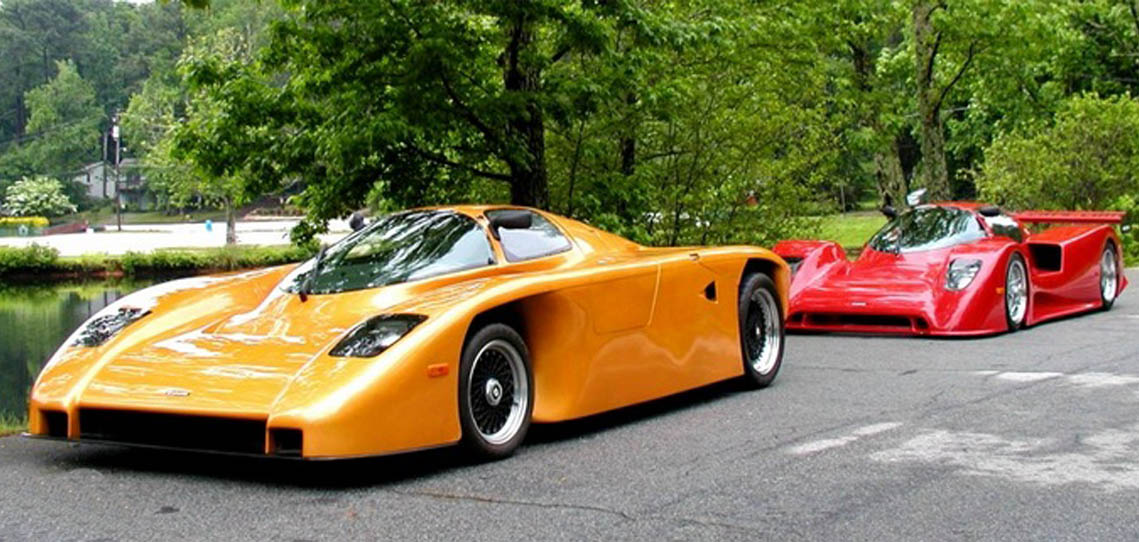
The initial model for Evans Automobiles, the Evans 386LM prototype, was designed by Dave Lynn. (Picture from: GT1History)
Founded in 1986 in Scottdale, Georgia, Evans Automobiles became the canvas for John Evans' ambitious project, the Evans 386LM model. Collaborating with the talented designer Dave Lynn (also recognized as the person behind the Kudzu GTP prototype), the company embarked on a journey to craft a supercar that defied conventional norms.
Initially equipped with a 3.8 and 4.7-liter Buick engine, the Evans 386LM underwent an evolution to accommodate a potent V8, boasting a capacity of up to 7 liters and featuring an aluminum block. (Picture from: GT1History)
The 386LM (initially intended as the ACO verification car, as well as the EPA certification car) weighed a mere 1,048 kg, built on a tubular frame adorned with carbon panels, and featured a carbon fiber body. An adjustable suspension system added adaptability, allowing the car to conquer both specific tracks and public roads.
Standard features of the Evans 386LM included a luxurious carbon fiber and leather interior with a cork and leather-wrapped roll cage, a Quaiffe limited-slip differential, and powerful front and rear calipers. (Picture from: GTPlanet)
Initially equipped with a 3.8 and 4.7-liter Buick engine, the 386LM underwent an evolution to accommodate a potent V8, boasting a capacity of up to 7 liters and featuring an aluminum block. This powerhouse enabled the car to achieve a breathtaking acceleration to the first hundred in just 3.8 seconds, reaching an impressive top speed of 330 km/h.
The Evans 386LM was
the ACO verification car, as well as the EPA certification car, weighed
a mere 1,048 kg, built on a tubular frame adorned with carbon panels,
and featured a carbon fiber body. (Picture from: GT1History)
Additionally, various sources mention multiple engine options throughout the program's development, including the Buick 4.0 turbo V6 or supercharged Buick 3.8 (likely in the early stages). Later on, alternatives like the natural aspirated aluminum 5.7 V8 block or even the massive 427 cu.in. (7.0-liter) were considered.
The Evans 486LM essentially the same as the 386LM but with a different nose section for public road comfort. (Picture from: Carakoom)
Standard features of the Evans 386LM included a luxurious carbon fiber and leather interior with a cork and leather-wrapped roll cage, a Quaiffe limited-slip differential, and powerful front and rear calipers. Additionally, a single-element, adjustable carbon fiber rear wing and rear diffuser were part of the package. Optional amenities like air conditioning, power steering, hydraulic ride height control, rear view camera, and CD/DVD/radio added to the appeal.
The Evans 486LM's specifications are identical to the 386LM except for overall length and price. (Picture from: VWVortex)
However, the high starting price of over 100 thousand dollars posed a challenge for sales. Prospective buyers hesitated due to the hefty price tag and the implied high level of piloting skill required for regular track day use. Despite these hurdles, the American automaker persisted, introducing the Evans 486LM – essentially the same as the 386LM but with a different nose section for public road comfort.
The 1989 Evans-Kudzu Series I GT, originally designed by Dave Lynn, later became produced by Evans Automobiles. (Picture from: BringATrailer)
Over the years, Evans invested considerable time in the development of the 386LM and its counterpart, the 486LM. Despite efforts to showcase the company's ability to produce a reliable racing car with minimal maintenance demands, sales were slow. By 2005, the price dropped to 65 thousand dollars, and even the molds with all the drawings were put up for sale, but interest remained tepid. The ambitious plan met its demise with the bankruptcy of Evans Automobiles, and even a rebranding to Silva based in Las Vegascouldn't salvage the situation.
In the end, John Evans' dream of crafting an accessible yet high-performance supercar encountered challenges extending beyond the realms of design and engineering. The narrative of the 386LM and 486LM stands as a testament to the intricate process of transforming automotive dreams into tangible reality. It offers enthusiasts a story rich in ambition and innovation. This unexpected conclusion to a chapter in automotive history could also serve as potential inspiration for others aspiring to turn their dreams into reality. *** [EKA | FROM VARIOUS SOURCES | CARAKOOM | DISENO-ART | GTPLANET | ALLCARINDEX | GT1 HISTORY | DAILYSPORTSCAR | BRINGATRAILER | VWVORTEX ]
Note: This blog can be accessed via your smart phone.
Unique ONES - Exploring the unique cars crafted by global automakers in the past is undeniably enjoyable, as it serves as a wellspring of inspiration for today's creative minds. One standout example is the E-GO Rocket, a groundbreaking concept car unveiled by Rinspeed AG. under the visionary leadership of Frank M. Rinderknecht. Renowned for their annual showcase of innovative designs at the Geneva Motor Show, Rinspeed consistently marries timeless aesthetics with cutting-edge technology, captivating audiences worldwide.
The Rinspeed E-GO Rocket is a groundbreaking concept car unveiled by Rinspeed AG. under the visionary leadership of Frank M. Rinderknecht, and unveiled at the 1998 Geneva "Salon de l'Auto" show. (Picture from: Rinspeed)
The E-GO Rocket, unveiled at the 1998 Geneva "Salon de l'Auto" show, is a testament to Rinspeed's commitment to pushing automotive boundaries. Developed within a swift six-month timeframe, this single-seater sports car challenges practicality norms, drawing inspiration from the sleek Bonneville salt flats land speed record cars of the 1940s.
The Rinspeed E-GO Rocket crafted with a composite body to achieve exceptional strength and rigidity while maintaining a lightweight profile at 1,050 kilograms. (Picture from: AllCarIndex)
Crafted with a composite body, the E-GO Rocket achieves exceptional strength and rigidity while maintaining a lightweight profile at 1,050 kilograms. The adjustable inclination of the windshield, coupled with 18-inch wheels adorned with 235/50 and 255/45 Continental tires, enhances both performance and visual appeal.
The Rinspeed E-GO Rocket' bodyworks built on a formidable steel tube frame, and powered by a supercharged aluminum-block V8 engine sourced from the renowned Eibach company. (Picture from: Rinspeed)
Beneath the classic racing car exterior lies a formidable powerhouse – a supercharged aluminum-block V8 engine sourced from the renowned Eibach company. Leveraging expertise from their work with international motorsport teams and the McLaren Formula 1 Racing Team, Rinspeed ensures a driving experience that transcends expectations.
By utilizing its engine power output of 410 horsepower, the Rinspeed E-GO Rocket capable to accelarate from 0 to 100 km/h in a mere 4.8 seconds, reaching a top speed of 260 km/h. (Picture from: DisenoArt)
With a rated output of 410 horsepower, the E-GO Rocket catapults from 0 to 100 km/h in a mere 4.8 seconds, reaching a top speed of 260 km/h. This impressive acceleration is a testament to Rinspeed's commitment to delivering not just aesthetics but also formidable performance.
The interior of the Rinspeed's single-seater marvel reflects a fusion of racing influences and modern comfort with the seat adorned in a mix of leather and washed blue denim, creates a unique ambiance. (Picture from: DisenoArt)
The interior of the Rinspeed's single-seater marvel reflects a fusion of racing influences and modern comfort. The seat, adorned in a mix of leather and washed blue denim, creates a unique ambiance. Despite the open-air cockpit and racing elements, the interior boasts high-end features such as satellite navigation and a multimedia system with CD/radio.
The Rinspeed E-GO Rocket boasts 18-inch wheels adorned with 235/50 and 255/45 Continental tires, enhancing both its performance and visual allure. (Picture from: DisenoArt)
While the Rinspeed E-GO Rocket is poised for production based on orders, the avant-garde creation's price remains undetermined. The anticipation surrounding the production units of this unique vehicle, beyond the one showcased at the 1998 Geneva Motor Show, adds an element of mystery to its exclusivity.
In essence, Rinspeed's E-GO Rocket stands as a testament to the brand's unwavering dedication to redefining the automotive landscape. The marriage of timeless design, advanced technology, and exhilarating performance positions this concept car as a symbol of innovation in the ever-evolving world of automobiles. The legacy of Rinspeed's daring concepts continues, leaving enthusiasts eagerly awaiting the next groundbreaking revelation. *** [EKA | FROM VARIOUS SOURCES | RINSPEED | DISENOART | ALLCARINDEX ]
Note: This blog can be accessed via your smart phone.
One Inspiration - Owning a sports car, particularly an iconic Lamborghini Countach, has always been a dream for many. Interestingly, one man turned this dream into a reality in a way that defies conventional norms. Ken Imhoff, an American engineer and avid car enthusiast, embarked on a remarkable journey to build his own Lamborghini Countach Replica from scratch, right in the confines of his basement. The inspiration struck him after being captivated by the car's allure during the Cannonball Run of 1991.
The Lamborghini Countach replica created by Ken Imhoff, an American engineer and avid car enthusiast, inspired by the original ones in the Cannonball Run of 1991. (Picture from: Drive.com.au)
Imhoff's endeavor was no ordinary DIY project; it was an ambitious undertaking that involved meticulous planning and execution. Over the course of 17 years ranging from 1991 to 2008, he dedicated countless hours to designing and fabricating a space frame, hand-forming aluminum body panels, and meticulously crafting the iconic Lambo' scissor doors. What sets Imhoff's project apart is that he single-handedly accomplished every aspect of the construction process, showcasing his unwavering commitment to bringing his dream car to life.
The creation of the Lamborghini Countach replica consumed approximately 17 years (spanning from 1991 to 2008). Ken Imhoff dedicated this time to designing and constructing a space frame, shaping aluminum body panels by hand, and meticulously crafting the iconic Lambo scissor doors. (Picture from: BusinessInsider)
To ensure precision in his work, Imhoff used wooden buck as a mould, allowing him to achieve intricate curves in the car's body. Every detail was carefully considered as he assembled iron piece by piece, transforming them into a formidable car frame. The garage in his house served as a witness to the birth of the Lamborghini Countach, with a small workshop housing all the necessary equipment for this extraordinary venture.
The Lamborghini Countach replica powered by a Boss 351 V8 engine, seamlessly mated to a ZF -5 speed manual gearbox, providing the power and performance synonymous with the Lamborghini legacy. (Picture from: Drive.com.au)
The heart of Imhoff's creation beat with a Boss 351 V8 engine, seamlessly mated to a ZF -5 speed manual gearbox, providing the power and performance synonymous with the Lamborghini legacy. Imhoff also incorporated a Corvette C4 suspension, further enhancing the authenticity and driving experience of his home-built masterpiece.
The Lamborghini Countach replica posed alongside its creator, Ken Imhoff, shortly after emerging from the basement. (Picture from: LamboCars)
The transformation from raw materials to a Lamborghini Countach replica involved crucial steps, as highlighted earlier, with meticulous attention to detail in Ken Imhoff's endeavor to replicate the distinctive features of the original. This comprehensive effort encompassed more than just the iconic Lamborghini Countach-style headlights; it extended to the integration of authentic Lamborghini taillights, parking lights, windshield, and badges. Imhoff spared no effort, ensuring each element was meticulously incorporated to authentically capture the essence of the iconic 1980 Countach.
The Lamborghini Countach replica involved crucial steps, as highlighted earlier, with meticulous attention to detail in Ken Imhoff's endeavor to replicate the distinctive features of the original. (Picture from: LamboCars)
As the project neared completion, the Lamborghini Countach replica emerged, ready to hit the road. However, the story took an unexpected turn when the Department of Motor Vehicles (DMV) posed a hurdle. Despite Imhoff's dedication, the replica faced challenges in being registered as road-legal. In an unusual twist, the DMV demanded a $750 deposit, with the condition that if, within five years, the car was proven stolen, the deposit would be forfeited.
The Lamborghini Countach replica's cabin adorned by MOMO's seats, 5 point harness, splined steering wheel, and simple dashboard. (Picture from: LamboCars)
Administrative hurdles aside, Imhoff's determination remained unshaken. He continued to actively engage with the local classic car club, seizing opportunities to rev the V8 engine and relish the fruits of his labor. Admitting that his creation had its imperfections, Imhoff tirelessly worked on enhancements, tinkering with the carburetor and even experimenting with carbon fiber to fortify the fenders.
This comprehensive effort encompassed more than just the iconic Lamborghini Countach-style headlights; it extended to the integration of authentic Lamborghini taillights, parking lights, windshield, and badges. (Picture from: AdrianFlux)
According to The Drive, Imhoff handed over this masterpiece to its new owner with an accompanying payment of approximately $90,000 (unconfirmed) back in the 2017. Today, the current owner is purportedly considering putting it up for sale again, with an estimated price tag of around $229,000.
In conclusion, Ken Imhoff not only realized his dream but also created a Lamborghini Countach that mirrored his vision. The journey was a testament to his commitment and passion for excellence. Imhoff's achievement goes beyond merely owning a replica; it embodies the spirit of pursuing dreams with unwavering dedication. His story stands as an inspiration for fellow car enthusiasts, proving that with determination, even the most audacious dreams can become a tangible reality. *** [EKA | FROM VARIOUS SOURCES | LAMBOCARS | ADRIANFLUX | BUSINESSINSIDER | THEDRIVE | DRIVE.COM.AU | TRENDHUNTER ]
Note: This blog can be accessed via your smart phone.
Unheard Roar - While exploring the vast realm of the internet, we stumbled upon a hidden gem in the world of sports cars—an exquisite creation that might be unfamiliar to many automotive enthusiasts. The spotlight is on a unique sports car crafted by a Zülpich-based company Airconcept Enterprises. The name might not ring a bell, leaving us curious about the brains behind this intriguing masterpiece.
The Lion Super Sports Coupe by Airconcept Enterprises debuted at the Essen Motor Show 2010. (Picture from: Airconcept Enterprises)
According to Autogen.pl, Airconcept Enterprises is a German company specializing in the design and production of various elements used in industries such as automotive, aerospace, and medicine. Led by Manfred Scholz, the company boasts expertise in composite materials, pushing boundaries beyond creating original designs for small airplanes to venturing into the realm of sports cars.
The IFL-Spyder launched by Airconcept Enterprises in sports car manufacturing dates back to the 1990s. (Picture from: Airconcept Enterprises)
The journey of Airconcept Enterprises in sports car manufacturing dates back to the 1990s when they introduced two hand-built models—the IFl-Spyder and the Black Molly Coupe. These models, with distinct inspiration drawn from the Ultima GTR, showcased a complete construction of carbon composites for race-prepared chassis and body. Interestingly, both were designed for both ordinary road use and production, but unfortunately, only single copies of each were ever produced.
The Airconcept Black Molly Sports Coupe launched by Airconcept Enterprises in sports car manufacturing dates back to the 1990s. (Picture from: Airconcept Enterprises)
Little information is available about the IFL-Spyder model. The focus is primarily on the Black Molly Coupe, weighing a mere 860 kilograms. It packs an 8-cylinder, 5-liter TVR engine generating around 370 horsepower. However, after this venture, Airconcept Enterprises took a hiatus from sports car production, redirecting their focus to automotive tuning until the early 2000s.
The Airconcept Lion Super Sports Coupe tipped the scales at approximately 1,100 kilograms, characterized by a flat body, upward-opening doors. (Picture from: Hadel.net)
The allure of sports car design proved irresistible for Airconcept Enterprises. In a grand reveal at the Essen Motor Show 2010, the German company showcased a brand-new super sports car—the Airconcept Lion Coupe. This model tipped the scales at approximately 1,100 kilograms, characterized by a flat body, upward-opening doors. The chassis, initially constructed from a lightweight metal alloy, was slated for an upgrade to a carbon fiber hull.
The Airconcept Lion Super Sports Coupe's chassis, initially constructed from a lightweight metal alloy, was slated for an upgrade to a carbon fiber hull. (Picture from: Cartefacts)
The power unit positioned centrally was a six-cylinder Audi engine, had the potential to produce anywhere between 410 to a staggering 680 horsepower, depending on the level of modification. This power was to be transmitted to the rear through a six-speed manual gearbox. While its cabin boasts a vibrant red-dominated interior with a racing-inspired steering wheel.
The Airconcept Lion Super Sports Coupe's cabin boasts a vibrant red-dominated interior with a racing-inspired steering wheel. (Picture from: Cartefacts)
Intriguingly, from 2008 to the Essen premiere, the prototype covered over 180,000 kilometers—a testament to the company's dedication to putting the car into production. Plans were even laid out to utilize a 5.2-liter V10 in subsequent models, although it remains unclear if this transition materialized, as a date for series production is yet to be officially announced until today.
The Airconcept Lion Super Sports Coupe powered by a six-cylinder Audi engine, had the potential to produce anywhere between 410 to a staggering 680 horsepower, depending on the level of modification. (Picture from: Cartefacts)
In conclusion, the journey of Airconcept Enterprises in the sports car realm is a testament to their innovative spirit and dedication to pushing the boundaries of design and performance. As we delve into the annals of automotive history, the unique creations from this German company remain a captivating and lesser-known chapter, waiting to be explored by enthusiasts seeking a blend of elegance and power in the world of sports cars. *** [EKA | FROM VARIOUS SOURCES | AIRCONCEPT ENTERPRISES | AUTOGEN.PL | CARTEFACTS | GTPLANET | HADEL.NET | CLASSIC AND RECREATION SPORTS CARS ]
Note: This blog can be accessed via your smart phone.


 In the world of automotive history, the FSO Syrena Sport stands as a testament to creativity stifled by political ideologies. The echoes of its unique design still resonate, leaving enthusiasts to ponder what might have been if the winds of change had blown differently. The Syrena Sport's legacy endures, not just in faded photographs, but in the hearts of those who appreciate the artistry of an unfulfilled automotive masterpiece. *** [EKA | FROM VARIOUS SOURCES | AUTOKULT.PL | NODUM.ORG | MOTORAUTHORITY ]