-->
Drop Down MenusCSS Drop Down MenuPure CSS Dropdown Menu

Sunday, April 3, 2022

Oldsmobile Toronado: The Legendary ‘Flame Red Car’ That Redefined American Power

Bold Legacy - There’s something magical about cars from the golden age of American motoring. They weren’t just machines that got you from one place to another—they were statements of power, pride, and style. Every curve, every roar of the engine carried a sense of identity that modern vehicles often struggle to match. Among those icons of the road, one name stands out not only for its daring engineering but also for its unforgettable presence: the Oldsmobile “Flame Red Car” Toronado.
The 1966 Oldsmobile Toronado stems from a design drawing of an Oldsmobile stylist named David North in 1962 and first launched in 1966. (Picture from: Supercars)
The story of this striking machine began not on a production floor, but on a sketchpad in 1962. A young stylist at Oldsmobile named David North drew a sleek, sporty concept that he called the Flame Red Car. It wasn’t meant for mass production; it was simply an expression of creativity—his vision of what a bold American sports car could look like. But fate had a different plan. Just weeks later, Oldsmobile received approval to build a new personal luxury car to rival the Buick Riviera and Ford Thunderbird. The team searched for the perfect design, and North’s “Flame Red Car” sketch caught everyone’s attention. What was once a dream on paper suddenly became the blueprint for one of the most daring vehicles Oldsmobile would ever create.
The 1966 Oldsmobile Toronado's interior featured with cloth inserts, chrome sport wheels, power steering, power brakes, air conditioning, bucket seats, center-shift automatic and a factory 8-track player. (Picture from: Mecum)
Building the Toronado, however, was no small task. Oldsmobile had to adapt North’s design to fit General Motors’ shared E-body platform—the same one used by the Buick Riviera. This meant reshaping the car’s dimensions while keeping its unique personality intact. The result was a muscular, long-bodied coupe that balanced elegance with aggression—a design that looked as fast as it felt.
The 1966 Oldsmobile Toronado is powered by a 425 cubic inch Super Rocket V-8 engine produced 385 horsepower coupled with a three-speed TH-425 automatic transmission. (Picture from: Barret-Jackson)
When it came to naming this bold new creation, Oldsmobile considered several options. Among the contenders were Magnum, Scirocco, and Raven—names that would later find homes with other automakers. But it was Toronado that ultimately captured the essence of the car: strong, exotic, and unforgettable.
The Oldsmobile Toronado had won the 'Car of the Year' award in 1966  from Motor Trend magazine at the time. (Picture from: Pinterest)
Under its sculpted hood lay a beastly 7.0-liter (6,968 cc) Olds Super Rocket V8 engine, producing 385 horsepower and a massive 644 Nm of torque. Paired with a three-speed TH-425 automatic transmission, it could sprint from 0 to 60 mph (about 100 km/h) in just 9 seconds—a remarkable feat for its size and weight. The Toronado also boasted a front-wheel-drive system, a rarity for American cars at the time, which gave it a unique driving feel and stability that set it apart from its rear-driven rivals.
The Oldsmobile Toronado represents one of the automotive milestones of the 1960s and one of the most important models that Oldsmobile ever built. (Picture from: Pinterest)
Oldsmobile didn’t rush perfection. The company spent seven years developing and refining the Toronado before its 1966 debut. Engineers logged over 1.5 million miles in testing to ensure its front-drive system could handle real-world conditions. That dedication paid off: when the Toronado finally hit the market, it wasn’t just another luxury coupe—it was a revolution on wheels. Its performance, innovation, and design earned it the prestigious Car of the Year award from Motor Trend magazine in 1966.
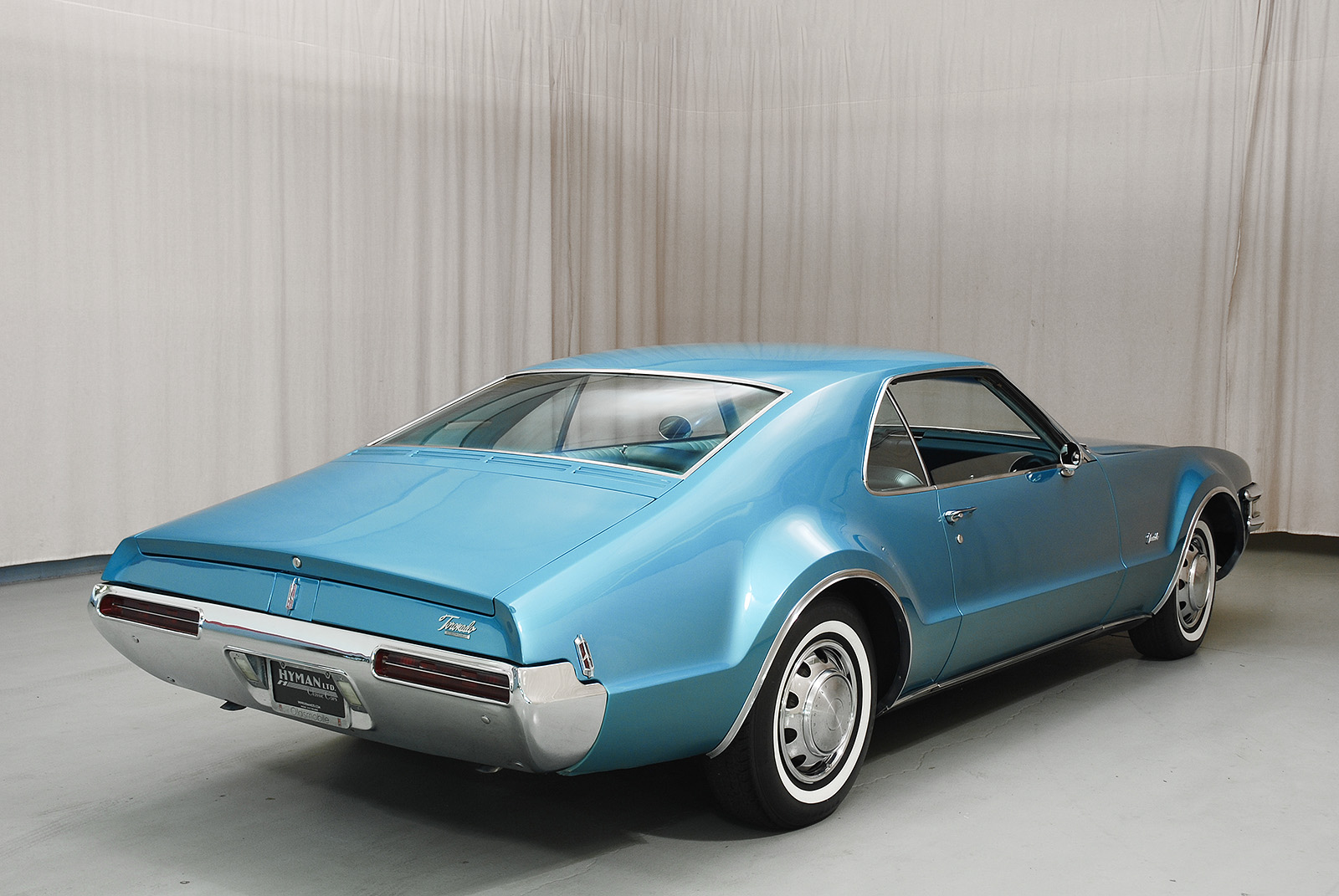
The 1968 Oldsmobile Toronado featured with no less unique headlights hidden behind the front grills. (Picture from: Hyman)
Visually, the first Toronado was a masterpiece of mid-century modern automotive art. Its hidden flip-up headlights gave the front end a clean, futuristic look when closed, while its muscular rear haunches hinted at the power underneath. Over the years, the Toronado went through a series of facelifts—each version presenting a new face while keeping its signature confidence intact. Models from 1968 to 1970 received more powerful engines, enhancing both performance and prestige
The 1968 Oldsmobile Toronado handled quite well and could reach the then noteworthy top speed of 135 miles per hour. (Picture from: Hyman)
By 1970, the first generation of the Toronado reached the end of its journey, making way for a completely redesigned second generation in 1971. Though the styling evolved, the spirit of the original “Flame Red Car” lived on—a symbol of Oldsmobile’s ambition and America’s fearless approach to automotive design.
Today, looking back at the Oldsmobile Toronado feels like revisiting a time when imagination ruled the roads. It wasn’t built just to compete; it was built to stand out. From David North’s red sketch to the roar of the Super Rocket V8, every part of its creation tells a story of passion and vision. The Toronado remains a vivid reminder that sometimes, the boldest ideas—the ones never meant to leave the drawing board—are the ones that end up defining an era. *** [EKA | FROM VARIOUS SOURCES | CLASSIC | SUPERCARS.NET ]
Note: This blog can be accessed via your smart phone. 

Saturday, April 2, 2022

The Forgotten Mitsubishi Concept-RA

Diesel HeadSmoke 55 Mitsubishi is a brand that’s introduced many unique sports cars over the past three decades. Unfortunately, though none of these sports cars were amazing, that is until the Mitsubishi Concept-RA hit in 2008. 
The Mitsubishi Concept-RA was officially introduced by Mitsubishi Motors at the North American International Auto Show 2008 as a gorgeous diesel-powered sports car concept. (Picture from: Autoblog)
The concept car was heavily based on the existing Eclipse model. But some differences made the concept car a bit more appealing. As we all know that the Mitsubishi Eclipse is the pioneer of this Japanese brand's sports vehicle in the US was first introduced in 1989, later became a symbol of sports vehicles for young people there at that time. 
The Mitsubishi Concept-RA is designed with a more aggressive exterior appearance than the Mitsubishi's previous generation sports vehicle. (Picture from: Motor-Junkie)
Well, the Mitsubishi Concept-RA was officially introduced by Mitsubishi Motors at the North American International Auto Show 2008 as a gorgeous diesel-powered sports car concept. The concept car is designed with a more aggressive exterior appearance than the Mitsubishi's previous generation sports vehicle. 
The Mitsubishi Concept-RA is powered by a 2.2 liter 4 cylinder turbo diesel engine, similar to such one used by the first Eclipse model. (Picture from: Motor-Junkie)
The Mitsubishi Concept-RA is powered by a 2.2 liter 4 cylinder turbo diesel engine, similar to such one used by the first Eclipse model. The mentioned turbo engine can produce bursts of power of 204 hp which is channeled to all the wheels through a dual clutch transmission system that can be operated manually or automatic.
The Mitsubishi Concept-RA's body made of recyclable plastic resin panels and also had equipped with aluminum engine guards, fenders to reduce vehicle weight and increase safety in the event of a collision as well. (Picture from: Pinterest)
As reported by TheAutoChannel, the Mitsubishi Concept-RA had many features adopted from the Lancer Evolution and Evo X models, including anti-lock brakes system, stability control, etc. However, the difference is that the sports car concept had been equipped with the active steering and active suspension control to provide more control when the vehicle has excessive torques so make its driving traction stability would be better and braking easier.
The Mitsubishi Concept-RA had many features adopted from the Lancer Evolution and Evo X models, including anti-lock brakes system, stability control, etc. (Picture from: Flickr)
Besides it is powered by turbo-diesel engine, this concept car also had recyclable plastic resin body panels and equipped with aluminum engine guards, fenders to reduce vehicle weight and increase safety in the event of a collision as well. Another advantage of the light weight, that it makes the engine' work less heavy when the car is moving fast on the roads.
The using of recyclable plastic resin body panels such on the Concept-RA initially meant to be a sustainable sports car in a segment where that isn’t commonplace. Unfortunately, the recession crushed plans for this potentially interesting sports car and let it remain a concept car to this day without ever being realized into a production version.😢 *** [EKA | FROM VARIOUS SOURCES | UNIVERSITYMITSUBISHI | THEAUTOCHANNEL | AUTOBLOG | MOTOR-JUNKIE ]
Note: This blog can be accessed via your smart phone.

Friday, April 1, 2022

The Mustang Mach 3 Concept as one of the 1990s American sportscar icons

Stepping Stone 55 There are many models which later bore the legendary status made by the Ford Motor Company, which has been known as one of American automotive giants and one of them is the Ford Mustang including its concept versions. A while ago we had discussed the uniqueness Mustang Mach 1 & 2 Concepts which were made by the Dearborn-based car manufacturer back in the 1960s.
The Ford Mustang Mach 3 Concept featured with the boxy Fox Body Mustang showing its age, and that shown the Ford's hard work to bring the car into a new direction. (Picture from: ConceptCarz)
Then actually in the 1990s, there's another car named Ford Mustang Mach 3 Concept which was built based on the Mustang fourth Generation of the 1992 and was made its debut at the 1993 New York Auto Show.
The Ford Mustang Mach 3 Concept was first shown at the 1993 New York Auto Show was thought to to give an idea of what the Mustang's near future in the '90s. (Picture from: Flickr)
The Mustang Mach 3 Concept is an example of Ford Motor Company's attempt to take the sportscar into a new direction away of its typical boxy Fox Body. Indeed stylistically, through its heavily rounded roadster body, the Mach 3 was about as far from the Fox Body as you could get.  
The Ford Mustang Mach 3 Concept is appeared heavily rounded roadster body, so made it was about as far from the typical Mustang' boxy Fox Body(Picture from: DrivingLine)
While it looks almost suggested a mid-engined sports car, the Mustang Mach 3 Concept actually sat on a traditional front-engine Mustang platform featured with a two-seat cabin, low-profile windshield and large side scoops giving it a fresh and exotic vibe.
The Ford Mustang Mach 3 Concept is powered by the front-mounted double overhead cam 4.6 liter V8 from the Lincoln MkVIII coupled with the T56 six-speed manual transmission and topped with an Eaton supercharger. (Picture from: DrivingLine)
The Mach 3 Concept also got the power to back up its looks, using the double overhead cam 4.6 liter V8 from the Lincoln MkVIII topped with an Eaton supercharger coupled with the T56 six-speed manual transmission to chanel the output was said to be 450 hp. These kind of similar powerplant would eventually find its way into a production Mustang, but not until a decade later with the debut of the 2003 Cobra with its "Terminator" V8 engine.
While it looks almost suggested a mid-engined sports car, the Mustang Mach 3 Concept actually sat on a traditional front-engine Mustang platform featured with a two-seat cabin, simple dashborad layout and low-profile windshield(Picture from: DrivingLine)
Being built in 1993, development of the next generation SN95 Mustang was already well underway by the time the Mach 3 debuted, and it seemed that the two-seat roadster was a preview of a possible additional version of the Mustang rather than a complete transformation of the car.
The uniqueness of the Ford Mustang Mach 3 Concept can be seen from the generous rear overhang which is said to be inspired by the Thunderbird  coupled with unique 3 LED horizontal stripes taillights(Picture from: MS-99)
Two hand-built examples of the Mach 3 Concept were commissioned for the auto show and media circuit, but it doesn't appear the idea ever got very close to production. On the other hand, plenty of its styling elements did in fact make their way on to the production SN95 Mustang including the headlight shape, side scoops and the basic dashboard layout.
Despite never getting into the company production lines, the Mustang Mach 3 nonetheless inserted itself into the mid '90s American sportscar icons. As you can see this Mustang concept car in video games, also has been recreated in both diecast and plastic model form.
2020 Ford Mustang Mach-E officially debuted at the 2019 Los Angeles Auto Show. (Picture from: Driving.co.uk)
How about today? For nowdays we could easily found many modern Mustang versions running on the highways including the latest electric-driven one due to since 2019 the Dearborn-based car company had launched an electrified version of Mach SUV model named Mustang Mach-E. *** [EKA | FROM VARIOUS SOURCES | DRIVINGLINE | SUPERCARS.NET ]
Note: This blog  can be accessed via your smart phone

Thursday, March 31, 2022

Unique and iconic retro car concept combined British and Italian designs

Beautiful Creation Jaguar, a leading British automotive manufacturer once made a concept car along with Italian coachbuilder Pininfarina, named Jaguar XJ Spider. These car made its maiden debut at the British Motor Show 1978, and took advantage of the record for most visitors to that year, which reached more than 900,000 people during the exhibition.
1978 Jaguar Pininfarina XJ Spider concept. (Picture from: OtoBlitz)
During its debut, the XJ Spider received high enthusiasm from the visitors of those automotive event. As the name suggests, the Pininfarina's XJ Spider is equipped with a convertible roof as well as several other distinctive features such as pop-up iconic headlights and leather-nuanced panels on its interior.
Right side view of 1978 Jaguar Pininfarina XJ Spider concept. (Picture from: ClassicDriver)
The high enthusiasm of visitors and the world's automotive circles at the British Motor Show then made Jaguar more enthusiastic in developing a series of their new prototype cars at Browns Lane, which was later known to have internal code of XJ41 (coupé/targa version) and XJ42 (convertible version).
Interior view of 1978 Jaguar Pininfarina XJ Spider concept. (Picture from: OtoBlitz)
These experimental cars take many styling cues from the Pininfarina XJ Spider concept combined with the Corvette-style at rear end, and replace the square pop-up headlights with oval-shaped ones - where this feature is then used on the famous XJ220.
Engine view of 1978 Jaguar Pininfarina XJ Spider concept. (Picture from: OtoBlitz)
Equipped with a V12 engine with a capacity of 5,343 cc which is capable of producing the power up to 284 horsepower and mated with a five-speed manual gearboks. 
Rear side view of 1978 Jaguar Pininfarina XJ Spider concept. (Picture from: OtoBlitz)
These Pininfarina XJ Spider shares the same chassis as the Jaguar XJ-S. However, despite sharing the same chassis, the XJ Spider is shorter, wider and lower than the XJ-S, and giving it a more sporty appearance.
Jaguar XJ Spider may have a 'too American' styling for those British automaker, but inevitably this Pininfarina's XJ Spider concept could inspire some Jaguar models which will later become the latest generation Jaguar E-type. *** [EKA [05122018] | FROM VARIOUS SOURCESCLASSICDRIVER]
Note: This blog  can be accessed via your smart phone

Wednesday, March 30, 2022

Another Portofino made by Chrysler in late '80s

Which comes first It turns out that not only Ferrari made the car by the name of Portofino, but the American automotive manufacturer Chrysler has also used that name, when they took over another Italian auto manufacturer Lamborghini in 1987. It's so strange, why the Maranello-based automaker name one its current model the same name as a Chrysler (Lamborghini) concept car? Is this a coincidence or what?
1987 Chrysler Portofino concept car applied Lambo’s scissor-hinged doors to a big sedan that marked the end of the K-car era and launched Chrysler’s cab-forward design which ignited a resurgence in American automotive design. (PIcture from: Motor1)
Well, in 1987 Chrysler started to work on its “Concept to reality” philosophy by introducing a sports sedan concept under the same name called of Chrysler Portofino at the Frankfurt Motor Show in same year.
Left side view of Chrysler Portofino concept car. (Picture from: TopSpeed)
This Portofino concept car was built on the chassis of the Lamborghini Jalpa. At the end of the day it was known as a prototype of the Sant'Agata Bolognese's car with the interior of a Chrysler Pentastar to symbolize the Chrysler takeover of Lamborghini.

In terms of design, the Portofino was an evolution of the Chrysler Navajo that had only been built as a clay model. The design was updated to show even more the connection between both brands. The car was built by Coggiola Carrozzeria, in Turin, Italy, and had to be lengthened by 66 cm to create a wide enough cabin to allow the space for four seats.
Steering wheel and dashboard view of Chrysler Portofino concept car. (Picture from: TopSpeed)
Even if the concept is badge “Chrysler”, the design reminds more of a Lamborghini model such as a four-door, four-seated car and applies scissor doors type that opened vertically in front and rear. The Portofino features with no B-pillars which are commonly used to strengthen the passenger area in case of side impacts. Besides that, it also facilitates the access to the car's cabin.
Interior view of Chrysler Portofino concept car. (Picture from: TopSpeed)
The interior of the Portofino is made in a beautiful three shades of textured blue leather with yellow piping and accents on the steering wheel and shift knob. A central console divided the passenger compartment adding stiffness to the structure and providing a comfortable wrap-around feeling in the rear seats.
1987 Chrysler Portofino concept car featured with the unique double scissor door type. (Picture from: OppositeLock)
For the drivetrain, the American automaker chosen a 3.5-liter V8 engine block that delivered 255 horse power and 310 Nm of torque. It was mated with a five-speed manual gearbox, which channeled all the power to the asphalt through a rear-wheel drive system. This configuration allowed it to reach a maximum speed of 240 kph.
Rear right side view of Chrysler Portofino concept car. (Picture from: TopSpeed)
Although this concept car never entered into production, but Chrysler used its design cues such as body, color up to the rear wing in the development of their next production car. It is different to scissor doors type was never used at all by those American automotive manufacturer. 
Chrysler only produced one Portofino what was heavily damaged in 1991, when transporter carrying the concept rolled over. Chrysler understood the importance of this concept for the evolution of the company’s design and they decided to restore the concept.

The unique Portofino is now in hands of Chrysler and starting 1999 it is on permanent display at the Daimler/Chrysler World Headquarters and Tech Center in Auburn Hills, Michigan. *** [EKA [26122018] | FROM VARIOUS SOURCES | AUTOBILD | CARROZZIERI ITALIANI | TOP SPEED | MOTOR1]
Note: This blog  can be accessed via your smart phone