-->
Drop Down MenusCSS Drop Down MenuPure CSS Dropdown Menu

Thursday, July 13, 2017

This Brazil-made motorcycle uses the VW Beetle engine

In addition to being famous for football turns out Brazil has also had a big cruiser named AME Amazonas. AME stands for Amazonas Motocicletas Especiais, and Amazonas is one of their flagship models.

Unfortunately, as Brazil's strength in the auto industry, AME Amazonas is considered to be one of the worst motorcycles in the world. In fact, this motorcycle is indeed the result of economic solutions rather than the development of automotive design and engineering.
In addition to Harley-Davidson in America or Honda Goldwing in Japan, it turns out Brazil has also had a big cruiser named AME Amazonas. This bike is quite striking in its era and use the VW Beetle engine. (Picture from: http://bit.ly/2tKKEFT)
The history of AME Amazonas began when Brazil's economic conditions in the early 1970s began to develop from agrarian countries to industrialized countries. Various policies made by the government at that time, and anything that is not produced locally it will be taxable high.

It applies in all sectors, including finally to big motorcycles. The dilemma, government agencies that used to use large motorcycles that is the Brazilian armed forces and police eventually lacked a big motorcycle unit because the government was 'reluctant' to spend money for those vehicles.

Then came Daniel Ferreira Rodrigues, a young businessman who was then aged 25 years. Like a hero, he told the government that he would make a local brand big motorcycle, and his factory would stand in Sao Paulo, and be named AME.


A Brazilian policeman rides on the AME Amazonas in 1970s. (Picture from: http://bit.ly/2tgDSnP)
The idea attracted the Brazilian government's interest at the time. The related authorities even immediately agreed and gave him a contract. Although from some literature mentioned that Daniel has never showed a motorcycle blue print to be built.

Not long after the factory was established and immediately produce. But what to get? Instead of having R & D facilities, Daniel decided to use a car's engine base that is VW Beetle. The choice is based on the VW Brazil is one of the largest manufacturers in Brazil.
Brazilian military also use the AME Amazonas in 1970s. (Picture from: http://bit.ly/2tgDSnP)
To capture the consumers, Daniel uses two of the most popular VW Beetle engines of the 1.3-liter and 1.6-liter. The smaller engines are sold as entry level, while the 1.6-liter as flag ship, including those ordered by Brazilian government agencies.

Once done with the engine problem is now turning to the chassis, and as mentioned, with minimal R & D makes AME Amazonas like a toy. As we knew, placing a VW Beetle boxer engine is not easy, and compared to making a 4-point cross-section of the machine, AME actually uses a swivel chassis.

Another problem that came because of many complaints with the process of 4-speed gear shifting. Its transmission system is hard, hard to do with the foot. Not to mention to save the production, the manufacturer would prefer to use the chain to the rear sprocket than the belt.

While the braking system is somewhat far from the good word. AME Amazonas uses cast iron discs purchased from a Ford factory near Sao Paolo. The condition of the discs are easily hot and thus makes it no grip when used to brake. While the rim with a size of 16-inch circumference wrapped with 5.00 tire type with 'AMAZONAZ' thick print on the side.
The first batch came out of the production line in 1977. Several hundred AME Amazonas were sent to the Brazilian armed forces and police for the next few years. But because the control is so bad, this motorcycle is more often used as a parade motorcycle.

Daniel Ferreira Rodrigues then sells AME to his colleague Guilherme Hannud Filho, who has the idea of ​​opening markets in Europe and the United States. And in 1985 Filho set up shop in Houston, USA, but failed because the VW Beetle engine uses outdated technology so it did not pass DOT standard in 1986.

Although from the technical side is less satisfactory, AME Amazonas remain a valuable collectibles. During its life span this motorcycle only sold 450 units. While in Houston, USA, estimated less than a dozen. AME Amazon itself officially closed in Brazil in 1989.

Kept spur your adrenaline on the power of two-wheeled monster and stay alive with the true safety riding. May God will forgive Your sins and so does the cops.... ••• [EKA | FROM VARIOUS SOURCES | WIKIPEDIA | NAIK MOTOR | ALPHAMOTOCLUBE.COM.BR]
Note: This blog can be accessed via your smart phone.

Tuesday, July 11, 2017

The German elite motorbike of 2nd World War era

The name of the manufacturer NSU Motorenwerke AG of Germany may be no longer known now, because since 1969 has been merged into part of the Audi incorporated in Auto Union AG, which also consisted Volkswagen therein. So NSU has now become part of one of the circles on the Audi logo.
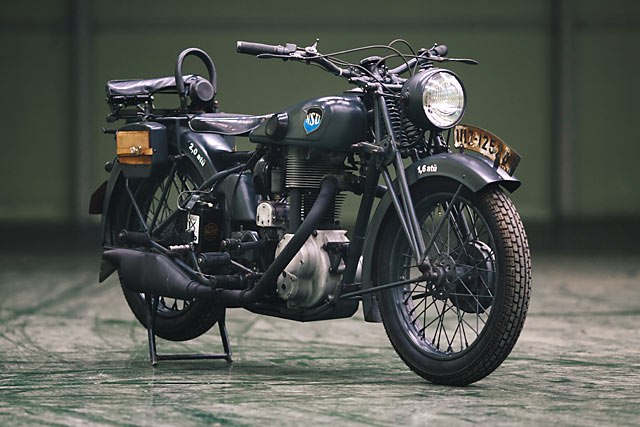
1939 NSU 601 OSL non-military version. (Picture from: http://bit.ly/2tEDSQj)
The name of the manufacturer is unique only stands for the city where they started, namely Neckarsulm. In fact, at first in 1873 the factory was not a special manufacturer to make a motorcycle or car, that is only a textile factory. But later developed into a motorcycle factory in 1901, because the world motor racing event began to hit Europe and America at that time.
German troops rest with their NSU 601 OSL in Poland during the invasion 1939. (Picture from: http://bit.ly/2sV9iVw)
NSU began to be glimpsed by the motorcycle racing enthusiast when Martin Geiger, a British racer used one of the NSU motorcycles on the Isle of Man TT despite only occupying the fifth position. Furthermore, in 1930-1950, the NSU became one of the motorcycle brand that counts the world of motorcycle racing at the time.
In 1930 the NSU was became the first German manufacturer to use an OHV or Overhead Valve engine configuration. Valve configurations that minimize side-valve engine deficiencies are commonly applied by other manufacturers, such as slow gas flow, combustion chamber shape is too large, and low compression of course power generated by side-valve was low. Apparently the engineer who designed the OHV engine on a NSU motorcycle is Walter Moore from the British manufacturer, Norton.
1939 NSU 601 OSL military version. (Picture from: http://bit.ly/2sV9iVw)
In fact, before designing the engine by themself, NSU relies heavily on design and material supplies from BMW and DKW manufacturers. Their original design engine was different from the double-cylinder engine supply of those two manufacturers, as well as the dependence will only make them left behind in the arena of motorcycle racing.
Second seat of 1939 NSU 601 OSL military version. (Picture from: http://bit.ly/2sV9iVw)
When the machine is self-produced and well-tested on the racecourse, then NSU direct offers the motorcycle models with special components for the race, on various engine capacities, such as 200, 350, and 500 cc. The capacity of the machine is tailored to the competition class of motorcycle racing that was rampant at the time.

One of the first motorcycle models to use a machine with an OHV configuration is the NSU 601 OSL that began production in 1938. And OSL itself means Overhead Luxury Racing, which uses an engine with 562 cc capacity, which can generate 24 horsepower @ 3,800 rpm.
Left side view of 1939 NSU 601 OSL military version. (Picture from: http://bit.ly/2sV9iVw)
The NSU 601 OSL also features the Bosch magnito and Amal carburetor. This motorcycle uses a 4 speed transmission system with multi plate clutch. On the back of the rigid without suspension and tubular frame. For brake devices still use the drum. The weight of the motorcycle reaches 185 kg and tank with a capacity of 12 liters is enough to explore as far as 240 km. Its top speed is 130 km/h and is a fairly fast speed figure of that era.
Engine view of 1939 NSU 601 OSL military version. (Picture from: http://bit.ly/2sV9iVw)
The NSU 601 OSL is actually a non-military motorcycle product with aluminum cylinder head and chrome-plated exhaust that looks classy in its time. But when Nazi officials were interested in it in the late 1930s, the NSU manufacturer was ordered to make the military version of the NSU 601. With the main characteristics of the second seat, twin pannier bags and matt black muffler. This bike was used for courier and escort tasks for high-ranking officials of Wehrmacht (Nazi German War Force) at the time.

Kept spur your adrenaline on the power of two-wheeled monster and stay alive with the true safety riding. May God will forgive Your sins and so does the cops.... ••• [EKA | FROM VARIOUS SOURCES | CLASSIC-MOTORBIKES.NET | PIPEBURN] 
Note: This blog can be accessed via your smart phone.

Sunday, July 9, 2017

Finally Jaguar made the successor of Project-7

A few years ago, the famous British car manufacturer, Jaguar released a special edition of the F-Type, with the nickname Jaguar F-Type Project-7, which was made limited. Now, after years, Jaguar finally launched the Project-7's successor under the name of Project-8. It's just different from Project-7, the successor does not use the F-Type as its base, but the entry-level sedan, Jaguar XE.
2018 Jaguar XE SV Project-8. (Picture from: http://bit.ly/2uUv1Jq)
The Jaguar XE SV Project-8 was born as the best product of the Jaguar Land Rover special operations calling itself as Special Vehicle Operations (SVO) which has headquarter at Jaguar's special facility in West Midlands, England.

Speaking of the car's appearance matters, Jaguar XE SV Project-8 is no less 'handsome' than other Jaguar models. It also being a testament to the skills of SVO designers, the visual side of the track-focused monsters with carbon-fiber body seem so exotic and full of bursting emotion.
Standard front interior and seats of 2018 Jaguar XE SV Project-8. (Picture from: http://bit.ly/2uUv1Jq)
Just look at the front bumper is now equipped with splitter, smooth underbody panel, and the stern is equipped by a diffuser and spoiler wing that can be adjusted. The sporty shades are also brought into the cabin, with a sports bench, steering wheel wrapped in Alcantara material, as well as carbon fiber trim in various parts.
Racing front interior and seats of 2018 Jaguar XE SV Project-8. (Picture from: http://bit.ly/2uUv1Jq)
If you want the feel of a very strong race car nuance, Jaguar XE SV Project-8 can be ordered with the racing seat in front, while the rear seat is removed and replaced with a roll cage protector.
Rear three quarter of 2018 Jaguar XE SV Project-8. (Picture from: http://bit.ly/2uUv1Jq)
Roll-cage and racing options may be required, given the Jaguar XE SV Project-8 carrying a 5.0-liter supercharged V8 engine capable of making this car bolt fast with a burst of power up to 600 hp channeled all over its wheels through an 8-speed transmission system.
While on the legs there is 4 20-inches aluminum rims that also hides the carbon ceram disc brakes to stop the car that will be produced as much as 300 units only. Are you interested to have it? Just wait its launching time. *** [EKA | FROM VARIOUS SORCES | CARANDDRIVER]
Note: This blog can be accessed via your smart phone.

Saturday, July 8, 2017

Here it is a cute patrol robot of Dubai Police

If we usually see the police officers who look dashing while on the streets, this time there is a very cute police and certainly very smart. Yes, the Dubai Police have released a police patrol robot in Gulf City, Dubai.
The O-R3 autonomous patrol robot will be fully deployed by Dubai Police later this year. (Picture from: http://bit.ly/2uxcZxP)
https://blogger.googleusercontent.com/img/b/R29vZ2xl/AVvXsEjsGW8ItN7YTA8S2ZZsz954Op_EIBtEK-IsB4zrCSZ7II2agZwApUdrnPSFYHqdjYhTRjoXVBKSfmpCEo_7Wfcsh1oj0KaCwkydnB47PyETiMB3xWSZCaE3R1muCcmg8h89LmrKTWP-sEs/s1600/dubai-police-9.jpgThe name of this smart and cute police patrol robot is O-R3, who is ready to eradicate the crime and protect the citizens in Dubai. Dubai's first police patrol robot has been tasked to patrol around the city. The plan will be many more patrol robots that will be assigned on the Dubai streets in order to realize the dream of the Dubai police.

As quoted from Telegraph (June 30, 2017), this autonomous robot armed with surveillance cameras that can rotate 360 ​​degrees and is programmed to patrol the streets. As well as this robot is also equipped with biometric scanners that can track criminals, identify mysterious objects, and even be able to pursue criminals.

This robot was released by OTSAW Robotic, a Singaporean company. The plan of this robot will be produced much more to reach the entire tourist attractions in Dubai. As far as we knew, this robot does not completely replace the work of Dubai's police officers, because it only works as a tracking device only.
This tiny robot can perform patrols for police. (Picture from: http://bit.ly/2uxcZxP)
According to the Chief of Dubai police Major General Abdullah Khalifa Al Marri, that he wants the streets of Dubai safe and secure without much the patrols of police officers, so tourists in Dubai can feel safe and comfortable. These robots will be placed in the famous tourist attractions in Dubai. Quite interesting isn't. *** [EKA | FROM VARIOUS SOURCES | OTSAW DIGITAL | TELEGRAPH]
Note: This blog can be accessed via your smart phone.

Friday, July 7, 2017

Helsinki now has driverless bus on the streets

After conducting several previous tests in the city of Helsinki, Finland finally managed to make the autonomous bus project to be fully operational and has begun to transport passengers in the nation's capital.
The EasyMile EZ10 autonomous bus in Helsinki, Finland. (Picture from: http://read.bi/2tOTxPh)
The smart bus made by RoboBusLine was initially limited to an experimental vehicle until it was finally approved by the government and in action carried the passengers. As quoted from Carscoops.com (June 17, 2017), noted that the EasyMile EZ10 (the name of the smart vehicle) is now officially on the streets with a speed of 11 km/hour. But now, the vehicle is also operated by human operator in it just in case if at any time there are some technical constraints on the bus.

In addition to Helsinki, the test will also be conducted in the city of Espoo and Tampere in Finland, until finally later the autonomous bus is back in operation after the test is completed. Uniquely, when the smart bus is operating, no bus drivers protest because their position are replaced by the vehicle, the Finns actually combine the two transport facilities with the function to reduce the number of congestion traffic in the country.
With this autonomous bus technology, Finland hopes to more effectively reduce road congestion as well as accidents caused by reckless drivers on the streets. Let's guess, about which country will follow in Finland's footsteps to apply this technology! *** [EKA | FROM VARIOUS SOURCES | EASYMILE | CARSCOOPS]
Note: This blog can be accessed via your smart phone.

Wednesday, January 18, 2017

Here it is the first electric car conquered the Dakar Rally

Peugeot was successfully re-conquer the Dakar Rally in 2017, with a completed victory in 1-2-3 positions. However, these little achievements also should be appreciated in the onslaught of the giants in the world's deadliest rally.
Acciona 100% EcoPowered car on action at the Dakkar Rally. (Picture from: http://bit.ly/1tMhOeL)
Yes, an electric car for the first time managed to follow the Rally Dakar 2017 until to reach the finish line, ie Acciona 100% EcoPowered, an electric car of Spain racing team.

Indeed only finish in 57th position in its class, but Acciona finally succeeded in completing the rally along more than 9,000 kilometers. And in 2017 also for the third time Acciona's competing in the Dakar Rally.

The cars named 100% EcoPowered itself used the electric motor with the power of 250 kW which is able to burst a torque of 800 Nm. And 100% EcoPowered advantages is its ability to recharge independently on 150 kWh battery module.
And its power sources derived from solar thermal energy absorbed by a 100 watt solar panel on the car's roof, and providing the power without stopping along the rally.

The Acciona project in Dakar Rally called as "sustainability challenges" is to rely on the duo rider Ariel Jatón and Tito Rolón behind the cockpit. *** [EKA | FROM VARIOUS SOURCES | ACCIONA]
Note: This blog can be accessed via your smart phone.