-->
Drop Down MenusCSS Drop Down MenuPure CSS Dropdown Menu

Thursday, August 18, 2016

Real version of Tamiya Aero Avante

Tamiya has been part of childhood for you, men. Even now, the game is still very popular of all ages. On that basis, In 2015 Tamiya makes a project to build a real car model based Aero Avante, which is the most popular series.
Tamiya made an Aero Avante in scale 1:1. (Picture from: http://adf.ly/1dCphb)
Through its website, Shizuoka-based toy manufacturer uploaded several videos to explain how a toy constructed into a real car in scale 1:1. Each piece is made as closely as possible with the Aero Avante. Even to make the cockpit canopy, the technicians use special techniques in order to form accurate.

"Our mission is to share the happiness and experience with mini 4WD enthusiasts around the world," writes the site.
Tamiya Aero Avante series. (Picture from: http://adf.ly/1dCphb)
As described, for body-car body using a plastic material that is printed. The chassis is made of tubular frame shaped like a buggy car. And from the rims, up to the body cover is placed in the rear of the car. In a way, this project embodies the children's dreams to see a "real" Tamiya that could drive fast on the circuit.
Rear side view of Tamiya Aero Avante in scale 1:1. (Picture from: http://adf.ly/1dCphb)
The size of real version of Tamiya Aero Avante has a length of 4,650 mm, width 2,800 mm and height of 1,440 mm. Despite the roller in the front and rear of the car, do not even think the driver must have rammed the car to the wall to turn. Yes, the driver does not have to turn in that way, because Aero Avante have the steering wheel in the cockpit, so the rollers just a display.
Behind its single seater cabin, there is a 4-cylinder engine capacity of 1,600 cc, combined with a 4-speed manual transmission system. But no mention of what the car's engine is derived, as well as how much torque and power, Tamiya only mention this car top speed is 180 km/h. Woow, cool too !! *** [EKA | FROM VARIOUS SOURCES | ]
Note: This blog  can be accessed via your smart phone

These aircraft offer an amazing experience

Windspeed Technologies, an aerospace company currently designing an airplane that has a solution to reduce boredom when inside the cabin. Windspeed are designing SkyDeck aircraft, which is basically the equivalent of aeronautics for the panoramic sunroof.
The SKyDeck offer an amazing experience while on long-distance flight. (Picture from: http://adf.ly/1dD5Iq)
As reported by Autoevolution on Monday, December 14, 2015, the basic idea of ​​making this aircraft is to be entertained while on the flight, which is often tedious if in the long-distance flights. Windspeed have a solution that passengers do not feel bored while traveling.

Therefore, the aircraft is designed to use a transparent canopy and passenger seat therein that may arise to the top of the plane' cabin in order to see the scenery while traveling. After making the development of more than one year, the project is finally ready to be implemented.
The transparent canopy located on the SkyDeck, will be as strong as the other aircraft exterior parts. The materials used are also able to withstand all kinds of bad weather.
The biggest problem in coming up with a functional design is aerodynamic interference with the aircraft's tail. It's not like doing spacewalks, but at least you'll pay less for an amazing experience. *** [EKA | FROM VARIOUS SOURCES | AUTOEVOLUTION]
Note: This blog  can be accessed via your smart phone

A noisy, skinny and charming Café Racer

It feels proud to be able to build an old motorcycle, especially when rewarded with the top prize when following a contest. This is what might be perceived by Larry Houghton and his crew of Lamb Engineering, at the time they managed to reach the championship title on the Custom Chrome International Bike Shows 2011, in Mainz, Germany.
BSA Gold Star 'Son of a Gun' by Lamb Engineering. (Picture from: http://adf.ly/1dBXfC)
At the time, Larry was carrying a 1951 BSA Goldstar motorcycle that has been modified in such a way and given the name "Son of a Gun". If you see the picture and said, "This is not the BSA Goldstar," then Larry and his crew will understand. Because, its original form almost nothing left anymore.

Motorcycles are becoming champion in the Championship Class was carrying the ZB machine model of the year of 1951 were estimated capacity of 499 cc. Larry claims that the machine was noisy and originally used for the race. And the transmission system taken from the BSA M20 military motorcycle.
Right side view of BSA Gold Star 'Son of a Gun' by Lamb Engineering. (Picture from: http://adf.ly/1dBXfC)
They then create forged steel frame and welded so as to produce the "skinny" impression. Meanwhile, the handlebars, fuel tank up to the stern made with the cafe racer style. It then combined with the bare-chains. It also get the inverted front forks, while the front and rear legs fitted with 17-inches sized alloy wheels and then wrapped with the Talon supermoto typical tires.

A unique, rear suspension seemed to be left alone. It no longer "assigned" hold the rear tires directly, but made as if monoshock (though there were two suspensions) and attached directly to the machine frame.
Rear side view of BSA Gold Star 'Son of a Gun' by Lamb Engineering. (Picture from: http://adf.ly/1dBXfC)
"Its style is a mix between the 1960 Honda racing motorcycle and Yamaha FS1E," said Larry. He was with the team spends up to 1,200 hours to build this bike and buy some spare parts from eBay.
The total cost of the construction of the gold, chrome bodied "Son Of A Gun" has reached US $9,800, or approx Rp.90 million and does not include the crew cost. That's worth priced for a champion trophy. At least, Larry can smile proudly that time.

Kept spur your adrenaline on the power of two-wheeled monster and stay alive with the true safety riding. God will forgive Your sins.... *** [EKA | FROM VARIOUS SOURCES | LAMB ENGINEERING | BIKEGLAM]
Note: This blog  can be accessed via your smart phone

Wednesday, August 17, 2016

The truth about Karma Revero

The long road to getting the Fisker Karma back in production is approaching its end. It was in early 2014 that China’s Wanxiang bought the remains of Fisker, including the rights to the failed automaker’s handsome albeit somewhat flawed extended-range electric sedan.

Since them Wanxiang has rebranded the remains of Fisker as Karma and set up a new factory in Moreno Valley, California to start building an updated version of the Fisker Karma, to be called the Karma Revero.
Karma Revero. (Picture from: http://adf.ly/1d6qZH)
Karma today provided a first look at the Revero ahead of a formal debut on September 8.  The name is said to be a translation of the word 'truth' in Latin. As expected, the designers didn’t muck around with the svelte lines of the original Karma sedan.  The only changes appear to be slight massaging of the front bumper and some new badges.

Karma states that while the look may be familiar, much of the technology has changed, including a completely redesigned infotainment system and new high-speed charging capabilities. Karma says the car also sports new solar panels on the roof that "will power the vehicle."

It will be interesting to see what Karma means by that last statement because, as Green Car Reports, the Fisker Karma also sported solar panels on its roof but these could only add 1 or 2 miles of battery range if the car were exposed to maximum sunshine for a week.

Unlike California's other electric car company, Tesla Motors, Karma doesn’t plan to be a high-volume automaker. As Karma chief marketing officer Jim Taylor, a former General Motors Company executive, explains, "serving a mass market is not, and never will be, our purpose."
That doesn’t mean Karma isn’t serious about ramping up production. On Monday it was reported that Karma’s parent company Wanxiang had applied for production approval for a new plant in China that could build the Revero and the smaller Atlantic sedan unveiled by Fisker in 2012. *** [EKA | FROM VARIOUS SOURCES | MOTORAUTHORITY]
Note: This blog  can be accessed via your smart phone

Hybrid polymers for the artificial skins and neural

Good news for the burn victims or smooth and durable skin lover. A new innovation from MIT (Massachusetts Institute of Technology) has successfully developed artificial skin and nerves are normal physiological functioning.

MIT research team, not only successfully developed the artificial skin, but also ensures that artificial tissues function like a normal skin, in which there are blood vessels and nerves. This innovation is expected to help burn victims, or anyone who needs a new skin tissues.
Engineers at MIT have devised a method to bind two stretchy materials: gelatin-like polymer materials called hydrogels, and elastomers, which are impervious to water and can thus seal in the hydrogel’s water. (Picture from: http://adf.ly/1dBbmi)
This innovation begins with the success of developing a method to bind the gelatin (hydrogel) with an elastic polymer material (elastomer). Both are basic materials to make artificial skin cells, neural tissues, and long lasting contact lenses.

To note, if we make jelly (hydrogel), within a certain period, it will evaporate, leaving the shrinking masses, harden and shrivel, with a form that is not attractive. The same applies to the hydrogel. Due mostly made of water, the hydrogel will expand when it absorbs water and shrinks when it dries and wrinkles.

Now, MIT researchers find ways to prevent the effects of dehydration of the hydrogel. They use a special technique that can cause us to be able to make the long lasting contact lenses, elastic microfluidic devices, flexible bio-electronic devices, and even artificial skin.

The team leader named Xuanhe Zhao of the Department of Mechanical Engineering of MIT devised a method for binding hydrogel and elastic polymer (elastomer) such as rubber and waterproof silicone. They found, among the hydrogel with a thin elastomer layers provided retaining water trap which makes hydrogel remains moist, flexible, and powerful. The results are published in the journal Nature Communications on July 2016.

Imitating Human Skin
Zhao said the team was inspired by the design of the human skin, which has bonded the outer epidermis and dermis layers protect. Epidermal layer acts as a shield that protects the dermis, nerves, capillaries, as well as the muscles and organs of the drying effect.
Hybrid hydrogel polymer-elastomer designed as bonding epidermis and dermis of the skin naturally. In fact, this hybrid is stronger and elastic as to be used for a variety of interests. Zhao and his team developed a hydrogel-elastomer design models. In addition, the researchers explored a wide range of applications for hybrid materials, including skin, blood vessels, and artificial neural.

"We hope this study will pave the way for the manufacture of synthetic skin, blood vessels and artificial neural tissues so that it can create bionic robot capable of operating as an intelligent living beings who have skin, organ maun biological tissues in general," said Zhao. *** [EKA | FROM VARIOUS SOURCES | MIT NEWS | INSIGHT]
Note: This blog  can be accessed via your smart phone

Destino Samurai, it's all about the ride

The beautiful Samurai Destino has been built by Australian motorcycle builders Destino Custom Garage. The Samurai took nine months to develop from the design stage to the glorious machine we see in this post. The unique motorcycle first released at the Sydney Motorcycle Expo 2011.
Samurai by Destino Custo Garage. (Picture from: http://adf.ly/1dBTN2)
There’s so much detail on the Samurai but it has very clear intentions from the start and as quoted of Pipeburn, the Destino Samurai used the powerful 1,100 cc V-twin Yamaha engine. Subtle performance upgrades have taken an already strong engine & elevated it to a whole new level." Dark blue and gold always work well and with a matte finish on all the black work it just look stunning.
Right side view of Samurai by Destino Custo Garage. (Picture from: http://adf.ly/1dBTN2)
Another interesting feature that is a salute to its Japanese heritage is the fuel tank has been emblazoned with a genuine antique brass Tsuba (samurai sword hilt). Some other features include twin front discs and custom made pipes that look like they mean business. 
Genuine antiqued brass Tsuba – samurai sword hilt. (Picture from: http://adf.ly/1dBTN2)
The black exhaust pipes are stunning and I bet make one hell of a noise those the streets of Sydney. What I really love about this garage is the fast they only make four bikes like the Samurai each year and only sell them to clients that they want to.
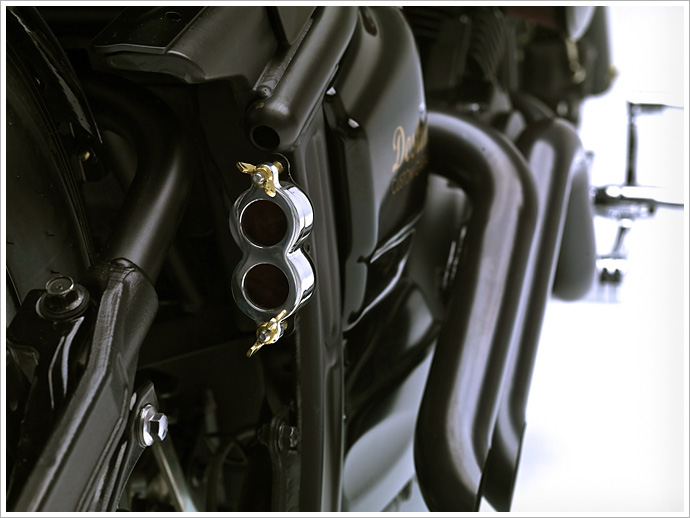
A cool yet understated take on the humble brake light. (Picture from: http://adf.ly/1dBTN2)
"A true Japanese warrior has a strong & powerful centre of balance," says Nikki from Destino. "Slung low and mean… ready to pounce. We wanted to capture that in the bikes stance."
Rear side view of Samurai by Destino Custo Garage. (Picture from: http://adf.ly/1dBTN2)
The front forks have been raked to achieve that look and the riding position is strong yet sleek. The bike might look like a hard tail but there is an internal mono shock suspension for added comfort.

This is a truely amazing outfit and has produced some of the finest custom motorcycles I’ve ever seen. Take five minutes to check out what else they have produced, you won't be disappointed.

Kept spur your adrenaline on the power of two-wheeled monster and stay alive with the true safety riding. God will forgive Your sins.... *** [EKA | FROM VARIOUS SOURCES | PIPEBURN]
Note: This blog  can be accessed via your smart phone