Feline Motorcycles, a Switzerland motorcycle manufacturer soon will launch a new motorcycle with a futuristic design. This fierce motorcycle is named 'Feline One'.
As reported by Visordown on Wednesday, February 11, 2015, Feline One is a concept motorcycle that built by a designer named Yacouba Galle. And the motorcycle is claimed uses many carbon fiber material, so making this bike is very light while riding on the highway.
"For 10 years, I tested the best engine in the world and my conclusion, this is the best machine that talks about the future of motorcycles," said Yacouba Galle. Reportedly, Feline One will use a three-cylinder engine with a capacity of 801 cc and can give off power up to 170 hp. The machine was then mated to a six-speed gearbox.
For carbon fiber material that attached in some parts such as the swingarm, fairing, girder forks, and the frame. Meanwhile, the muffler made of titanium. Feline One has a dry weight of 155 kg, while the distance between the ground with sitting position is 808 millimeters.
Yacouba said, Feline One is planned to be released in 2016 and produced in limited quantities. This bike is planned to be sold at a price tag of US. $280 thousand, or equivalent Rp.3,5 billion. Wow, a quite fantastic price for a motorcycle!!
Kept spur your adrenaline on the power of the two-wheeled monster and
stay alive with true safety riding. May God will forgive Your sins and
so does the cops...... *** [EKA | FROM VARIOUS SOURCES | FELINE MOTORCYCLES | VISORDOWN]
By using the latest technology called 'flow cell' and claimed to be far better than Lithium Ion batteries. The latest electric sports car that made by Switzerland automotive manufacturer, nanoFlowcell AG, reportedly will soon be introduced in the near future in the annual event of the 2015 Geneva Motor Show, as reported by Gizmag.
The Quant E, formerly called the Quant e-Sportlimousine, at the 2014 Geneva Motor Show. (Picture from: Gizmag)
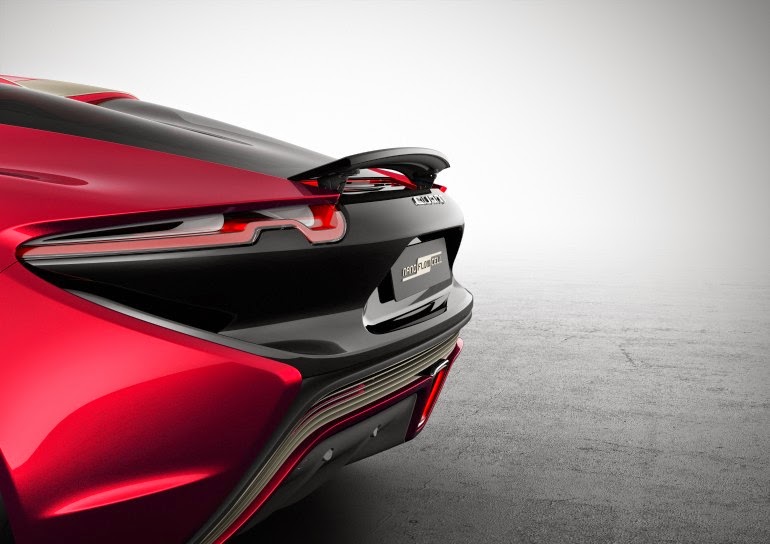
This time the electric car on display named 'Quant F'. According to the manufacturer, Quant F is the latest generation from its predecessor 'Quant E' which is also exhibited in the same event last year. Confirmed as the latest generation has undergone a complete overhaul both in terms of technology, powertrain as well as in design.
The all-new Quant F is the second research vehicle from Nanoflowcell. (Picture from: Gizmag)
The outside view of Quant F does look similar to the previous generation of the Quant E. The difference between them is the use of color schemes, rearview larger door, rim designs and patented "QUANTeYES" headlights.
The all-new Quant F promises 1,000 hp, 500 miles of range. (Picture from: Gizmag)
Another feature of Quant F is the application of gull wing doors that are a popular type used in the '80s supercar and a rear spoiler that automatically appears at a speed of 80 kph. While passenger capacity can accommodate four passengers and has a 207-inch length. Its length is longer than the Mercedes S-Class LWB. The interior space was relieved thanks to the use of carbon fiber monocoque and a more slender A-pillars.
The electric motor is pinned in the car can produce power of 1,075 hp (802 kW). And claimed to be able to accelerate from 0 to a speed of 100 kph (62 mph) in less than 3 seconds with a maximum speed of up to 300 kph. And it mentioned also has a range of up to 805 km (500 miles).
The two-stage active spoiler is one of the new features on the Quant F. (Picture from: Gizmag)
Power of the electric motor is distributed via the automatic transmission system with two levels of acceleration. The car has a motor for each wheel so makes it permanent AWD. Electricity from the motor comes from the fuel cell which used two ionic liquids - one as positive and another one negative fluid, which is stored in pair of tanks with a capacity of 250 liters. *** [EKA | FROM VARIOUS SOURCES | NANOFLOWCELL | GIZMAG ] Note: Thisblogcan be accessedviayoursmartphone.
This motorcycle modification should be given the thumbs up. Let's see, the classic looks of the Honda 125cc SuperSport has been successfully removed and transformed into a very beautiful radical artwork.
A Beijing-based motorcycle modification house, Bandit9 has been successfully overhauled his performance and gave him the name 'Bishop'. His figure is now a minimalist yet powerful aesthetic beauty exudes luxury wrapped.
The most radical modification is by reconstructing its framework that uses a unibody frame of high grade aluminum. More unique, they also make the fuel tank merges with frame to show the impression of rigid and sturdy.
So that it looks more beautiful, then the fuel tank coated with a walnut. For this parts, Bandit9 provides an alternative layers, namely oak or teak.
A tiny engine with unique muffler installed on Bandit9 Bishop. (Picture from: http://bit.ly/1A8xqj6)
Furthermore, the old seat replaced with the best grey suede seat that will make our butts like sitting for hours on it. Meanwhile, for the lighting and suspension, Bandit9 offers a new sets of their own homemade.
Other extreme changes that cuts are considered less functional components such as front and rear fenders, instrument panel, and then old exhaust system is replaced by an eccentric custom exhaust and muffler.
The custom motorcycle is made in a limited number ie only nine units. Well, if you are interested in having the Bishop, then you have to prepare the money as much of US. $6,400 or approximately Rp. 74 millions.
Kept spur your adrenaline on the power of the two-wheeled monster and
stay alive with true safety riding. May God will forgive Your sins and
so does the cops...... *** [EKA | FROM VARIOUS SOURCES | BANDIT9 | WELOVEHONDA]
On Thursday, February 19th, 2015, the Moon in full and are in a state of its closest point to Earth. However, unfortunately, the phenomenon known as 'Supermoon' it can not be seen by humans, so this event dubbed 'Ghost Supermoon'.
The Moon will be in the closest point to the Earth (extreme perigee) at 02:00 ET or 14:00 pm Western Indonesian Time. The distance to the Earth ranges 221,826 miles or 356.994 km - only 117 km farther than Supermoon on September 27, 2015 - in which the moon will look bigger and brighter in the night sky.
Astrophotographer Lovro Dujnić caught a close-up of the supermoon taken in Zagreb, Croatia, on Sept. 8, 2014. Another supermoon will occur on Feb. 19, but it will be invisible to skywatchers. (Picture from: http://bit.ly/1zCwazF)
The reason of why the skywatchers could not see it, because the new Moon and the position of the Moon is too close to the Sun, so she did not appear and the phenomenon also happens to occur in the daytime sky.
Does the Moon - which though invisible - was at the closest point to the Earth, will cause effects on our planet? As quoted from SPACE, the answer is yes. One of them could trigger a high tide, as will accompany the September Supermoon phenomenon.
Because that happened in February was a new moon. Thus, the position of the Earth, Moon, and Sun relative to form a straight line. Those alignments will trigger what is called 'spring tides' - which occurs when the Sun mingled fascination with the Moon's gravity - which resulted in a higher tide than usual.
Spring tide occurs 2 times a month, around the time of the new moon or full moon. The term of 'spring' has nothing to do with the spring - in English. But taken from German, 'entspringen', which means 'rose'.
Full tide associated with the new moon will cause higher than normal tide and low tide levels will be lower than normal. It happened because the perigee (the approach events of the Moon to the Earth) occurred more than seven hours after the new moon. The new moon this time it will be closer 12.2 percent while perigee than the full moon on March 5, 2015.
And this new moon will trigger tidal more than 42 percent during the full moon tide on February 19 compared which happened on 2 weeks ago. "So, although could not see the Supermoon, for those who living on the coast will see its signs through the tide that occur at the time, or within a few days after the February 19, 2015," said Joe Rao, an instructor at New York's Hayden Planetarium, as published by SPACE. *** [EKA | FROM VARIOUS SORCES | SPACE]
The art deco era, spanning over two decades, influenced design internationally — and vehicles were beneficiaries of this arty approach to industry.
So much of what was built in the ’20s, ’30s and ’40s now only exists in the hallowed halls of museums and collectors’ garages as we drool upon this glorious motoring past, as you can see on the video below;
Here are the 1st list of 10 beautiful art-deco cars:
1. 1930 Mercedes-Benz SSK
Designed by none other than Ferdinand Porsche, the SSK was not just a fine example of art deco influence but an eminently capable racing car that performed and made podium. The supercharged engine with 500 lb-ft of torque rocked the SSK to 120 mph, making it the world’s fastest car in 1930. It went on to win numerous races such as the German Grand Prix and the Mille Miglia.
Ferdinand went on to a somewhat illustrious automotive career. A rare restored SSK, called the Count Trossi, was a Best of Show winner at no fewer than two Concours D’Elegance shows and is owned by none other than Ralph Lauren. Oh, Ralph. Must you have everything?
2. 1934 Voisin C27 Aerosport
Gabriel Voisin, a French aviation pioneer and car builder was a true revolutionary in the automotive world in the 1930s, building the beautiful and pricey Voisin C27 Aerosport mostly out of aluminum, with a stunning mosaic art deco interior and innovations such as a vacuum-operated sliding glass roof that also doubled as a rear window.
It belted out 104 hp from its 3.0-liter engine and could top out at an impressive 93 mph. Voisin built it on borrowed funds and went nearly broke in order to bring his cars to the market. Sound familiar, Citroën?
3. 1936 Auburn Boattail Speedster
Originally the Eckhart Carriage Company, the Auburn Automobile Company was founded in Auburn, Indiana at the turn of the century. When they created the "Boattail" speedster, an American icon was born that is a cherished piece nearly a century later.
There is an art deco museum in Indiana, the Auburn Cord Duesenberg Automobile Museum, that is recognized as a historic landmark to honor the three major car companies of the day, which are all featured throughout this list.
4. 1937 Cord 810/812
Cord was an American car company manufactured at the Auburn Automobile Company in Indiana, founded and run by E.L. Cord. The 810 caused a frenzy when it debuted at the 1935 New York Auto Show, where Cord was immediately overwhelmed with orders. But production couldn't keep up with demand along with "mechanical trouble."
Cord redeemed his reputation in 1937 with the now supercharged 812, which was easily distinguished by the awesome chrome-plated exhaust pipes pouring out either side of the hood. This world-famous stunner actually coined the phrase "suped-up", a common term now embedded in the jargon of every avid hot-rodder and 21st century tuners alike.
Production ceased in 1937 after about 3,000 cars were made, but Cord's demise wasn't too unfortunate for him, as he moved to Nevada to make millions in real estate. And by Nevada, we mean Vegas. The supercharged coupe with it's globally recognized "coffin-nose" is by far one of the most iconic cars of the era, an excellent contribution to art deco's golden age.
5. 1937 Delahaye 145 Chapron Coupe
French car maker Delahaye left its strong design impression on the world of art deco style cars. The 145 Chapron Coupe is one of the more subtle, but still stunning models, and only a scant two were built.
Housing a big 4.5-liter V12, the cigar shaped body was designed by Henri Chapron and updated with a beautiful two-tone paint job. Not only was the 145 elegant, it was also incredibly fast, belching out 235 horsepower and a top speed of over 160 mph — Grand Prix speeds that resulted in numerous race car victories, including the Mille Miglia. Count this as one instance where the French didn’t relinquish power. (Jump to next part). *** [EKA | FROM VARIOUS SOURCES | GEAR PATROL | COMPLEX]
Sukhoi Su-47 Berkut (in Russian: Су-47 Беркут - Golden Eagle) (NATO code name: Firkin), also designed as S-32 and S-37 during initial development, this is a supersonic fighter developed by Sukhoi. Distinguishing feature of this aircraft is the sweeper front wing, similar to Tsybin LL-3, which gives this aircraft amazing agility.


 As reported by Visordown on Wednesday, February 11, 2015, Feline One is a concept motorcycle that built by a designer named Yacouba Galle. And the motorcycle is claimed uses many carbon fiber material, so making this bike is very light while riding on the highway.