Vanished Dream - In the world of classic sports cars, we often celebrate the icons—those with long histories, roaring engines, and endless reissues. But once in a while, a forgotten name surfaces with a story so daring, it feels like it was pulled from the pages of an underdog novel. One of those names is
Gilbern,
a small automaker from Wales that once dreamt of greatness. And their boldest, most fascinating dream took shape in the form of a car called
the Gilbern T11.
 |
The only-one Gilbern T11 sports car prototype of Wales built by Gilbern Sports Cars (Components) Ltd. back in 1970. (Picture from: Historic Automotive Promotion)
|
It all began in 1959 when
Giles Smith,
a local butcher, joined forces with
Bernard Friese,
a German engineer skilled in fiberglass molding. Together, they founded
Gilbern Sports Cars—named by blending their own names—
and began building hand-crafted vehicles from a humble workshop in Church Village. Their cars started out as kits, but soon they were offering fully built models, catching the attention of a small but passionate audience.
 |
| The only-one Gilbern T11 sports car prototype of Wales appears in the typical wedge style, and sits very low and it’s thin wide windscreen enhances it’s wide profile. (Picture from: Historic Automotive Promotion) |
From 1959 to 1973, Gilbern produced three main models: the Gilbern GT (280 units from 1959–1967), the Gilbern Genie (197 units from 1966–1969), and the Gilbern Invader (603 units from 1969–1973). These weren’t just showpieces—they were contenders. Gilberns were entered into hill climb competitions, notably at Wiscombe Park, with their first recorded appearance in 1962 driven by a member of the Aston Martin Owners Club. For a company that started in a garage, they were doing more than just keeping up—they were pushing boundaries.
 |
| Actually the interior of the only-one Gilbern T11 sports car prototype of Wales was a blank canvas; then adjusted by Johnston used Smith dials to match the Genie/Invader during restoration. (Picture from: Historic Automotive Promotion) |
By the end of the 1960s, however, financial trouble began to cast a shadow over the company. Ownership shifted to
Ace Capital Holdings,
a firm more known for slot machines than sports cars. But even as the pressure mounted,
Gilbern didn’t back down. Instead, they launched their most ambitious project yet—
a mid-engine, two-seater sports car with sharp,
futuristic lines:
the Gilbern T11.
 |
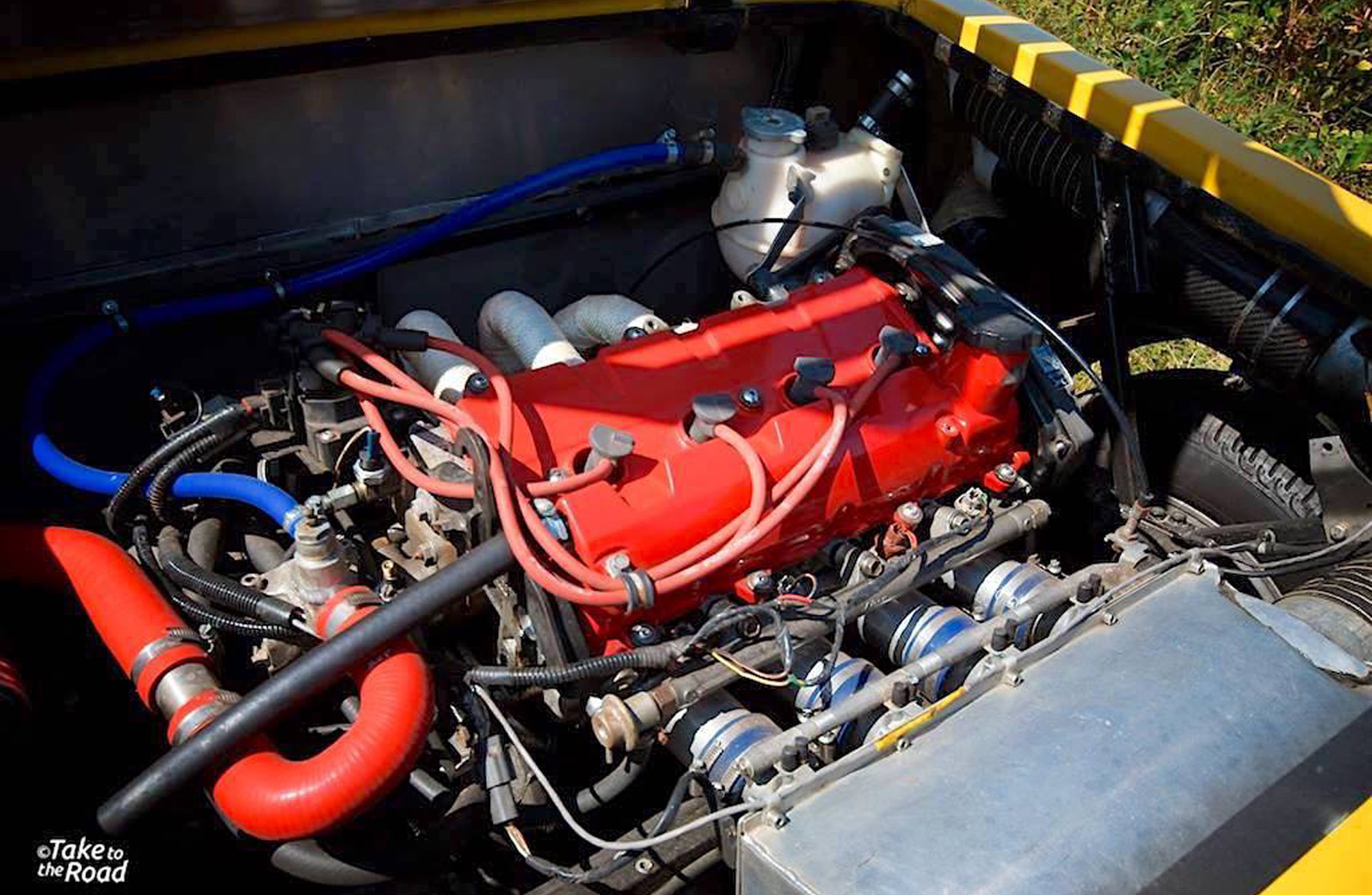
| The only-one Gilbern T11 sports car prototype of Wales initially powered by a lightly tuned 1.5-liter Austin Maxi drivetrain, then replaced by a Toyota MR2's 2.0 liter Mk 2 engine in 2011. (Picture from: Historic Automotive Promotion) |

The car was designed by
none other than Trevor Frost (also known as Trevor Fiore), a name associated with forward-thinking designs like
the Alpine A310,
the TVR Trident and
Monteverdi 450 Hai.
The T11 f
ollowed the wedge design trend of the early ’70s,
giving it a sleek,
exotic appearance that looked ready to take on the world. Underneath its body was
a reversed, mid-mounted 1.5-liter Austin Maxi engine.
Gilbern had planned to unveil it at
the prestigious 1971 Geneva Motor Show—a statement move that would’ve placed them alongside the automotive elite.
 |
| The only-one Gilbern T11 sports car prototype of Wales has extremely curvy rear end softens the sharpness of the front end and gives the car a very wide stance. (Picture from: Historic Automotive Promotion) |
But that moment never came. As Gilbern’s financial problems worsened, the T11 project was quietly shelved. Only three chassis were ever built, and just one car was completed. The dream of Geneva faded, and by 1973, the company declared bankruptcy. The lone T11 slipped into obscurity, unfinished and unknown to most of the world.
 |
| The one-of-a-kind Gilbern T11 sports car prototype from Wales during its restoration, with Gordon Johnston standing beside it. (Picture from: Gilbern) |
Years later, the prototype resurfaced. It found its way into the hands of
Gordon Johnston,
a dedicated enthusiast who saw more than just a forgotten car—he saw unfinished business. Over nearly a decade,
Johnston meticulously restored
the T11,
finally completing the build around 2009–2010. But in
2011, tragedy struck.
A mechanical failure damaged the driveshafts and differential beyond repair. Instead of giving up,
Johnston gave the car a new life, this time with
a 2.0-liter Toyota MR2 Mk2 engine producing 200 bhp—bringing
the T11 to a level of performance it had always deserved.

Today,
the Gilbern T11 exists as a one-off survivor of a once-promising dream. It captures everything that made
Gilbern special: gutsy ambition, clever engineering, and a refusal to play by the rules. It may never have made it to Geneva, but it still tells a story worth remembering—of a tiny Welsh company that dared to dream big, even when the odds were stacked against them.
*** [EKA [14052023] | FROM VARIOUS SOURCES | GILBERN | FABWHEELDIGEST | HISTORIC AUTOMOTIVE PROMOTION | TAKETOTHEROAD | WIKIPEDIA | SIMONCARS ]Note: This blog can be accessed via your smart phone.


 The car was designed by none other than Trevor Frost (also known as Trevor Fiore), a name associated with forward-thinking designs like the Alpine A310, the TVR Trident and Monteverdi 450 Hai. The T11 followed the wedge design trend of the early ’70s, giving it a sleek, exotic appearance that looked ready to take on the world. Underneath its body was a reversed, mid-mounted 1.5-liter Austin Maxi engine. Gilbern had planned to unveil it at the prestigious 1971 Geneva Motor Show—a statement move that would’ve placed them alongside the automotive elite.


