Can You Believe Only 10 Units of This Rare Tempo Matador Truck Still Exist Worldwide?
OLD-School - It is easy to scroll past old photographs of forgotten machines without giving them much thought, yet every now and then an image stops you cold and forces you to reconsider automotive history. That moment often comes when something truly uncommon appears on a modern timeline, quietly challenging today’s mass-produced vehicles. The Tempo Matador does exactly that, reminding us how inventive and daring commercial vehicle design once was.
Did you know that this old-school Tempo Matador truck is now one of the rarest vehicles in the world, with fewer than 10 units surviving today? (Picture from: the Twitter timeline of QuirkyRides)
The Tempo Matador is an old-school light truck from Germany, instantly recognizable by its relaxed, almost sleepy facial expression formed by round headlights and a split windshield. Built by Vidal & Sohn Tempo-Werk, a Hamburg-based manufacturer that no longer exists, this truck carried Volkswagen DNA at its core. Its mechanical heart came from Volkswagen, making it a fascinating hybrid of commercial practicality and passenger-car engineering.
The Tempo Matador is a 1-ton class light truck that was popular in Europe during the 1940s and 1950s, produced by Hamburg-based Vidal & Sohn Tempo-Werk in partnership with Volkswagen as the engine supplier. (Picture from: Oldbug)
Introduced to the public in 1949, the Matador was designed by Dietrich Bergst, a long-time Tempo employee who had been with the company since 1930. Bergst was tasked with refreshing Tempo’s aging lineup, and the Matador became his bold answer. At the time, Europe was rebuilding after the war, and there was a strong demand for compact, efficient work vehicles that could handle urban logistics without excessive cost or complexity.
The 1951 Tempo Matador truck during its daily routine of delivering bottled mineral water to customers in Bandung. (Picture from: Otomotifnet)
Technically, the Matador broke away from Tempo’s earlier trucks in several meaningful ways. It used a front-mounted cabin and a 1,131 cc four-cylinder Volkswagen boxer engine placed under the seat, connected to a Volkswagen gearbox that drove the front wheels. This configuration was highly unusual for a commercial truck of its era and placed the Matador among the earliest trucks to adopt a front-wheel-drive layout.
The 1951 Tempo Matador truck unit found in Bandung belongs to Terror Garage, a well-known Volkswagen specialist workshop based in the city. (Picture from: Otomotifnet)
Despite its modern drivetrain concept, the Matador did not completely abandon old construction methods. It retained a tubular chassis and floating axles derived fromthe earlier Tempo Hanseat models. Inside, the cabin remained deliberately simple, featuring Spartan wooden floors and basic fittings that reflected its utilitarian purpose rather than any luxury ambition.
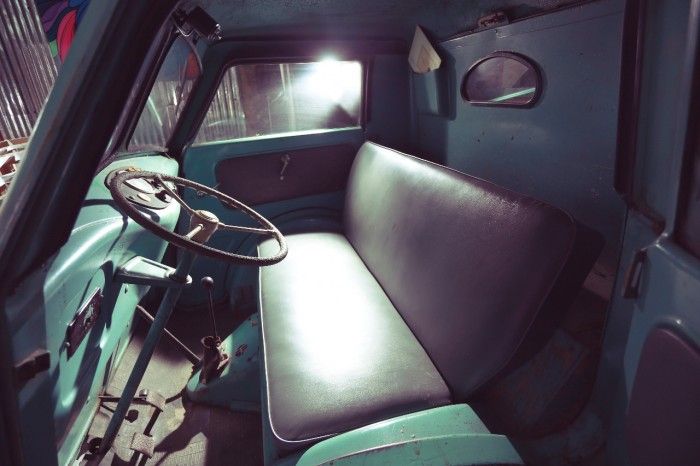
The 1951 Tempo Matador truck unit found in Bandung features a centrally positioned steering wheel, a unique layout that sets it apart from most commercial vehicles of its era. (Picture from: Otomotifnet)
In Europe during the late 1940s and early 1950s, the Tempo Matador belonged to the popular one-ton light truck class. Roughly 1,300 units were produced in Hamburg before production ended, yet time has not been kind to most of them. Today, fewer than ten units are believed to have survived worldwide, placing the Matador among the rarest surviving post-war commercial vehicles.
The 1952 Tempo Matador 1400 promotional prospect, showcasing the truck’s distinctive front design and its practical commercial layout. (Picture from: Motor-Lit-Berlin.de)
One of those survivors lives far from its birthplace, in Bandung, Indonesia. A 1951 Tempo Matador is known to belong to Terror Garage, a Volkswagen specialist workshop. Its existence there proves that German commercial vehicles once traveled much farther than many people assume, reaching Southeast Asia and serving practical roles in cities like Jakarta and Bandung decades ago.
The 1952 Tempo Matador 1400 unit found on Belitung Island is now owned by an automotive enthusiast based in Jakarta, adding another chapter to the truck’s long journey. (Picture from: AirCooledSyndicate)
Indonesia has offered more clues to the Matador’s quiet global journey. Beyond the Bandung truck, a Tempo Matador 1400 delivery vanwas discovered on Belitung Island and is now owned by an automotive enthusiast in Jakarta. These findings suggest that the Matador was available not only as a pickup but also as a minibus or delivery van, adapting to different commercial needs.
The 1952 Tempo Matador 1400 unit while on display at the 2022 Jogjakarta Rame Volkswagen event, held in September 2022, where it drew attention from classic VW enthusiasts. (Picture from: AirCooledSyndicate)
What makes the Matador even more memorable is its unusual layout and detailing. The steering wheel sits in the center, allowing up to three people to sit across the front. Twin windshield wipers rest above the split glass, suicide-style doors open access to the cabin, and the suspension combines independent mono-leaf springs at the front with a rigid rear axle.
Seen through a modern lens, the Tempo Matador is not just an old truck—it is a rolling reminder of an era when innovation often came wrapped in humble, hardworking forms, now reduced to fewer than ten surviving witnesses worldwide.😉 *** [EKA [26052023] | FROM VARIOUS SOURCES | QUIRKYRIDES | OLDBUG | AIRCOOLEDSYNDICATE ]
Note: This blog can be accessed via your smart phone.
Can You Believe Only 10 Units of This Rare Tempo Matador Truck Still Exist Worldwide?




 Seen through a modern lens, the Tempo Matador is not just an old truck—it is a rolling reminder of an era when innovation often came wrapped in humble, hardworking forms, now reduced to fewer than ten surviving witnesses worldwide.😉 *** [EKA [26052023] | FROM VARIOUS SOURCES | QUIRKYRIDES | OLDBUG | AIRCOOLEDSYNDICATE ]
