The Unique Doorless Enzmann 506 Spyder: A Bold Swiss Classic Roadster Design
Bare Elegance - In the golden age of post-war motoring, when Europe was rebuilding both its cities and its sense of style, small-scale ingenuity often gave birth to some of the most fascinating machines. Among these lesser-known creations is the Enzmann 506 Spyder, a car that quietly captured the spirit of innovation and individuality in the late 1950s, while offering a refreshing alternative to the more established names of its time.
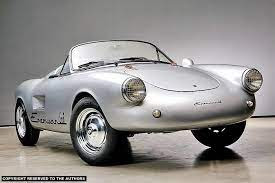
The Enzmann 506 Spyder was designed and built by Dr. Emil Enzmann based on the Volkswagen Beetle, with an attractive fiberglass bodywork at his father garage. (Picture from: Pinterest)
At first glance, its silhouette might remind enthusiasts ofthe iconic Porsche 356, with its smooth curves and compact proportions. Yet the Enzmann 506 Spyderwas never meant to imitate—it emerged from a deeply personal ambition. Its creator, Emil Enzmann, was not a major industrialist but a determined visionary who simply wanted a beautiful sports car he could call his own. Unable to afford one from a major brand, he decided to build it himself.
The Enzmann 506 Spyder's bodywork made of fiberglass done by known as a plastic boat builders named A.&O. Staempfli of Grandson, Switzerland. (Picture from: Porsche Galerie RS)
The journey began with a humble foundation: the chassis of a Volkswagen Beetle. Enzmann removed its original body and replaced it with a lightweight fiberglass shell of his own design. This new body was not only visually striking but also practical, crafted with assistance from a boat-building company experienced in working with fiberglass. The result was a sleek, minimalist roadster that felt both handcrafted and forward-thinking.
The Enzmann 506 Spyder was produced in very limited series with the work done entirely by hand. (Picture from: Pinterest)
As interest grew, Enzmann formalized his efforts by establishing Enzmann Automobile in Schüpfheim, Switzerland. His goal was clear: to create a sports car that was affordable, easy to handle, and stable at high speeds. The production process remained deliberately artisanal, with the fiberglass bodies manufactured by A.&O. Staempfli using meticulous hand-layup techniques. Each body was shaped inside molds, layered with resin, then carefully sanded and finished to achieve a professional look.
The
Enzmann 506 Spyder's cabin featured an integrated roll bar, safety pelvic strap and an ergonomically designed sports bucket seat. (Picture from: Porsche Galerie RS)
One of the most distinctive aspects of the car was its unconventional design. The body was essentially a single, rigid piece, with openings only for the engine and fuel tank. There were no doors—just sculpted indentations along the sides where occupants could step in. This doorless concept gave the car a raw, open-air character, reinforcing its identity as a pure driving machine rather than a luxury object.
The doorless fiberglass bodied roadster called the Enzmann 506 Spyder debuted at the 1957 Frankfurt Auto Show. (Picture from: Pinterest)
The Enzmann 506 Spydermade its public debut at the Frankfurt Auto Show, where it immediately stood out among more traditional vehicles. Interestingly, the “506” designation came not from engineering specifications but from the exhibition booth number assigned to the company. This small detail reflects the car’s unconventional story—practical, spontaneous, and rooted in real-world circumstances rather than corporate planning.
Most of the Enzmann 506 Spyders powered by by the Okrasa 1,295 cc engines, while a few of them used the Porsche 356's engine. (Picture from: Porsche Galerie RS)
Underneath its lightweight body, performance was surprisingly lively. Most units were powered by engines developed by Okrasa, specifically a 1,295 cc configuration that delivered impressive speed for such a compact car. With proper tuning and its low weight, the Spydercould reach speeds of around 100 mph (160 km/h). Some later examples even adopted engines similar to those found in the Porsche 356, further enhancing their performance potential.
Production remained limited and exclusive, with just over a hundred units built between 1957 and around 1970. That rarity, combined with its unconventional design and grassroots origin, gives the Enzmann 506 Spyder a unique place in automotive history. Today, it stands as a reminder that innovation does not always come from large factories or famous badges—sometimes it begins with a single idea, a modest workshop, and the determination to create something truly different. *** [EKA [27122022] | FROM VARIOUS SOURCES | CONCEPTCARZ |SUPERCARS.NET | PORSCHE GALERIE RS ]
Note: This blog can be accessed via your smart.
The Unique Doorless Enzmann 506 Spyder: A Bold Swiss Classic Roadster Design




 Production remained limited and exclusive, with just over a hundred units built between 1957 and around 1970. That rarity, combined with its unconventional design and grassroots origin, gives the Enzmann 506 Spyder a unique place in automotive history. Today, it stands as a reminder that innovation does not always come from large factories or famous badges—sometimes it begins with a single idea, a modest workshop, and the determination to create something truly different. *** [EKA [27122022] | FROM VARIOUS SOURCES | CONCEPTCARZ |SUPERCARS.NET | PORSCHE GALERIE RS ]
