-->
Drop Down MenusCSS Drop Down MenuPure CSS Dropdown Menu

Saturday, September 17, 2016

The Lazareth LM 847 Isn’t Concept Art—It’s a Rideable V8 Motorcycle

Ridable Extremity - In an era where custom motorcycles often blur the line between engineering and art, a few creations push far beyond visual shock value. The Lazareth LM 847 belongs to that rare category where curiosity turns into disbelief, then quickly into respect. At first glance it looks like a sculptural experiment built for an auto show floor, yet its true story unfolds when the machine actually moves under its own power, ridden like any other motorcycle—just on a dramatically different scale. 
The Lazareth LM 847 has undergone real-world road testing, proving that it is not merely a display piece but a machine that can be ridden like other motorcycles. (Picture from: Carscoops)
The LM 847 was conceived by French designer and builder Ludovic Lazareth, a name long associated with radical mechanical ideas. Revealed to the public at the Geneva Motor Show in March 2016, the project immediately stood apart because it challenged an unspoken boundary: how much engine can a motorcycle realistically carry? Lazareth’s answer was unapologetically bold—drop a full-sized Maserati V8 into a bike chassis and design everything else around that decision.
The Lazareth LM 847 was conceived by French designer and builder Ludovic Lazareth, a name long associated with radical mechanical ideas. Revealed to the public at the Geneva Motor Show in March 2016. (Picture from: NewAtlas)
At the heart of the LM 847 sits a naturally aspirated 4,691 cc, 32-valve Maserati V8, originally found in the Quattroporte. The engine is capable of producing around 470 horsepower at 7,000 rpm, with torque figures reported between 457 Nm and up to 620 Nm at roughly 4,750 rpm depending on configuration references. To manage this immense output, the motorcycle uses a single-speed transmission paired with a hydraulic clutch and a chain final drive, keeping the mechanical layout surprisingly straightforward despite the engine’s automotive origins. 
The LM 847 features a carefully engineered chassis with a custom beam frame developed by Lazareth that also serves as a counterbalance to help stabilize the motorcycle. (Picture from: NewAtlas)
Visually, the LM 847 rejects traditional bodywork almost entirely. The rider sits directly above the exposed V8, with the engine acting as the centerpiece rather than something to hide. There are no fairings to insulate heat or mask complexity, creating a raw, almost biomechanical impression—as if the rider is merged with the machine. 
The Lazareth LM 847 is powered by a naturally aspirated 4,691 cc, 32-valve Maserati V8 engine originally found in the Quattroporte. (Picture from: NewAtlas)
The seating position is upright yet commanding, emphasizing control rather than comfort, while the absence of a conventional “interior” highlights its purpose as a functional, rideable sculpture.  Beneath that dramatic silhouette lies a carefully engineered chassis. Lazareth developed a custom beam frame that doubles as a counterbalance, helping stabilize a motorcycle that measures approximately 2.6 meters in length and weighs close to 400 kilograms.  
The Lazareth LM 847 rides on a four-wheel layout with two wheels at the front and two at the rear, drawing conceptual inspiration from the legendary Dodge Tomahawk. (Picture from: Carscoops)
The LM 847 rolls on four wheelstwo at the front and two at the rear—similar in concept to the legendary Dodge Tomahawk V10 Superbike, supported by a bespoke suspension system including a TFX rear setup. Braking is equally serious, featuring massive 420 mm Brembo discs with eight-piston Nissin calipers up front and 255 mm discs with four-piston Brembo calipers at the rear
What ultimately defines the Lazareth LM 847 is not just its specifications, but the fact that it genuinely works. Video demonstrations following its debut confirmed that this machine is not a static showpiece—it can be ridden like other motorcycles, accelerating, balancing, and moving with surprising composure despite its size. In a modern context where many extreme builds remain conceptual, the LM 847 stands as a reminder that innovation still thrives when imagination is matched with engineering discipline, turning the improbable into something thrillingly real.

Kept spur your adrenaline on the power of two-wheeled monster and stay alive with the true safety riding. May God will forgive Your sins.... *** [EKA [17092016] | FROM VARIOUS SOURCES | CARSCOOPS | NEWATLAS ]
Note: This blog can be accessed via your smart phone.

Friday, September 16, 2016

The world's first flat-pack truck made by F1 designer

This is the world's first flat-pack truck launched in the UK. An innovative truck that can accommodate three people and the goods was made by a designer supercar and the Formula One (F1) car Gordon Murray and a former pilot Sir Torquil Norman along with entrepreneurs, philanthropists.
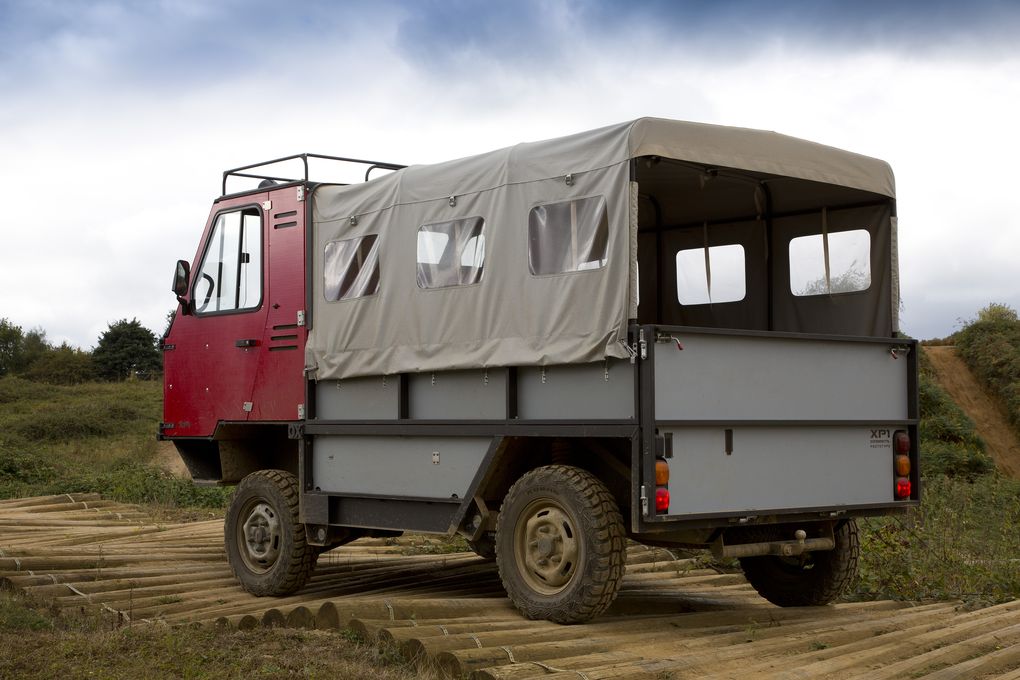
Global Vehicle Trust 'OX,' the world's first flat-pack truck made by Gordon Murray. (Picture from: http://adf.ly/1dwrdu)
The goal of the development of the versatile vehicle named 'OX' by Gordon Murray was already clear, is to help the people who lived in isolated areas in the interior of Africa. Those people do not have to walk, using the animals or even carried to carry the food, drinking water supplies, medicines, or building materials.
Cabin view of Global Vehicle Trust OX. (Picture from: http://adf.ly/1dwrdu)
To support its operation, the OX is designed as an all terrarin small truck that can devour rough terrain. Remarkably OX can be assembled in 12 hours by three people. The plan, this car will be marketed at a price of between ‎£10 thousand to ‎£15 thousand or approximately Rp.175,5 million to Rp.263 million. In addition to use in the interior of Africa, this car can also be used by the farmers in the United Kingdom and Europe who want cheap cars to transporting the crops.
Steering wheel and dashboard of Global Vehicle Trust OX. (Picture from: http://adf.ly/1dwrdu)
The idea of ​​making this versatile truck was actually born of Sir Torquil Norman and then he founded a charity board called the Global Vehicle Trust to address transportation-related issues in the developing world. He took inspiration from the 'Africar' project in the 1980s to help the people who living in rural areas. Then he took Murray to design a lightweight vehicle capable of exploring in the wild terrain until finally born the OX. His dream is to see the OX will exist in every village in Africa.
Rear-left side view of Global Vehicle Trust OX. (Picture from: http://adf.ly/1dwrdu)
This car cabin can accommodate three people including the driver. But this car is designed with the position of steering wheel in the middle, with a size shorter than SUV, but the payload can be twice as heavy as the nearly 2 tons or comparable to carry 13 people or eight drum with a capacity of 44 gallons each.
Its drivetrain rely on a diesel engine with a capacity of 2 liter combined with a 5-speed manual transmission system and capable of running up to a maximum speed of 120 kilometers per hour. *** [EKA | FROM VARIOUS SOURCES | THE OX | THE VERGE | AUTOBLOG]
Note: This blog  can be accessed via your smart phone

Storr Loch, the sea monsters from the Jurassic era

The team of scientists have uncovered the reptile fossil which have a length of almost four meters that once inhabited the oceans some 170 million years ago. The fossil, dubbed the Storr Lochs Monster, an almost intact Ichthyosaur skeleton.

Ichthyosaur are a family of marine extinct reptiles that lived in the Jurasic era. Such creatures like dolphins at that time; fast swimmers with a narrow snout and long, as well as the perfect cone-shaped teeth for eating fish and squid. Storr Lochs is the most complete specimens of marine reptile fossils that found in Scotland from the Jurasic era. For decades, the skeleton preserved in very hard rock.
Artist's rendering of Storr Lochs Monster, an ancient reptile which have a length of almost four meters that once inhabited the oceans some 170 million years ago. (Picture from: http://adf.ly/1dwy07)
"Although some people think that there are sea monsters that are still alive in the lake up to now, there are actually a sea monster who lived here more than a hundred million years ago," said Stephen Brusatte, principal investigator of the University of Edinburgh who analyzed the fossils.

The fossil was discovered by amateur fossil collector, Norrie Gillies in the summer of 1966 on the island of Skye, Scotland. Then, he contacted the Royal Scottish Museum, which immediately sent a team of investigators a few weeks later to make sure and remove the fossil.
One researcher, Nigel Larkin was preparing the fossil before shown to the public. (Picture from: http://adf.ly/1dwyC7)
For decades, Gillies who works as a manager at the SEE energy company, kept in touch with the museum to know the progress of fossils. But until he died in 2011 at the age of 93 years, the specimen was still not successfully separated from the stone. Gillies never see the full picture of a creature whose fossil he found.

Maintaining the fossil remains in the stone is very appropriate action. Because, fossils trapped in sedimentary rocks that hardened when a lava flow coating Skye Island during the Paleocene era, about 66-56 million years ago. Separating it from the rocks without the use of equipment or expertise that may cause damage to the fossil.
Skye's Storr Lochs Monster fossil will be analysed by Palaeontologists. (Picture from: http://adf.ly/1dwyC7)
Slowly but sure, the Storr Lorchs Monster Mystery solved, thanks to the cooperation between the University of Edinburgh, the Scottish National Museum and SEE energy company. The researchers finally succeeded in separating the skeletal remains of Ichthyosaur surrounding rock for millions of years.

Now, after these fossils have been separated completely, paleontologists can tell whether this Ichthyosaur species included in the existing, or a new species. The finding also provides the key data that refers to the Middle Jurassic. In this era, the fossils record are very a little.

"In the era of the Middle Jurassic, in the oceans there seems to be a massive shift between the smaller reptiles and primitive reptile with a large group," said Brusatte.

He continued, "It seems so, because we did not have many fossils of that era. This is why, the present finding has the potential to become a very important specimen international scale. This is one of the few best Ichthyosaur fossils that managed to find from those dark era." *** [EKA | FROM VARIOUS SOURCES | LIVESCIENCE]
Note: This blog  can be accessed via your smart phone

The latest model of BMW electric scooter will adopted the i3 battery

BMW can be said fairly successfully market the i3 electric cars in the global market. Apparently, BMW wants to continue the success story to the electric scooter, the C Evolution.

The i3 models are manufactured by a four-wheel vehicles division under the 'i' series development teams which is known to produce environmentally friendly products. In addition to the i3, BMW also market the i8 hybrid sports car. While the C Evolution created by the motorcycle division of BMW Motorrad.
The latest BMW C Evolution electric scooter will adopted the i3 battery. (Picture from: http://adf.ly/1dvcme)
As reported of Autoblog, although manufactured by different division, it does not mean there is no technological collaboration. This is precisely what the newest model of C Evolution that will receive the battery inheritance from the i3. BMW Motorrad get the battery of 94 Ah which is also used in the new 2017 BMW i3.

The old version of BMW C Evolution electric scooter itself being marketed in several countries, mostly in Europe. With the new battery usage, the C Evolution scooter will have a cruising range of up to 160 kilometers on a single charge. Its coverage was not much different from the i3 e-car.
Its 94 Ah battery capable of producing 11 hp higher than that used today ie 60 Ah. So it becomes 26 hp with a torque of 53 lb-ft. (Picture from: http://adf.ly/1dvcme)
Although the battery was bigger than the one used by the current model of BMW C Evolution, but has a faster charging time. Its 94 Ah battery capable of producing 11 hp higher than that used today ie 60 Ah. So it becomes 26 hp with a torque of 53 lb-ft.

In addition, the latest model of C Evolution to be unveiled at the Paris Motor Show 2016 next month with the changes in the use of LED lights, reverse assist, and already uses the BMW's EfficientDynamics ABS braking system. Besides Europe, this scooter will be marketed in the United States, Japan, South Korea, and Russia.

Kept spur your adrenaline on the power of two-wheeled monster and stay alive with the true safety riding. God will forgive Your sins.... *** [EKA | FROM VARIOUS SOURCES | AUTOBLOG]
Note: This blog  can be accessed via your smart phone

Thursday, September 15, 2016

A nameless radical custom Corvette

What do you do when you have so much free time, metal-working skills, fondness for Morgan modern car design and a 1998 Corvette? Maybe like this would happen. This Warren Scaife's custom Corvette technically not have a name yet, but we're not sure it needs one. A name will not help people better understand what they're looking at when they ask the owner "What's that?"
A nameless XL Stainless Custom Corvette by Warren Scaife. (Picture from: http://adf.ly/1dy3W7)
But Scaife's thingking to pinned one or two of the 'XL' badges on it, so the car could better fulfill its intended purpose; ie to act as a rolling billboard for his fabrication company, XL Stainless. So what is it? In short, it is a custom-built 1998 Corvette equipped with a 665-horsepower supercharged V8 engine, which has a custom leather interior and hand formed aluminum body inspired by the Morgan LIFEcar concept.
Left side view of XL Stainless Custom Corvette by Warren Scaife. (Picture from: http://adf.ly/1dy3Ra)
All of this started, when business slows down in early 2009 due to the recession, and Warren Scaife, owner of Barrie, Ontario-based, XL Stainless fabrication, found himself with way too much free time and nothing to do with it. That's when he had the idea to create a project for himself that will double as an ad for his business and the radical, head-turning custom car.

XL Stainless specializes in the manufacture of stainless steel pharmaceutical machinery and equipment, but around eleven years ago, Scaife decided to break back into the automotive fabrication, where he had got his start.
Interior view of XL Stainless Custom Corvette by Warren Scaife. (Picture from: http://adf.ly/1dy3TX)
This car will be a calling card for the automotive side of his business, and would hopefully turn him a profit when he decided to sell it, too. He chose a Corvette as the donor car (specially a 1998 Virginia rear-end victim that have been written-off) because he figured the car's high performance reputation would help when looking for a buyer for the finished product.
Engine view of XL Stainless Custom Corvette by Warren Scaife. (Picture from: http://adf.ly/1dy3TX)
Design inspiration comes through the then-new Morgan LIFEcar concept, a car with its not-short wheelbase and a pontoon-style fenders, does not exactly lend itself to adaptation through a Corvette.
Rear side view of XL Stainless Custom Corvette by Warren Scaife. (Picture from: http://adf.ly/1dy3TX)
Then Scaife moved the Corvette's front suspension cradle forward 21 inches. He widened the car's rear end and relocated the engine, shock mounts and tilted the radiator forward instead backward. A rear spoiler was originally in the plans, as were Lamborghini-style scissor doors, but both felt too off-the-shelf to him. The gloss black on the car was supposed to be matte or satin, but a mix-up on the painter’s part left Scaife settling for the shinier stuff.
XL Stainless Custom Corvette inspired by the design of Morgan LIFEcar concept. Look at how similar both of them. (Picture from: http://adf.ly/1dy3W7)
And then the drivetrain. Both engine and transmission got a full rebuild and were crammed full of almost every aftermarket performance part you could ask for. A stroker kit and supercharger gave the 383-cube V8 some 665 horsepower to work with, and the automatic transmision and low rear gears help the Corvette pull 160 km/h (100 mph) in second while returning 10 L/100 km (23 mpg) highway, according to Scaife.
For all of this, he has spent nearly 2,500 work hours and cost about $80,000. But the result was not in vain, and I think he has managed to build a very nice car. What do you think? *** [EKA | FROM VARIOUS SOURCES | AUTOFOCUS]
Note: This blog  can be accessed via your smart phone

Meet the world's first soft-bodied robot

The scientists' interest with the soft-bodied robot writhing in recent years. The soft body more makes robot more flexible in order to be in confined spaces or when dealing with finer objects safely.

The octopus-shaped robot is a perfect blueprint for the kind of soft-bodied robots. A team of scientists from Harvard University to bring this cephalopod design into the future. They succeeded in creating of the 'Octobot', the world's first soft-bodied robot.
The Octobot is supported by a network of pneumatic embedded in the body and tentacles, whereas the tentacles expand and contract as they fill wiyh gas, propelling it forwards. (Picture from: http://adf.ly/1dvZwb)
Octobot has a height of less than 2 cm (0.8 inches) approximately the size of the palm of a human. The robot can walk for between four and eight minutes before running out of fuel. THe Octobot can run up to 8 minutes with 1 milliliter of fuel. 50 percent of their fuel is hydrogen peroxide solution. The larger versions can remain active for a longer time according to the amount of fuel.

The Octobot made of silicone rubber. Its brain was a flexible microfluidic circuit that directs the flow of liquid fuel through the channel using the valve.
"Just the brain, electronics, and batteries of component parts are hard," said Daniela Rus a robot expert at the Massachusetts Institute of Technology, Cambridge. "This work is new and really interesting."

"Now need to do is how to reprogram the robot to perform different actions, respond to the environment, and not just do a pre-order program," said Robert Shepherd an engineer from Cornell University in Ithaca, New York. *** [EKA | FROM VARIOUS SOURCES | IFLSCIENCE]
Note: This blog  can be accessed via your smart phone