-->
Drop Down MenusCSS Drop Down MenuPure CSS Dropdown Menu
Showing posts sorted by date for query Lamborghini Diablo. Sort by relevance Show all posts

Wednesday, October 22, 2025

Lamborghini Diablo VT: The 90s Supercar That Tamed the Beast

Tamed Fury - If you ever wondered what it would be like if a flamethrower went to finishing school, the Lamborghini Diablo VT might just be your answer. Wild, loud, unapologetically dramatic—but also the first time Lamborghini looked at one of its raging bulls and thought, “Hmm, maybe we should teach this thing to behave just a little.” 

The Lamborghini Diablo VT, launched in 1993, marked Lamborghini’s bold leap into all-wheel-drive supercars with its “Viscous Traction” system that could send up to 25% of the engine’s power to the front wheels. (Picture from: Cars.Bonham)
Introduced in 1993, the Diablo VT was Lamborghini’s bold leap into the unfamiliar world of all-wheel-drive supercars. “VT” stands for “Viscous Traction”—which might sound like something you'd find in a sci-fi movie, but in reality, it was a viscous coupling that could send up to 25% of the engine’s power to the front wheels. That may not sound revolutionary today, but for Lamborghini at the time, it was practically heresy. Until then, Lambos had a reputation for being beautiful, brutally fast, and borderline unhinged on the road. The Diablo VT changed that narrative—just a bit.
The Lamborghini Diablo retained its iconic wedge shape and signature scissor doors, combining a sleek, low-slung body that looked fast even at a standstill, menacing in motion, and downright outrageous in red—a bold statement that dismissed conventional car design entirely. (Picture from: Wikipedia)
Powering this mechanical beast was a 5.7-liter V12 engine producing around 492 horsepower and 428 lb-ft of torque. Numbers like that, especially in the early '90s, weren’t just impressive—they were absurd. This wasn’t just a fast car; this was a car that could embarrass most motorcycles. It did 0 to 60 mph in about 4.5 seconds and had a top speed north of 200 mph, which meant the speedometer was really more of a suggestion than a limit.
The Lamborghini Diablo VT featured a surprisingly refined interior with leather trim, carbon fiber accents, and improved comfort over its predecessors—offering just enough ease to remind drivers they were in an exotic, not a race car.. (Picture from: TomWookieFord in X)
But here’s where things get interesting: the Diablo VT wasn’t just about brute force. Lamborghini added features like power steering, anti-lock brakes, and electronically adjustable suspension—things that today sound standard, but back then were like giving a rock concert stage pyrotechnics and then throwing in a string quartet for balance. The result? A car that still looked and sounded like an untamed creature, but one that could now dance through corners without biting your head off
The Lamborghini Diablo VT introduced several improvements, including front air intakes below the driving lamps for better brake cooling, larger rear arch intakes, a more ergonomic interior with revised electronically adjustable dampers, four-piston brake calipers, power steering, and minor engine refinements. (Picture from: Wikipedia)
Design-wise, the Diablo VT kept the iconic wedge shape and those glorious scissor doors that basically shouted “supercar” before the engine even started. It looked fast parked, threatening when in motion, and practically criminal when in red. The sleek, low-slung body was more than just a statement—it was a middle finger to anything shaped like a box on wheels.
The Lamborghini Diablo VT Roadster, launched in December 1995, featured a removable carbon fiber targa top stored above the engine lid and a revised front bumper with two rectangular and two round driving lamps replacing the original quad rectangular setup. (Picture from: Wikipedia)
Inside, things took a turn for the surprisingly plush. You’d find leather-wrapped everything, carbon fiber accents, and just enough comfort to remind you that you weren’t driving a race car—you were driving an Italian exotic that happened to also know what legroom was. It wasn’t exactly a living room on wheels, but compared to previous Lambos, it was practically a spa day.
The Lamborghini Diablo VT Roadster featured a substantially redesigned engine lid to ensure adequate ventilation when the removable roof panel was stored above it. (Picture from: RobbReport)
Production ran from 1993 to 1998, with around 400 units built—making the Diablo VT relatively rare, even by supercar standards. Lamborghini, of course, didn’t stop there. They followed up with versions like the Diablo VT Roadster, which let you experience all that thunderous V12 glory with the added bonus of messing up your hair. 
The Lamborghini Diablo VT 6.0 introduced in 1999 with major design updates, including Murciélago-style front air intakes, reworked bumper and quarter panels, enlarged turn signals repositioned below the headlights, removal of upper air inlets, and body-colored taillight surrounds with GT-style lamp configuration. (Picture from: MobilLangka.id in Instagram)
And then came the Diablo VT 6.0, which arrived with a larger 6.0-liter engine, sharper looks, and more refined stylingincluding integrated headlights and carbon fiber trim that made it look ready for both a racetrack and a red carpet. Due to the development of the Murciélago, the Lamborghini Diablo VT 6.0 was offered exclusively in coupé form; however, customers could still request a rear-wheel-drive version by special order. | OF621dLzlPY |
At the end of the Diablo's production run, the company introduced the limited-production Lamborghini Diablo VT 6.0 SE, offered exclusively in two colorsgold metallic “Oro Elios” symbolizing sunrise and color-shifting bronze/maroon “Marrone Eklipsis” representing sunset—with additional updates including a new magnesium intake manifold, short-ratio transmission, unique upholstery, “Lamborghini” badged brake calipers, enhanced carbon fiber interior trim, and integrated navigation with road map software, while retaining the same power output as the standard VT 6.0
The Lamborghini Diablo VT 6.0 SE shown here is a 2001 model finished in the color-shifting bronze/maroon “Marrone Eklipsis,” featuring major design updates. (Picture from: RMSothebys)
What makes the Diablo VT truly special isn’t just that it was fast, exotic, and dangerously cool—it’s that it marked a turning point. It was the first Lamborghini to embrace a little more control, a little more usability, without sacrificing the drama that made people fall in love with the brand in the first place. It showed that a supercar could evolve without losing its soul. | bD5JF-penCQ |
In short, the Lamborghini Diablo VT was proof that even the wildest machines can grow up—just enough to be usable, but not so much that they stop being thrilling. And let’s be honest: when a car can scare you and make you smile at the same time, it’s probably doing something right. ***  [EKA | FROM VARIOUS SOURCES | WIKIPEDIA | DRIVERSOURCE | ROBBREPORT | RMSOTHEBYS | TOMWOOKIEFORD IN X | CARS.BONHAM ]
Note: This blog can be accessed via your smart phone.

Tuesday, August 26, 2025

Pacchetto Titano: The Track-Inspired Evolution of the Lamborghini Diablo Restomod

Carbon Fury - Every once in a while, the automotive world reminds us that passion can be engineered, sculpted, and fine-tuned into something truly extraordinary. Some creations don’t just roll out of a factory — they feel like they’ve been reborn, carrying the DNA of a legend yet infused with fresh adrenaline for a new generation. That’s exactly the feeling stirred up by the Pacchetto Titano, Eccentrica Cars’ track-flavored evolution of their already jaw-dropping Lamborghini Diablo restomod.
The Lamborghini Diablo Restomod Pacchetto Titano by Eccentrica Cars. (Picture from: TopGear)
When Eccentrica unveiled their reimagined Diablo back in July 2023, the world got a taste of what happens when meticulous craftsmanship meets raw Italian flair. Two years on, they’ve sharpened the claws of their raging bull with a package that’s as much about performance as it is about presence.  
The Lamborghini Diablo Restomod Pacchetto Titano by Eccentrica Cars made its debut at The Quail motorsport gathering in California with two examples, one finished as the striking “Rose Phoenix” in rose gold metallic paint with handcrafted trim and exclusive bespoke detailing. (Picture from: Carbuzz)
The Pacchetto Titano isn’t just an upgrade — it’s a statement. The most striking difference hits you before the engine even fires: a full exposed carbon fibre body. Eccentrica says it’s a technical move, shaving weight and boosting rigidity, but let’s be honest — it also looks like the car slipped straight out of a hypercar fever dream. 
At the same venue, Eccentrica Cars also unveiled its sibling, the equally bold “Green Dragon” in vivid green paint with intricate metallic flake, complemented by custom body accents, unique aerodynamic elements, and finely tailored interior craftsmanship. (Picture from: Carbuzz)
The details are just as obsessive. A discreet but purposeful rear wing perches above the tail, part of a suite of aerodynamic tweaks that quietly but effectively increase downforce without upsetting the Diablo’s signature silhouette. Beneath the skin, stiffer springs and recalibrated adaptive dampers give the car sharper reflexes on the track, yet remain forgiving enough for a spirited blast along canyon roads. Brembo brakes now hide behind lightweight forged alloys, designed not just to turn heads but to cool the stoppers more efficiently during high-speed abuse. 
The Lamborghini Diablo Restomod Pacchetto Titano by Eccentrica Cars. (Picture from: TopGear)
Eccentrica also massaged the Diablo’s brain — the ECU now delivering throttle response that’s instant, sharp, and unapologetically visceral. Under that sculpted rear decklid lies Lamborghini’s iconic 5.7-litre naturally aspirated V12, breathing through new cams and pushing output to roughly 540 horsepower. No forced induction, no artificial soundtrack — just pure mechanical music. 
The Lamborghini Diablo Restomod Pacchetto Titano by Eccentrica Cars. (Picture from: TopGear)
Inside, the Pacchetto Titano keeps the motorsport spirit alive with Alcantara trim, billet aluminium highlights, and a steering wheel that wouldn’t look out of place in a GT race car. “We wanted to create a package that genuinely amplifies the driving experience without overshadowing the core essence of our car,” explains Eccentrica founder Emanuel Colombini. Judging by the results, mission accomplished.
The Lamborghini Diablo Restomod Pacchetto Titano by Eccentrica Cars. (Picture from: TopGear)
Only 19 Eccentrica Diablos will exist, making the Titano even more of a unicorn. Its public debut takes place at The Quail motorsport gathering in California, where it will share the stage with two other flamboyant siblingsthe rose-gold-finished Rose Phoenix and the vivid Green Dragon. Each is spectacular in its own way, but the Titano? That’s the one that looks like it could leap off the lawn straight onto a racetrack, and never look back. The video featured below isn’t actually of the Pacchetto Titano we’re focusing on here—it shows the Eccentrica’s reimagined Diablo from July 2023.  | jXXMfTRh2dU |
In a world where many “special editions” feel like stickers and marketing, the Pacchetto Titano stands apart — a car that has been honed, not hyped; built to be driven, not just displayed. It’s proof that when passion meets precision, legends don’t fade… they evolve. *** [EKA | FROM VARIOUS SOURCES | TOPGEAR | BBC_TOPGEAR IN X | CARSCOOPS | CARBUZZ ]
Note: This blog can be accessed via your smart phone.

Thursday, August 21, 2025

Lamborghini Diablo Roadster: The Bold Concept That Stole the Spotlight

Fearless Elegance - Sometimes in the automotive world, a single bold idea can ignite more excitement than a hundred safe releases. Back in the early ‘90s, Lamborghini embraced that daring spirit and delivered something so striking it still turns heads today—the ingenious concept of the Lamborghini Diablo Roadster. It wasn’t just a car; it was a statement of pure imagination on wheels, born at a time when the brand itself was navigating turbulent waters.
The Lamborghini Diablo Roadster prototype while sat in display at the Lamborghini Automobile Museum in Sant'Agata Bolognese, Italy. (Picture from: Dyler)
When the Diablo Roadster prototype made its debut at the 1992 Geneva International Motor Show, it carried the kind of presence only Lamborghini could pull offloud, elegant, and dripping with confidence. At that time, Lamborghini was under the ownership of Chrysler Corporation, a partnership that had its share of growing pains.
The Lamborghini Diablo Roadster Concept aimed squarely at the sun-soaked roads of California, promising a thrilling blend of exotic Italian flair, open-air freedom, and raw, unrestrained speed. (Picture from: Forum.Forza.net)
While the Americans hoped to maximize returns without heavy investment, the reality was far messier. Sales of the standard Diablo weren’t hitting expectations, so the company needed something fresh, something to remind the world why Lamborghini was the name you whispered when talking about the ultimate dream car.  
The Lamborghini Diablo Roadster Concept debuted at the 1992 Geneva Auto Show, featuring a removed carbon-fiber roof, a short visor in place of the windshield, a reinforced chassis, roll bars behind the seats, and iconic scissor doors. (Picture from: HotCars)
That “something” became the open-top vision of the Diablo. Imagine the already aggressive stance of the coupe, but with the wind ready to whip through the cabin, the exhaust snarling louder under the open sky. The concept aimed squarely at the sun-soaked roads of California, promising a mix of exotic flair and raw speed.  | 5rvBKyJpUAQ |
But despite the applause it received in Geneva, the project stalled almost immediately after returning to Lamborghini’s headquarters. The company’s finances couldn’t support full production, and the Roadster seemed destined to remain a one-off showpiece.
The Lamborghini Diablo Roadster reimagined by Walter Koenig by taking a standard Diablo coupe platform. (Picture from: Pinterest)
Enter Walter Koenig, a master of automotive customization who refused to let the idea fade away. Taking a standard Diablo coupe, Koenig and his team transformed it into a roadster that wasn’t just a roofless version of the original—it was a reinvention. They sculpted new bodywork, added dramatic styling cues, and, in a move true to Lamborghini’s over-the-top ethos, fitted a monstrous twin-turbocharged V12. The result was a 750-horsepower beast with a mechanical gearbox, extreme rear tires, and just enough wildness to make it feel alive in your hands. 
The Lamborghini Diablo Roadster reimagined by Walter Koenig, sculpted new bodywork, added dramatic styling cues, and, in a move true to Lamborghini’s over-the-top ethos, fitted a monstrous twin-turbocharged V12. (Picture from: Dyler)
This wasn’t a car for gentle Sunday drives. It was unruly, unapologetic, and thrilling—exactly what supercars should be. Even with its imperfect handling, the Diablo Roadster concept proved that Lamborghini could blend elegance and insanity in perfect measure. Koenig’s work kept the spirit alive until 1995, when Lamborghini finally launched the Diablo VT Roadster, bringing a more refined version of the dream to the streets.
The The Lamborghini Diablo VT Roadster was finally launched by Lamborghini in 1995, offering a more refined way to experience the dream — driving a raging bull with the wind over your head on the open road. (Picture from: Dyler)
Looking back, the original Roadster concept wasn’t just a prototype; it was a glimpse into the fearless heart of Lamborghini. It captured a moment when creativity outran corporate caution, when the company dared to show the world something audacious even if the odds were stacked against it. And that’s why, decades later, it still holds a place among the most fascinating chapters in the brand’s history—a reminder that in the world of supercars, boldness is the real engine that keeps the wheels turning. *** [EKA | FROM VARIOUS SOURCES | DYLER | HOTCARS | STEEMIT | FORUM.FORZA.NET | DREAMSTIME | KIZOOLSIZAM IN X ]
Note: This blog can be accessed via your smart phone.

Wednesday, August 13, 2025

1-of-1 Arancio Miura 1990 Lamborghini Countach 25th Anniversary

Raging Rarity - Some cars are born to fill a gap in the market. Others are born to make a statement. The 1990 Lamborghini Countach 25th Anniversary somehow managed to be both — conceived as a stop-gap before the Diablo was ready, yet refined and distinctive enough to become one of the most captivating Countach variants ever made. Over three decades later, one particular example — the only one painted in Arancio Miura from new — remains a living snapshot of Lamborghini’s rebellious spirit.
The 1990 Lamborghini Countach 25th Anniversary, chassis KLA12958 with its sole factory Arancio Miura finish, stands as a vivid emblem of the marque’s rebellious spirit. (Picture from: SupercarNostalgia)

Saturday, July 12, 2025

Lamborghini Diablo GTR: The Ultimate Track-Bred Supercar

Brutal Elegance - There’s something timeless about machines engineered with one clear mission: pure domination. In a time when supercars often blur the line between luxury and performance, one machine stood out as a raw, unfiltered expression of power and purpose. While names like the Skyline GT-R, AMG GT R, and BMW M3 GTR have made their mark in automotive history, one GTR redefined what it means to be born for the track — the Lamborghini Diablo GTR.
The Lamborghini Diablo GTR was born from Lamborghini’s fiery motorsport ambition and made its debut at the 1999 Geneva Motor Show. (Picture from: RoadAndTrack)
Born from the fiery passion of Lamborghini’s motorsport ambition, the Diablo GTR didn’t exist to cruise city boulevards or grace red carpets. It was bred in the pit lanes and designed to crush lap times. Introduced in 1999 at the Geneva Motor Show, this fierce evolution of the Diablo was more than just another variant. It was Lamborghini’s answer to the growing hunger for an elite, no-compromise race machine. Just 30 units were ever produced between 1999 and 2000, making it one of the most exclusive machines to carry the Raging Bull emblem.
The Lamborghini Diablo GTR features striking aluminum bodywork enhanced by dramatic carbon fiber add-ons, including massive intakes and roof scoops. (Picture from: RoadAndTrack)
Underneath the striking aluminum bodywork and dramatic carbon fiber add-ons lies the beating heart of a naturally aspirated 6.0-liter V12 engine, producing an earth-shaking 590 horsepower and 640 Nm of torque. Those numbers translate into blistering performance: 0–96 km/h in just 3.5 seconds and a top speed reaching 339 km/h. These aren’t just stats — they’re a reflection of what happens when engineering meets obsession. All that power is channeled through a six-speed manual gearbox, giving the driver full command of every ounce of fury that V12 can summon.
The Lamborghini Diablo GTR's side profile is adorned with NACA ducts that channel cooling air to the engine and brakes, while its signature sliding plexiglass windows and fresh air tubes integrated into the mirrors highlight its pure racing DNA. (Picture from: RoadAndTrack)
Everything about the Diablo GTR screams function over form. The massive fixed rear wing is bolted directly to the chassis, not for show, but to generate real downforce on the track. Massive intakes, roof scoops, and NACA ducts feed cooling air to the engine and brakes, while the signature sliding plexiglass windows and fresh air tubes snaking through the mirrors reveal its racing DNA. Inside, creature comforts were sacrificed for the sake of speed. The luxurious leather of the standard Diablo is stripped away in favor of exposed carbon fiber, lightweight racing seats with 6-point harnesses, and a roll cage — not exactly your typical Sunday cruiser.
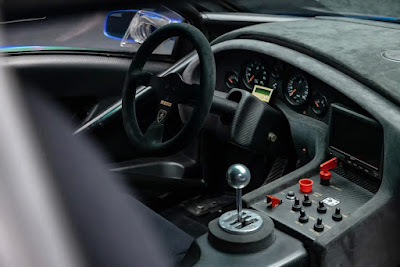
The Lamborghini Diablo GTR’s cabin features lightweight racing seats with 6-point harnesses, a roll cage, a sporty three-spoke steering wheel, a simple dashboard, and a racing gear shifter, while the center console houses racing knobs and buttons. (Picture from: RoadAndTrack)
It wasn’t just built to impress — it was built to compete. The Diablo GTR was developed for Lamborghini’s one-make race series, the Supertrophy. With track-only ambitions, it came factory-equipped with a fire suppression system, racing jacks, and free-flow exhausts that would make any purist grin. Some of these cars, like one unit known to have raced at Monza, left their mark on the circuit, showcasing not only speed but resilience.
The Lamborghini Diablo GTR is powered by a naturally aspirated 6.0-liter V12 engine, delivering a staggering 590 horsepower and 640 Nm of torque. (Picture from: RoadAndTrack)
But perhaps the most captivating part of the Diablo GTR story is not just what it achieved on the track, but what it represented off it. It was among the last analog Lamborghinis — a raw, untamed beast with no digital filters or electronic helpers. This car demands respect, punishes hesitation, and rewards bravery. It's the kind of machine that whispers to a select few who understand that driving should be visceral.
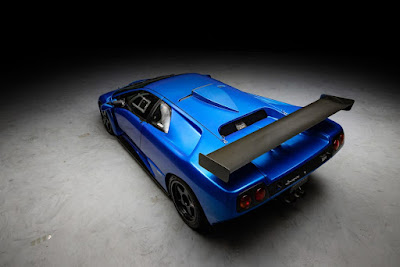
The Lamborghini Diablo GTR features a massive fixed rear wing, bolted directly to the chassis—not for show, but to deliver genuine downforce on the track. (Picture from: RoadAndTrack)
Today, surviving units are rare collectibles, often tucked away in private museums or exclusive collections. Some have barely seen the track, with mileage figures under 1,000 kilometers. Others, once warriors of the circuit, wear their racing scars like badges of honor. Wherever they are, one thing is certain — the Diablo GTR is no ordinary car. It’s a symbol of an era when Lamborghini dared to build something purely for the thrill of speed, the purity of competition, and the roar of a V12 unleashed without restraint.
To own a Lamborghini Diablo GTR is to own a chapter of automotive rebellion. Not many cars can claim that, and even fewer have the pedigree, rarity, and sheer audacity to do it with such unmistakable style. *** [EKA | FROM VARIOUS SOURCES | ROADANDTRACK | PATINARESEARCH ON X | CARVAGANZA ]
Note: This blog can be accessed via your smart phone.

Wednesday, June 18, 2025

Vector M12: Rare American Supercar Powered by Lamborghini V12

Turbo Legacy - When people talk about supercars, names like Ferrari, Lamborghini, or McLaren often dominate the conversation. But the dream of building a world-class supercar wasn’t confined to Europe. Back in the early 1970s, an ambitious young American named Jerry Wiegert set out to prove that the United States could build a machine just as exotic, powerful, and desirable. 
The Vector M12, loosely based on the WX-3, was powered by a version of the Lamborghini Diablo's V12 engine and became the first model produced under MegaTech's new management in 1996. (Picture from: RMSothebys)
That dream eventually became reality—albeit with plenty of twists and turns—culminating in one of the most intriguing cars ever produced: the Vector M12. It all began in 1971 when Jerry Wiegert teamed up with Lee Brown, a skilled auto body expert, to form a company they called Vehicle Design Force. Their goal? Create the first true American supercar. Just a year later, their striking Vector concept landed on the cover of Motortrend magazine, putting their bold vision in the spotlight. 
The Vector M12 fused Vector’s bold, wedge-shaped design with the proven performance of Italian engineering. (Picture from: RMSothebys)
But bold ideas come with bold price tags—the early projections for the Vector's production cost hovered around $100,000, while a brand-new Lamborghini Miura at the time sold for just $20,000. That massive price gap made it tough for the small California-based startup to gain traction. Wiegert's passion never wavered, but his journey through the supercar world was anything but smooth.
The Vector M12's interior was also based on the Diablo, resulting in the removal of the aircraft-inspired features that had made the W8 iconic. (Picture from: RMSothebys)
By the mid-1990s, the original Vector dream had come crashing down, overtaken by corporate maneuvering and international power plays. The company, now under the control of MegaTech—a firm owned by the son of an Indonesian ruler—shifted its base of operations to Florida and took a new direction. Yet, out of all this chaos emerged the Vector M12, the first model produced under the new management.
The Vector M12 was powered by a mid-mounted Lamborghini V12 engine—the same one used in the Diablo—making it a true American-Italian hybrid. (Picture from: RMSothebys)
Though the M12 looked every bit a continuation of Wiegert’s futuristic designs, its DNA had shifted. It was born from the Vector WX-3 Concept that debuted at the Geneva Motor Show in 1993. That prototype used Vector’s homegrown 7.0-liter twin-turbo V8 engine. But once MegaTech took over in 1994, the plan pivoted. Rather than sticking with Vector's in-house powerplants, the M12 adopted a more international flavor—specifically, a mid-mounted Lamborghini V12 engine, the same used in the Diablo, making this new creation a true American-Italian hybrid.
The Vector M12's rear end, which housed the massive powertrain, was overly long, giving the car a futuristic pickup-like appearance with an aggressive tonneau cover and a large spoiler mounted on top. (Picture from: RMSothebys)
Revealed in production form at the 1996 Detroit Auto Show, the M12 combined Vector’s aggressive, wedge-shaped styling with the proven performance of Italian engineering. It shared its chassis with the Diablo, but MegaTech fine-tuned the body and interior, blending Lamborghini components with Vector’s vision. The result was a 500-horsepower beast that could hit 60 mph in under five seconds—impressive by any standard, especially for the time.
The Vector M12 saw a total of only 14 cars sold, with an additional 3 prototypes—including a race car—built before production ended in 1999. (Picture from: RMSothebys)
Still, the M12’s story is about more than speed. It was a car born from drama, built with international parts, and shaped by a deep desire to challenge the automotive elite. Even though only 17 were ever made14 of them true production models—each one tells a story of what might have been. Among them, one car stands out: the fifth M12 ever built, finished in a striking purple shade, with only 6,000 miles on the clock. It's not just a collector's item; it’s a piece of automotive folklore. | Im0OaGJVWHk | GWJvOQuN7p8 |
Today, the Vector M12 is more than a rare machine. It’s a rolling reminder of one man’s vision to shake up an industry, the global forces that shaped its destiny, and the passion that kept it alive, even against the odds. For those who get behind the wheel—or even just admire it from a distance—it’s a powerful symbol of ambition, perseverance, and the wild ride that comes with chasing a dream. *** [EKA | FROM VARIOUS SOURCES | RMSOTHEBYS | AUTOEVOLUTION | CARBUZZ | WIKIPEDIA ]
Note: This blog can be accessed via your smart phone.

Tuesday, June 3, 2025

The SL73 Quicksilver: Brunei’s Custom V12 Roadster by Pininfarina

Royal Obsession - In the world of exotic cars and royal indulgence, few stories are as fascinating as the quiet intersection of cutting-edge design and opulent exclusivity. Imagine a car that’s not just rare, but nearly mythical—a one-off masterpiece born from the creative genius of Pininfarina and built exclusively for one of the most extravagant car collectors in history. That car is the Royal Family of Brunei’s Mercedes Benz SL73 "Quicksilver", a bespoke automotive marvel that remains shrouded in mystery, luxury, and performance.
In 1996, His Majesty the Sultan of Brunei commissioned Pininfarina to recreate the Argento Vivo using a different platform, yet replicating the original Honda concept exactly, including the materials. (Picture from: PublicFotki)
To understand how this special roadster came into existence, we have to trace its roots back to the Argento Vivoa stunning concept car born from a collaboration between Honda and the legendary Italian design house, Pininfarina. The Argento Vivo turned heads in the mid-1990s with its sleek curves, minimalist elegance, and futuristic presence. But while the concept was merely a design exercise for most, it became something more in the eyes of His Majesty the Sultan of Brunei. Intrigued by its style but not bound to Honda’s engineering, the Sultan envisioned a version of this car tailored to his own high standards. 
Some say that Pininfarina built as many as five or six units of the Mercedes-Benz SL73 Argento Vivo for the Royal Family of Brunei. (Picture from: BenzWorld)
Instead of using the original Honda platform, he chose something more powerful and prestigious: the Mercedes-Benz R129 SL600. Already a rare and respected grand tourer in its own right, the SL600 served as the perfect base for what would become a completely reimagined machine. Pininfarina, known for shaping some of the most beautiful cars ever made, took this German chassis and transformed it into a near-exact replica of the Argento Vivo’s design. Every detailfrom the fluid body lines to the advanced material choiceswas preserved, blending Italian artistry with German engineering.
His Majesty the Sultan of Brunei’s Argento Vivo was built by Pininfarina on a brand-new Mercedes SL600 chassis. (Picture from: ClassicDriver)
What set the Brunei version apart, beyond its exclusive styling, was what lay under the hood. The car was fitted with a monstrous 7.3-liter M120 E73 V12 engine, the same powerplant found in the ultra-rare AMG SL73. This engine wasn’t just powerful—it was a beast. Delivering between 525 and 565 horsepower and a staggering 553 lb-ft of torque, it launched this roadster from 0 to 60 mph in just about 4.0 seconds, putting it in the same league as legends like the Lamborghini Diablo and Ferrari F40. And with a top speed surpassing 174 mph, the car was more than just a pretty face. 
His Majesty the Sultan of Brunei’s Argento Vivo is powered by a 7.3-liter M120 E73 V12 engine, also used in the AMG Mercedes-Benz SL73. (Picture from: BenzWorld)
Despite its raw capabilities, what makes the Quicksilver even more intriguing is how little is known about it. Like much of the Sultan’s private collection, these cars live in a veil of secrecy. Only a handfulfive or six at mostare believed to have been made. Four were reportedly built exclusively for the Royal Family of Brunei.
The Argento Vivo of the Royal Family of Brunei was significantly larger than the original Honda concept, yet could sprint from 0 to 60 mph in around 4.0 seconds and reach a top speed of over 174 mph. (Picture from: Supercars.net)
Today, it's said that at least two remain in their possession, while whispers suggest another one found its way to Monaco. There's even talk of a second, unfinished Honda-based concept that was eventually completed and now resides in the same European playground of the rich and famous.
The story of the SL73 Quicksilver isn't just about horsepower or head-turning design. It’s about the rare magic that happens when limitless resources meet unrestrained imagination. It's about a king’s vision turned into reality by one of the world’s finest design houses. And most of all, it’s about a car so rare and so exquisitely crafted that it seems to exist outside the ordinary timelines of automotive history—seen by few, remembered by fewer, and admired by all who know its name. *** [EKA | FROM VARIOUS SOURCES | HOTCARS | TOPSPEED | BENZWORLD | CLASSICDRIVER | MOTOR1 | CARSTYLING.RU | SUPERCARS.NET ]
Note: This blog can be accessed via your smart phone.