Maestro WORKS - Long before futuristic supercars became common conversation pieces, industrial designers were already imagining shapes that could slip through the air with the ease of migrating birds. The late 20th century was a fertile playground for such visions, and among the most daring voices of that era was Luigi Colani, the German-born designer who championed organic curves at a time when the automotive world was still dominated by sharp angles. His philosophy was disarmingly simple: nature already solved most aerodynamic problems—designers merely needed to pay attention. That idea would guide the trajectory of his work from the 1970s into the 1990s and eventually culminate in a radical concept known as the Mercedes C112 Megastar.
 |
| Luigi Colani’s Visionary Mercedes C112 Megastar: A Supercar for the Future. (Picture from: CultObjects in X, and Image Nanobana generated) |
 Colani's
 automotive journey with
Mercedes-Benz stretches further back than most people realize.
In the 1970s,
he began experimenting with alternative automotive shapes,
often using exaggerated curvature to prove how dramatically airflow could be controlled through organic geometry. His prototypes of that decade rarely resembled production vehicles; instead, they looked like sculpted wind tunnels made tangible, a blend of biology and machinery. These early experiments set the tone for everything that followed, especially as he pushed deeper into aerodynamic theory throughout the 1980s.
 |
| Thirty-four years ago, the 1991 issue of Auto-Illustrierte (1/91) introduced the Mercedes C112 as a groundbreaking concept created by the visionary Luigi Colani. (Picture from: CultObjects in X) |
 By the late 1980s and into the early 1990s
,
Colani’s relationship with high-speed performance became increasingly intertwined with motorsport. He proposed several extreme designs for
Mercedes endurance racing, including imaginative studies meant for
Le Mans. These machines were shaped like rolling airfoils—smooth, domed cockpits, rounded fenders, sweeping tails, and closed wheel housings that suggested a vehicle grown rather than engineered. Although
Mercedes did not adopt these proposals for official competition, the concepts themselves influenced
Colani’s own thinking.
They were attempts to solve the same issues Group C cars faced:
the need for stability at enormous speeds,
efficient cooling,
and minimal drag across hours of racing. In hindsight, these racing studies became the spiritual forerunners to the road-going supercar idea he would later pursue.
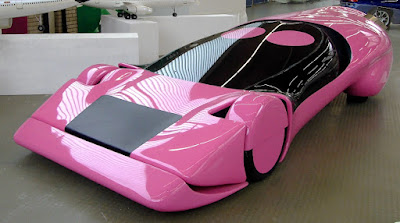 |
| The
1970 Mercedes-Benz Colani C112 prototype, based on the Mercedes-Benz
C111 with a rotary engine, stands out as a testament to his avant-garde
vision. (Picture from: EternalConsumptionEngine) |
That evolution led to the early 1990s, when
Colani turned his attention to a more holistic supercar concept.
In 1991,
Auto-Illustrierte published what would become one of his most talked-about car creation under Mercedes badge—
the C112 Megastar. While the name echoed
the Mercedes C112 engineering prototype of the period,
Colani’s interpretation was something entirely different, a sculpture of motion built upon his distinctive design language.
 |
| The
1970 Mercedes-Benz Colani C112 prototype's rear featured with a giant
wiper and a series of exhaust pipes, boasts radical aerodynamics with a
drag coefficient of 0.2. (Picture from: EternalConsumptionEngine) |
What made the C112 Megastar stand out was not just its visual boldness but how carefully its shape was engineered around airflow. Colani believed the world underestimated the power of what happened under a car, not just above it. In the Megastar, the air beneath the body was channeled to move faster than the air flowing over the top. This deliberate difference in velocity allowed the underbody to rise at a calculated angle, creating natural downforce at the rear axle without relying on aggressive wings or spoilers. It was a rare instance where aerodynamic function translated directly into aesthetic form.
 |
The
1985 Mercedes-Benz W201/190 Le Mans Concept maintaining a sleek,
low-slung profile, and exuded a more refined aesthetic compared to its
predecessor, the Colani C112. (Picture from: ConceptCars)
|
The exterior continued this theme with generously sized side vents designed to extract heat from the engine and maintain steady temperatures during high-load driving. These openings did more than cool—their placement helped smooth the pressure zones along the car’s flanks, allowing the vehicle to maintain stability as speeds climbed. The roof was sculpted like an aero helmet, narrowing airflow into a controlled stream that reduced drag and guided air cleanly toward the rear. Even the tail served a role in managing turbulence, shaping the departing airflow to keep the car planted and consistent at speed.
 |
| The 1985 Mercedes-Benz W201/190 Le Mans Concept's rear incorporated smooth, rounded lines to enhance aerodynamics. (Picture from: ConceptCars) |
Colani’s obsession with harmony extended all the way to the exhaust system, which he treated not as a mechanical afterthought but as part of the aerodynamic whole. Custom exhaust outlets were positioned to work with the body instead of against it, minimizing drag and supporting the airflow pattern established from nose to tail. While the interior of the Megastar was less documented than its exterior, Colani’s design philosophy suggests that he likely envisioned a cockpit built around organic ergonomics—smooth, flowing, uninterrupted shapes meant to merge with the driver rather than restrict movement.
 |
| The
1991 Mercedes-Benz W201/190 Le Mans Concept introducing slanted-style
headlights, a typical modern Mercedes-Benz grille, and a striking orange
hue. (Picture from: WeirdWheels) |
Looking back several decades later, the C112 Megastar feels less like a relic and more like a preview of the design conversations happening today. Electric supercars, efficiency-driven shapes, underbody aerodynamics, and airflow-centric engineering have become standard topics in modern design studios. Colani’s Megastar anticipated the movement long before computational fluid dynamics became mainstream. And perhaps that is why his work continues to resonate: it occupies a rare intersection between art and engineering, challenging the idea that speed requires aggression rather than elegance.
 |
| Although
the planned engine for this iteration remains undisclosed (seems like
it still utilizes the donor's drivetrain), the design evolution
showcased Colani's commitment to innovation. (Picture from: WeirdWheels) |
 Colani’s legacy is often framed through the lens of eccentricity
,
but the Megastar shows that his ideas were deeply grounded in physics. The car embodies decades of refinement—
from his early 1970s organic experiments,
to his Le Mans–inspired studies of the 1980s,
to the fully formed aerodynamic philosophy he expressed in the early 1990s. The result is a concept not only representative of its era but also surprisingly aligned with the direction performance design is heading today.
The C112 Megastar remains one of those rare creations that feels both rooted in its moment and remarkably ahead of it, a reminder that imagination, when paired with the laws of nature, can point toward futures the industry has yet to fully explore.
*** [EKA | FROM VARIOUS SOURCES | CULTOBJECTS IN INSTAGRAM | CULTOBJECTS IN X | STORY-CARS | AMAZINGCLASSICCARS | 2H-LEMANS | DARKROASTEDBLEND | ETERNALCONSUMPTIONENGINE ]Note: This blog can be accessed via your smart phone.


 Colani's automotive journey with Mercedes-Benz stretches further back than most people realize. In the 1970s, he began experimenting with alternative automotive shapes, often using exaggerated curvature to prove how dramatically airflow could be controlled through organic geometry. His prototypes of that decade rarely resembled production vehicles; instead, they looked like sculpted wind tunnels made tangible, a blend of biology and machinery. These early experiments set the tone for everything that followed, especially as he pushed deeper into aerodynamic theory throughout the 1980s.
 By the late 1980s and into the early 1990s, Colani’s relationship with high-speed performance became increasingly intertwined with motorsport. He proposed several extreme designs for Mercedes endurance racing, including imaginative studies meant for Le Mans. These machines were shaped like rolling airfoils—smooth, domed cockpits, rounded fenders, sweeping tails, and closed wheel housings that suggested a vehicle grown rather than engineered. Although Mercedes did not adopt these proposals for official competition, the concepts themselves influenced Colani’s own thinking. They were attempts to solve the same issues Group C cars faced: the need for stability at enormous speeds, efficient cooling, and minimal drag across hours of racing. In hindsight, these racing studies became the spiritual forerunners to the road-going supercar idea he would later pursue.


