Bespoke Velocity - Rare sports cars often tell stories of visionaries who refused to follow the mainstream. In the 1990s, Patrick Veyrat, a celebrated Ferrari driver and creative thinker, imagined a car that could capture his idea of perfection—fast, elegant, and uniquely French. Knowing he lacked the technical skills to design engines or chassis, he sought out ARC (Ateliers-Recherche-Création), a small but innovative racing car company in Dijon led by Michel Faure, to turn his dream into reality.
 |
The ARC Narval Concept is powered by a mid-rear mounted Gordini 1,300 cc (135 hp) engine. (Picture from: AllCarIndex)
|
Veyrat’s goal was ambitious:
he wanted a sports car that reflected his taste,
ambition,
and the thrill of high-performance driving. Having experienced legendary Italian machines, he knew precisely what kind of driving dynamics he wanted.
ARC,
with its heritage in lightweight racing prototypes,
offered the technical expertise needed to transform Veyrat’s ideas into a functional,
road-ready vehicle.
 |
| The ARC Narval Concept designed by Gérard Faure, and had built in co-operation with Jacques Durand (JIDE). (Picture from: Wikipedia) |
The origins of ARC’s design philosophy trace back to the late 1960s. French engineer Gérard Faure began designing the ARC Narval around this time, completing it circa 1971. This single-seat, mid-engined prototype showcased principles of racing cars in a road-going format, emphasizing light weight, balance, and performance. The Narval laid the foundation for future ARC sports cars and inspired the vehicles commissioned by Veyrat decades later.
The ARC Narval,
co-designed with Jacques Durand (JIDE),
embodied elegance and innovation,
with a mid-rear mounted Gordini 1,300 cc engine producing 135 hp.
Its compact size,
race-inspired layout,
and distinctive styling set a precedent for bespoke French sports cars. Though predating
Veyrat’s involvement, its design philosophy became the blueprint for the cars he later commissioned.
 |
| The ARC Narval Concept sets as the pattern for many of the sports racing cars to follow. (Picture from: AllCarIndex) |
When
Veyrat collaborated with
ARC in the 1990s, the first tangible result was
the Veyrat 630 prototypes. These cars debuted at
the 1990 Paris Car Show,
continuing the lightweight,
performance-focused tradition established by the Narval.
One prototype featured a PRV (Peugeot-Renault-Volvo) V6 engine,
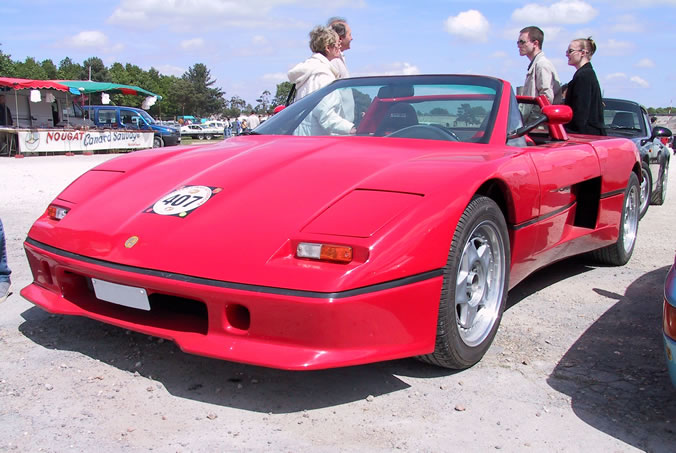
while the red version remained incomplete and was later customized by a private owner.
 |
| Michel Faure at young-ages posed along with the ARC Narval Concept's wooden bucks. (Picture from: AllCarIndex) |
After parting ways with
ARC due to differing visions,
Veyrat partnered with
Karfex,
a company experienced in single-seaters and sports racing machines. Together, they developed
the Opio 630,
slightly heavier than the original ARC prototypes but still lightweight by production standards. Its robust chassis used specialized oval-section tubing, balancing strength and agility.
 |
| One of two the Veyrat 630 prototypes commissioned by Patrcick Veyrat to ARC powered by a PRV V6 engine, and were launched at the 1990 Paris Car Show. (Picture from: FrenchAutoMuseum) |
Visually,
the Opio 630 echoed
the ARC prototypes but refined the design with smoother lines and sharper edges. It looked modern, aggressive, and elegant all at once. Every curve and contour reflected careful thought, balancing beauty with performance.
 |
| This Veyrat 630 prototype originally a non-runner model and was then sold to an individual who completed it according to their own specifications. (Picture from: AllCarIndex) |
Under the hood,
the Opio 630 was no compromise.
Its 3-liter SOHC Alfa Romeo V6 engine,
paired with a 5-speed transaxle and custom exhaust,
matched the 2.5-liter PRV V6 turbo in power,
while offering 39 more horsepower than a naturally aspirated 3-liter version.
Despite being 30 kg heavier than the original ARC prototypes, the mid-engine layout improved balance and handling, showing
Karfex’s ability to blend racing technology with road usability.
 |
| The Veyrat 630 production version or the Opio 630 by Karfex powered by a 3 liter SOHC V6 of Alfa Romeo coupled with 5-speed transaxle, and few modifications save for a special exhaust system. (Picture from: RareFrenchSportscars) |
Meanwhile,
Michel Faure continued developing
the ARC lineage.
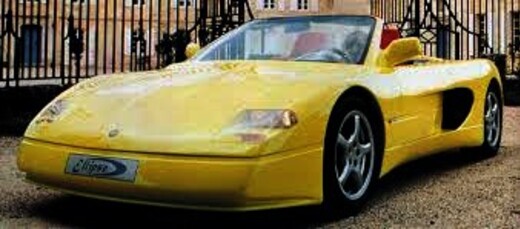
The ARC Ellipse emerged as a more powerful evolution, equipped with
a 24-valve DOHC Alfa Romeo Quadrifoglio V6 engine delivering 40 hp more than the SOHC variants. Its production numbers remain a mystery, but few units were ever completed, preserving its exclusivity and allure.
 |
| The Veyrat 630 as the ARC further version named ARC Ellipse taken by Michel Faure down its original design. (Picture from: FrenchAutoMuseum) |
Between 1990 and 2000,
only four cars were known to be commissioned by Veyrat:
two Veyrat 630 prototypes,
one Opio 630, and
one ARC Ellipse. Each vehicle remains a unique combination of vision, engineering, and craftsmanship, showcasing the possibilities when ambition meets skill.
 |
| The Veyrat 630 as the ARC further version named ARC Ellipse taken by Michel Faure down its original design. (Picture from: FrenchAutoMuseum) |
The rarity and story of these cars make them extraordinary. They are more than transportation; they are rolling works of art, meticulously crafted to a personal vision rather than mass-market demand. Each line, engine choice, and chassis decision reflects a careful balance between design, performance, and individuality.
 |
| The ARC Ellipse is powered by a 24-valve DOHC V6 drivetrain of the Alfa Romeo Quadrifoglio model. (Picture from: FrenchAutoMuseum) |
 Patrick Veyrat’s commissioned French sports cars
 remind us that automotive history is not just about famous brands or record-breaking performance. Sometimes, the most remarkable machines are born from personal vision, meticulous engineering, and the courage to create something rare—proof that imagination, when combined with expertise, can produce truly unforgettable cars.
*** [EKA [26112022] | FROM VARIOUS SOURCES | RAREFRENCHSPORTSCARS | FRENCH MOTOR MUSEUM ]Note: This blog can be accessed via your smart phone.