Cord 810: The Elegant American Classic That Redefined 1930s Style
Futuristic Grace - While exploring the digital world in search of rare gems from automotive history, a particular photograph stopped us in our tracks. It was a stunning image of a white classic car, all curves and grace, radiating an elegance that unmistakably pointed to the 1930s. The shape, the smooth lines, the refined air—everything about it suggested it wasn’t just a car, but a statement. Our curiosity sparked: what was this captivating machine?
A bit of digging led us to its name—Cord 810—a model that didn’t just belong to the 1930s, but one that defined what futuristic automotive design meant in that era. Produced between 1936 and 1937 by Cord Automobile, a division of the Auburn Automobile Company, the Cord 810 didn’t merely follow trends; it started them. The man behind its radical styling was designer Gordon M. Buehrig, with his talented team including Vince Gardner and Alex Tremulis, who together brought to life a shape so bold that it still turns heads today.
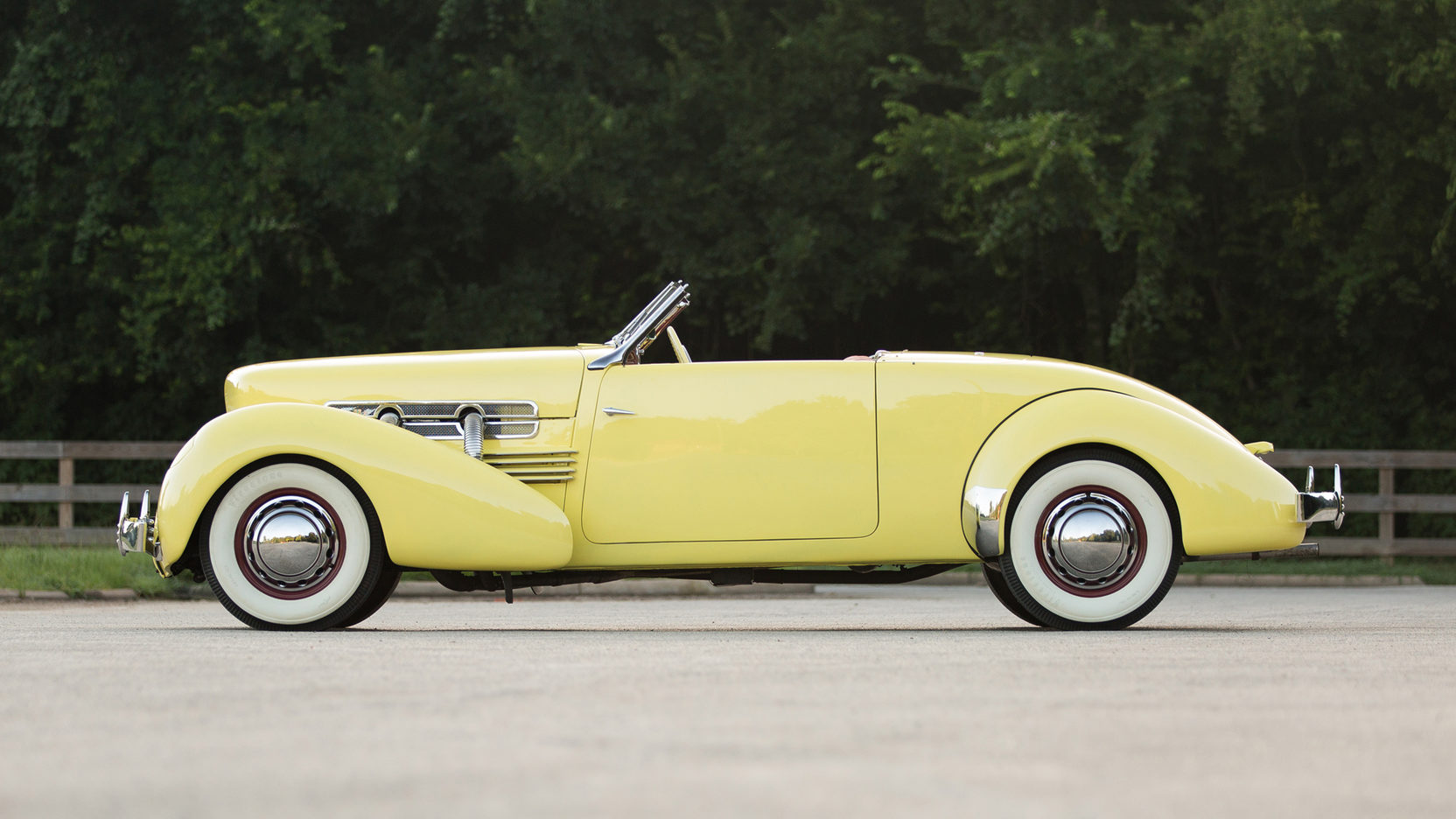
What set the Cord 810 apart wasn’t just its looks, though the design alone was revolutionary. This was the first American production car to hide its headlights within the front fenders—a feature that would go on to inspire generations of “pop-up” headlamps. Its streamlined, coffin-nose front, absence of a traditional radiator grille, and rear-hinged “suicide” doors gave the car an exotic charm that looked like it came from a distant future, not the middle of the Great Depression.
Beyond its visual appeal, the Cord 810 was an engineering marvel for its time. It was the first American car to combine front-wheel drive with independent front suspension—an innovation that was already being explored in Europe, most notably in the Citroën Traction Avant(one of which became a beautiful Willy Bernath made cabriolet of 1944). Interestingly, the Cord also carried influences from its predecessor, the Cord L-29, another front-wheel-drive pioneer, and though it retained a tube-style rear axle with semi-elliptic springs, the overall mechanical setup still felt impressively advanced.
The Cord 810 featured a Lycoming 289 cubic-inch V8 engine with 4,739 cc displacement, paired with a four-speed semi-automatic transmission, producing around 125 hp..(Picture from: OtoBlitz)
Under the hood, the Cord 810 was powered by a Lycoming 289 cubic-inch V8 engine with a displacement of 4,739 cc. Shared with the Cord L-29, this powerplant was paired with a four-speed semi-automatic transmission (three gears plus overdrive), enabling the vehicle to produce around 125 horsepower.
While those numbers might not sound like much today, it gave the car enough force to reach 60 mph in 20 seconds—a respectable figure in the 1930s—and top out at around 93 mph. The engine came with aluminum cylinder heads to manage heat more effectively, though oddly, only a single exhaust system was installed. Like most cars of its time, it ran on a six-volt electrical system.
Interior view of the 1937 Cord 810 - Phaeton Convertible.(Picture from: OtoBlitz)
When the Cord 810 debuted at the 1935 New York Auto Show, it didn’t just make an impression—it stole the show. Crowds swarmed around it. People stood on the bumpers of nearby cars just to catch a glimpse. This was more than just excitement—it was a cultural moment. Everyone wanted to see what the future looked like, and it wore a Cord badge.
However, as revolutionary as the Cord 810 was, it wasn’t without its flaws. The semi-automatic transmission, though innovative, turned out to be more complex than expected. Production delays meant that the first units weren’t delivered until early 1936, and even then, customers encountered issues ranging from gear slipping to vapor lock. These teething problems cooled the initial buzz, and despite its stunning design and ambitious engineering, Cord could not sustain the model's momentum.
By the end of 1937, production quietly ceased after approximately 3,000 units were built. It was a short run, but a meaningful one. The Cord 810 wasn’t just a car—it was a vision on wheels. It dared to be different, to innovate, to excite. And while its life was brief, its legacy remains deeply etched in the annals of automotive history.
Today, the Cord 810 is remembered not just for what it was, but for what it represented—a brave leap into the unknown, crafted with artistry and ambition. And in every preserved example still driving or displayed, that spirit of daring design continues to shine, just as brightly as it did under the lights of that New York showroom almost a century ago. *** [EKA [23072022] | FROM VARIOUS SOURCES | PREWAR | CLASSICDIGEST | JOURNAL-CLASSICCARS | HEMMINGS | DRIVE-MY | MECUM ]
Note: This blog can be accessed via your smart phone.
Cord 810: The Elegant American Classic That Redefined 1930s Style


 By the end of 1937, production quietly ceased after approximately 3,000 units were built. It was a short run, but a meaningful one. The Cord 810 wasn’t just a car—it was a vision on wheels. It dared to be different, to innovate, to excite. And while its life was brief, its legacy remains deeply etched in the annals of automotive history.
 Today, the Cord 810 is remembered not just for what it was, but for what it represented—a brave leap into the unknown, crafted with artistry and ambition. And in every preserved example still driving or displayed, that spirit of daring design continues to shine, just as brightly as it did under the lights of that New York showroom almost a century ago. *** [EKA [23072022] | FROM VARIOUS SOURCES | PREWAR | CLASSICDIGEST | JOURNAL-CLASSICCARS | HEMMINGS | DRIVE-MY | MECUM ]
