The Track-Driven Motorcycle That Changed Military Innovation
Unusual Locomotion - Long before sleek superbikes and futuristic electric scooters took over the streets, there was a time when innovation in transportation took on a far more rugged and experimental form. In the tense years leading up to World War II, engineers around the world were in a race not just for speed, but for survival — blending mechanical ingenuity with military ambition. Among the strangest creations to roll out of that era was a machine that looked like it belonged more on a battlefield than a boulevard: a track-driven motorcycle that defied both convention and comfort, known as the Mercier Moto Chenille.
Built in 1937 by Swiss inventor Adrien Mercier in Bois-Colombes, France, this extraordinary hybrid of a motorcycle and a tank was designed for military use. It wasn’t made to win style awards or offer a smooth Sunday ride; its purpose was purely tactical — to conquer terrains where ordinary motorcycles would surrender. The design itself tells a story of bold experimentation: a long tubular rear frame stretched out to support both the saddle and fuel tank, while a track mechanism dominated the front end. Instead of the familiar pair of wheels, it featured tank-like treads leading the way, and a single rubber wheel at the back, modest in size but crucial in function.
Front and rear view of the 1937 Mercier Moto Chenille.(Picture from: Unusuallocomotion)
Beneath this rugged skeleton lay a set of two metal skids running from rear to front, allowing the machine to glide across rough ground when the rear wheel could no longer find traction. At its heart, the Mercier Moto Chenille carried a 350cc JAP (JA Prestwich) OHV Sports engine mounted at the front — a modest but reliable source of power. With just 11 horsepower, it might sound underwhelming by today’s standards, yet in the late 1930s it represented a precise balance of strength and simplicity.
Left side view of the 1937 Mercier Moto Chenille. (Picture from: Unusuallocomotion)
The engine was paired with a Soyer 3-speed manual transmission and a hand-operated clutch that directed power to the track, enabling the vehicle to reach speeds of around 40 mph (roughly 64 km/h). Stopping the machine required a hand-operated internal expanding brake connected to the drive wheel of the track, supported by two leaf springs on either side to absorb the shocks of unforgiving terrain. Every component of the Moto Chenilleseemed designed not for comfort, but for endurance — a mechanical creature built to crawl, climb, and persist.
Right side view of the 1937 Mercier Moto Chenille. (Picture from: Unusuallocomotion)
When the French military tested the prototype on steep slopes of up to 45%, they were intrigued. The vehicle’s strange hybrid nature seemed promising for reconnaissance or transport missions across uneven landscapes. Mercier even developed the motorcycle in several configurations, suggesting a mind constantly refining and reimagining the possibilities of mobility. Yet despite its ingenuity, only three prototypes were ever built, and none went into mass production. The project faded into obscurity as the world’s attention turned toward larger machines of war.
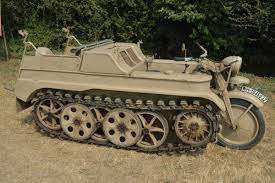
Still, the legacy of Mercier’s invention echoed beyond France. Just a few years later, in 1941, German engineers at NSU Werke developedthe NSU Kettenkrad — a tracked motorcycle strikingly similar in concept to Mercier’s creation. Unlike the Moto Chenille, the Kettenkraddid see action on the battlefield, serving the German military during World War II. It became one of the most iconic military vehicles of its kind, but its DNA — that fusion of motorcycle agility and tank traction — can be traced back to Mercier’s workshop in Bois-Colombes.
The NSU Kettenkrad is designed by Ernst Kniekamp in 1939, then produced by the NSU Werke of Neckarsulm in 1941. (Picture from: TanksetPanzerOverblog)
Today, the surviving example of the Mercier Moto Chenille stands as more than just a relic of experimental warfare. It’s a window into a time when invention was driven by necessity and curiosity in equal measure — when engineers weren’t afraid to blur the lines between categories in pursuit of progress. In a modern world where motorcycles are designed for precision and pleasure, the Mercier Moto Chenille reminds us of an era when machines were born from bold ideas and raw imagination. It may never have raced on the battlefield, but its spirit — half motorcycle, half tank — continues to roll through history as one of the most fascinating mechanical oddities ever built.
Kept spur your adrenaline on the power of two-wheeled monster and stay alive with the true safety riding. May God will forgive Your sins and so does the cops.... ••• [EKA [24122016][14032022] | FROM VARIOUS SOURCES | UNUSUALLOCOMOTION | YESTERDAYS ]
Note: This blog can be accessed via your s mart phone.
Thank you for your comment. Please keep the discussion relevant and respectful, as spam or off-topic remarks may be removed to maintain a meaningful conversation for everyone.


 Built in 1937 by Swiss inventor Adrien Mercier in Bois-Colombes, France, this extraordinary hybrid of a motorcycle and a tank was designed for military use. It wasn’t made to win style awards or offer a smooth Sunday ride; its purpose was purely tactical — to conquer terrains where ordinary motorcycles would surrender. The design itself tells a story of bold experimentation: a long tubular rear frame stretched out to support both the saddle and fuel tank, while a track mechanism dominated the front end. Instead of the familiar pair of wheels, it featured tank-like treads leading the way, and a single rubber wheel at the back, modest in size but crucial in function.


 Today, the surviving example of the Mercier Moto Chenille stands as more than just a relic of experimental warfare. It’s a window into a time when invention was driven by necessity and curiosity in equal measure — when engineers weren’t afraid to blur the lines between categories in pursuit of progress. In a modern world where motorcycles are designed for precision and pleasure, the Mercier Moto Chenille reminds us of an era when machines were born from bold ideas and raw imagination. It may never have raced on the battlefield, but its spirit — half motorcycle, half tank — continues to roll through history as one of the most fascinating mechanical oddities ever built.
No comments:
Post a Comment
Thank you for your comment. Please keep the discussion relevant and respectful, as spam or off-topic remarks may be removed to maintain a meaningful conversation for everyone.